

QuantConnect vs Alpaca is really one question: do you want a research lab with data and a backtest engine already wired up, or a bare brokerage API you build everything on top of? That is the whole fight in QuantConnect vs Alpaca, and your answer depends on whether you’d rather write a strategy this weekend or write infrastructure for a month first.
Quick Answer
QuantConnect is a hosted research and backtesting platform built on LEAN, an open-source algorithmic trading engine. Alpaca is a commission-free brokerage API for US stocks and options with no backtester at all. Beginners who want one place to research, backtest and deploy should start with the free QuantConnect tier. Developers who already know Python or JavaScript and want full control should start with the alpaca api.
Key Takeaways
Short version before the detail.
- QuantConnect Free costs $0 and includes one backtest node and one research node, but zero live-trading nodes, per QuantConnect tier documentation.
- Researcher runs $84 per month as of the October 2026 QuantConnect pricing page.
- Alpaca charges no commission on US stocks and options, with free IEX data or $99 per month for SIP data, per Alpaca’s data page.
- QuantConnect brokerages: Alpaca, IBKR, Schwab, tastytrade and TradeStation, so you can run both together.
- QuantConnect holds 3.9 from 67 reviews on Trustpilot as of September 2026.
- Alpaca launched live index options on September 2, 2026 covering SPX, SPXW, VIX, VIXW, DJX and XSP, per Alpaca’s launch post.
What is QuantConnect and what is Alpaca?
QuantConnect is a cloud quant platform: a browser IDE called the Algorithm Lab, a hosted data library, a backtest engine, and a path to live deployment. Alpaca is a broker with an API-first design, built so your code places the orders instead of your thumb.
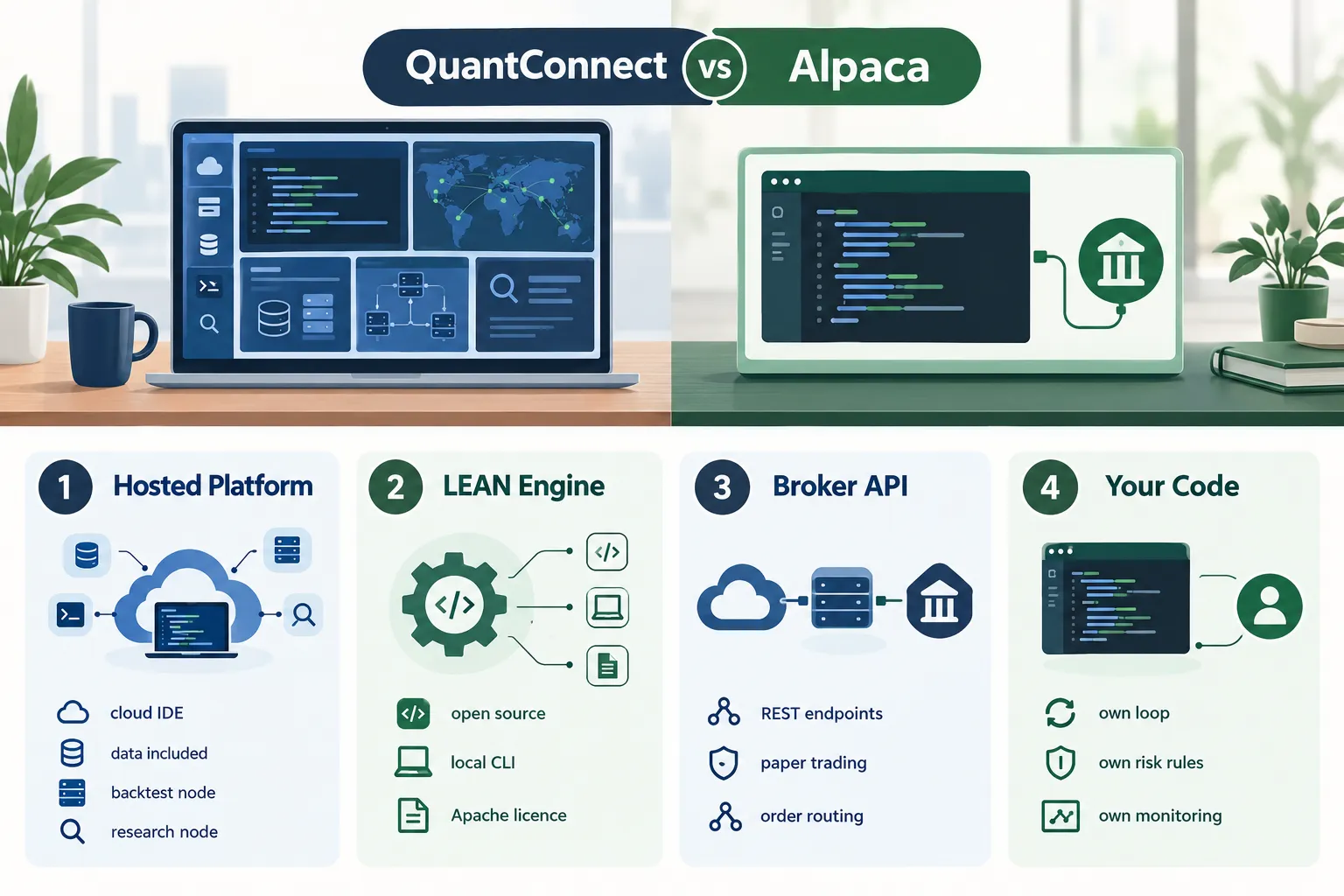
QuantConnect runs on LEAN, the open-source algorithmic trading engine you can also download and run locally. LEAN itself is free under Apache 2.0 according to LEAN documentation, so “QuantConnect free” and “LEAN free” mean two different things. Our deeper breakdown of how the LEAN engine works covers that split.
Alpaca sells rails, not research. It gives you REST endpoints, free paper trading, and SDKs. On August 6, 2026 it shipped a TypeScript rewrite of its Node.js SDK plus its first supported Java SDK, per Alpaca’s SDK announcement.
Which should you pick in quantconnect vs alpaca?
For a first algorithm, QuantConnect wins on speed to a working backtest and Alpaca wins on control and simplicity of execution. The honest framing for quantconnect vs alpaca: one is a gym with equipment, the other is a set of weights you have to assemble.
| Factor | QuantConnect | Alpaca | Cost |
|---|---|---|---|
| Backtesting | Built in, event-driven LEAN engine | None, bring vectorbt or backtesting.py | Free tier each |
| Data | Hosted multi-asset library | IEX free, SIP paid | $0 or $99/mo SIP |
| Live deployment | Needs a paid plan plus a live node | Included with the brokerage account | Paid vs $0 |
| Languages | Python and C# | Python, Node.js, Java, Go | Free |
| Learning curve | Platform conventions to learn | Plain REST, faster to read | Free |
The decision rule in quantconnect vs alpaca: choose QuantConnect if your bottleneck is research, choose Alpaca if your bottleneck is plumbing. If you can’t yet answer “what is my edge in one sentence,” neither tool fixes that. See our ranking of the best algorithmic trading platforms for the wider field.
How much does QuantConnect cost compared to Alpaca?
Is quantconnect free? The hosted platform has a genuine $0 tier, but live trading is paywalled. Alpaca’s trading account is free and has no stated minimum for a cash account, which is why many first bots start there.
QuantConnect pricing as of October 2026, per the official pricing page: Free, Researcher at $84 per month, Team at $168 per user per month, and Institution at $1,272 per user per month. Compute nodes are billed on top, so your real monthly number depends on how many backtest, research and live nodes you add. An independent QuantConnect review from BacktestScore is worth a read on how that bill adds up. Check the official LEAN pricing page before you commit, since configurations change.
In quantconnect vs alpaca cost terms, the gap is simple: QuantConnect charges for compute and convenience, Alpaca charges nothing to place the trade and makes money elsewhere.
Alpaca’s side is simpler: no commission on US stocks and options, free paper trading, and data tiers listed on its algorithmic traders page. Partner-level rate limits are reviewed individually under the Broker API rate limit docs, and account tiers are described in Alpaca’s account-plan documentation.
Which is better for backtesting, and which is better for live trading?
QuantConnect is better for backtesting. Alpaca is better for cheap live execution. That split is the core of quantconnect vs alpaca for most first-time builders. Can you backtest on Alpaca? Not natively, you supply your own engine.
LEAN gives you minute, second and tick resolution, survivorship-adjusted data, and realistic fill models. The September 24, 2026 update added bracket orders, one-cancels-other and one-triggers-other orders, plus an Order Factory for estimating fees and checking buying power, per QuantConnect’s change log. That is production-style risk management, not toy entry and exit.
A warning most beginners miss: every security subscription in LEAN costs memory, and a big universe on a small node can crash a backtest. A correct algorithm can still die from infrastructure limits. If you’re new to validation, read how to backtest a strategy without fooling yourself and our list of free backtesting software.
QuantConnect paper trading versus live trading is the same code against a simulated broker, which is the point. Alpaca paper trading is free and unlimited, documented in Alpaca’s algo trading hub. Paper trade it first. Always.
Can you use QuantConnect and Alpaca together?
Yes, and this is the setup most retail quants land on. Research and backtest on QuantConnect, then route a QuantConnect trade signal through your Alpaca account for commission-free execution.
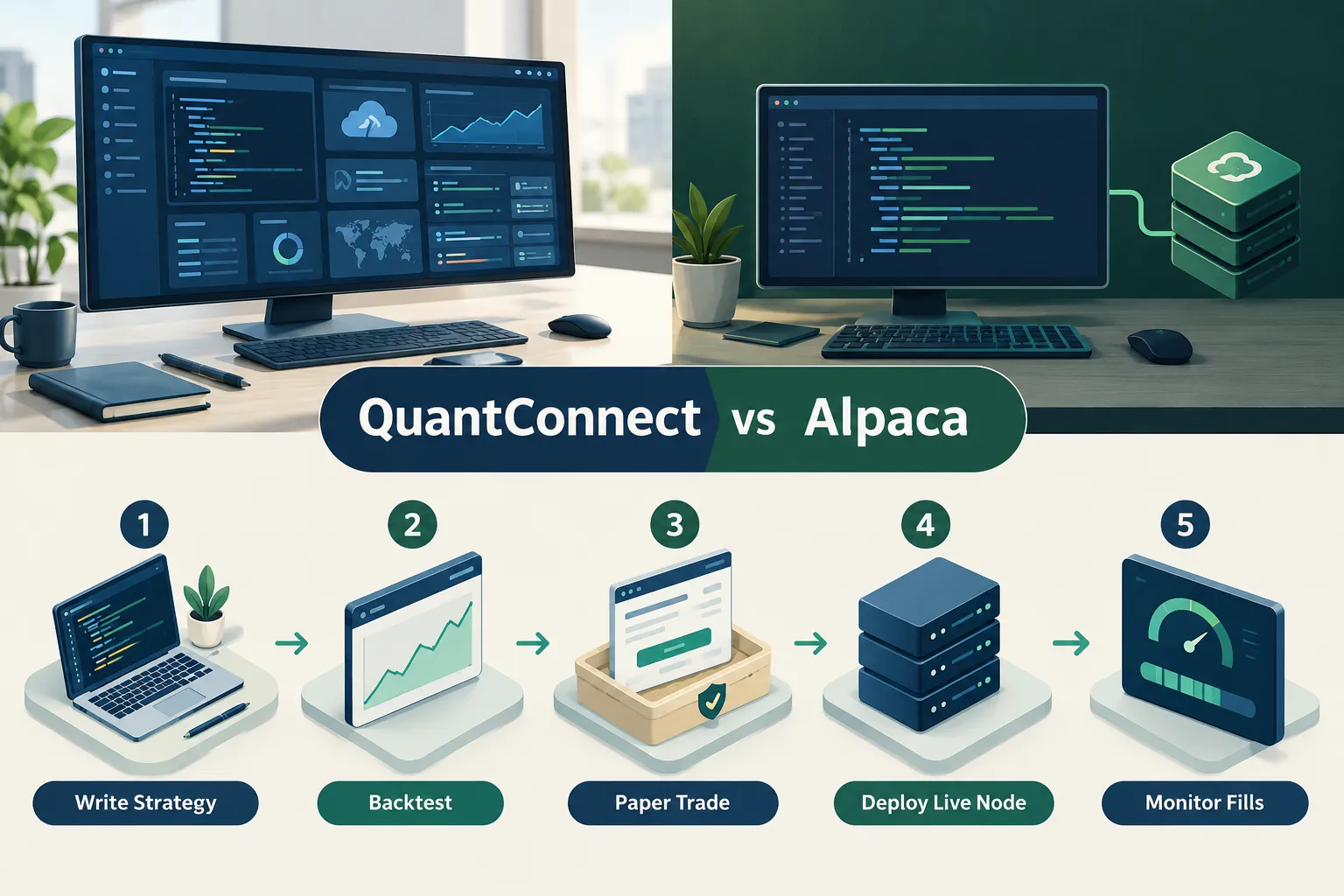
Can you use QuantConnect without Alpaca? Of course. Among the brokerage partners QuantConnect supports you’ll also find IBKR, Schwab, tastytrade and TradeStation, and the LEAN CLI can run locally against them. With Alpaca now offering index options through its Trading API, check QuantConnect’s change log for current Alpaca coverage before you plan an index options strategy.
That combined setup is why quantconnect vs alpaca is often a false choice. Plenty of traders use both.
Decision rule: if you want a hosted live node, you pay QuantConnect. If you want to deploy a QuantConnect or local LEAN algorithm cheaply, Alpaca is the execution layer. Our Alpaca API guide for beginners walks the credential setup.
What does the QuantConnect community actually look like?
The QuantConnect community is one of the real reasons to pick it. There’s a public forum, a Discord channel, and a Quant League leaderboard, and the discussion level is higher than most trading Discords.
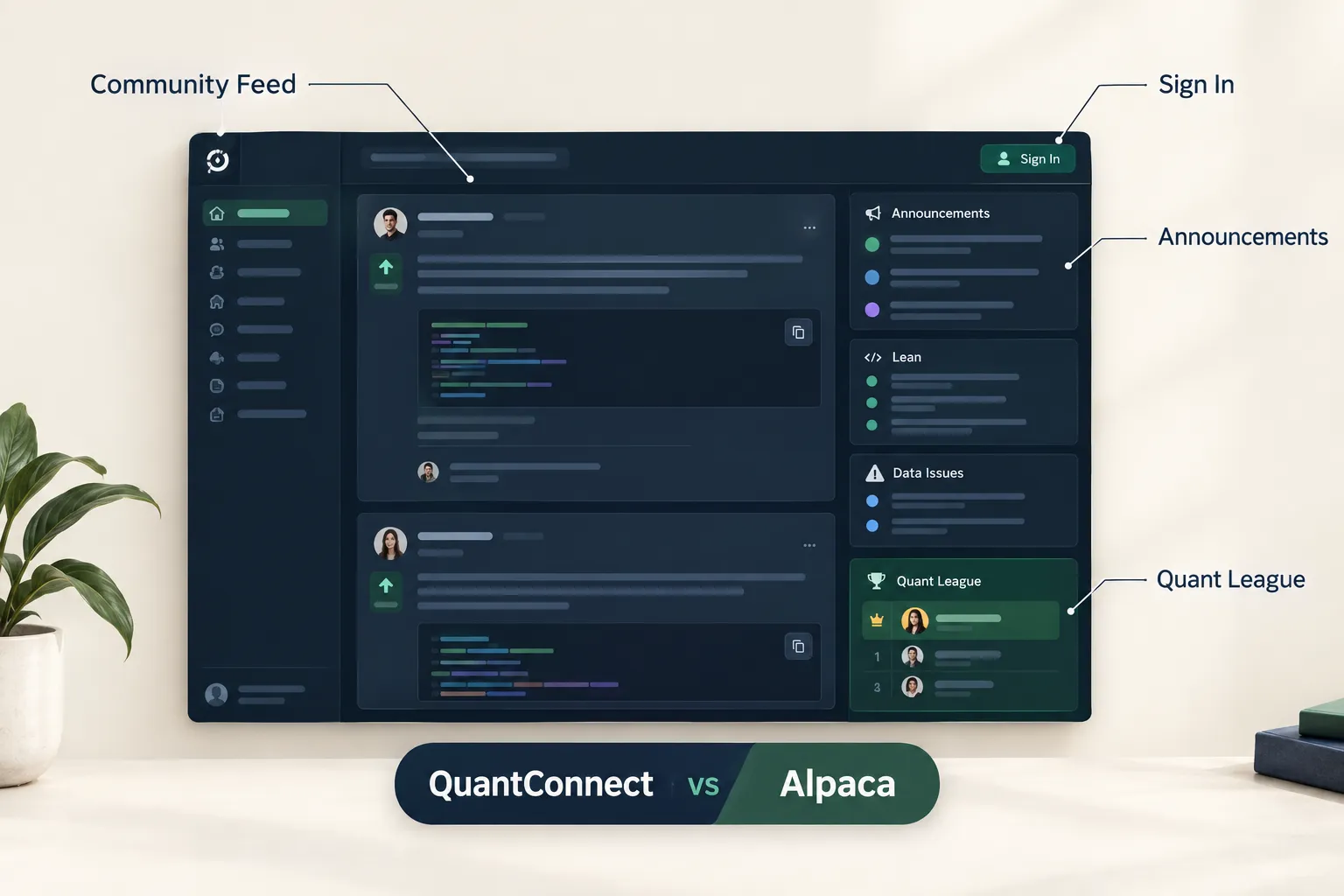
Join for free, lurk in the forum for a week, and read the most upvoted threads before you post. The announcements channel is where data issues, like a mishandled corporate action, tend to get flagged first. That habit alone puts you ahead of most first-time users in either camp of the quantconnect vs alpaca debate.
If you run the open-source engine locally instead of in the browser, expect some setup friction. Pin your SDK and Docker image versions, copy package versions from the official sample projects, and search the forum and GitHub issues before filing a duplicate. Alpaca has the opposite profile: almost nothing to install, and everything else to build yourself.
What are the best QuantConnect alternatives and competitors?
If neither side of quantconnect vs alpaca fits, the main quantconnect alternatives are Blueshift, Backtrader with a broker API, Composer, and Interactive Brokers with the ib_insync library. Alpaca’s competitors are IBKR, Tradier and Schwab’s API.
- Alpaca vs Interactive Brokers: IBKR has far broader markets and futures access, Alpaca has the friendlier API and faster onboarding.
- Composer: no-code strategy building, covered in our Composer Trade review.
- Trade Ideas: scanning, not backtesting. See QuantConnect vs Trade Ideas.
- Roll your own: start with Python algorithmic trading basics.
Top 5 favorite features
The five things that earn their keep across both platforms.
- LEAN’s single codebase for backtest, paper and live. One strategy, three modes.
- QuantConnect’s hosted research notebooks, so your investment research and your algorithm share one environment.
- Alpaca’s free paper trading with real market data.
- Contingent orders in LEAN: bracket, OCO and OTO.
- Alpaca’s MCP server documentation access, added August 10, 2026, which lets AI assistants read the API docs during integration per Alpaca’s announcement.
What we like and what we don’t like
Both tools are genuinely useful and both have real drawbacks. No tool here is a free lunch.
Like: QuantConnect’s data breadth, its active community, LEAN being open source, Alpaca’s zero commissions, and Alpaca’s clean docs.
Don’t like: QuantConnect’s compute-node pricing is confusing and the free tier can’t trade live. LEAN’s learning curve is steep. Alpaca has no backtester, and its free IEX feed is thinner than SIP, which can quietly distort a backtest. Business-account onboarding, announced August 18, 2026 in Alpaca’s partner post, targets fintech builders, not solo traders.
What do real users say?
Sentiment is mixed, which the 3.9 Trustpilot score reflects. The praise centers on running one codebase across backtest and live trading. The complaints center on bugs and slow support. A separate QuantConnect review from NewTrading and a technical review from New York City Servers reach similar conclusions: strong engine, uneven polish.
Common mistakes when starting with QuantConnect or Alpaca
Most first algorithms fail on process, not code. The quantconnect vs alpaca choice is less dangerous than the habits around it.
- QuantConnect: subscribing to a 500-symbol universe on a small node and blowing the memory budget. Also, over-fitting a backtest you never paper traded.
- Alpaca: no retry logic on order state, no stop loss in the code, and assuming IEX data matches consolidated prints.
- Both: copying a forum strategy you don’t understand. Copy trading someone else’s logic is not a system.
Our Take
The short answer to quantconnect vs alpaca for a first algorithm: start free on QuantConnect, then add Alpaca as the live broker once a strategy survives 30 days of paper trading. Run the live step through the open-source engine on your own machine and that sequence can cost $0 while teaching you both halves of the stack.
FullStack Alpha’s position on quantconnect vs alpaca: the platform is not the edge. Position sizing and a written rule set are. QuantConnect makes the research easy, Alpaca makes the execution cheap, and the services QuantConnect sells are compute and data, never signals. The biggest investment QuantConnect asks for is your time. Systems over hacks.
Two tools compared here. 200+ catalogued in the FullStack Alpha directory, sorted by category, price and use case. Compare the full field at aistockpickerapp.com/reviews
Prices are subject to change in this fast AI market. Compute nodes get repriced more often than most strategies get retested.
This article is education, not financial advice, and nothing here is a personalized investment recommendation.
Your market edge starts with the right tool. Stay alpha.
Frequently Asked Questions
Who are QuantConnect's main competitors?
QuantConnect's main competitors are Blueshift, Backtrader paired with a broker API, Composer for no-code strategies, Interactive Brokers with ib_insync, and self-hosted LEAN. For scanning rather than backtesting, Trade Ideas and TrendSpider compete for attention. Each trades breadth of data for simplicity, so pick by what you actually lack.
Who has the best automated trading platform?
There's no single best. Interactive Brokers leads on market access, Alpaca leads on API simplicity and zero commissions, and QuantConnect leads on hosted backtesting and research depth. The best automated trading platform is the one whose data and language match your strategy and your coding ability today.
Is QuantConnect any good?
Yes, with caveats. QuantConnect holds 3.9 from 67 Trustpilot reviews as of September 2026, praised for running one codebase across backtest and live, criticised for bugs and support. The engine and data library are strong. The pricing structure and learning curve are the weak points.
What are some alternatives to Alpaca?
Alternatives to Alpaca include Interactive Brokers for global markets and futures, Tradier for options-focused APIs, Schwab's trading API, and tastytrade. Interactive Brokers, Schwab and tastytrade are also supported QuantConnect brokerages, so you can swap execution layers without rewriting your strategy logic.
What is QuantConnect used for?
QuantConnect is used for writing, backtesting and deploying trading algorithms in Python or C# against hosted equity, options, futures and forex data, then running them live through a connected brokerage account.
Is QuantConnect free?
The Free tier costs $0 and includes one backtest node and one research node, but no live-trading node. Hosted live trading needs a paid plan, with Researcher at $84 per month as of October 2026, and compute nodes are billed on top. The open-source LEAN engine itself is free to run locally.
Does QuantConnect support Alpaca?
Yes. Alpaca is a supported live brokerage on QuantConnect, so you can research and backtest on QuantConnect and route orders through an Alpaca account. Check QuantConnect's change log for the latest Alpaca asset coverage.
Alpaca vs Interactive Brokers for algo trading?
Pick Alpaca for a simpler REST API, free paper trading and commission-free US stocks and options. Pick Interactive Brokers for futures, global equities and deeper order types.
Is Alpaca good for beginners?
Yes if you can write Python or JavaScript. No if you want a built-in backtester, since Alpaca supplies none. Its free paper trading account is one of the cleanest sandboxes in retail trading.
Contributing writer at AI Stock Trading Bots.
