

The FullStack Alpha research desk tests AI trading bots on paper and live accounts. Reviewed and edited by Jay Rocco, Founder and Editor.
By FullStack Alpha Editorial Team | Reviewed by Jay Rocco, Chief Editor
A Jev AI trading bot is any trading project built on Jev, the “System One” decision model TypeSafe AI announced on September 15, 2026, and there is no official Jev AI trading bot from TypeSafe itself. We checked five public builds against their own code, logs and leaderboards: Jarrod Watts’s jev-trader, Roan’s high-frequency design, Miles Deutscher’s Opus plus Jev hybrid, the TradeRank contest entry and Abozar Alizadeh’s trAIde bot. Only one of them, trAIde, put Jev on a real-money account, and it lost 1.78% of that account over 17 days and 15 trades. The others ran dry-run, simulated capital or showed no results at all. Jev delivered the speed and price TypeSafe promised; no builder has shown it picks winning trades.
Key insights
- Jev costs $0.042 per million input tokens with free output, per TypeSafe’s models page, so the model bill for a Jev AI trading bot is close to zero. Fees, spread and gas are the real costs.
- The only real-money test (trAIde) found Jev’s confidence ran backwards: calls at 0.95 or higher were right 32% of the time over four hours, calls under 0.70 were right 57% of the time.
- On TradeRank’s simulated $10,000 contest, Jev finished Season 9 in 8th of 18 at -1.26% with just 3 trades, then posted early Season 10 numbers that swung from first to sixth depending on which TradeRank page you read.
- jev-trader is real infrastructure (one post-only order every ~300 ms Monad block), but its README ships with a mock model as the default and a deployed demo running dry-run.
- Decision rule: until a Jev build publishes a trade log, fees and drawdown over 100+ trades, treat it as an engineering demo.
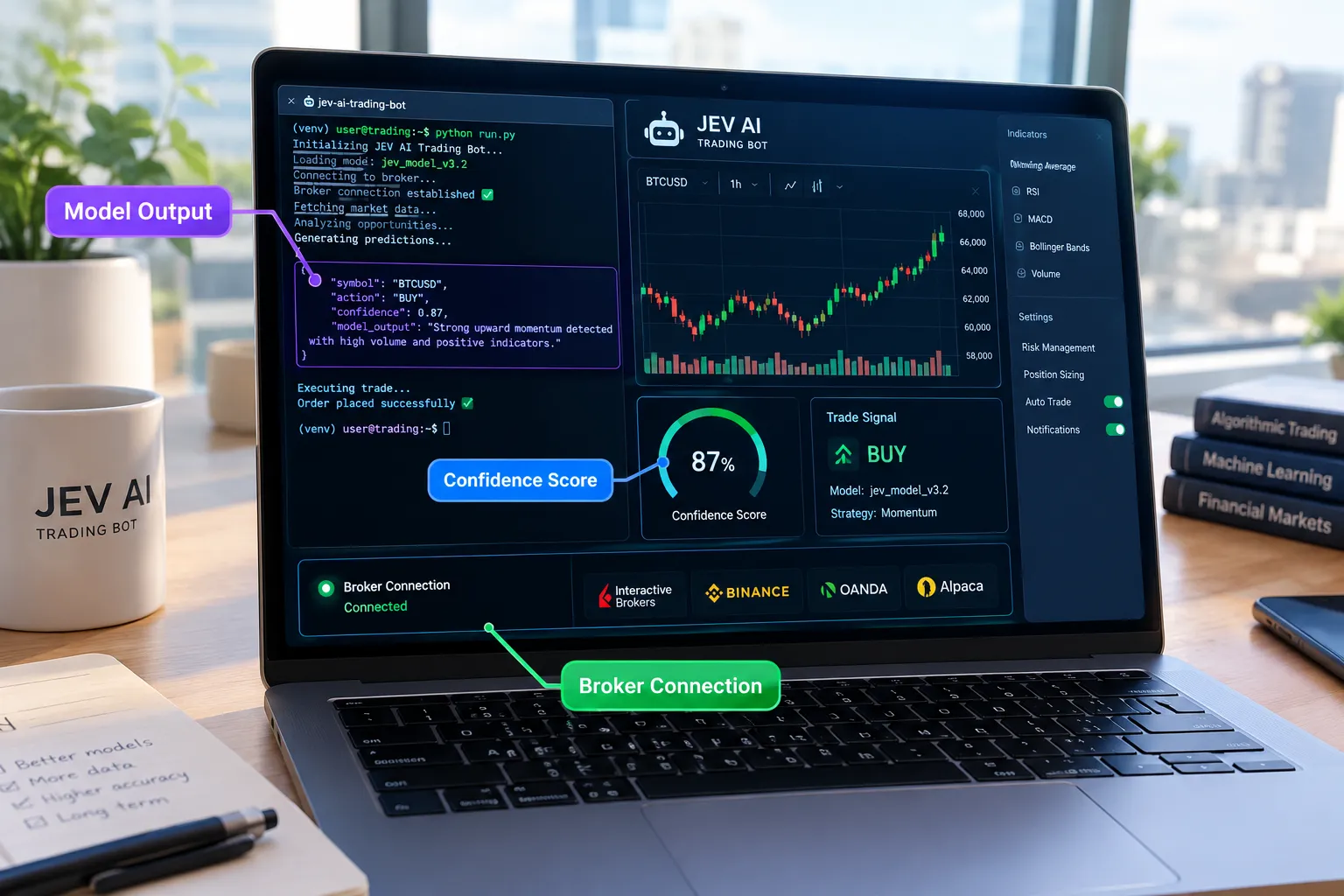
What Is a Jev AI Trading Bot?
A Jev AI trading bot is ordinary trading code that asks Jev a narrow question at each decision point (“buy or sell?”, “long, short or stand aside?”) and acts on the typed answer. Jev is not a trading product. TypeSafe’s launch post and docs never mention markets, trading or finance at all.
TypeSafe calls Jev a System One model. The name borrows from Daniel Kahneman’s fast, automatic System 1 thinking. You send a state (a string, JSON object or text array) plus typed questions, and Jev returns structured answers instead of prose. Per the TypeSafe docs, there are three answer types:
- Choice: picks one option from a fixed set and returns a probability for each option plus a confidence value.
- Score: places the answer on ordered levels.
- Noul: returns a 0 to 1 probability that a yes or no question is yes.
That shape is why traders noticed it. A chat model writes three paragraphs about why Tesla might drop. Jev hands back “short 0.80, long 0.12, stand aside 0.08” in a format your code can read in one line.
What TypeSafe actually publishes
Here is what we confirmed on TypeSafe’s own pages in 2026:
- Launch: the introduction post is dated September 15, 2026, and says Jev is “available today in early access,” with developers moved off a waitlist as fast as TypeSafe can. We found no TypeSafe page saying the waitlist ended on a set date, so treat any “public on day X” claim as unverified.
- Speed: TypeSafe quotes 70 ms to 500 ms end-to-end response time, measured from laptops on the US West Coast.
- Price: $0.042 per million input tokens, output free, for both jev-1.13.0 and jev-1.14.0. The launch post admits TypeSafe cannot prove the price is not subsidized.
- Versions: Jev 1.14 became available October 14, 2026 as
jev-preview. The aliasjev-lateststill pointed to jev-1.13.0 on the models page when we checked. The Jev 1.14 post changed features (a bounding-box type, a long-context header, multilingual gains), not pricing. - Limits: 64k tokens per request and 32k per question by default, rate limits set per organization, and a
429 Too Many Requestsresponse when you exceed them.
One fix to a claim circulating in earlier drafts and social posts: there is no separate TypeSafe pricing page with “different figures.” The homepage and the models page both list the same $42 per billion input tokens, which is the same number as $0.042 per million.
The weak spots TypeSafe documents
TypeSafe’s Jev 1.13 jaggedness page is the most useful page for anyone building a Jev AI trading bot, because it lists where the model breaks:
- “Jev is not a calculator.” Keep arithmetic in code.
- It reads dates as text, not ordered quantities, so durations and windows are unreliable.
- It “leans toward the option that comes first.” Reorder your options and check the answer holds.
- Score levels are “weak in numerical calibration.”
- Injected or misleading text in the state can shift answers.
Read that list again with a trading hat on. Prices are numbers. Bars are dates. Long or short is an option list. Headlines are untrusted text. Every one of those weak spots sits on the hot path of a trading bot, which is exactly why the real-money test below matters.
What Did the 5 Creators Build With Jev?
Five public builders put Jev into trading code between mid September and mid October 2026. Each one tested a different slice of the problem. Only one tested the slice that pays the bills: real money after real costs.
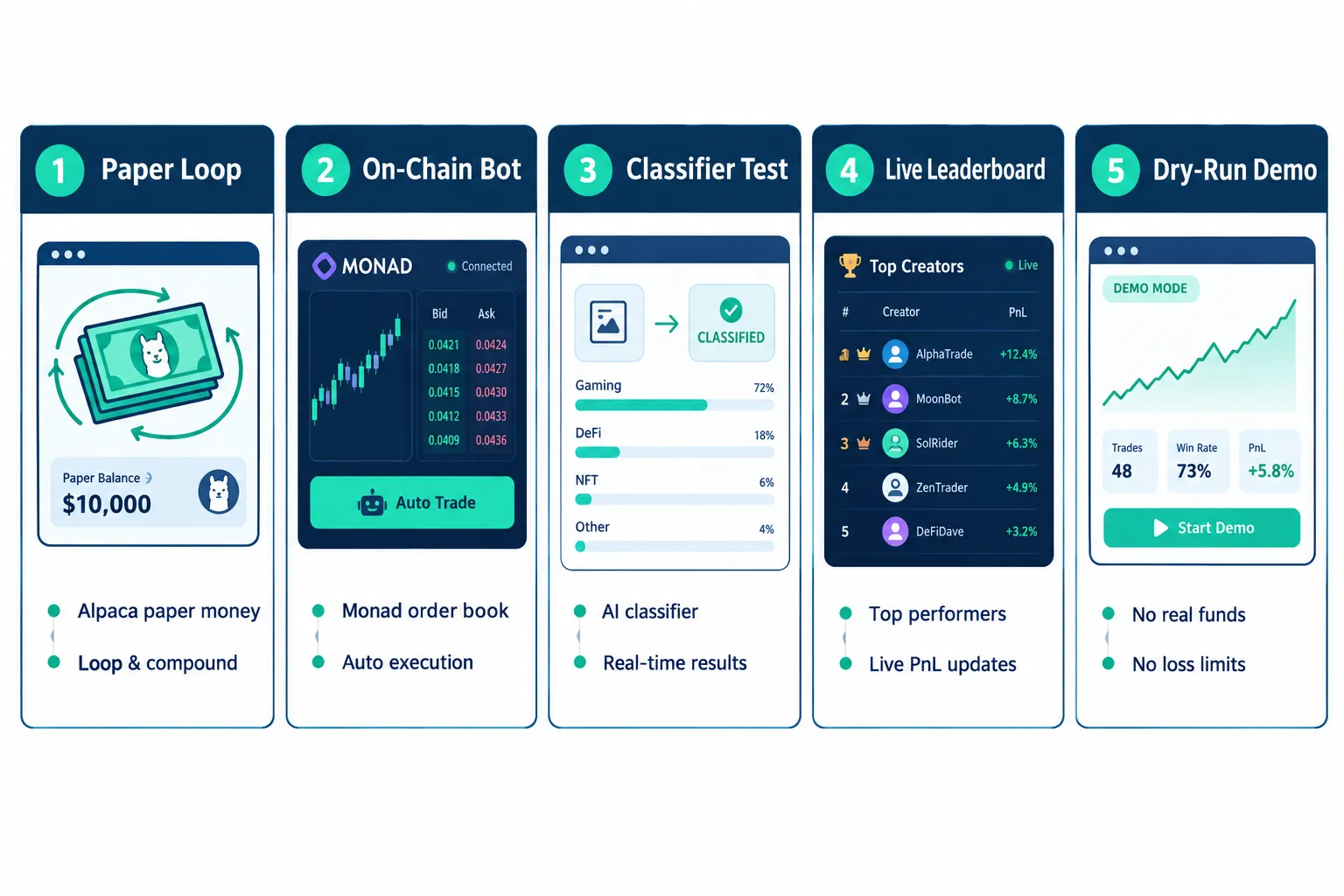
| Builder | Build | Venue | Money at risk | Result published | What was skipped |
|---|---|---|---|---|---|
| Jarrod Watts (jev-trader) | One buy or sell decision per Monad block | Kuru MON-USDC on-chain order book | Dry-run by default; live if you add a key | Latency and a sample event; no P&L history | Profit after gas, stop-loss rules, long-run results |
| Roan (@RohOnChain) | 24/7 high-frequency design write-up | On-chain books and prediction markets | Not stated | None | Any trade, any number |
| Miles Deutscher | Claude Opus 5.5 designs, Jev decides | Alpaca path described; he says he uses Bybit | Not stated for the demo | One screenshot of a $HYPE bot | P&L, win rate, drawdown, trade count |
| TradeRank | Jev entered as a "measured baseline" | 60 assets, daily decisions | Simulated $10,000 | Season 9: 8th of 18, -1.26%, 3 trades, max drawdown -1.60% | Real fills, real slippage, sample size |
| Abozar Alizadeh (trAIde) | Jev vs an LLM trader on the same data and risk rules | KuCoin perpetual futures | Real, deliberately tiny account | 15 trades, -4.5R, -1.78% of account | Sample size (and he says so) |
Jarrod Watts: jev-trader on Monad
Watts posted his build on September 17, 2026, and the jev-trader repository is the most serious engineering in the group. It is TypeScript, MIT licensed and had about 3,100 GitHub stars when we checked.
Per the README, Jev watches the Kuru MON-USDC order book and answers buy or sell roughly every 300 ms Monad block. Each block posts a post-only limit order one tick inside the best price on the chosen side and cancels the last one. The bot earns the spread when a taker hits it instead of paying the spread itself. The question it asks Jev is about the move over the next 100 blocks, about 30 seconds.
What the README also says, and most clips leave out:
- With no private key, it dry-runs: real order book, real decisions, simulated fills.
- The default model is
mock, a momentum heuristic stand-in. You must setMODEL=jevand an API key to use Jev at all. - The deployed public demo runs dry-run with the mock model, not Jev.
- There is a position cap, but we found no stop-loss or daily loss limit described in the README.
- Gas on Monad is charged on the gas limit “whether the order lands or not.”
That last line is the one that decides profitability. We do the math on it in the costs section below. It is also why the repo is a better learning tool than a ready product: the code is clean and readable, and the economics are left for you to prove.
Roan: a high-frequency architecture, no results
Roan, posting as @RohOnChain on September 19, 2026 (republished on YouMind), wrote the clearest design for a Jev AI trading bot. Jev answers typed questions about each block (market regime, toxic flow, quote environment). Deterministic code owns state, pricing via the Avellaneda-Stoikov market-making model, and hard risk limits.
He also says the design fits on-chain order books and prediction markets, not top US equities. That is a useful admission. It reported no trades and no P&L.
Miles Deutscher: Opus designs, Jev decides
Miles Deutscher’s September 29, 2026 post (republished here) pairs Claude Opus 5.5 for strategy design and backtests with Jev for fast decisions on live data. He describes an Alpaca path and a VPS path, says he personally executes on Bybit, reports about 400 ms decisions and recommends paper trading first.
The proof shown is one screenshot of a $HYPE bot’s trading “last week.” No P&L, win rate, drawdown or trade count. We could not tell whether those trades were paper or real money from the post.
TradeRank: a contest with Jev as the baseline
TradeRank runs a public contest where AI models each trade $10,000 of simulated capital against live prices across 60 assets (10 cryptocurrencies and 50 large US stocks), with one decision cycle a day at 16:00 UTC. TradeRank says Jev joined Season 9 mid-season and is “entered as a measured baseline rather than a contender.”
Season 9 ran 28 days, from September 12 to October 10, 2026, with 18 models. Jev’s final line:
- Rank 8 of 18, return -1.26%
- Total P&L -$125.65 (realized -$118.15, unrealized -$7.50)
- Trades: 3, with a 33.3% win rate
- Max drawdown -1.60%, fees $15.16
Earlier versions of this story said Jev lost $138.56 on a Tesla short and was the only model to short. We could not find either claim on TradeRank’s Season 9 page, so we removed them.
Season 10 opened October 10, 2026 with 22 models. On the same day we checked, TradeRank’s leaderboard page showed Jev first at +2.20% while the TradeRank home page showed Jev sixth at -0.24%. Two pages, two answers, 12 days into a season. That alone tells you how much weight a contest standing can carry.
Abozar Alizadeh: the only real-money Jev test we found
Alizadeh’s 17 Days with Jev on Towards AI is the closest thing to a real audit of a Jev AI trading bot. He ran Jev next to an LLM trader (“Luna”) on KuCoin perpetual futures with a deliberately tiny real account, from September 30 to October 17, 2026, with the same market data, the same order path and the same code-owned risk rules.
His results, from his own published record:
- Speed and cost: median answer 0.33 seconds; about 4,700 input tokens per coin, roughly $0.0002 per question set.
- Calls: 507 scored calls. At the four-hour mark Jev lost 0.44% per call after costs and was right 44% of the time.
- Trades: 15 real trades, 8 winners (53%), -4.5R, -1.78% of the account. The LLM trader: 49 trades, -1.2R, -0.75%.
- Confidence: calls at 0.95 or higher were right 32% of the time; calls under 0.70 were right 57% of the time.
- Option order: 26% of Jev’s answers moved by 0.10 or more when only the order of the options changed.
- Echo effect: when both traders called the same coin, Jev picked the same side 112 of 117 times, and those shared calls were right 44% of the time.
He is careful to say neither trader proved an edge and 15 trades is a tiny sample. He also credits the code, not the model, for keeping the loss small: one morning Jev gave 357 entry answers in seven hours and the bot’s gates placed zero orders.
Does the Jev AI Trading Bot Work?
No public Jev AI trading bot has shown a profitable, verifiable track record. The single real-money test lost money, the contest record is three trades deep, and the rest are engineering demos. Jev works as a fast, cheap classifier. Whether it works as a trader is still an open question, and the early evidence leans no.
Split the evidence into three buckets, because creators blur them:
- Engineering proof (Watts, Roan, Deutscher): Jev can answer inside a 300 ms block and plug into a broker or an on-chain book. That proves plumbing, not edge.
- Simulated proof (TradeRank): same rules for every model, public records, but simulated money and a daily decision cycle that ignores intraday fills.
- Real-money proof (trAIde): real fills, real fees, real stops. Result: -1.78% of the account.
The worked example: why a 53% win rate still lost
trAIde’s numbers show the trap that catches most new bot builders. Jev won 8 of 15 trades. That sounds fine until you look at the size of wins and losses.
Alizadeh reports an average win of +0.27R and an average loss of -0.95R (R is the amount risked per trade). Expectancy per trade is:
- Win side: 0.53 x 0.27R = +0.143R
- Loss side: 0.47 x 0.95R = -0.447R
- Net: about -0.30R per trade
Multiply by 15 trades and you get roughly -4.5R, which matches his reported total. To break even with those win and loss sizes, the bot needed to win 0.95 / (0.95 + 0.27) = about 78% of trades. A coin-flip win rate with small wins and full losses is a slow leak, no matter how fast the model answers.
Calibration is the question that matters
A Jev answer of “0.80 short” is only useful if 80% calls come true about 80% of the time. That property is called calibration, and it is what turns a probability into something you can size a trade on.
The trAIde record says Jev’s direction calls ran the wrong way: the more confident it sounded, the worse it did. An independent test outside trading by Anthus found Jev’s confidence pointed the right way but ran overconfident, and that calibrating on your own labelled data fixed most of the gap. Markets are the hard case because there is no label at decision time. You only learn the answer after the trade.
Decision rule: never let raw Jev confidence set position size. Size from your stop distance and your measured record, as trAIde did.
What Did the Jev Demos Skip?
Most Jev AI trading bot demos skipped at least three of the five numbers that decide whether a strategy survives: fills, costs, sample size, drawdown and live money. Here is where each build stands.
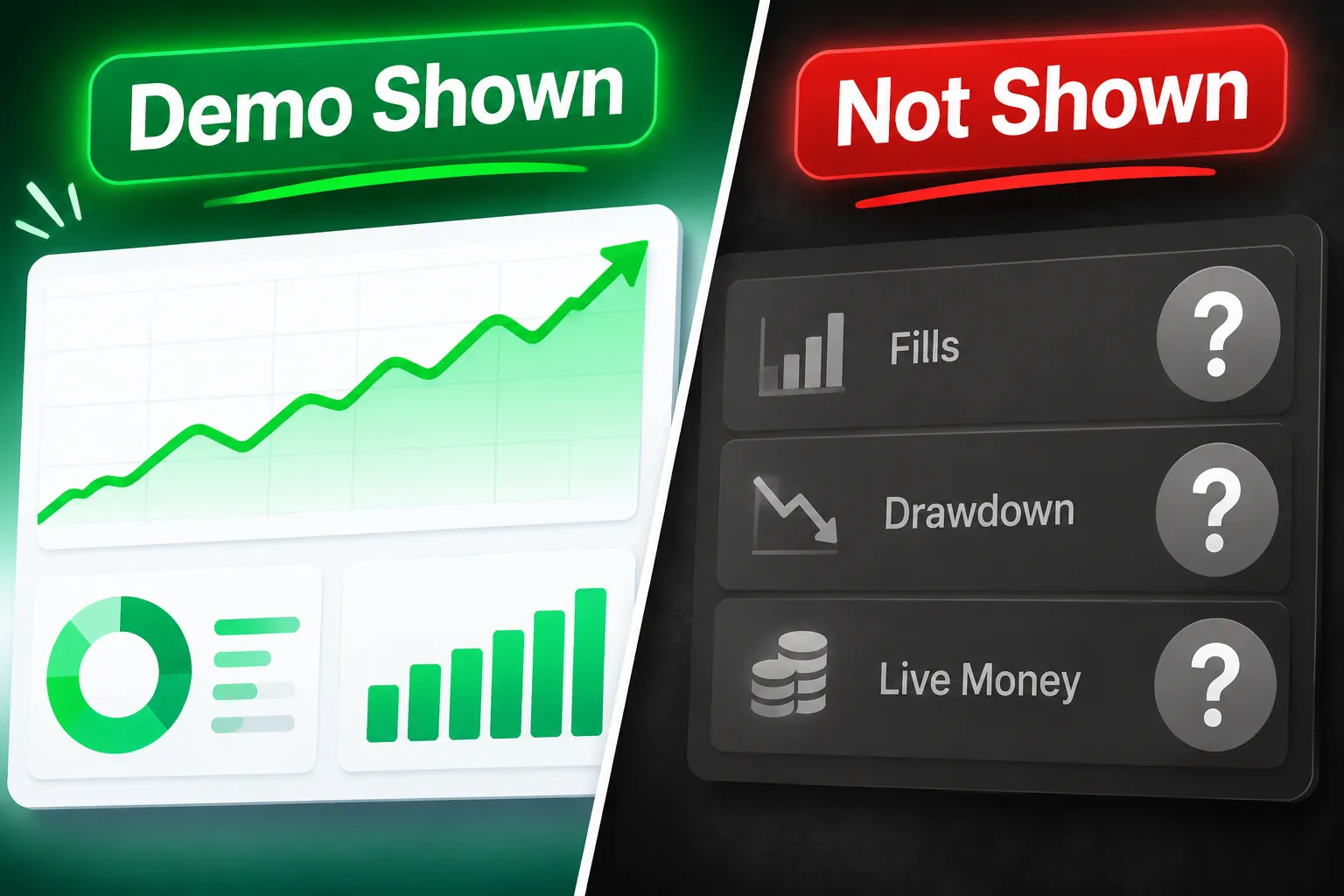
- Fills. jev-trader’s dry-run fills a resting order when a real print crosses its price, which is generous: in a live book you queue behind other orders. Only trAIde reported real exchange fills, and all 15 of its trades closed on a stop; none reached its target.
- Costs. Model cost is not the issue. trAIde’s 4,700-token question set at $0.042 per million tokens works out to 4,700 / 1,000,000 x $0.042 = $0.0002. A full eight-coin pass is about $0.0016. Exchange fees, spread and gas dwarf that.
- Sample size. TradeRank Season 9 had 3 Jev trades. trAIde had 15. You need well over 100 closed trades before a win rate means much.
- Drawdown. TradeRank does publish one (-1.60% in Season 9), which corrects the claim in earlier drafts that no build did. The demo builds publish none.
- Live money. One build out of five.
The gas math on an every-block bot
jev-trader’s README includes a sample event where one block’s order costs about 0.0357 MON in gas, and three blocks of gas (0.107 MON) equal $0.0024. That implies MON at roughly $0.0224 in that sample. Monad charges the gas limit whether the order lands or not.
Run the sample numbers for one hour:
- Blocks per hour at ~300 ms: 3,600 / 0.3 = 12,000
- Gas per hour: 12,000 x 0.0357 MON = about 428 MON
- In dollars at the sample price: 428 x $0.0224 = about $9.60 an hour, or about $230 a day
Those are the README’s illustrative values, and real gas and MON prices move. The point stands: an every-block cancel-and-replace bot has to earn more than its gas bill from the spread before it makes a cent. Check your own fee estimate in dry-run before you add a private key.
Is the Jev AI Trading Bot Safe to Connect to a Broker?
A Jev AI trading bot is as safe as the code around it. Jev cannot place an order by itself; your code does. The risks are the usual ones: API key scope, missing loss limits, and fake bots borrowing a hot AI name.
Before anything touches a funded account:
- Use paper or dry-run first. Alpaca’s paper trading environment is free, uses real-time quotes, and anyone can open a paper-only account with an email address. Paper-only accounts get IEX data, not the full consolidated feed. Our Alpaca API for beginners guide walks through keys and a first order.
- Keep risk in code. Every serious build here (Roan, trAIde) puts stops, caps and circuit breakers in deterministic code. That is also TypeSafe’s own advice: build a normal workflow and insert Jev only where you need a judgment.
- Add an external kill switch. A loop that posts an order every block can burn a day of gas or margin while you sleep. See our breakdown of AI trading agent risks and kill switches.
- Fence off untrusted text. If your bot feeds headlines or social posts into Jev’s state, TypeSafe’s docs warn that injected content can shift answers.
- Watch for scams. The SEC, NASAA and FINRA investor alert on AI fraud flags AI trading systems sold as loss-proof, promised returns and pressure to fund fast. A “Jev bot” sold with a deposit to “activate” it fits that pattern. Our fake Claude trading bot scam story shows how the same pitch took $517,000 from 224 people, and our AI trading bot red flags list covers the tells.
Common mistake: treating a dry-run as proof. jev-trader’s own README says dry-run fills are simulated. Our piece on paper trading slippage shows why simulated fills flatter a strategy.
How Would You Test the Jev AI Trading Bot Yourself?
Test a Jev AI trading bot the way trAIde did: same rules as your current system, a written log, code-owned risk and a stop rule set before day one.
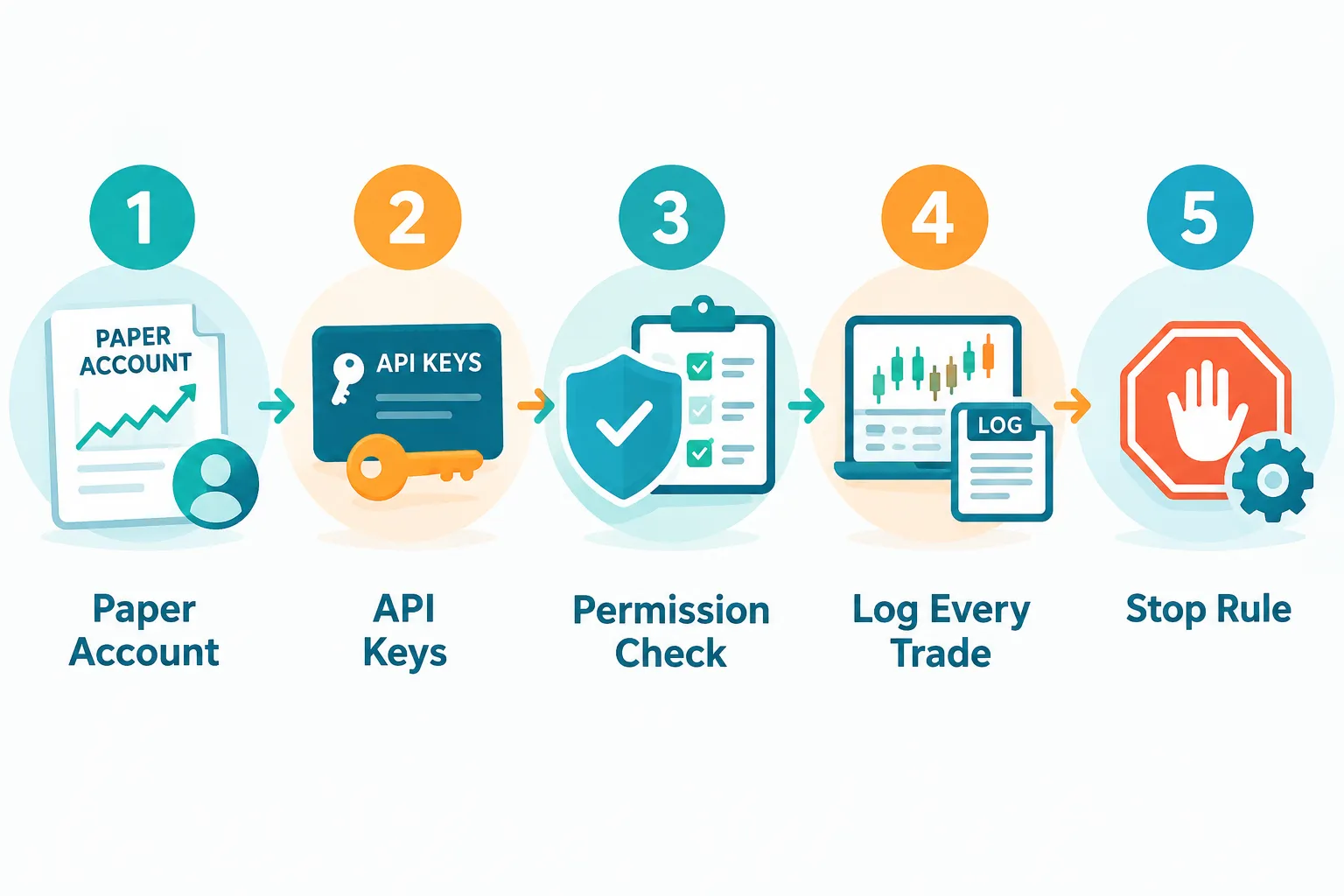
- Open a paper or dry-run environment. Alpaca paper for stocks, or jev-trader’s no-key dry-run for Monad. Keep it separate from real money.
- Pin the model version. Use
jev-1.13.0orjev-1.14.0, notjev-latest, because aliases move when a new release ships. Log the version on every call. - Turn numbers into labels. TypeSafe says Jev is not a calculator. Send “RSI: overbought,” not “RSI: 78.3,” and keep all math in code.
- Ask in every option order and average. Jev leans toward the first option. Rotate long, short and stand aside and average the three answers in code, as trAIde does.
- Always offer a way out. Include “stand aside” or “hold” so the model does not force a trade.
- Log every answer, not just every trade. Timestamp, asset, probabilities, confidence. After 200 or more calls, bucket them by confidence and check hit rates. If your 0.90+ bucket is right less often than your 0.60 bucket, you have the trAIde problem.
- Count all costs. Fees, spread, funding on perpetuals, gas on-chain. Compare net results to a dumb benchmark such as buy-and-hold on the same list.
- Set a stop rule in advance. For example, stop the test at -10% of the paper account or after 30 days, whichever comes first, and do not move it.
If you want a model that reasons rather than classifies, our comparison of the best AI for trading covers Claude, GPT, Grok and Gemini for bot builders. A Claude-based agent build is also on our list in our coming Claude trading agent guide.
Where Jev fits in a trading stack
Based on the five builds, Jev earns its place as a cheap gate, not as the trader:
- Good fit: tagging headlines, filtering setups, “does this still match the reason we entered?” checks, and deciding when to wake a slower, more expensive model.
- Poor fit: raw price direction with no label at decision time, position sizing from confidence, and anything that needs arithmetic.
That matches both TypeSafe’s build guide and Alizadeh’s conclusion: Jev judges, code decides.
Frequently Asked Questions
What is a Jev AI trading bot?
A Jev AI trading bot is trading code that asks TypeSafe AI’s Jev model a typed question, such as long, short or stand aside, and acts on the probability it returns. TypeSafe does not sell a trading bot, and its docs never mention trading. Every Jev bot you see is an independent build.
Has any Jev AI trading bot made money with real funds?
Not on any public record we found in 2026. The only real-money test, Abozar Alizadeh’s trAIde bot on KuCoin futures, lost 1.78% of a small account over 15 trades in 17 days. The other public builds ran dry-run, simulated capital or published no results.
How much does Jev cost to run in a trading bot?
Jev costs $0.042 per million input tokens and output is free, per TypeSafe’s models page. A 4,700-token question set works out to about $0.0002, so the model bill is tiny. Exchange fees, spreads, funding and on-chain gas are the costs that decide whether a Jev AI trading bot is profitable.
Can I trust Jev’s confidence scores for trade sizing?
No, not without calibrating them on your own results first. In the trAIde real-money test, Jev’s calls at 0.95 confidence or higher were right only 32% of the time over four hours, while calls under 0.70 were right 57% of the time. Size trades from your stop distance and measured record, not raw confidence.
How did Jev do on the TradeRank leaderboard?
Jev finished Season 9 in 8th place of 18 at -1.26%, with 3 trades, a 33.3% win rate and a -1.60% max drawdown on simulated $10,000 capital. TradeRank says Jev is entered as a measured baseline, not a contender. Season 10 standings move daily, so check the live leaderboard.
Is jev-trader by Jarrod Watts safe to run live?
Run it in dry-run first, which is what it does when no private key is set. Its README defaults to a mock momentum model, shows a position cap but no stop-loss rule, and notes Monad charges gas on the gas limit whether or not an order lands. Estimate your hourly gas bill before going live.
How do I spot a fake Jev trading bot?
Treat any bot that promises returns, claims it cannot lose or asks for a deposit to activate it as a likely scam. The SEC, NASAA and FINRA investor alert on AI fraud lists those exact signs. A real Jev AI trading bot is code you run with your own API keys, and you can read every line.
Our Take
Jev is a real, fast, cheap decision model, and the plumbing builders made with it is impressive. A Jev AI trading bot, as a category, has not earned your money yet. The one real-money test lost 1.78% of a small account, its most confident calls were its worst, and the contest record is three trades long. That is not a verdict on Jev forever. It is where the evidence sits in 2026.
Use Jev as a filter inside a system you already trust, keep risk in code, and wait for someone to publish 100+ real trades with fees and drawdown before you treat any Jev bot as proven. For more tested tools and plain-English bot breakdowns, start at AI Stock Trading Bots, and for a wider list of legit versus scam bots, see the AI Stock Picker Apps directory guide.
Built a Jev AI trading bot with a real trade log? Send it to us and we will run it through the same checks.
Stay alpha.
The FullStack Alpha research desk tests AI trading bots on paper and live accounts. Reviewed and edited by Jay Rocco, Founder and Editor.
