

The FullStack Alpha research desk tests AI trading bots on paper and live accounts. Reviewed and edited by Jay Rocco, Founder and Editor.
By FullStack Alpha Editorial Team | Reviewed by Jay Rocco, Chief Editor
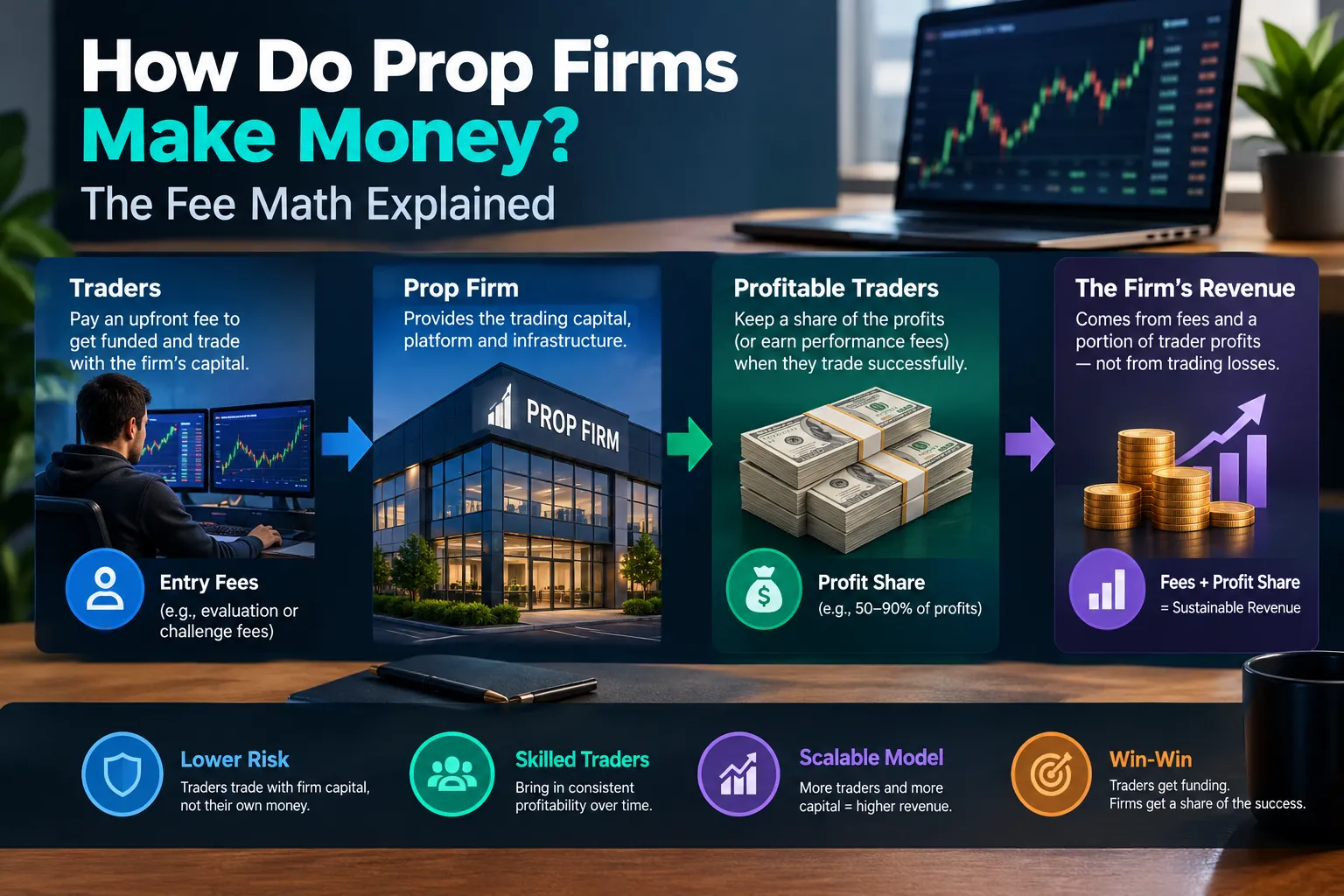
How do prop firms make money? Mostly from the fees traders pay to attempt an evaluation, plus reset fees, upgrades, monthly subscriptions, and only secondarily from a cut of the profits that funded traders generate. Independent operator-economics analyses published in 2026 estimate failed-challenge fees at roughly 60-75% of revenue and reset fees at another 10-15%, though those are industry estimates and not audited sector data. The number to check first is the total cost of one full attempt including resets, not the advertised account size. Everything below that is fee math.
What You Should Know
- Evaluation fees are the dominant revenue line. A 2026 industry revenue analysis identifies challenge fees as the primary income source for most retail prop firms.
- FTMO launched FTMO Futures in September 2026, covering $50,000, $100,000 and $150,000 nominal sizes, with official materials describing 90/10 payouts, simulated funding, qualifying-day requirements and payout caps.
- SurgeTrader reportedly ceased operations in October 2026, shortly after Match-Trade Technologies terminated its platform license. Vendor dependency is a real risk for your deposit.
- Hantec Trader rebranded as RZR Funded on October 19, 2026, with the firm stating existing profit splits, drawdown limits, targets and payout schedules would continue unchanged.
- Most evaluation accounts are simulated, not live capital. CFTC Staff Letter 26-25, reportedly issued September 17, 2026, addressed passive software providers connecting users to registered futures intermediaries and did not convert simulated evaluation accounts into regulated brokerage accounts.
How Do Prop Firms Make Money?
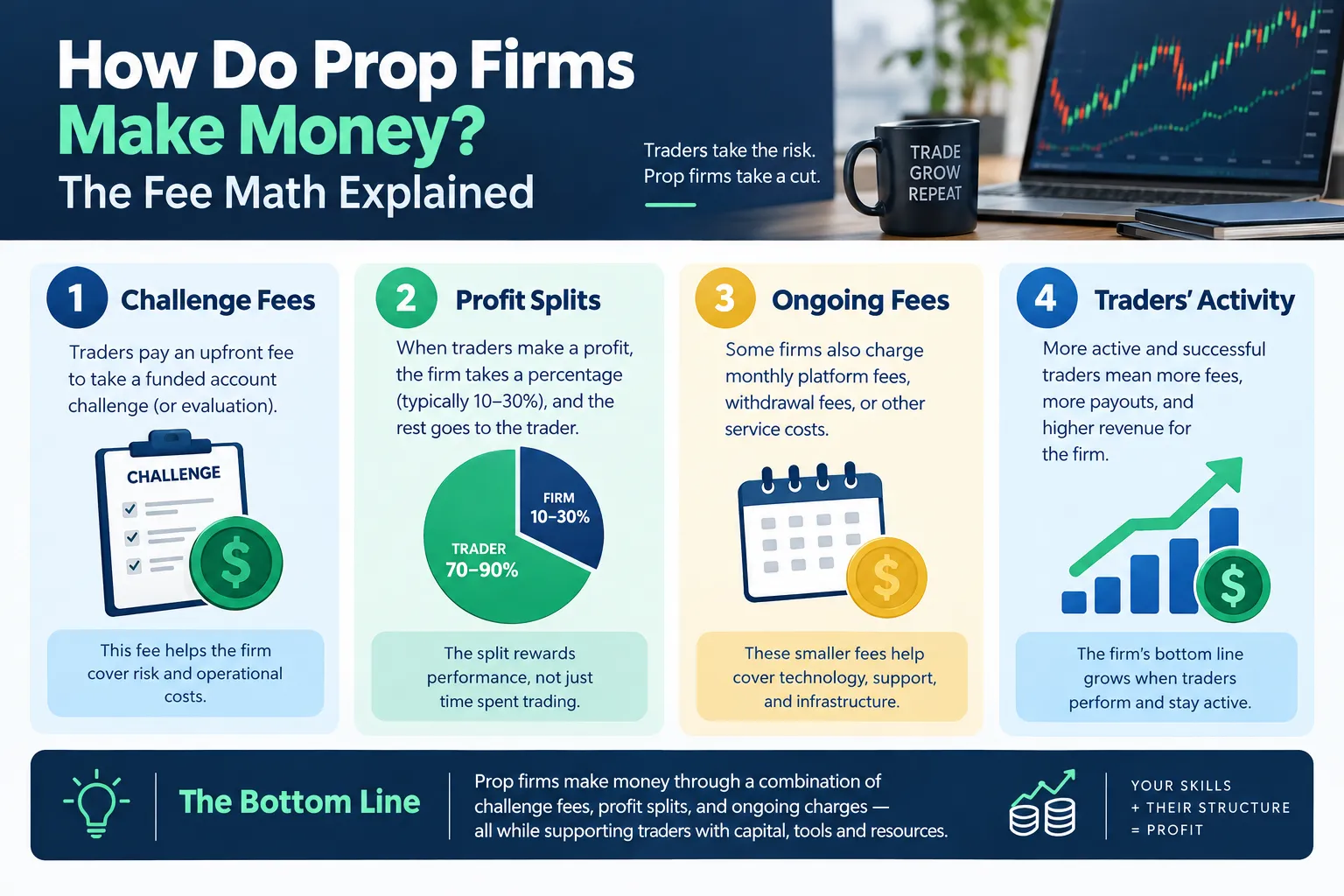
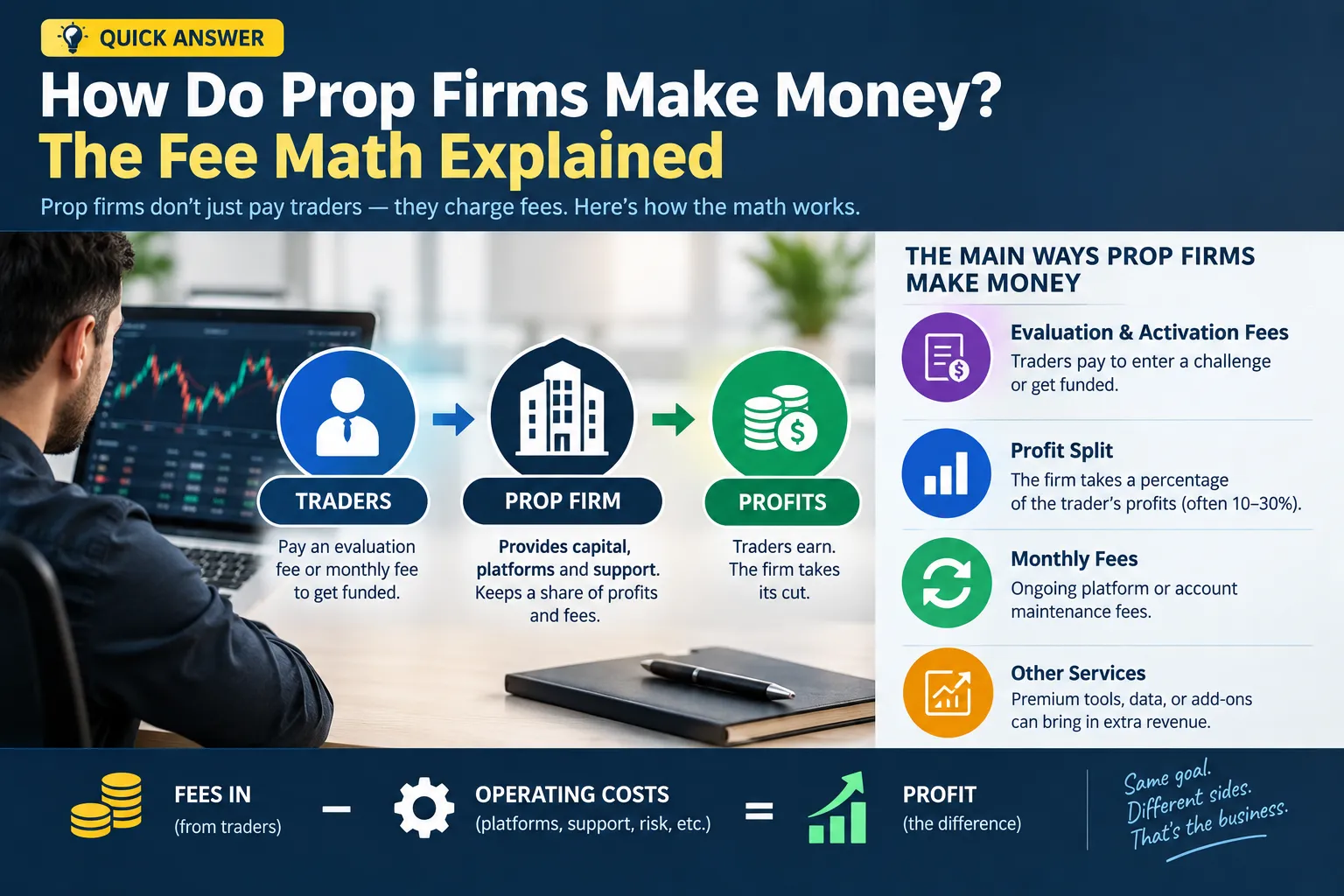
How do prop firms make money? They sell attempts. A trader pays a one-time or recurring fee for the right to take a rule-based test. Pass it and you get a simulated “funded” account with a profit split. Fail it, breach a rule, or run out the clock, and the firm keeps the fee. That single transaction is the engine.
How does a prop firm work, step by step
A proprietary trading firm, in the traditional sense, trades the house’s own capital through salaried or commission-paid traders. The modern retail version works differently. Here’s the standard sequence:
- You buy an evaluation. Sometimes called a challenge. The price scales with the nominal account size.
- You trade a simulated account against a set of rules: a profit target, a daily loss limit, a maximum drawdown, often a minimum number of trading days.
- You pass or you don’t. Breach any rule and the account is closed. Most firms then offer a reset fee, cheaper than a fresh evaluation.
- If you pass, you get a funded account. Usually still simulated on the firm’s side, with your payouts funded from firm revenue.
- You request a payout under the firm’s schedule and split. FTMO’s futures materials, for example, describe a 90/10 split in the trader’s favor along with qualifying-day requirements and payout caps.
The four revenue lines
| Revenue line | What it is | Who pays it |
|---|---|---|
| Evaluation fee | One-time cost to attempt the challenge | Every applicant |
| Reset fee | Discounted restart after a breach | Failed traders |
| Subscription | Monthly recurring evaluation access | Traders on monthly plans |
| Profit split | Firm’s share of funded-account gains | Only traders who pass and withdraw |
Notice which one is last. The profit split is the only line that requires a trader to actually succeed. The other three are paid whether you make a dollar or not. That asymmetry answers most of the question of how do prop firms make money without any conspiracy theory attached.
Why the model keeps expanding
FTMO’s September 2026 futures launch is a clean illustration. A firm with an existing customer base can open a new evaluation category, collect recurring fees, and keep the same mechanics underneath: simulated execution, rule-based eligibility, selective payouts. It doesn’t have to wire the full advertised capital to every trader on day one. The product is the evaluation, and the capital is the marketing.
There’s also a structural shift worth watching. Topstep Brokerage and Tradeify’s Slay Markets have built routes into personal futures brokerage accounts, separating the simulated evaluation product from a regulated introducing-broker operation. CMC Markets Funded was scheduled to launch publicly on October 1, 2026, with legal documents reportedly naming Dubai-based True North Tech as operator and CMC Markets Singapore as an exclusive brokerage partner, while explicitly stating CMC Singapore is not the operator or guarantor. Read that sentence twice. It tells you exactly where liability sits.
The practical takeaway: before you ask whether a firm is good, ask which of its four revenue lines depends on you winning.
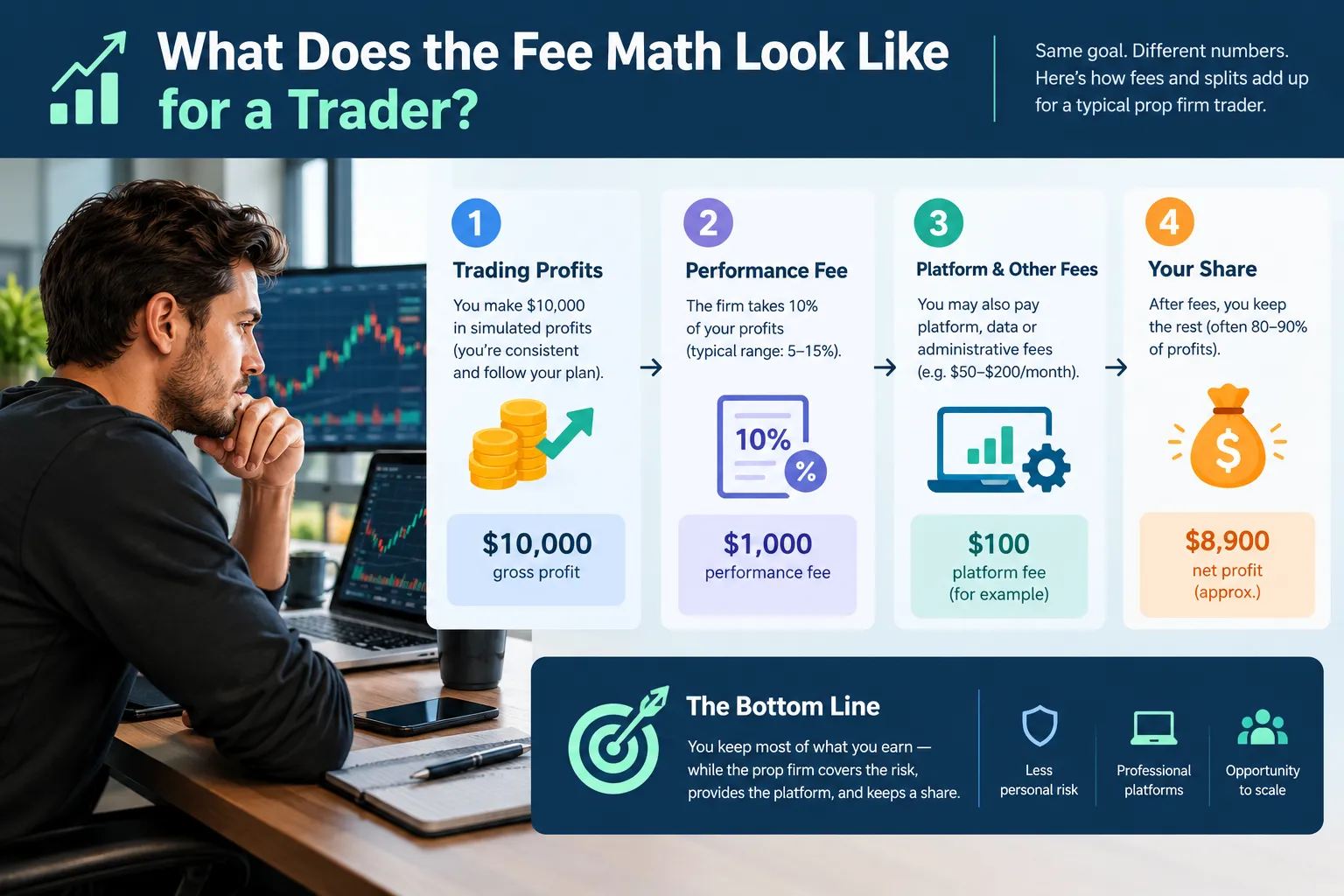
What Does the Fee Math Look Like for a Trader?
The fee math is simple arithmetic, and most traders never run it. Add every dollar you’d spend across the attempts you realistically need, divide by the payout you realistically expect, and see whether the number survives. Below is a worked example using illustrative inputs only, not published pass rates, not any firm’s actual data.
Setting the example inputs
Say the evaluation costs $345 (an example figure used in operator-economics modeling, not a specific firm’s price). Reset fees run roughly a third of that in many published fee schedules, so call it $115 as an example. You set your own assumption for how many attempts it takes. No one can hand you a verified pass rate, because almost no firm publishes audited one.
The honest framing is a cohort. Take 1,000 example traders each paying $345. Gross evaluation revenue before any resets: $345,000. Now the firm’s cost of goods is close to platform fees, data fees, payment processing, and marketing. The payouts come out of that pool.
Three scenarios, same trader
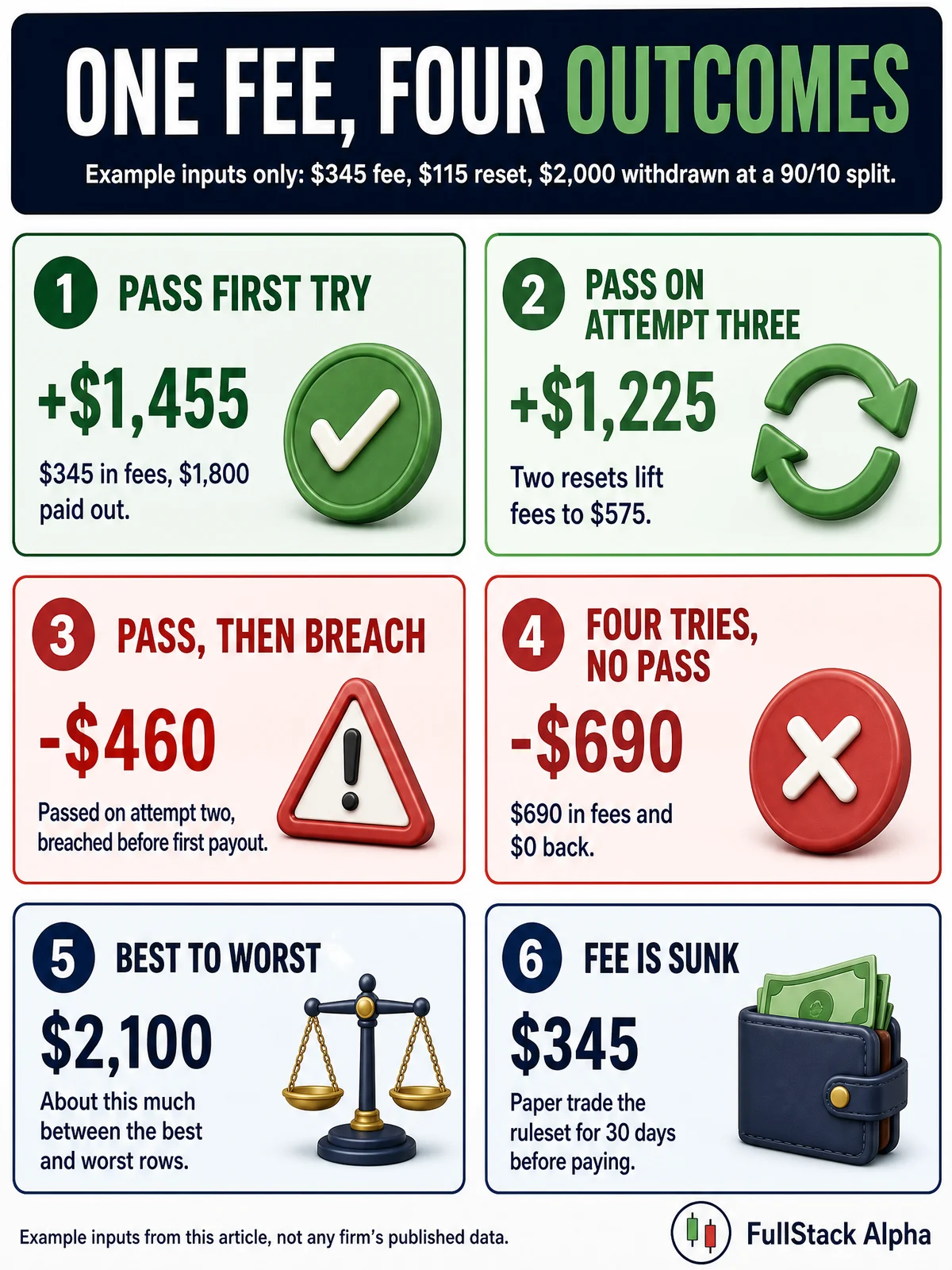
| Scenario (example inputs) | Fees paid | Payout received | Net |
|---|---|---|---|
| Pass first attempt, withdraw $2,000 at 90/10 | $345 | $1,800 | +$1,455 |
| Pass on third attempt (2 resets), withdraw $2,000 | $575 | $1,800 | +$1,225 |
| Four attempts, never pass | $690 | $0 | −$690 |
| Pass on attempt two, breach before first payout | $460 | $0 | −$460 |
All four rows use example numbers. Nothing here is a prediction, and no firm has published the probability of any of these outcomes.
What the table actually tells you
The spread between best case and worst case in this example is about $2,100. That’s the real variable. And notice row four, which gets ignored constantly: passing the evaluation is not the finish line. Breaching a rule in the funded phase before your first qualifying payout means you’ve paid full freight for zero dollars back.
Decision rule: if you can’t name the dollar amount you’d lose after four failed attempts, you aren’t ready to buy the first one.
The one adjustment most traders skip
Your fee is a sunk cost the second you click buy, and that creates the worst incentive in trading. You’ve paid $345, so now you need to “get it back,” so you size up, so you breach the daily loss limit on a choppy tape. That’s revenge trading with a receipt attached. The fee doesn’t just cost money. It distorts the process you were supposedly buying the account to execute.
Paper trade the exact ruleset for 30 days before you pay anything. If your simulated account can’t clear the target inside the drawdown limit without a fee hanging over it, the fee won’t help. A disciplined swing trading process that already works is the prerequisite, not the prize.
A common mistake worth naming
Traders compare prop firms by account size. “This one gives me $150,000.” The account size is nominal and usually simulated. What you’re comparing is cost per attempt against the payout rules attached to it. A $100,000 account with a 5% trailing drawdown and a consistency rule can be harder to monetize than a $50,000 account with a static drawdown. Bigger number, worse deal.
Why Do Most Prop Firm Challenges End Without a Payout?
Because the rules are stacked tighter than the profit target suggests, and the rules compound. A trader can hit the profit target and still fail on a consistency clause, a news-window restriction, or an intraday drawdown breach that happened three weeks earlier. No credible pass-rate statistic exists for the sector, because almost no firm publishes audited numbers, so treat any figure you see quoted on a forum as unverified.
The three rule traps that do the most damage
1. Trailing drawdown. A static drawdown is a fixed floor: breach it and you’re out. A trailing drawdown moves up as your equity peaks, sometimes tracking unrealized highs. Get up 4%, give back 3%, and you can breach a limit you never consciously approached. Check which type your firm uses and whether it trails on closed or open equity. If the page doesn’t say, check the official page before you pay.
2. The consistency rule. This one caps how much of your total profit can come from a single day or a single trade, often expressed as a percentage. The logic is that firms don’t want to pay out lottery tickets. The effect is that one great day can disqualify an otherwise clean month. If you run a low-float breakout strategy where a handful of trades carry the P&L, a consistency rule may be structurally incompatible with how you trade.
3. News windows and holding restrictions. Many firms block trading within a set window around high-impact economic releases, and some restrict holding positions over the weekend or past session close. Violate it accidentally and the account closes even if the trade was profitable.
The quieter ones
- Minimum trading days. You can hit the target in two sessions and still wait out a qualifying-day requirement. FTMO’s futures materials describe qualifying-day requirements explicitly.
- Payout caps. A ceiling on how much you can withdraw per cycle regardless of what you earned. Again, FTMO’s futures product documentation references payout caps.
- Inactivity clauses. Go quiet for a set number of days and the account can be closed.
- Prohibited strategies. Latency arbitrage, copy trading across accounts, tick scalping, hedging between accounts. Broad language here gives the firm wide discretion.
The target gets the headline. The drawdown type, the consistency clause, and the payout cap decide the outcome.
Edge case: passing twice and still getting nothing
Consider a trader who passes two separate evaluations at the same firm and runs correlated positions across both accounts. Many terms treat that as a single-strategy breach or a risk-management violation. Both accounts close. Both fees gone. The rule was in the document. Play stupid games.
Are Prop Firms Legal and Are They a Scam?
Are prop firms legal? Generally yes, in most jurisdictions, as they currently operate. Selling access to a rule-based simulated trading evaluation is not inherently illegal, and firms structure their terms to make clear you’re buying an assessment product, not an investment. Are prop firms a scam? The honest answer is that the model is legal and the industry contains both serious operators and bad ones, and no firm will be named a scam here.
Where the legal line sits
Regulatory uncertainty is the sector’s biggest strategic risk, and the question regulators keep circling isn’t whether a firm says “simulated.” It’s whether the activity involves customer funds, discretionary trading, trade execution, investment advice, commodity-pool interests, brokerage services, or marketing claims that imply live capital is at work.
CFTC Staff Letter 26-25, reportedly issued September 17, 2026, addressed qualifying passive software providers that connect users to registered futures intermediaries. That clarification does not create a general prop-firm license, and it does not turn a simulated evaluation account into a regulated brokerage account. Anyone telling you otherwise is reading a press release, not the letter.
The hybrid structures are the industry’s answer. Topstep and Tradeify have separated the evaluation product from registered introducing-broker operations. That’s a real structural change, and it’s a reasonable thing to look for.
Red flags worth taking seriously
- No named operating entity. If you can’t find who you’re contracting with and in what jurisdiction, stop. The CMC Markets Funded documents reportedly name an operator and explicitly state which partner is not the guarantor. That level of clarity is what you want.
- Terms that can change retroactively. Clauses letting the firm amend rules mid-evaluation, applied to your existing account.
- Payout discretion language. Phrases like “at the firm’s sole discretion” attached to withdrawals rather than to fraud enforcement.
- Marketing that implies live capital when the terms describe simulation.
- Single-vendor dependency with no contingency. SurgeTrader reportedly ceased operations in October 2026 after Match-Trade Technologies terminated its platform license. Your fee doesn’t care whose fault it was.
- Guaranteed-income or near-certain-pass claims. Same energy as the fake bot sellers the SEC has charged over AI trading claims.
The pattern-matching skills transfer. The same checklist that catches a sketchy automated system catches a sketchy evaluation product. If you want the longer version of that red-flag framework, the AI trading bot red flags breakdown covers it.
What Does a Payout Denial Case Show?
Payout disputes cluster into a handful of repeatable types, and the ones that get traction publicly almost always come down to a clause the trader didn’t read rather than outright theft. Individual user reports on Reddit and review sites are worth reading as signals, not as evidence. One anonymous account is one anonymous account.
The dispute types that recur
Type 1: Retroactive rule enforcement. The trader gets to payout, the firm reviews the account history, and flags a trade from week one that violated a prohibited-strategy clause. The profit stands, the payout doesn’t. The firm’s position is that the rule was always in the document.
Type 2: Consistency recalculation. Payout is reduced or denied because a single day exceeded the permitted share of total profit. Common, and almost always technically correct per the terms.
Type 3: KYC and documentation holds. Identity verification fails or mismatches, payment processor rejects, payout stalls indefinitely. Frustrating, often resolvable, frequently reported as a denial when it’s an operational jam.
Type 4: Account-linking allegations. The firm claims the trader operated multiple accounts or copy-traded with another user. This is where disputes get genuinely murky, because the evidence sits entirely on the firm’s side.
Type 5: Platform or vendor failure. The firm loses its platform license or payment rail and payouts freeze. The October 2026 SurgeTrader reports fall into this operational category rather than a rules dispute.
How to read someone else’s complaint
Before you weight a Reddit thread heavily, check three things: did the poster quote the specific clause they were accused of breaking, did they post the firm’s written response, and did the firm reply publicly. A complaint with all three is useful. A complaint with none is a data point of one with no context. The same skepticism applies to algorithmic trading discussions on Reddit generally, negative skew is real, and so is astroturfing in both directions.
Decision rule: if a firm’s dispute reports cluster in Type 1 and Type 4, that’s a terms problem. If they cluster in Type 3 and Type 5, that’s an operations problem. Both matter, but only one is about intent.
How Do You Read a Prop Firm’s Terms Before You Pay?
Read the payout section first, the drawdown definition second, and the marketing page last. Here’s a numbered checklist with the fix for each item. Run it before any prop firm challenge purchase.
-
Find the operating entity and jurisdiction. Fix: search the terms document for the legal name, not the brand name. If the brand and the operator differ (as reportedly with CMC Markets Funded and True North Tech), know which one owes you money.
-
Identify the drawdown type. Static, trailing on closed equity, or trailing on unrealized highs. Fix: if the terms don’t specify, email support and keep the written reply. If they won’t answer in writing, check the official page or walk.
-
Locate the consistency rule and its percentage. Fix: model your last 30 trades against it. If one day carried more than the cap allows, your strategy is incompatible regardless of edge.
-
Read the prohibited strategies list in full. Fix: note anything vague, “abusive trading,” “exploitative behavior.” Vague language is discretion, and discretion isn’t on your side.
-
Map the full prop firm payouts schedule. First eligible date, cycle length, minimum amount, maximum cap, split percentage. Fix: write the date of your realistic first payout on a sticky note. That’s your true time-to-cash.
-
Check the reset policy and price. Fix: add two resets to your worst-case budget before you buy. That’s the honest cost of entry.
-
Find the refund clause. Some firms refund the evaluation fee with the first payout. Many don’t. Fix: treat the fee as non-refundable unless the terms say otherwise in plain language.
-
Check the amendment clause. Can the firm change rules on your live evaluation? Fix: screenshot the full ruleset the day you buy, with a timestamp.
-
Verify the platform and the vendor behind it. Fix: a firm running on one third-party platform with no stated backup carries the risk the SurgeTrader situation put on display in October 2026.
-
Search for the firm’s own published payout data. Fix: if they publish totals with dates, that’s a point in their favor. If they publish a pass rate with no audit, treat it as marketing.
Keep this list next to the terms tab. It takes twenty minutes. The prop firm challenge takes weeks and real money.
Do Prop Firms Pay Real Money?
Yes, funded traders at established firms receive real money, but the trading account generating it is usually simulated. The distinction matters: your profit is a calculated entitlement under the firm’s rules, paid from firm revenue, rather than a withdrawal of gains from a live brokerage account in your name.
Simulated account versus funded payout
- Simulated account: order fills are modeled by the firm or its platform vendor. No customer funds are held in your name. Rule breaches close the account instantly because there’s no real position to unwind.
- Funded payout: an actual bank transfer or processor payment, based on the simulated P&L and the stated split. FTMO’s futures materials describe a 90/10 split with qualifying-day requirements and payout caps attached.
- Hybrid structures: Topstep Brokerage and Tradeify’s Slay Markets provide routes into personal futures brokerage accounts, which is a genuinely different arrangement from a pure simulated product.
Firms that have been operating for years with public payout records are a different proposition from firms six months old with an aggressive affiliate program. Age and payment history aren’t guarantees, Hantec Trader’s October 19, 2026 rebrand to RZR Funded came with assurances that profit splits, drawdown limits, targets and payout schedules would continue unchanged, which is what you want to see during a brand transition. But a brand change is still a moment to re-read your terms.
If you want a verified figure for a specific firm’s total payouts, get it from the firm’s own published page with a date on it. Otherwise, check the official page rather than trusting an aggregator.
Should You Join a Prop Firm or Stay a Retail Trader?
Choose a prop firm if you have a tested, rule-compatible process and not enough capital to size it properly. Stay retail if you’re still finding your edge, because paying for attempts while you learn is the most expensive classroom in trading.
Prop firm versus retail broker
| Factor | Prop firm evaluation | Retail brokerage account |
|---|---|---|
| Capital at risk | Your fee only | Your full deposit |
| Upside cap | Payout caps and splits apply | Uncapped, all yours |
| Rules imposed | Firm’s drawdown, consistency, news windows | Your own, plus margin rules |
| Account ownership | Usually none, simulated | Yours, held at the broker |
| Who absorbs losses | The firm, in simulation | You |
| Failure cost | Fee, repeatable | Real capital, permanent |
The honest version: the prop model converts an unlimited downside into a fixed, repeatable one. That’s a genuine feature. The price is that you’re now trading someone else’s ruleset, and the firm gets paid whether you win or not.
Can beginners make money at prop firms?
Some do, most don’t, and the ones who do almost always had a working process before they bought anything. A prop firm challenge doesn’t teach you a strategy. It tests whether you already have one that fits inside tight risk constraints. If your current answer to “what’s your edge, in one sentence” is fuzzy, buy nothing and paper trade it first.
Why do some firms charge so much more than others?
Pricing tracks account size, rule leniency, and marketing spend, not quality. A firm with a generous drawdown and no consistency rule charges more because more people pass and get paid. A cheap evaluation with a tight trailing drawdown may be the more expensive product once you count resets. Compare cost per realistic attempt, not sticker price. The same logic applies to trading software, which we covered in what you pay for versus what you get with AI trading tools.
Which firms have the best fee structure?
No single answer, and anyone giving you one has an affiliate link. The structures worth favoring share three traits: a static or clearly-defined drawdown, a published payout schedule with dates, and a refund of the evaluation fee on first payout. Verify all three on the official terms page for any firm you’re considering. If you’d rather spend the same money on tools you own outright, the free AI stock screeners directory is a reasonable starting point.
Are Prop Firms Profitable for the Traders or Just the Company?
Both, but asymmetrically. The firm’s profitability is diversified across every fee payer; the trader’s depends entirely on their own outcome. That’s why the question of how do prop firms make money resolves cleanly for the company and messily for the individual.
Run the cohort math from earlier. A thousand example traders at $345 generates $345,000 in gross evaluation revenue before resets. The firm’s payout obligation is concentrated in whatever fraction reaches a qualifying withdrawal. Even with a generous split like 90/10, the firm’s downside is bounded by how many people clear the rules, and its revenue isn’t.
For the trader, the distribution is brutal and binary. You either clear the ruleset and get paid, or you don’t and you’re out the fee. There’s no partial credit for a good month that breached a consistency clause on day 19.
Market truth: the firm sells a probability-weighted product and you buy a single outcome. That’s the whole asymmetry.
Which doesn’t make it a bad deal. It makes it a deal you need to price correctly. Buying one evaluation with a tested strategy and a budgeted worst case is rational. Buying your fourth reset in six weeks because you want the money back is not.
Do Prop Firms Make Money If Their Traders Lose?
Yes, and that’s the structural concern regulators keep circling. Since the evaluation fee is collected upfront and most accounts are simulated, a trader losing money in a simulated account costs the firm nothing in trading losses. The fee is already booked.
Three nuances keep this from being as sinister as it sounds:
- Reputation is a real constraint. Firms that never pay out get torn apart publicly, lose affiliate partners, and lose repeat buyers. Repeat customers and successful traders are marketing assets.
- Some firms hedge or mirror. Certain operators route a portion of funded-trader flow to live markets or take the opposite side selectively. Terms rarely disclose this in detail, so treat it as unknown unless a firm states it.
- The hybrid shift reduces it. Where a firm moves traders into actual brokerage accounts, as Topstep and Tradeify have structured, the incentive changes shape.
The practical read: the firm doesn’t need you to lose, but it doesn’t need you to win either. Design your decision around that, not around the marketing.
Frequently Asked Questions
Do prop firms pay real money?
Yes, funded traders at established firms receive real payments, even though the trading account is typically simulated. The payout is a contractual entitlement calculated from simulated P&L and paid from firm revenue under a stated split, such as the 90/10 structure FTMO describes for its futures product launched in September 2026.
What are the disadvantages of prop firms?
Non-refundable fees, restrictive rules, no account ownership, payout caps, and operational risk if the firm’s platform vendor pulls out. The October 2026 SurgeTrader reports, which followed Match-Trade Technologies terminating its platform license, show how a third-party dependency can end a firm’s operations and your access with it.
Are prop firms very profitable?
For well-run operators, the model appears highly profitable because evaluation fees are collected upfront regardless of outcome. A 2026 operator-economics estimate puts failed-challenge fees at roughly 60-75% of revenue and reset fees at 10-15%, though those are industry estimates rather than audited figures.
Which prop firm is the most trusted?
No single firm can be named most trusted responsibly, and trust should be assessed on verifiable traits rather than reputation. Look for a named operating entity, published payout data with dates, a clearly defined drawdown type, and a regulated brokerage pathway like those Topstep Brokerage and Tradeify’s Slay Markets have built.
How does a prop firm challenge work?
You pay a fee, trade a simulated account to a profit target within a daily loss limit and a maximum drawdown, and usually satisfy a minimum trading-days requirement. Pass and you move to a funded account with a profit split; breach any rule and the account closes, with a discounted reset typically offered.
What happens if you lose money while trading at a prop firm?
In a simulated evaluation, you lose your fee, not trading capital, because no customer funds are deployed. The account closes on a drawdown breach and the firm generally offers a reset at a reduced price, which is itself a documented revenue line for many operators.
Our Take
The fee is the product. Everything else, the $150,000 account size, the 90/10 split, the dashboard, is packaging around a paid attempt at a rule-based test. That’s not an accusation, it’s the business model, and understanding it is the difference between buying an evaluation as a calculated decision and buying one as a hope.
So do the math before you pay. Write down the fee, add two resets, read the drawdown definition and the consistency rule, and find the date of your realistic first payout. If those four numbers don’t work on paper, no amount of screen time fixes them. And if you’re still building the process, paper trade the exact ruleset for 30 days first. Costs nothing, tells you everything.
Related: the AI Stock Trading Bots home page tracks the bots people try to pass these challenges with, and our broker and platform reviews at AI Stock Picker App cover the retail route if you decide to trade your own account instead.
Weighing a prop firm challenge and not sure the fee math holds? Send us the firm or the bot you plan to run and we’ll check the rules against it.
Cut the noise, keep the alpha. Stay alpha.
The FullStack Alpha research desk tests AI trading bots on paper and live accounts. Reviewed and edited by Jay Rocco, Founder and Editor.
