

Jay Rocco is the Founder and Editor of FullStack Alpha. He has tested 200+ AI stock tools since 2022 and run 15+ AI trading platforms on live accounts with his own money. He reviews the software. He does not tell you what stocks to buy.
Quick Answer
Alpaca is the best api for stock trading for most first-time bot builders: commission-free US stocks and options, readable REST docs, and a paper account you can hit the same afternoon you create API key credentials. Tradier is the better pick for options-heavy bots at $10 a month flat. IBKR wins on asset breadth and execution quality and loses on developer comfort. The choice comes down to what you trade, how much market data you’re willing to pay for, and whether you can live with a messy auth flow.
Key Takeaways
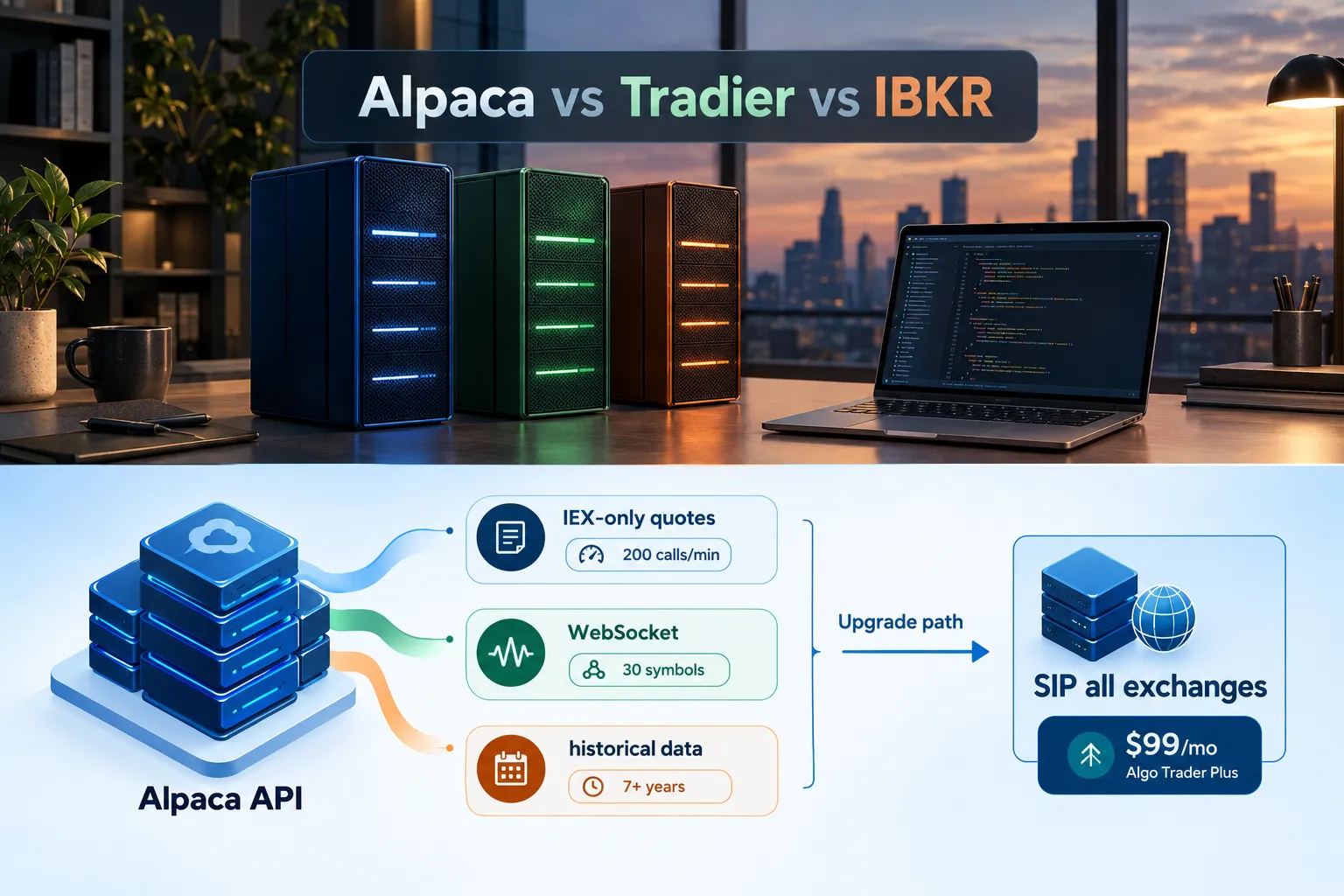
- Alpaca’s free data plan gives IEX-only quotes, 200 API calls per minute, 30 WebSocket symbols and 7+ years of history; all US exchanges (SIP) costs $99 a month on Algo Trader Plus.
- Tradier Lite is $0 a month with $0.35 per stock trade and $0.35 per options contract. Pro is $10 a month with $0 stock and equity option commissions. Pro Plus is $35 a month (tradier.com/pricing, checked October 2026).
- IBKR tightened Web API pacing on September 9, 2026: /iserver/marketdata/history is now capped at 10 requests per second or 50 per minute, and the /hmds/scanner endpoint was removed, per the IBKR Web API changelog.
- Schwab refresh tokens expire every seven days, which forces a manual re-login and quietly kills unattended bots.
- Robinhood still has no general public trading API for retail bots, only agentic accounts for third-party AI agents.
- Alpaca and Tradier both offer MCP servers, so AI agents can reach your account through one connection.
- The real cost of a bot is rarely commissions. It’s market data, and that’s where most beginners get surprised.
What makes a broker API good for a trading bot?
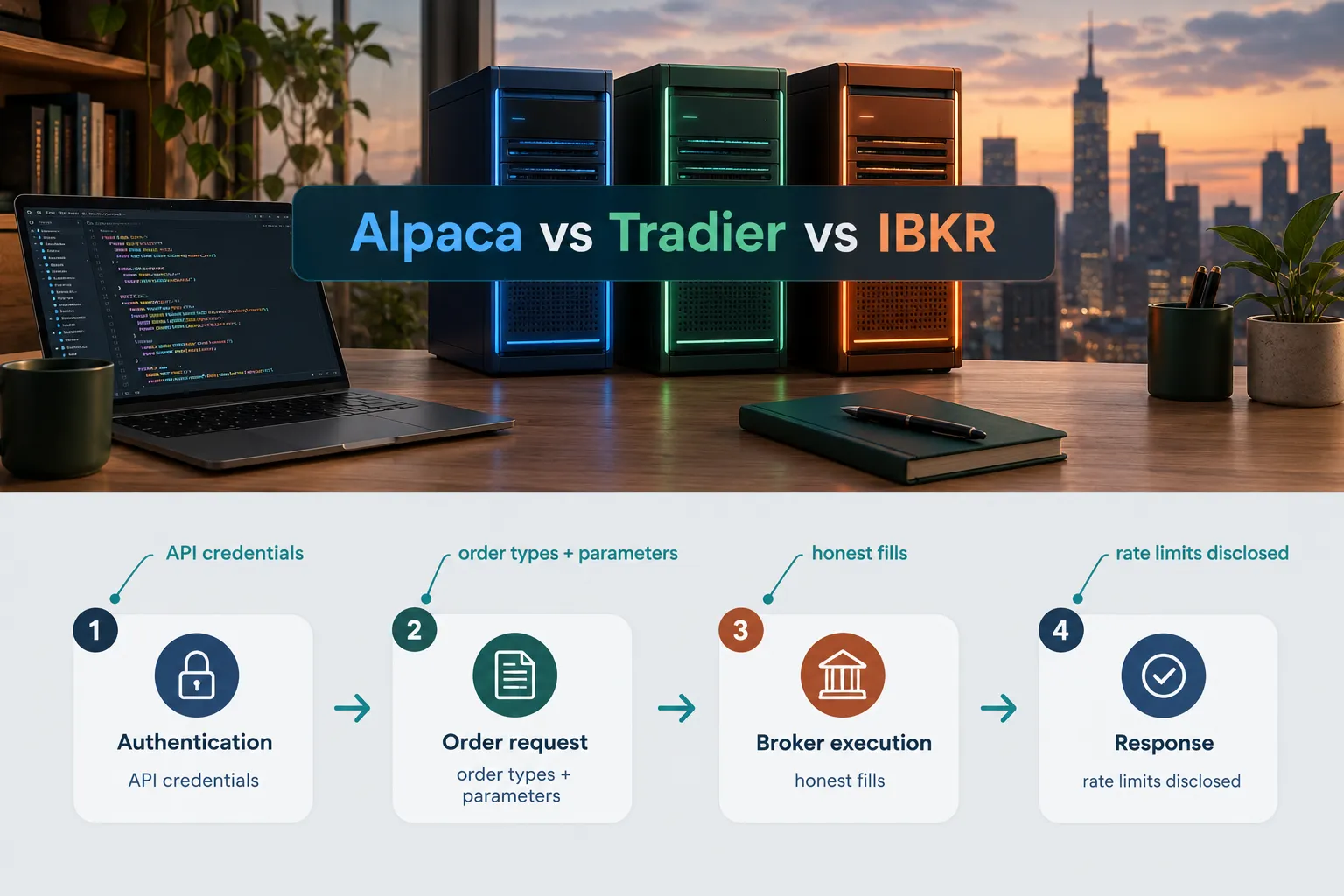
A good broker API, and any real contender for best api for stock trading, does four boring things well: authenticates without drama, accepts the order types your strategy needs, returns honest fills, and tells you in writing what its rate limits are. Everything else is decoration.
What is a stock trading api and how does it work?
A stock trading API is a set of web endpoints your code calls to place, change or cancel orders and to pull positions and quotes. Your script sends a request with an API key, the broker answers with JSON, and your bot reads that JSON to decide what to do next. No clicking, no mouse, no human.
What to grade before you commit:
- Order types. Bracket, OCO and trailing stops matter more than fancy charts. Tradier documents its order classes in the Tradier trading API docs.
- Documentation. Be picky about documentation. You will live inside the api docs for weeks, so view api docs before you fund anything.
- Rate limits in writing. Published limits beat vague promises. Alpaca spells out per-endpoint throttles in its Broker API rate limits documentation.
- Sandbox quality. A paper endpoint that behaves like production saves you a month.
- Legal terms. Read the Tradier API agreement before you redistribute a single quote.
Pick the API whose failure modes you can debug at 9:28 a.m., not the one with the prettiest site.
What is the best api for stock trading in 2026?
For a retail trader building a first automated strategy, Alpaca is the best api for stock trading on balance, Tradier is the best api for stock trading if you trade options every week, and IBKR is the choice when you need more than US stocks and options.
Decision rules, plain:
- Choose Alpaca if you want a free api key, commission-free stocks and options, and the fastest path from zero to a paper fill. Start with our Alpaca API guide for beginners.
- Choose Tradier if options contract fees are your biggest line item. Tradier API pricing is plan-based: Lite at $0 a month, Pro at $10 a month with $0 stock and equity option commissions, and Pro Plus at $35 a month.
- Choose IBKR if you need futures, non-US exchanges, or institutional routing, and you accept a steeper build. See the Interactive Brokers TWS API walkthrough.
Best free stock trading api for beginners
Alpaca. The free plan is a genuinely usable free api for paper and live equity trading, and the catch is honest: IEX-only data, 30 streaming symbols, 200 historical calls a minute. Tradier Lite is also $0 a month, but you pay $0.35 per trade, so “free” depends on your frequency.
Best stock api for options trading, and for high frequency
For options, Tradier and Alpaca both expose chains and multi-leg orders, which makes either one a reasonable best stock api pick for a spread bot. For genuine high frequency work, none of these three are it. Retail REST APIs are built for seconds, not microseconds, and IBKR’s own pacing proves the point.
How do Alpaca, Tradier and IBKR compare on cost, data and order types?
On raw cost, Alpaca is cheapest to trade and most expensive to feed with real-time data. Tradier is cheapest to feed. IBKR sits in the middle on both and ahead on markets covered.
| Broker API | Assets via API | Market data | Developer experience | Cost (Oct 2026) |
|---|---|---|---|---|
| Alpaca | US stocks, ETFs, options, crypto | Free tier IEX only; SIP real-time on paid plan | Easiest REST, official MCP server, CLI | $0 commissions; data $0 or $99/mo |
| Tradier | Stocks, ETFs, equity options, index options | Included with account | Clean docs, strong options endpoints | Lite $0/mo plus $0.35 per trade; Pro $10/mo; Pro Plus $35/mo |
| IBKR | Stocks, options, futures, FX, global exchanges | Paid subscriptions per exchange | Steep, multiple API flavors, session auth | Tiered commissions; data fees extra |
Stock trading api commission fees comparison, and minimum balance
Alpaca and Tradier Pro both run $0 commissions on US stocks. Margin accounts at any US broker carry the standard $2,000 regulatory minimum, so check each broker’s account rules before you fund. Regulatory and exchange fees still apply everywhere, so model them in your backtest.
Real-time data versus delayed, and why it decides your strategy
Delayed or IEX-only quotes are fine for daily-bar swing systems and useless for intraday scalping. IEX covers a small slice of consolidated volume, so your “last price” can differ from the tape. If your entry depends on the inside quote, you’re buying SIP data, full stop.
Which stock market data APIs feed the bot, and do you need real-time or delayed?
Even the best api for stock trading only routes orders. Market data apis supply the history and the quotes, and that’s a separate purchase for anything serious. Most retail bots end up pairing one broker with one data vendor.
Flat files, REST or SQL: pick the format by the job
Data vendors now deliver the same stock market data three ways. Flat files for bulk backtests, a REST data API for live calls, and SQL access so you can query without downloading everything first. Use flat files for research and the REST API for execution.
Consolidated or direct: where accuracy comes from
Vendors like Massive (formerly Polygon) and Databento sell consolidated and exchange-level feeds as a separate purchase from your broker. That is the upgrade path once a free single-venue feed starts lying to your volume filter. Check asset coverage before you build: stocks, options, indices, currencies and futures are not all included everywhere, and cheap feeds often stop at equities and leave an options bot blind.
Free starter data: Alpha Vantage and Finnhub
Alpha Vantage is still the gentlest entry. You get a free API key in about a minute, and the documentation covers stocks, FX and economic indicators. The free tier is rate-capped hard, so explore it, then budget. The finnhub stock api is the other common cheap start for fundamentals and news.
AI agent access through MCP
Alpaca and Tradier both ship MCP servers, so Claude Code, Cursor, ChatGPT and similar clients can read accounts, pull data and place trades when you grant permission. Powerful, and also the fastest way to let an agent do something expensive. Scope the key to read-only until you trust it.
Which broker with api is easiest to set up for a first bot?
Alpaca, by a wide margin, is the broker with api access that a beginner can get running in one sitting. You get an API key and secret from the dashboard, point at the paper endpoint, and place a test order in a few lines. Our Alpaca API keys setup guide covers the gotchas.
Can I build a trading bot with alpaca api?
Yes. Alpaca’s Trading API handles orders, positions, account state and streaming from one key pair. Paper first, live second. Compare your logic against the field in our roundup of AI trading bots for 2026.
Stock trading api rate limits and how to avoid them
Cache anything that isn’t price. Batch symbol requests. Use WebSockets for quotes instead of polling REST. Back off exponentially on 429s. IBKR’s Web API now caps historical data at 10 requests per second or 50 per minute, so a naive polling loop will throttle you before lunch.
How to fix api connection errors
Most “API is broken” tickets are an expired token, a wrong base URL, or a sandbox key pointed at production. Tradier publishes answers to the common ones in its API FAQ and its brokerage API documentation table of contents.
Is a stock trading api safe and secure?
Reasonably, if you treat keys like cash. Store them in environment variables, never in a repo. Use read-only scopes where offered, rotate quarterly, and enable withdrawal restrictions on the account. Tradier’s API support notes cover key handling basics.
How reliable are paper fills versus live fills on each API?
Paper fills on all three are optimistic. Alpaca’s paper engine fills at the quote without queue position, Tradier’s sandbox is simulated, and IBKR’s paper account models more market structure but still skips real queue dynamics. Treat every paper backtest as a best case.
- Add a slippage assumption before you go live. Our guide on paper trading slippage shows how much it moves results.
- Test in the first and last 30 minutes, where spreads are widest.
- Run live with one share for two weeks. That’s the only honest fill test.
Does Robinhood or Schwab have an API for stock trading?
Robinhood has no general public stock trading API for retail bots. It opened agentic trading accounts for third-party AI agents instead. Schwab does have a developer API, with a real catch.
- Schwab: refresh tokens expire every seven days, so unattended bots need a manual re-login each week. Details in our Schwab API guide.
- Webull: has an official API in limited markets. See the Webull API breakdown.
- Edge case: unofficial reverse-engineered Robinhood libraries exist and can get your account restricted. Don’t.
Top 5 favorite features
The features that actually save a first-time builder time, across the best api for stock trading candidates.
- Alpaca paper endpoint parity. Same code, one URL change.
- Tradier multi-leg options orders. Spreads in a single request.
- IBKR asset breadth. Equities, options, futures and FX from one account.
- MCP servers at Alpaca and Tradier. Agent access without custom glue.
- Published rate limits. Boring, and the reason your bot stays online.
What we like, and what we don’t
Honest ledger. Every candidate for best api for stock trading has at least two real drawbacks.
What we like: Alpaca’s docs and $0 commissions. Alpaca’s free data tier: IEX-only quotes, 200 calls a minute, 30 streaming symbols and 7+ years of history, with all exchanges at $99 a month on Algo Trader Plus. Tradier’s $10 flat Pro plan with $0 equity option contracts. IBKR’s execution and market coverage.
What we don’t like:
- Alpaca: free data is IEX-only and capped at 200 calls a minute; real-time SIP jumps to $99 a month, and there’s no futures trading.
- Tradier: Lite charges $0.35 per stock trade and $0.35 per options contract, which punishes active bots, and futures sit in a separate entity with a separate account.
- IBKR: multiple competing API flavors and session-based auth make it the hardest first build, and September 2026 pacing cuts plus the removal of the /hmds/scanner endpoint can break working code.
- Schwab: the seven-day token expiry is disqualifying for unattended automation.
What do real users say?
Sentiment in r/algotrading splits along exactly the lines above, and it is the same alpaca vs interactive brokers argument every week: IBKR for capability, Alpaca for ease. Two quotes, verbatim.
“honestly I just use interactive brokers, the api is kinda messy but it works once you get it set up.” u/absurd_atheism, r/algotrading
“Alpaca is god” u/--someone, r/algotrading
Competitors and alternatives
If none of the three fit, the next tier splits between brokers and pure data vendors. Pick by what’s missing.
- tastytrade: options-first broker with an API, worth a look alongside our best trading platform for options comparison.
- Data only: Alpha Vantage, Finnhub, Polygon, Massive. Get a free api key, test one symbol, then decide.
- No-code: if you’d rather not write Python, compare the free AI trading bots beginners keep flocking to.
- Before you automate anything, read how to backtest a trading strategy without fooling yourself.
Our take
Ask which is the best api for stock trading for a first bot and the answer is Alpaca, with Tradier Pro as the upgrade once options contract fees start showing up on your statement, and IBKR as the destination once your strategy outgrows US equities. Whether you build on one or all three, the API is never the edge. The rules you follow are.
Spend less time worrying about plumbing and more time on the setup, the position sizing, and the stop. The best api for stock trading is the one that stays out of the way of your rules. Systems over hacks.
Next step: create API key credentials on Alpaca paper, place ten simulated orders with a hard stop on each, and log every fill price against the quote you saw. Two weeks of that teaches you more than any api documentation.
Comparing tools, not picking stocks. Head-to-head reviews of 200+ AI trading tools and broker APIs live at aistockpickerapp.com/reviews. Depth here, breadth there.
Conclusion
Three APIs, three jobs. The best api for stock trading for a beginner is the one you can debug, which is Alpaca. The best api for stock trading for an options bot is Tradier Pro. The best api for stock trading for a grown-up multi-asset system is IBKR, once you’ve earned the headache. Get your key, paper trade it first, and track slippage from day one.
Pricing fine print: broker fees change faster than a bot hits a rate limit. Confirm on the official page before you code around them.
This article is education, not financial advice.
Your market edge starts with the right tool. Stay alpha.
Frequently Asked Questions
Is there any API for stock market?
Yes. Brokers like Alpaca, Tradier, Interactive Brokers and Schwab offer trading APIs that place real orders, and separate market data APIs from Alpha Vantage, Finnhub, Polygon and Massive supply quotes and history. Most retail bots combine one broker API for execution with one data vendor for research.
Which stock API is the most accurate?
Accuracy tracks the data source, not the brand. Consolidated SIP or direct exchange feeds are the most accurate. Single-venue feeds like Alpaca's free IEX tier are correct for IEX and incomplete for the full tape, which matters for intraday strategies.
Which stock news API is the best?
Finnhub's news endpoints and Massive's corporate event data are common retail choices, with Alpha Vantage as the free starting point. Judge a news API on timestamp precision and symbol tagging, not headline volume.
What is the best AI tool to use for stock trading?
There's no single best AI tool, and anything promising a win rate is selling. The useful category in 2026 is agent access: MCP servers from Alpaca and Tradier let Claude Code, Cursor or ChatGPT read your account and market data, then act under permissions you set. Keep keys read-only first.
Does Robinhood have an API for stock trading?
No general public trading API for retail bots exists at Robinhood. It launched agentic trading accounts for approved third-party AI agents instead. Unofficial reverse-engineered libraries violate terms and risk account restriction, so use Alpaca or Tradier for automation.
Is the Alpaca API free?
Trading via the Alpaca API is commission-free for eligible US stocks, ETFs and options, and the free data plan costs $0. It limits you to IEX quotes, 30 WebSocket symbols and 200 API calls per minute. All US exchanges with real-time OPRA options data costs $99 a month on Algo Trader Plus.
How much does the Tradier API cost?
Lite is $0 a month with $0.35 per stock trade and $0.35 per options contract, Pro is $10 a month with $0 stock and equity option commissions, and Pro Plus is $35 a month (tradier.com/pricing, October 2026).
Alpaca vs Interactive Brokers, which is better for bots?
Alpaca is better for a first bot: simpler auth, cleaner docs, $0 commissions, faster time to first fill. Interactive Brokers is better once you need futures, FX or non-US exchanges, and it brings more complexity, including historical data pacing of 10 requests per second or 50 per minute since September 2026.
Jay Rocco is the Founder and Editor of FullStack Alpha. He has tested 200+ AI stock tools since 2022 and run 15+ AI trading platforms on live accounts with his own money. He reviews the software. He does not tell you what stocks to buy.
