

Jay Rocco is the Founder and Editor of FullStack Alpha. He has tested 200+ AI stock tools since 2022 and run 15+ AI trading platforms on live accounts with his own money. He reviews the software. He does not tell you what stocks to buy.
Last updated: September 30, 2026
Quick Answer
There is no single best AI trading app for every trader. The right pick depends on whether you need signals, execution, research, or all three, and how much you’re willing to pay for it.
For beginners, apps like Prospero.ai and moomoo lean on free tiers and paper trading. For active traders who want scanning and speed, Trade Ideas and ChartingLens show up at the top of independent 2026 rankings.[2][4][9] Pick based on the job you need done, not the app with the loudest marketing.
On AI Stock Trading Bots: go deeper in our AI Trading Apps guide, and see How We Test for the method behind every score.
The Short Version
- The best AI trading app in 2026 is the one that matches your specific job: signal generation, sentiment reading, scanning, or execution, not a generic “AI does it all” pitch.[10]
- Trade Ideas was rated the top AI stock trading bot in StockBrokers.com’s August 2026 independent testing, according to WalletInvestor’s review.[2]
- Prospero.ai runs a free app processing over 100 million data points through more than 10,000 AI and machine learning models, per B2BNN’s September 2026 ranking.[4]
- Any app promising “guaranteed” profits or demanding you deposit funds directly into the bot’s own website instead of a regulated broker is a red flag, according to Hyscaler’s July 2026 scam-warning guide.[3]
- Interactive Brokers is the most developed AI-connected broker for multi-asset retail accounts, based on WalletInvestor’s September 2026 review.[2]
- Robinhood’s May 2026 Agentic Trading rollout lets users connect their own AI agents instead of relying on a black-box bot, a meaningful shift toward transparency.[2]
- No AI trading app removes market risk. This article is education, not personalized financial advice.
What Does the Best AI Trading App Actually Do
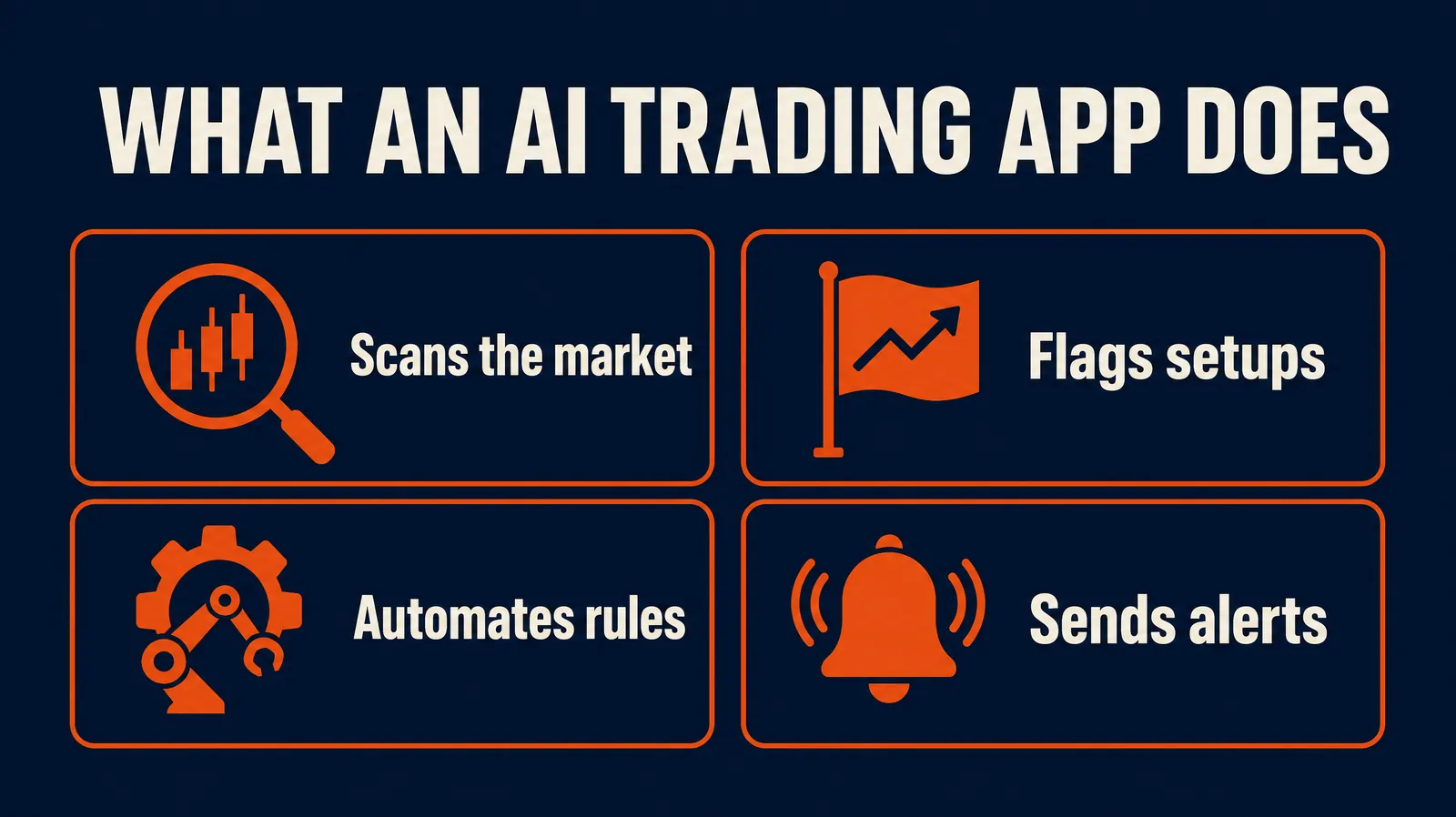
An AI trading app pulls in market data, runs it through a model, and outputs something you act on: a signal, a scan result, a sentiment score, or in some cases, an executed trade. That’s the whole job description, stripped of the marketing gloss.[6]
Analytics Insight’s August 2026 breakdown groups the entire category into five real jobs.[10]
- Signal generation. The app tells you “buy” or “sell” based on a model.
- Sentiment analysis. It reads news, filings, and social chatter for tone.
- Market scanning. It filters thousands of tickers down to a short watchlist.
- Chart pattern recognition. It spots setups like breakouts or basing patterns faster than a human eye.
- Event tracking. It flags earnings, filings, or unusual options flow in real time.
Most 2026 platforms now bundle two or three of these into one account instead of selling a single-purpose tool.[10] Trade Ideas leans hardest into scanning and pattern detection. Prospero.ai leans into signal generation for a general audience.[4] Knowing which job you actually need is the first filter, before you look at price or reviews.
Decision rule: if you can’t name the specific job you want the app to do, you’re not ready to pick one yet. Write it down first.
Best AI Trading Apps Compared Side by Side for 2026
Here’s how five widely cited platforms stack up on what they’re built for, not on hype.
| App | Best For | Starting Price | Standout Feature | Source |
|---|---|---|---|---|
| Trade Ideas | Active scanning, day traders | Paid plans | Rated top AI stock trading bot in independent testing | [2] |
| Prospero.ai | Beginners wanting free signals | Free, iOS and Android | 100M+ data points, 10,000+ models | [4] |
| ChartingLens | All-in-one suite users | $14.99/month | Buy signals plus plain-English backtester | [9] |
| Interactive Brokers | Multi-asset AI integration | Standard IBKR fees | Most developed AI connection for retail accounts | [2] |
| moomoo | Beginners, paper trading first | Free to open | Mobile research plus simulated trading | [2][5] |
None of these apps is objectively “the best.” They’re built for different jobs and different budgets. For a deeper side-by-side, see the best AI trading tools of 2026 put head to head.
The 10 Best AI Trading Apps in 2026, Ranked by the Job They Do
We sorted every pick by the one job it does best. Prices and ratings were checked on September 30, 2026 from each company’s pricing page, the App Store and Trustpilot. The best AI trading app on this list is the one that matches your job, your budget and your broker.
Composer by SoFi
Best for no code strategy automationWhy it made the list: 2,000+ community strategies you can copy, backtest and automate, now inside SoFi (June 2026).
Price: Starter free, Advanced $10/mo, Pro $40/mo ($32 billed yearly)
User rating: App Store 4.4 (687 ratings)
Watch out: Price the plan before you fund the account. One App Store reviewer only found the $32/mo plan after depositing $50.

Trade Ideas
Best for active day trading scansWhy it made the list: Holly AI runs overnight simulations and serves setups at the open. Brokerage Plus routes to IBKR, E*TRADE, Alpaca and TradeStation.
Price: From $89/mo billed yearly; Holly AI on Premium ($189/mo)
User rating: Trustpilot 3.7 (48 reviews)
Watch out: A Trustpilot user wrote: “I don't see the 60% success they tout.” Treat Holly as a scanner, not a promise.

TrendSpider
Best for automated chart analysisWhy it made the list: Automated trendlines, pattern recognition and no code strategy testing in one charting app.
Price: About $50/mo billed yearly
User rating: Trustpilot 4.8 (892 reviews)
Watch out: Watch the renewal date. Yearly billing is where the savings live, and where the surprise charges show up.

Robinhood
Best for bringing your own AI agentWhy it made the list: Agentic Trading launched May 27, 2026. 150,000+ accounts have connected an agent, per Robinhood.
Price: Free app; Gold $5/mo; Agent Apps $5 to $30
User rating: Trustpilot 3.9 (13,705 reviews)
Watch out: Start your agent in read only mode. Let it watch a week before it touches an order.

Public.com
Best for AI research built into a brokerWhy it made the list: Public Agents (March 31, 2026) answer portfolio questions and can act on instructions you approve.
Price: Free to open; premium tiers available
User rating: App Store reviews flag fee confusion
Watch out: Read the fee schedule line by line. One reviewer counted a buying fee, a selling fee and an inactivity fee.

Prospero.ai
Best free AI signals for beginnersWhy it made the list: Plain English signal scores built from 100M+ data points and 10,000+ models, per B2BNN.
Price: Free
User rating: App Store 4.4 (57 ratings)
Watch out: Coverage has gaps. Check that your tickers are in the app before you build a routine around it.

StockHero
Best for plug and play botsWhy it made the list: Marketplace bots you can rent, paper trade, then send live to a connected broker.
Price: Lite $49.99, Premium $99.99, Pro $159.99 a month; 14 day trial
User rating: Trustpilot 4.6 (19 reviews)
Watch out: One reviewer warned that bot fees add up without the annual plan. Do the math on your account size first.

Surmount
Best cheap entry to automated strategiesWhy it made the list: Prebuilt automated strategies that run inside E*TRADE, Alpaca or TradeStation accounts.
Price: Free, Core $5, Plus $10, Pro $30 a month
User rating: Newer, small review base
Watch out: Low price is not low risk. Paper trade any strategy for a full month first.
Option Alpha
Best for automated options tradingWhy it made the list: No code options bots with free access through TradeStation ($10k) or Tradier and tastytrade ($5k).
Price: $99/mo billed yearly or $149 monthly; free tier via partner brokers
User rating: Trustpilot 3.5 (11 reviews)
Watch out: A reviewer noted that test, paper and live results can differ a lot. Size small when you go live.

Interactive Brokers
Best for serious multi asset AI tradingWhy it made the list: IBKR MCP (July 28, 2026) lets AI assistants place orders you review one by one, across 170+ markets.
Price: Standard IBKR commissions
User rating: Trustpilot 3.1 (5,506 reviews)
Watch out: The Trader Workstation learning curve is real. Start with IBKR Mobile and the MCP connector.
Quick Pick: The Best AI Trading App by Goal
| If you want to… | The best AI trading app for you | Starting cost |
|---|---|---|
| Learn with zero spend | Prospero.ai | Free |
| Automate a strategy without code | Composer by SoFi | Free to $40/mo |
| Scan for day trades at the open | Trade Ideas | $89/mo yearly |
| Let charts analyze themselves | TrendSpider | About $50/mo |
| Plug your own AI agent into a broker | Robinhood or Interactive Brokers | Free app |
| Rent a ready made bot | StockHero | $49.99/mo |
| Automate options | Option Alpha | Free via partner brokers |
Still torn? Paper trade your top two for 30 days and keep the one you still open on day 30.
How Much Does It Cost to Use an AI Trading App
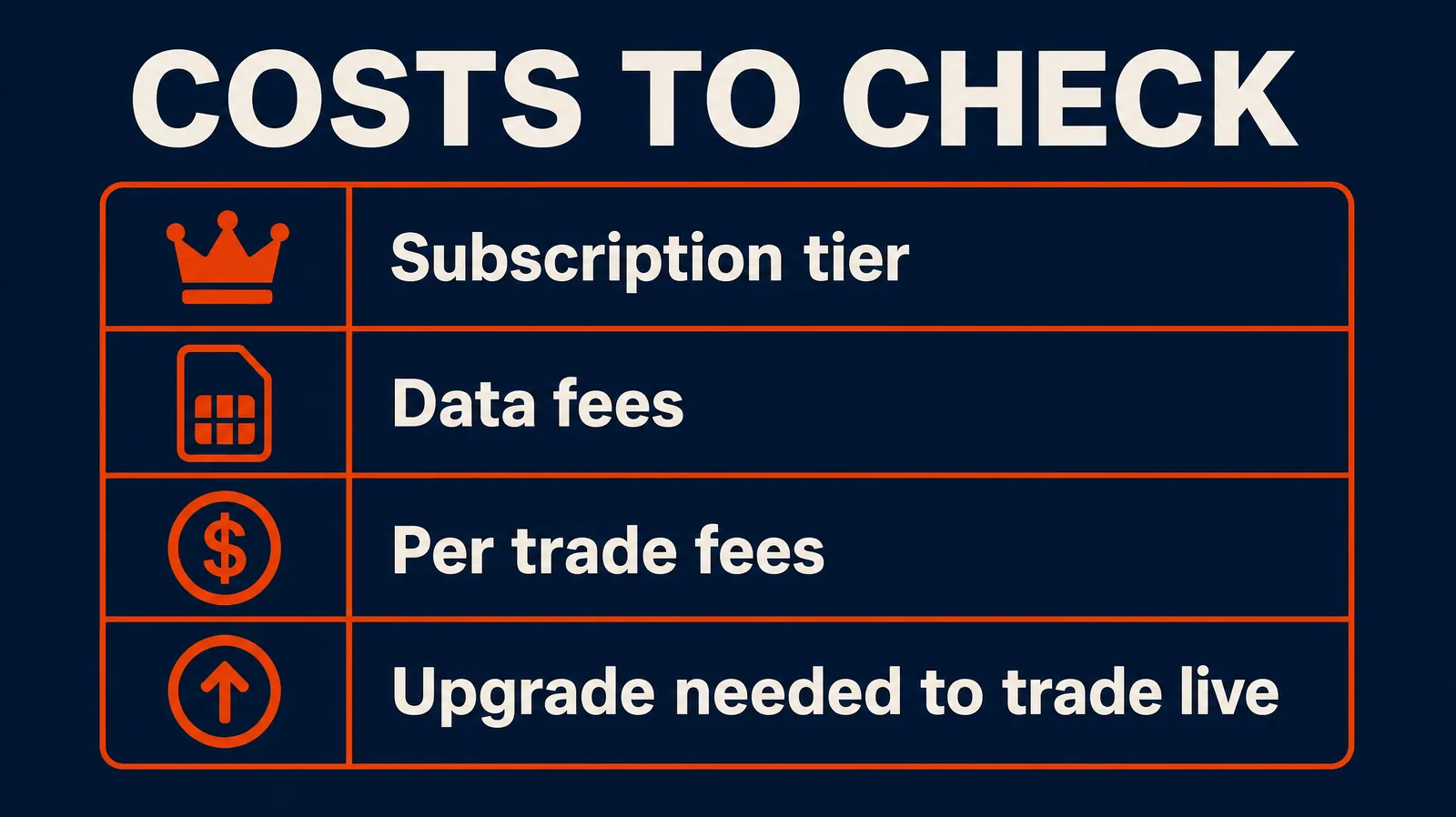
Costs range from free to roughly $200 a month, and price rarely correlates with quality the way you’d hope. ChartingLens starts at $14.99 a month for its full suite, while Prospero.ai’s core app is free.[4][9]
Which AI Trading App Has the Lowest Fees
Free tiers from Prospero.ai and moomoo cost nothing to start, and Interactive Brokers charges standard brokerage commissions rather than a separate AI subscription fee.[2][4][5] The catch: free tools often gate the good stuff (deeper scans, more signals, faster refresh rates) behind a paid tier once you’re hooked.
Before you subscribe to anything, run the math on what a monthly fee costs against a small account. A $50 monthly fee on a $2,000 account is 2.5% a month before you’ve made a single trade. That’s not a rounding error, that’s a hurdle.
Can You Really Make Money With an AI Trading App
You can make money using an AI trading app. You can also lose money using one. The app doesn’t change that math, it just changes how fast decisions get made.
No credible source claims these tools guarantee profit, and any that do are the ones to avoid.[3] What the better platforms actually deliver is faster research and cleaner setups, not a crystal ball. Signal over noise beats prediction over discipline every time, and that’s true whether a human or a model is generating the signal.
For a numbers-first look at this exact question, see whether AI trading bots actually make money based on real results.
Edge case: an app can have a strong model and you can still lose money if your position sizing is reckless or you ignore your own stop loss. The tool doesn’t fix bad risk management. You do.
AI Trading App Not Working: Why Is It Losing Money
Most “the app is broken” complaints trace back to three things: chasing signals after they’ve already moved, ignoring a stop loss, or running the tool in conditions it wasn’t built for.
- Overextended entries. Buying a signal after the stock already ripped 8% means you’re often the exit liquidity, not the early buyer.
- No stop loss discipline. A great signal with no exit plan is just a coin flip with extra confidence.
- Choppy tape. Pattern-recognition tools struggle in low-volume, sideways markets where there’s no real trend to catch.
- Data lag. A scan result that arrives four minutes late isn’t a signal anymore. It’s a history lesson.
Common mistake: blaming the model for a loss that was actually a position-sizing problem. Check your own rules before you blame the algorithm.
AI Trading Apps for Beginners vs Experienced Traders
Beginners need apps that teach while they trade. Experienced traders need speed and depth. Confusing the two is how people either get overwhelmed or get bored and unsubscribe.
Barebone AI’s June 2026 guide points beginners toward apps like moomoo that emphasize paper trading (simulated trades with fake money) and mobile-friendly research over live execution.[5] That’s the right instinct. Paper trade it first, always, no exceptions.
Experienced traders lean toward tools like Trade Ideas or TrendSpider, which assume you already know what a breakout or a tight consolidation looks like and just want the scan to find it faster.[2][7] If you’re newer to the game, start with the AI day trading platforms beginners are actually using in 2026 before touching anything built for a professional desk.
How to Pick the Best AI Trading App Without Getting Scammed
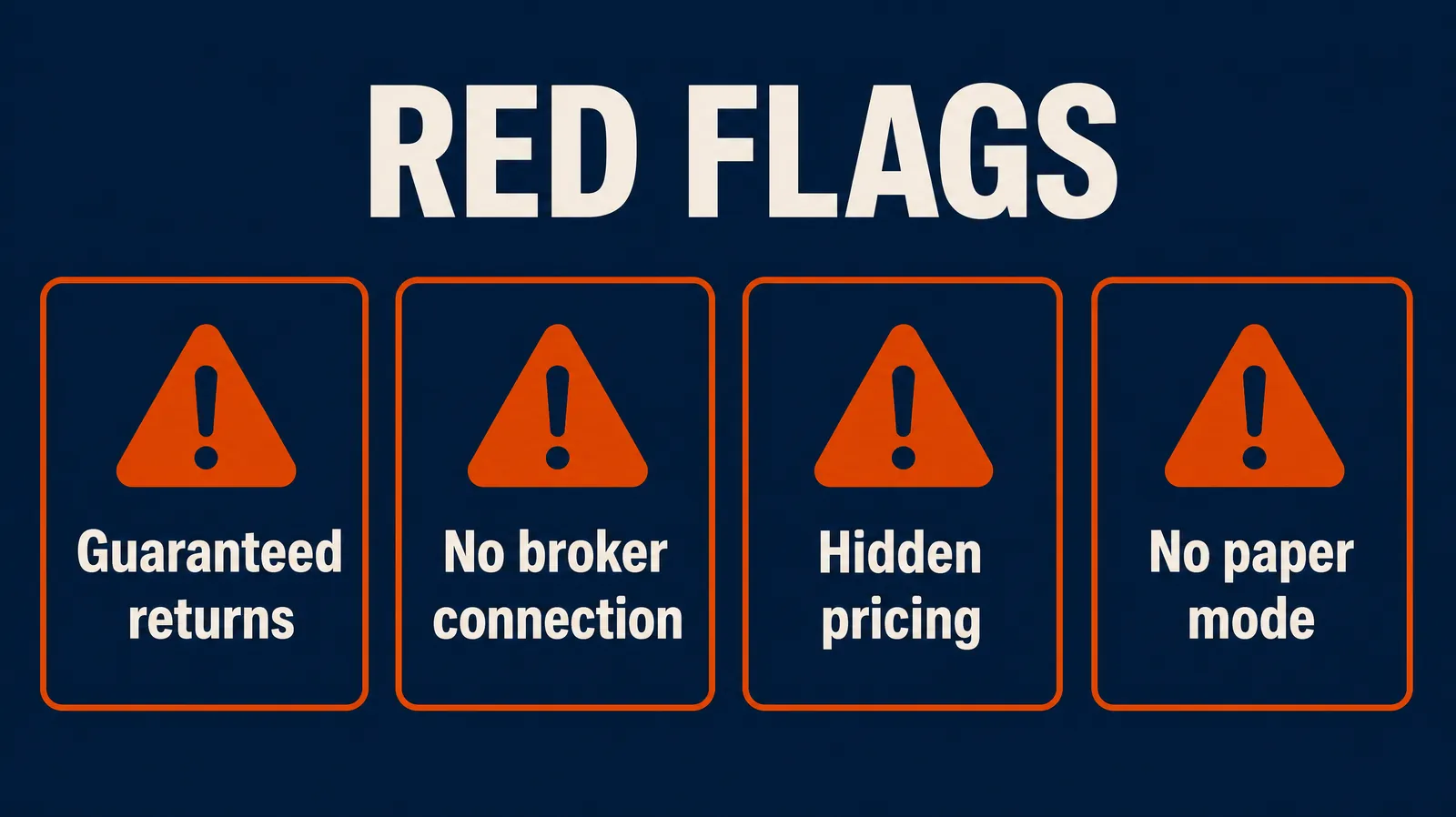
Avoid scam AI trading apps by checking three things before you fund an account: where your money actually goes, whether the strategy is disclosed, and whether independent reviews exist outside the app’s own marketing.
Hyscaler’s July 2026 guide lays out the clearest red flags in the category.[3]
- “Guaranteed” or “100% certain” profit language. No legitimate trading tool can promise this. Full stop.
- Deposits go to the bot’s own website, not a regulated broker or exchange. That’s almost always a fraud structure.
- Opaque ownership with no clear company, no registration, no way to verify who’s running it.
- Aggressive social media pressure to deposit fast, often paired with countdown timers or fake urgency.
For the full checklist, see our AI Trading Bot Scams guide.
Is Your Data Safe With AI Trading Apps
Data safety depends on whether the app connects to your brokerage through an official API (a secure, documented connection) or asks for your login credentials directly. Reputable platforms like Interactive Brokers and Robinhood’s Agentic Trading framework use permissioned connections rather than raw credential sharing.[2] If an app asks for your brokerage password outside of an official OAuth login screen, that’s a hard stop.
Before downloading anything, run it through what to check before you download an AI trading app, and cross-reference it against which AI trading bots are legit versus scams.
Do AI Trading Apps Work in a Bear Market
AI trading apps don’t stop working in a bear market, but pattern-recognition and momentum-based signals tend to get noisier when the broader trend flips down. A model trained heavily on breakout patterns in a rising market can misfire when everything is a bull trap or a dead cat bounce.
Sentiment-analysis tools sometimes hold up better in down markets because they’re reading tone and news flow rather than assuming price keeps climbing. Match the tool to the tape you’re actually trading in, not the tape you wish you had.
AI Trading App vs Hiring a Human Financial Advisor
An AI trading app is a tool for active decision-making. A human financial advisor is a relationship for long-term planning, tax strategy, and accountability. They’re not really competing for the same job.
A sensible order of operations is to start with lower-risk AI uses, like sentiment tools or execution-optimization APIs, before handing full portfolio control to any system, human or algorithmic. A human advisor can also talk you out of a bad decision at 11 p.m. An app just executes what you tell it to.
Choose an AI app if you’re self-directed and want faster research. Choose an advisor if you want ongoing planning across your full financial picture, not just trades.
Common Mistakes People Make With AI Trading Apps
The same five mistakes show up across nearly every AI trading app complaint thread.
- Treating a signal as a guarantee instead of one input among several.
- Overtrading because the app generates more ideas than any human can responsibly act on in a day.
- Skipping the paper trading phase entirely and going live with real money on day one.
- Revenge trading after a loss, chasing the next signal to “get it back.”
- Ignoring fees relative to account size, especially on small accounts under $10,000.
AI Trading Apps That Work Without a Minimum Deposit
Several platforms, including Prospero.ai’s free app and moomoo’s account structure, don’t require a large minimum to start exploring the tool.[4][5] That said, “no minimum to open” isn’t the same as “no minimum to trade well.” Position sizing math gets harder, not easier, on a smaller account.
How Long Does It Take to See Results From an AI Trading App
There’s no fixed timeline, and any app promising fast results is leaning into the exact hype language this category should avoid. A realistic approach: paper trade for at least two to four weeks, tracking win rate and risk-reward on every simulated trade, before risking real capital.
Backtesting (running a strategy against historical data before using it live) is the other piece most beginners skip. Learn to backtest a trading strategy without fooling yourself before trusting any AI-generated setup with real money. And once you’re live, these five settings to check before your first trade matter more than people expect.
Practical takeaway: Pick one job (signals, scanning, sentiment, or execution). Pick one app that does that job well. Paper trade it for at least two weeks. Then, and only then, decide if it earns real money.
Our Take
The best AI trading app isn’t a single winner sitting on a leaderboard. It’s whichever tool matches the exact job you need done, at a price your account size can actually support, connected to a broker you can verify. Trade Ideas earns its reputation for scanning speed. Prospero.ai earns its reputation for accessible, free signals. Interactive Brokers earns its reputation for AI integration depth across asset classes.[2][4] None of them earns a guarantee, because none of them can.
Start narrow. Name the one job you need the app to do. Paper trade it for two to four weeks. Check the fee against your account size before you subscribe to anything. That’s the whole system, and it beats chasing the app with the loudest marketing every single time.
The FullStack Alpha directory catalogues 200+ AI stock tools by category and price, filterable by what you actually need.
Browse the FullStack Alpha directory of 200+ AI stock tools
This article contains affiliate links. FullStack Alpha may earn a commission if you sign up through certain links, at no added cost to you.
Keep Going
More from AI Stock Trading Bots: AI Trading Apps · AI Trading Bot Scams · Free AI Trading Bots.
Written and edited by Jay Rocco, Founder and Editor of FullStack Alpha. 200+ AI stock tools tested since 2022. Educational content only, not financial advice. See our Financial Disclaimer and How We Make Money.
Free weekly email
Join the FullStack Alpha newsletter
One email a week. The AI trading tools we tested, what broke, and what is worth your money. NO BS, no stock picks. Stay alpha.
Unsubscribe anytime. We never sell your email.
Stay alpha.
References
[2] WalletInvestor: Best AI Trading Platforms for Retail Investors
[3] Hyscaler: Top AI Trading Apps
[4] B2BNN: 7 Best AI Trading Apps in 2026
[5] Barebone AI: Best AI Trading Apps for Beginners
[6] TradeAlgo: AI Trading App Guide
[7] Barebone AI: Best AI Investing Apps
[9] ChartingLens: Best AI Trading Platforms 2026
[10] Analytics Insight: Best AI Trading Platforms of 2026, Ranked by What They Automate
Frequently Asked Questions
Is there one best AI trading app for everyone?
No. The best fit depends on your goal, whether that's scanning, signals, sentiment reading, or execution, plus your budget and experience level.
Do I need coding skills to use an AI trading app?
No. Most retail-facing apps like Prospero.ai, moomoo, and ChartingLens are built for no-code use with a mobile or web dashboard.
Can an AI trading app replace a broker?
No. Most AI trading apps connect to a regulated broker through an API rather than replacing one. Interactive Brokers and Robinhood both support this kind of connection.
Are free AI trading apps worth using?
Free tiers, like Prospero.ai's app, can be a legitimate starting point, especially for beginners who want to learn before paying anything.
What's the biggest red flag in an AI trading app?
Any promise of guaranteed profit, or a request to deposit funds directly into the app's own website instead of a regulated broker or exchange.
Does an AI trading app beat trading manually?
Not automatically. These tools speed up research and pattern spotting, but they don't remove market risk or replace basic risk management. This is education, not personalized financial advice.
Jay Rocco is the Founder and Editor of FullStack Alpha. He has tested 200+ AI stock tools since 2022 and run 15+ AI trading platforms on live accounts with his own money. He reviews the software. He does not tell you what stocks to buy.
