

The FullStack Alpha research desk tests AI trading bots on paper and live accounts. Reviewed and edited by Jay Rocco, Founder and Editor.
By FullStack Alpha Editorial Team | Reviewed by Jay Rocco, Chief Editor
AI day trading works best as a research and filtering layer, not as a trigger finger. Software is genuinely good at scanning thousands of tickers, summarizing news, flagging unusual volume, doing your position-size math, and keeping an honest trade journal. It’s weak at the things intraday trading actually rewards: sub-second reaction, reliable real-time data, and a proven edge after commissions, spread, slippage, and subscription costs. Before you fund anything, run one test: paper trade the exact system for 30 sessions and log every fill against the price the signal fired at.
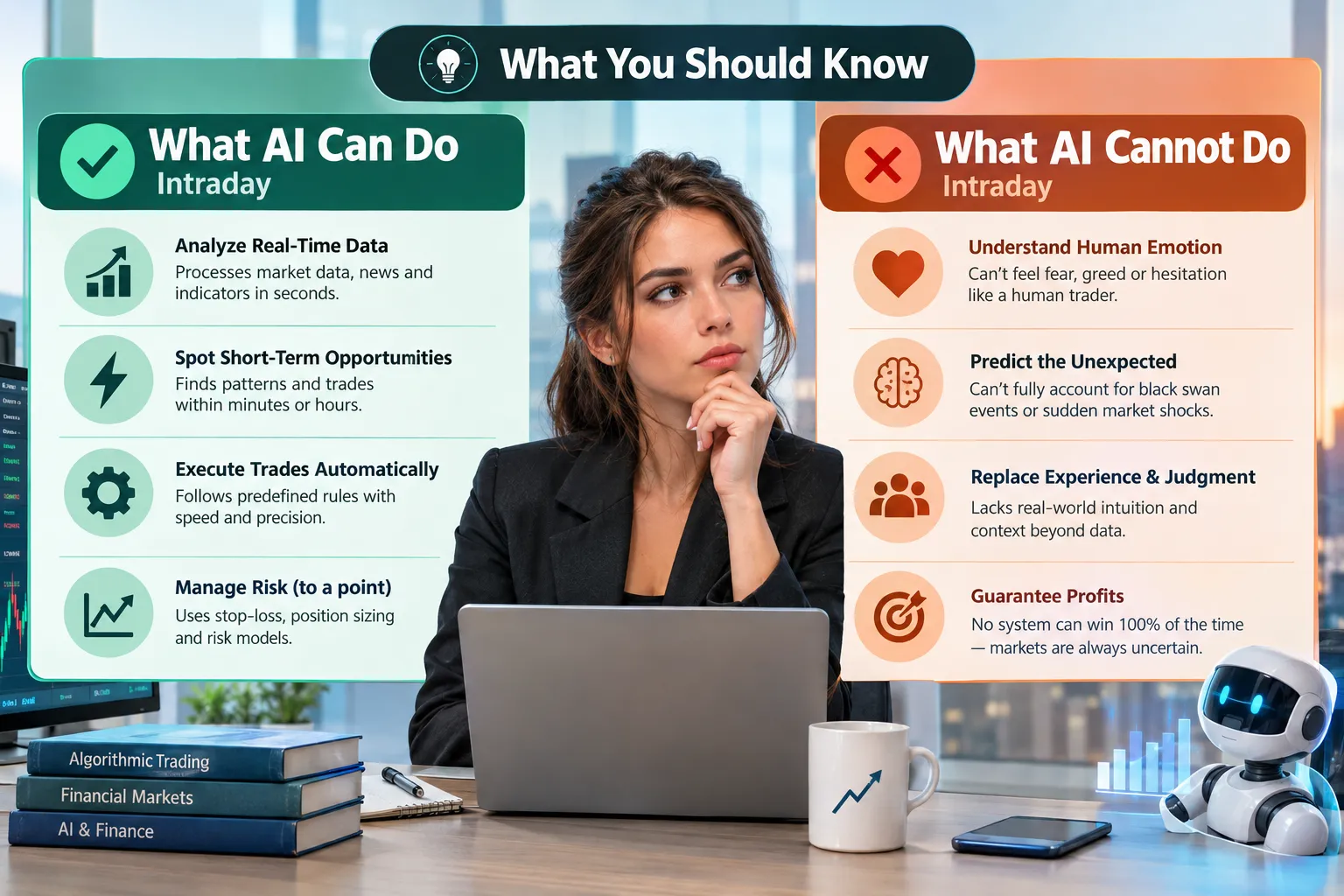
What You Should Know
- Interactive Brokers turned on autonomous AI trading on October 21, 2026. Eligible clients connect an AI platform, give instructions in plain English, and let it submit supported orders across more than 75,000 listed stocks, options, and ETFs in a walled-off “AI Partition.”
- IBKR’s own guardrails are tight. Per its Traders’ Toolbox post, clients can generally allocate up to 10% of account equity, with a $1,000 minimum and a $25,000 aggregate cap, and must first complete at least 10 trades of $100 or more over two weeks in “Review & Approve” mode.
- The SEC’s 2026 examination priorities name automated investment tools, AI technologies, and trading algorithms directly. Examiners are checking whether firms accurately describe what their AI can do.
- On September 29, 2026, the SEC charged Cryptoaiml Ltd. and TSAI Pro Ltd. over alleged AI trading bot fraud, citing claims like 98% accuracy, roughly 300 and 1,715 investors respectively, and more than $15 million in combined alleged losses.
- Australia’s ASIC announced amended Market Integrity Rules for AI and algorithmic trading on September 24, 2026, covering pre-use testing, written governance, kill-switch controls and multi-year record keeping, with compliance required from 2028. Check ASIC’s own release for the current wording and dates.
What Is AI Day Trading?
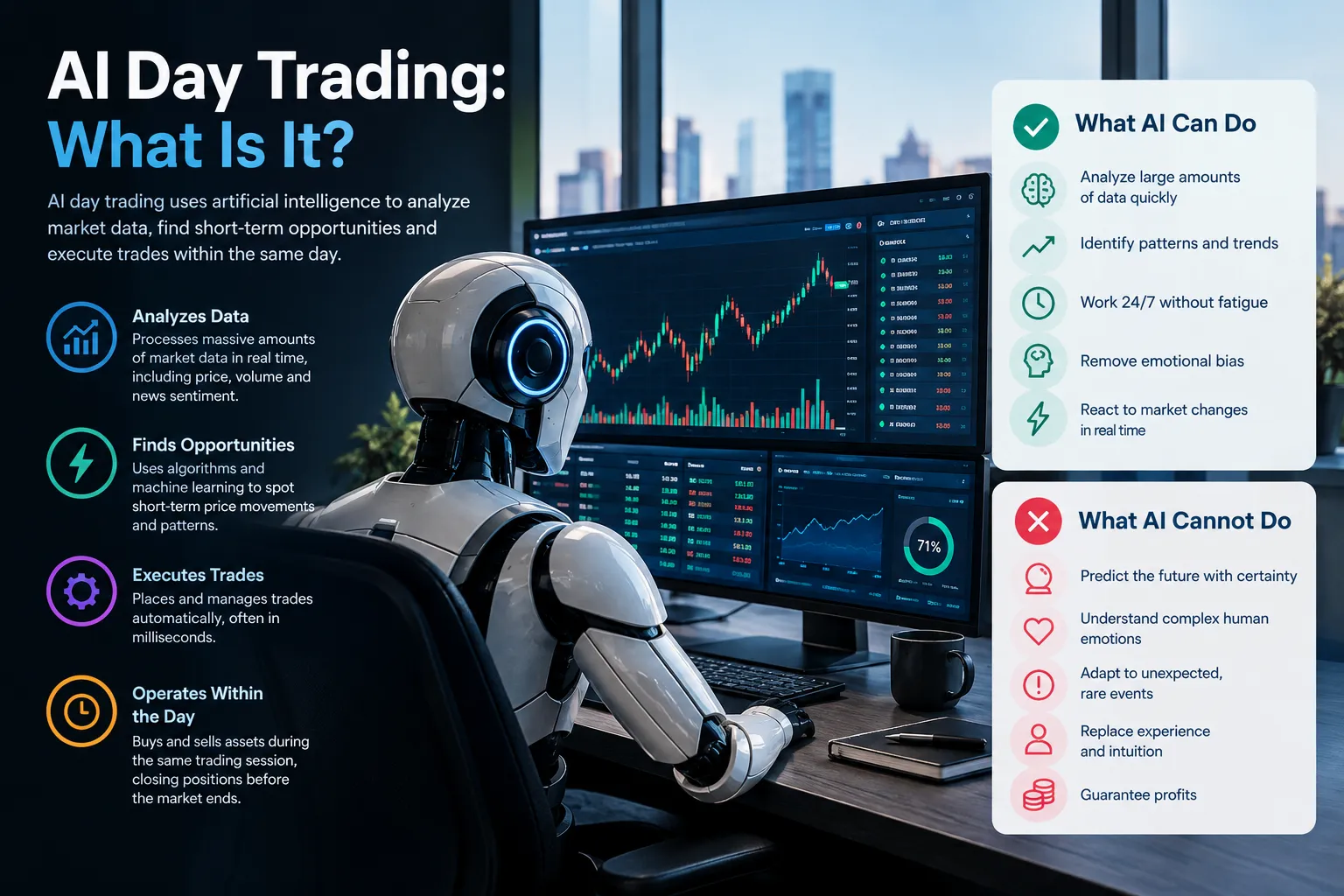
AI day trading is using machine-learning software to help find, evaluate, or execute trades that open and close within the same session. It covers four different animals that marketing copy loves to blur together.
1. The ai stock scanner. This is a filter. You tell it what you want (relative volume above 5, price between $2 and $20, gapping up more than 4%) and it returns a list. The “AI” part, when it’s real, ranks the list by something learned from historical data instead of just sorting alphabetically. Scanners are the most useful and least glamorous category. Most of what retail traders call AI is a well-built scanner with a nicer logo.
2. Ai trading signals. A service that says buy here, stop here. Some are model-generated, some are a guy in a Discord with an API. Signals don’t execute. They hand you a decision and walk away.
3. The rules bot. Pre-coded logic that runs unattended. If price breaks the opening range high on above-average volume, buy; if it drops below the low of the breakout bar, sell. There’s often no machine learning at all in these. That’s not a knock, it’s just accuracy.
4. The language-model agent. The newest one, and the reason you’re reading this. You describe a strategy in plain English and the system interprets it, watches the tape, and submits orders. IBKR’s October 2026 launch is the first mainstream retail version of this from a major broker.
Here’s the part that matters for your expectations. Categories 1 through 3 are deterministic: same input, same output, every time. Category 4 is not. Buy-side traders at the Fixed Income Leaders Summit in October 2026 made exactly this point, that generative models produce stochastic outputs, which is why governance and human judgment stay in the loop. Their framing was blunt: AI is a tool, automation is the objective. Two different things.
Plain-English glossary, since half the industry refuses to define its terms:
- Latency is the delay between something happening in the market and your system reacting to it.
- Slippage is the gap between the price you expected and the price you actually got filled at.
- Price action is what the chart is doing right now, as opposed to what an indicator says about what it did.
- The setup is the specific, repeatable pattern you’re willing to risk money on.
If a tool’s sales page can’t define its own terms, that tells you something about the product. For a broader map of what’s out there, our breakdown of AI day trading tools sorts the categories before you spend anything.
What Can AI Do Intraday?
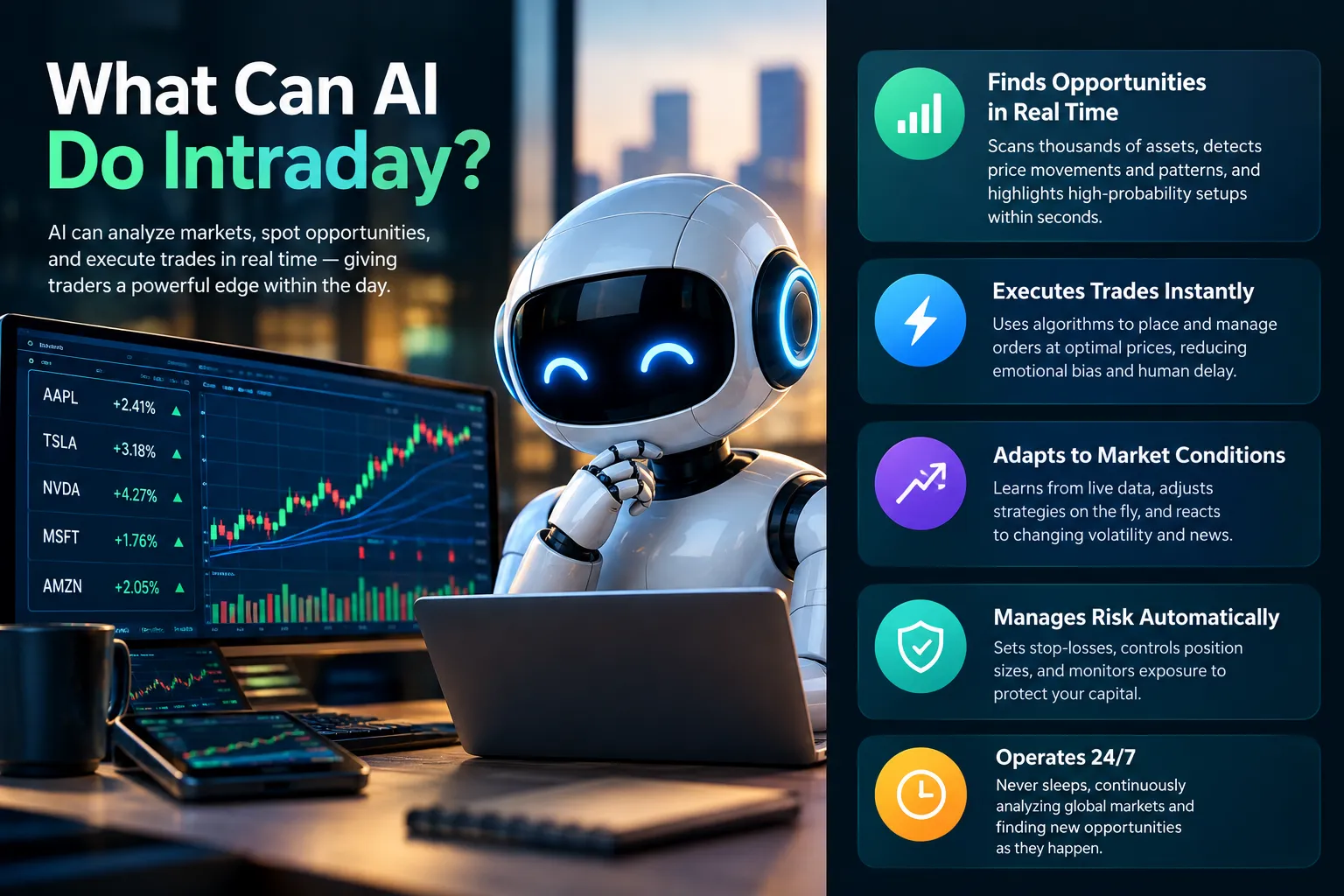
AI genuinely outperforms a human at breadth, consistency, and arithmetic. It scans more symbols than you can watch, never gets bored at 11:40 a.m., never skips the journal entry, and never fat-fingers position size math. Those are real advantages and they’re worth paying for.
| Task | Works well | Needs a human | Main risk |
|---|---|---|---|
| Scanning the universe | Filtering 8,000+ tickers against volume, float, and gap criteria in seconds | Deciding which of the 40 hits is actually a clean setup | Over-filtering until you only see yesterday’s winners |
| Ai trading signals | Flagging when conditions you defined are met | Judging the tape, the spread, and whether you want that risk today | Signals fire in choppy tape, you take all of them |
| News summaries | Compressing an 8-K or a press release into three lines, fast | Deciding whether the market already priced it | Models hallucinate details from headlines |
| Trade journaling | Auto-logging entry, exit, size, R-multiple, time of day | Writing the honest sentence about why you broke your rule | A pretty dashboard that no one reads |
| Position size math | Calculating share count from account risk and stop distance, instantly | Choosing the risk percentage in the first place | Garbage in, garbage out on account value or stop |
| Pattern recognition on charts | Spotting tight consolidation, basing, or a gap fill candidate across many names | Confirming support and resistance in context | Pattern matched, context missed |
Where the scanner earns its keep
The honest use case for an ai stock scanner is time compression. A trader manually flipping charts covers maybe 150 symbols before the open. A scanner covers the whole market and hands you 25. You still do the work on those 25. You just skipped two hours of flipping.
Decision rule: if a tool saves you time on inputs, it’s probably worth it. If it promises to replace your judgment on outputs, be suspicious.
Where journaling quietly beats everything else
This is the least sexy item in the table and the one with the clearest payoff. Most traders can’t tell you their win rate by time of day, by setup, or by position size. An AI that tags and summarizes 200 trades will show you that you lose money every single Friday afternoon, or that your third trade of the day is where the account bleeds. That’s revenge trading and overtrading showing up in your own data, with a timestamp.
A quick example
A trader runs a scanner for stocks gapping up more than 4% on five times average volume with a float under 50 million. Twelve names hit at 9:25 a.m. The AI ranks them and summarizes the catalyst for each in one line. By 9:31, the trader has two names on the watchlist and a plan for each, including entry, stop loss, and target. The AI did zero predicting. It did an hour of filing in six minutes. That’s the actual win.
What Can AI Not Do Intraday?
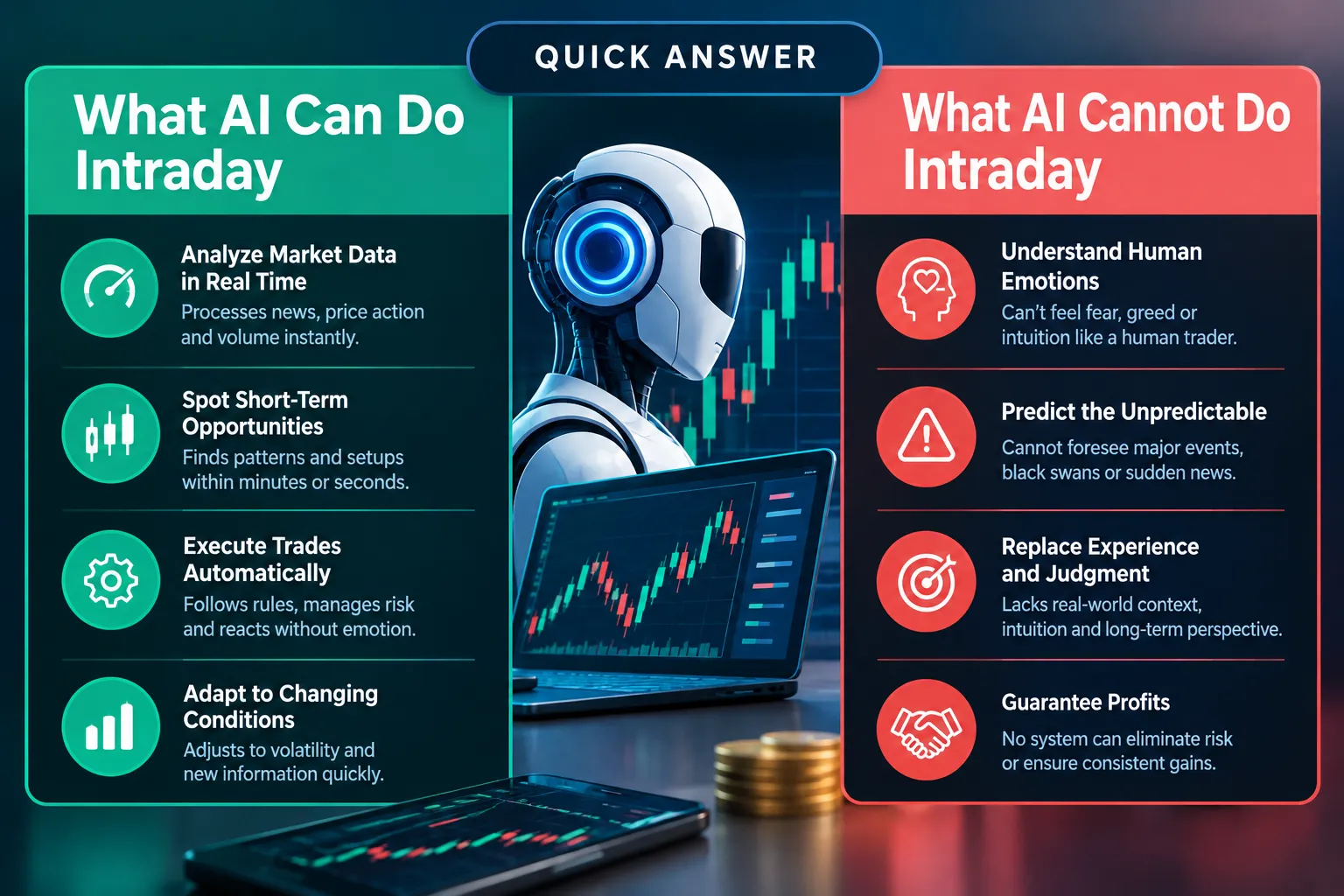
AI cannot react at intraday speed, cannot reliably read a chart it wasn’t given clean data for, cannot invent an edge that survives costs, and cannot promise you anything about tomorrow. Each failure has a different cause and a different fix.
1. Model latency: it thinks too slowly for a fast tape
A language-model agent takes time to produce a response. Depending on the model and the prompt, that’s typically a few hundred milliseconds to several seconds. Professional market-making systems are operating in microseconds.
Example: a low float name pops 3% in four seconds on a halt resume. By the time an LLM has read the prompt, checked the data, and formed an order, the move is done and you’re buying from the people who caught it. The AI isn’t wrong. It’s late.
Fix: use AI for pre-market prep and setup review, not for chasing fills on fast movers. If your strategy depends on being first, a chat-based model is the wrong tool entirely.
2. Invented price levels
Ask a general-purpose model where support is on a ticker and it will often give you a number with total confidence. Sometimes that number came from the chart data you supplied. Sometimes it came from the model’s training data, which is months or years old. Sometimes it came from nowhere at all.
Example: a model states a stock has “strong support at $41.20.” The stock hasn’t traded below $58 in six months. The level is fiction dressed as analysis.
Fix: never accept a level you can’t see on your own chart. If an AI gives you support and resistance, treat it as a hypothesis to verify, not an answer. The UK FCA made essentially this point on October 19, 2026, calling on AI providers to give clear, proportionate warnings about the limitations of AI-generated financial information, and reminding firms they remain responsible for outcomes their AI produces.
3. No proof of edge
This is the big one. A September 2026 review by EBC Financial Group concluded that AI has clearly improved research speed, information processing, and automation, but the evidence stays mixed on the output that actually pays: risk-adjusted returns after costs. Faster analysis and a tradable edge are not the same product.
And the floor of this market is ugly. The SEC’s September 29, 2026 actions against Cryptoaiml Ltd. and TSAI Pro Ltd. alleged schemes marketed with claims like 98% accuracy, reaching roughly 300 and 1,715 investors, with more than $15 million in combined alleged losses. Play stupid games.
Fix: demand a live, dated, out-of-sample record. A backtest is a sales document. Our guide to which AI trading bots are legit versus scams walks the specific red flags.
4. Delayed data
Plenty of AI tools run on free or delayed feeds. A 15-minute delay on an intraday strategy is not a strategy, it’s archaeology.
Example: a scanner on delayed data flags a breakout at 10:15 that actually broke out at 10:00 and has already faded 2%. You’re buying an overextended chart and calling it a signal.
Fix: confirm the data source and the latency in writing before paying. If the page won’t say, check the official page or assume delayed.
5. Gaps and flash crashes
Can AI handle gaps and flash crashes? Mostly no, and for a structural reason: a stop loss is an instruction, not a guarantee. In a gap down, the next printed price can be far below your stop, and your order fills there. No model prevents that. Models trained on normal conditions tend to behave worst exactly when conditions stop being normal, because the pattern they learned isn’t on the screen anymore.
This is why ASIC’s September 2026 rule update sets out kill-switch expectations for suspending a specific algorithm, plus testing before first use and after material changes. Regulators aren’t worried about the AI being slightly wrong. They’re worried about it being confidently wrong at scale.
Edge case worth naming: halts. If a stock halts while your bot holds a position, the bot is sitting on a frozen instrument with no exit. Ask any automated system how it handles halt-and-resume before you let it run unattended.
A stop loss is a plan, not a promise. AI doesn’t change the plumbing of how orders fill.
6. It cannot want things for you
Discipline beats prediction. An AI can tell you that you’ve taken six trades today when your rule says three. It cannot make you stop. That gap is still yours to close.
What Did the Creator Day Trading Bots Claim?
Creator demonstrations of AI trading bots, including a widely shared Gary Ross video on day trading bots, should be treated as claims rather than verified results. Watch them for the workflow, not for the outcome.
The standard structure of these videos is consistent enough to map:
| The claim | What’s typically shown on screen | What usually gets skipped |
|---|---|---|
| ”This ai day trading bot makes money while I sleep” | A platform dashboard, a few green trades, an upward curve | Date range, number of trades, losing periods |
| ”I built it in an afternoon with no code” | Screen recording of prompting an AI, a connected broker key | Whether it ran live with real money or on simulated fills |
| ”It beats manual trading” | Side-by-side of two equity lines | Commissions, spread, slippage, data and model subscription costs |
| ”Here’s my win rate” | A number on a card | Average win versus average loss, which decides profitability |
| ”Anyone can do this” | A simple setup walkthrough | Account size, drawdown, and what happened in the next month |
Three questions to ask of any creator demo, including the Gary Ross one:
- Is the account real and funded, and is there a dated broker statement, not a platform screenshot?
- How many trades over how many sessions? Twenty trades proves nothing.
- Are results net of all costs, including the API bill for the model itself?
A win rate without an average win-to-loss ratio is a vanity metric. A 70% win rate with a 1:3 risk-reward loses money. A 35% win rate with 1:4 makes money. If the video shows one and not the other, that’s a choice, and it’s rarely an accident.
Also watch who’s paying. Many bot demos carry a broker or platform referral link. That doesn’t make the content wrong. It does mean the incentive is to show the setup working, and the SEC’s 2026 exam priorities include checking whether firms accurately represent AI capabilities. Regulators are watching the same gap you should be.
Practical takeaway: use creator videos as free tutorials on the mechanics. Take the performance claims and throw them in the bin until someone shows you a dated statement.
How Do Costs and Latency Eat an Intraday Edge?
Intraday costs compound against you on every single trade, and they’re the most underestimated line in retail trading. A strategy that looks profitable in a backtest usually dies on the spread and the slippage.
Here’s a worked example. All numbers below are illustrative examples, not quotes from any specific broker or vendor. Check current pricing on the official page of whatever you use.
Example setup: $10,000 account. 6 round-trip trades per day. 20 trading days a month. Average position $3,000.
| Cost line | Example assumption | Monthly example cost |
|---|---|---|
| Commissions | $1 per side, 2 sides, 6 trades/day | $240 |
| Spread paid | 0.05% of $3,000 per round trip | $180 |
| Slippage | 0.08% of $3,000 per round trip | $288 |
| Market data feed | Real-time Level 2 subscription | $30 |
| Scanner or platform | Mid-tier charting and scanning | $60 |
| Model API usage | Agent calls during market hours | $40 |
| Example total | $838/month |
On a $10,000 account, that example total is roughly 8.4% of equity per month in friction. The strategy has to clear 8.4% before you earn a dollar. That’s before a single losing trade.
The three takeaways from that table:
- Slippage and spread, not commissions, are the biggest line. Commission-free doesn’t mean cost-free. Our piece on paper trading slippage explains why simulators flatter your results on exactly this line.
- Trade frequency multiplies everything. Cut from 6 trades a day to 2, and the variable costs drop by roughly two-thirds. Fewer, cleaner setups beats more signals.
- Smaller accounts carry proportionally heavier fixed costs. That $130 of monthly subscriptions is 1.3% of a $10,000 account and 0.13% of a $100,000 account. Same tool, ten times the drag.
Latency works the same way, just invisibly. If your system is consistently 1.5 seconds behind the print on a fast mover, you’re systematically buying a worse price than the one your signal referenced. Over 120 trades a month that’s not bad luck, it’s a tax. For a reality check on what the subscriptions actually buy, see what you pay for versus what you get in AI trading software.
How much does an AI day trading bot cost?
Retail pricing spans from free tiers to several hundred dollars a month, and the number on the pricing page is rarely the number you pay. Add real-time data fees, model API usage if you’re running an agent, and the broker’s own costs. Do not trust any price you read in an article, including this one. Check the vendor’s official pricing page the day you buy. A fuller cost map lives in our rundown of how much a trading bot costs.
Is it worth buying a premade AI bot or building one?
Buy if you want to find out quickly whether automated intraday trading suits you at all, and you’d rather pay a subscription than spend eight weekends debugging. Build if you already have a tested, written strategy and the main thing you need is faithful execution of rules you can defend.
Decision rule: buy to learn, build to scale. The common failure is building before you have a strategy worth automating. Automating a bad setup just lets you lose money with better uptime.
How Do Pattern Day Trader Rules Affect an AI Day Trading Bot?
FINRA’s pattern day trader rule applies to the account, not to the software. A bot trading your margin account is counted exactly the same as you clicking the mouse. Rule status changes, so verify the current requirement directly on finra.org before you build around it, check the official page rather than relying on any article’s summary, including this one.
What the rule has historically done, in plain English:
- A pattern day trader is an account flagged for executing four or more day trades within five business days in a margin account, where those day trades are more than 6% of total trades in that window.
- A flagged account has been required to maintain a minimum equity level in the margin account on any day it day trades.
- Fall below the minimum, and the account faces restrictions until equity is restored.
Three things traders get wrong here:
- The bot doesn’t get its own exemption. Automated orders count toward day-trade totals. There’s no “it wasn’t me” clause.
- Cash accounts avoid the PDT designation but face settlement timing. You can’t infinitely recycle unsettled funds. That hard-caps how many round trips an intraday bot can do in a cash account.
- The rule applies to US margin accounts at FINRA member firms. Non-US brokers and non-US residents operate under different frameworks.
Worth noting on broker-level limits, which are separate from any FINRA rule: Interactive Brokers’ own autonomous AI rollout, launched October 21, 2026, caps allocation at generally 10% of account equity with a $1,000 minimum and a $25,000 aggregate maximum, and requires at least 10 trades of $100 or more over two weeks in “Review & Approve” mode before full autonomy is granted. Per IBKR’s Q3 2026 earnings materials, the rollout is limited and invitation-based, starting with clients who already used its human-in-the-loop AI Connector. That’s a broker treating autonomous execution as a graduated privilege.
Practical takeaway: confirm three numbers before you automate anything intraday. The current FINRA requirement on finra.org, your broker’s day-trade counting policy, and your broker’s specific limits on AI or API-driven orders. Then pick your platform. Our comparison of the best day trading platform options covers which brokers play nicely with automation.
Which AI Day Trading Apps and Scanners Are Worth a Look?
The categories below reflect what each product does, not a ranking. Pricing moves constantly and is not listed here on purpose. Check the official page for every tool before subscribing.
| Tool | Category | What it does | The catch |
|---|---|---|---|
| TradingView | Charting + scanning | Deep charting, custom screeners, Pine Script alerts, huge community library | Real-time data for US exchanges is a separate add-on cost. Not an ai day trading app on its own |
| Finviz Elite | Screener | Fast fundamental and technical screening, intraday charts on the paid tier | The free tier runs on delayed data, which rules it out for intraday triggers |
| TrendSpider | Automated technical analysis | Auto-drawn support and resistance, multi-timeframe scanning, backtesting | Learning curve is real. Powerful tools lose people in week one |
| Interactive Brokers AI Partition | Broker-native autonomous execution | Natural-language instructions across 75,000+ listed instruments, walled-off capital | Invitation-based and capped. Not open retail access as of its October 2026 launch |
| Option Alpha | Rules-based automation | Visual bot builder for options strategies, no coding required | Options-focused, not a general ai stock scanner |
Useful head-to-heads if you’re narrowing down: TrendSpider versus TradingView on AI charting and Finviz Elite versus the free tier.
Do you need to know coding to use AI for day trading?
No, not anymore. Visual bot builders, natural-language interfaces, and point-and-click screeners cover most retail use cases without a line of Python.
Coding still helps in three situations: custom indicators no one else has built, backtesting against your own data, and connecting systems that don’t talk to each other natively. If none of those apply, the no-code path is fine. Start with the concepts rather than the syntax, which is the angle our AI trading for beginners guide takes.
What’s the difference between AI day trading and regular automated trading?
Regular automated trading runs fixed, human-written rules. AI day trading uses a model that learned patterns from data, or interprets instructions in natural language, which means its output can vary between identical-looking situations.
| Rules-based automation | AI-driven trading | |
|---|---|---|
| Logic source | Written by a human | Learned from data or interpreted from language |
| Same input, same output? | Yes, always | Not necessarily |
| Auditable | Easy, read the code | Harder, especially with language models |
| Adapts to new regimes | No, you rewrite it | Sometimes, sometimes badly |
The practical difference: a rules bot fails predictably and you can find out why. An AI system can fail creatively, which is much harder to debug at 2:15 p.m. with money on the line.
What kind of data does an AI trading model actually need?
Real-time or near-real-time price and volume at minimum, plus whatever the specific strategy keys off: order book depth, options flow, news feeds, or fundamentals.
Three quality requirements matter more than quantity:
- Clean. Splits, dividends, and halts handled correctly. Bad historical adjustments produce fake backtests.
- Timely. Delayed data kills intraday systems. Confirm latency in writing.
- Representative. If your training window only covers a trending bull market, the model never learned what a choppy tape feels like.
Two years of beautiful, clean data from one market regime is worse than it looks. That’s the structural reason AI fails during crashes: the pattern it learned isn’t on the screen anymore.
How Do You Test an AI Day Trading Setup Safely?
Test for 30 sessions before you risk real size, and measure the gap between signal price and fill price on every trade. That gap is your edge leaking out.
The five-step process:
- Paper trade it first, for 30 sessions minimum. Not three. Thirty gives you a trending stretch, a choppy stretch, and at least one ugly day. Use a proper paper trading app that simulates realistic fills rather than a spreadsheet of hypothetical entries.
- Replay old sessions. Market replay lets you run the system through a known day at speed. Pick a day the setup should have worked and a day it shouldn’t. If you only test the good days, you’ve built a highlight reel.
- Log every trade with signal price and actual fill. If those two numbers diverge by more than your expected profit per trade, the strategy doesn’t work in reality no matter how the backtest looks.
- Set a daily loss stop and hard-code it. One number, written before the session, that shuts the whole thing down. Both ASIC’s upcoming rules and IBKR’s rollout design assume a kill switch exists. Yours should too.
- Scale in slowly. One-tenth of intended size for the first two weeks live. If it survives, go to a quarter. There’s no prize for going fast.
Decision rule: if you can’t state your system’s rules in three sentences, you can’t test it. You can’t debug what you can’t describe.
Common mistake: paper trading with unrealistic fills, which flatters every strategy ever built. Simulators often fill you at the mid or the exact signal price. Real markets don’t. Assume your live results will be meaningfully worse than paper and size accordingly.
Who Shouldn’t Use AI for Day Trading?
Four groups should stay away, at least for now, and it’s not about intelligence.
- Anyone without a written strategy. Automating an undefined process just produces faster chaos. Write the rules first.
- Anyone who can’t afford to lose the capital. Day trading has a brutal failure rate across the board, and adding software doesn’t change that math.
- Anyone who treats a bot as a reason to stop watching. The FCA’s October 2026 guidance was explicit that firms deploying AI remain responsible for outcomes. Same logic at your desk.
- Profitable long-term investors looking for excitement. If a quarterly rebalance is working, intraday automation is a solution looking for a problem.
Is AI day trading better than swing trading or long-term investing?
Different jobs. AI day trading maximizes the number of decisions per dollar of capital, which also maximizes your exposure to costs and to your own worst impulses. Swing trading, holding days to weeks, gives the model more room to be approximately right and gives the costs less surface area to bite.
Choose day trading if you have screen time, capital you can risk, a tested setup, and genuine comfort with fast decisions. Choose swing trading if you have a job, a smaller account, or you want AI’s research advantage without paying the intraday friction tax. Our swing trading tools section covers what fits there. Choose long-term investing if you’ve honestly never proven an edge in either. Nothing wrong with that answer.
Can you make money with AI day trading if you’re a beginner?
Possible, not likely, and the software doesn’t shift the odds much in your favor on day one. Beginners lose for behavioral reasons, chasing, oversizing, revenge trading, and a bot can automate those mistakes just as efficiently as it automates good ones.
The realistic beginner path: learn one setup properly, paper trade it, use AI for scanning and journaling only, and don’t hand over execution until you can describe exactly what you want it to do and why.
Frequently Asked Questions
Is AI day trading profitable?
There’s no reliable public evidence that AI day trading is profitable for retail traders as a category. EBC Financial Group’s September 2026 review found AI has improved research speed and automation, but evidence stays mixed on risk-adjusted returns after costs. Profitability depends on your strategy, your costs, and your discipline, not on the software label.
Which is the best AI for trading?
There’s no single best. TradingView leads on charting and community scripts, TrendSpider on automated technical analysis, Finviz on fast screening, and Interactive Brokers on broker-native execution. The right answer depends on whether you need scanning, signals, or execution. Check current pricing and data costs on each official page before deciding.
Can an AI day trading bot trade for me automatically?
Yes, with limits. Interactive Brokers launched autonomous AI trading on October 21, 2026, allowing eligible clients to authorize order submission across more than 75,000 listed instruments inside a dedicated AI Partition. Access is invitation-based and capped at roughly 10% of account equity, a $1,000 minimum and a $25,000 aggregate maximum.
Do AI trading signals work?
Some do, most are unproven. A signal is only as good as its live, dated, out-of-sample record, net of spread and slippage. Be especially wary of accuracy claims: the SEC’s September 29, 2026 enforcement actions against two AI bot operations cited marketing claims like 98% accuracy alongside more than $15 million in alleged losses.
Do you need $25,000 to day trade with a bot?
FINRA’s pattern day trader rule applies to your margin account regardless of whether a human or a bot places the orders, and the minimum equity requirement has changed over time. Verify the current requirement on finra.org before planning around any specific figure. Cash accounts avoid the PDT designation but face settlement timing limits that cap trade frequency.
How fast does AI react compared to human day traders?
A rules-based bot beats a human comfortably, typically reacting in milliseconds against a human’s 200 to 500 milliseconds of reaction plus decision time. A language-model agent is often slower than a human, taking hundreds of milliseconds to several seconds to produce a response. Neither comes close to professional low-latency systems operating in microseconds.
Why do AI trading algorithms fail during market crashes?
Because they learned patterns from normal conditions that stop existing in a crash. Correlations break, liquidity disappears, spreads widen, and stops fill far below where they were set. Regulators have responded directly: ASIC’s amended rules, announced September 24, 2026, set out kill-switch expectations for suspending a specific algorithm, with compliance required from 2028. Read the current wording in ASIC’s own release before you plan around a date.
Our Take
Use AI to find and review setups. Don’t use it to chase fills.
The evidence as of late 2026 points one direction. AI is excellent at the parts of ai day trading that are really information work: scanning, summarizing, calculating, and keeping an honest record of what you actually did versus what you said you’d do. It is unproven at the part everyone wants it for, which is predicting the next five minutes better than the market does. Brokers know this, which is why IBKR capped its own autonomous launch at 10% of equity with a graduated approval path. Regulators know it, which is why ASIC wants kill switches and the SEC is checking whether firms describe their AI accurately.
So build the boring version. Let the ai stock scanner cut your watchlist from 8,000 names to 20. Let the AI write your journal and do your position sizing. Keep the entry, the exit, and the decision to stand down on a choppy tape where they belong, which is with you. Then prove it on paper for 30 sessions before a single real dollar moves.
Fewer tabs, fewer alerts, one process you can actually defend. Cut the noise, keep the alpha.
Built an AI trading bot or testing one you think holds up? Submit it for review and we’ll put it through the same five pillars as everything else.
Stay alpha.
The FullStack Alpha research desk tests AI trading bots on paper and live accounts. Reviewed and edited by Jay Rocco, Founder and Editor.
