

The FullStack Alpha research desk tests AI trading bots on paper and live accounts. Reviewed and edited by Jay Rocco, Founder and Editor.
By FullStack Alpha Editorial Team | Reviewed by Jay Rocco, Chief Editor
A swing trading bot is a program that applies fixed entry, stop, and exit rules to daily or 4-hour price bars and holds positions for days to weeks. Because it checks a handful of bars per day instead of thousands of ticks, a swing trading bot is cheaper to host, easier to backtest honestly, and far less sensitive to slippage than a day-trading bot. The trade-off is overnight gap risk: price can open past your stop on earnings or weekend news, so the stop you set is not the loss you take. The safe first step is to paper trade the exact rules for 30 to 60 trades before a single dollar is live.
What You Should Know
- The SEC’s Fiscal Year 2026 Examination Priorities, published September 2026, states that examiners will review automated investment advisory services, AI technologies, and trading algorithms, including whether marketing claims match actual controls.
- That SEC document is a staff examination-priorities statement, not a new rule. It creates no new legal obligations on its own, but it signals where scrutiny is going.
- FINRA’s 2026 annual regulatory oversight report names autonomous trade-execution agents as an emerging risk, flagging excessive scope, poor auditability, misaligned reward functions, and hallucinations.
- The CFTC advisory “AI Won’t Turn Trading Bots into Money Machines” warns that AI cannot predict sudden market changes, and cites the Mirror Trading International case: over 23,000 people allegedly defrauded of more than $1.7 billion in bitcoin by a supposed automated forex bot promising at least 10% monthly returns.
- FINRA’s investor alert on auto-trading services from unregistered entities lists consistent monthly returns above 10%, “risk-free” claims, and vague AI capabilities as hallmark warning signs.
Key Takeaways
- A swing trading bot trades daily or 4-hour bars and holds for days, not seconds. That timeframe is the most forgiving place to learn swing trading automation.
- Automation improves consistency and execution discipline, not forecasting. The bot will follow your rules at 4:01pm whether you feel confident or nauseous.
- Overnight gap risk is the defining hazard. Size positions assuming your stop can be jumped, not honored.
- You do not need to be a developer. Claude can write Pine Script for TradingView; the main skill is specifying the rule precisely.
- Costs range from free (paper trading on Alpaca) to roughly a few hundred dollars a year for charting plus execution middleware. Check each vendor’s official pricing page before you commit.
- Fewer than 30 backtested trades is not a result, it’s an anecdote. Aim for 100+ across at least two market regimes.
- Any product promising a fixed return, a 100% win rate, or fixed monthly percentages is a red flag per CFTC and FINRA guidance.
- Stocks are easier for a first swing trading bot than crypto: cleaner data, fewer exchange failures, no 3am liquidation cascades.
What Is a Swing Trading Bot?
A swing trading bot is software that reads price data on daily or 4-hour bars, checks it against a written set of rules, and places orders to open and close positions held for several days to several weeks. No prediction engine required. Just a swing trading algo that does exactly what you told it, every bar, without an opinion.
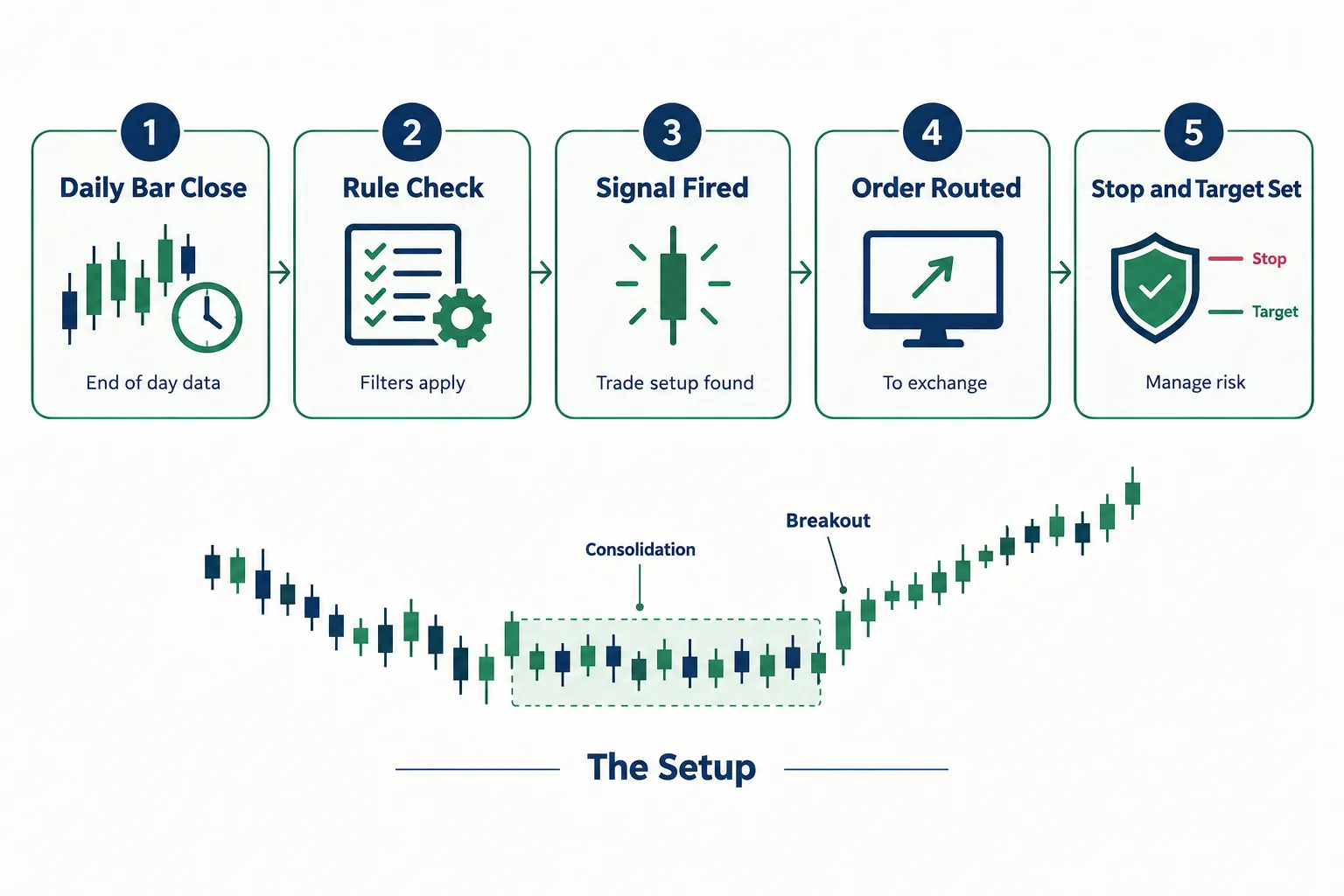
Compare that to a day-trading bot, which evaluates one-minute or tick data and closes everything by the bell. Same idea, wildly different engineering problem.
A swing trading bot has three parts and nothing else matters until those three work:
- A signal rule. The condition that triggers entry. Example: close above the 20-day high after at least 10 days of tight consolidation (a narrow price range, where the stock is basing rather than trending).
- A risk rule. Where the stop loss sits, how big the position is, and what the maximum open exposure is across all positions.
- An exit rule. A profit target, a trailing stop, a time stop (close after N bars regardless), or some combination.
Most people spend 90% of their effort on part one and wonder why the account bleeds. The signal is the cheapest part to copy and the least important to your survival.
What swing trading automation actually buys you
It buys you repeatability. A human trader who’s had three losers in a row skips the fourth setup. That fourth setup is frequently the one that pays for the week. A bot doesn’t have a bad morning. It doesn’t revenge trade. It doesn’t widen a stop at 3:55pm because the position “feels like it’ll come back.”
What it does not buy you: an edge you didn’t already have. Automating a losing rule set just makes you lose faster and more consistently.
Discipline beats prediction. A mediocre rule followed exactly will usually outperform a good rule followed when you feel like it.
Decision rule: build a swing trading bot if you already have a written setup you’ve traded manually at least 50 times and can describe in one paragraph with no “it depends.” If you can’t write it down, you can’t code it, and no AI can guess what you meant.
If you’re still defining the setup itself, start with a screener. Our breakdown of the stock screener for swing trading replacing manual picks covers that step.
Why Are Swing Trading Bots Easier to Test Than Day Trading Bots?
Swing trading bots are easier to test because they generate fewer trades on cheaper data, tolerate larger execution errors, and run on infrastructure that doesn’t need to stay awake. A daily-bar strategy that makes 40 trades a year can be backtested on free end-of-day data in seconds. A one-minute strategy making 40 trades a week needs paid tick data, realistic slippage modeling, and a server that never hiccups.
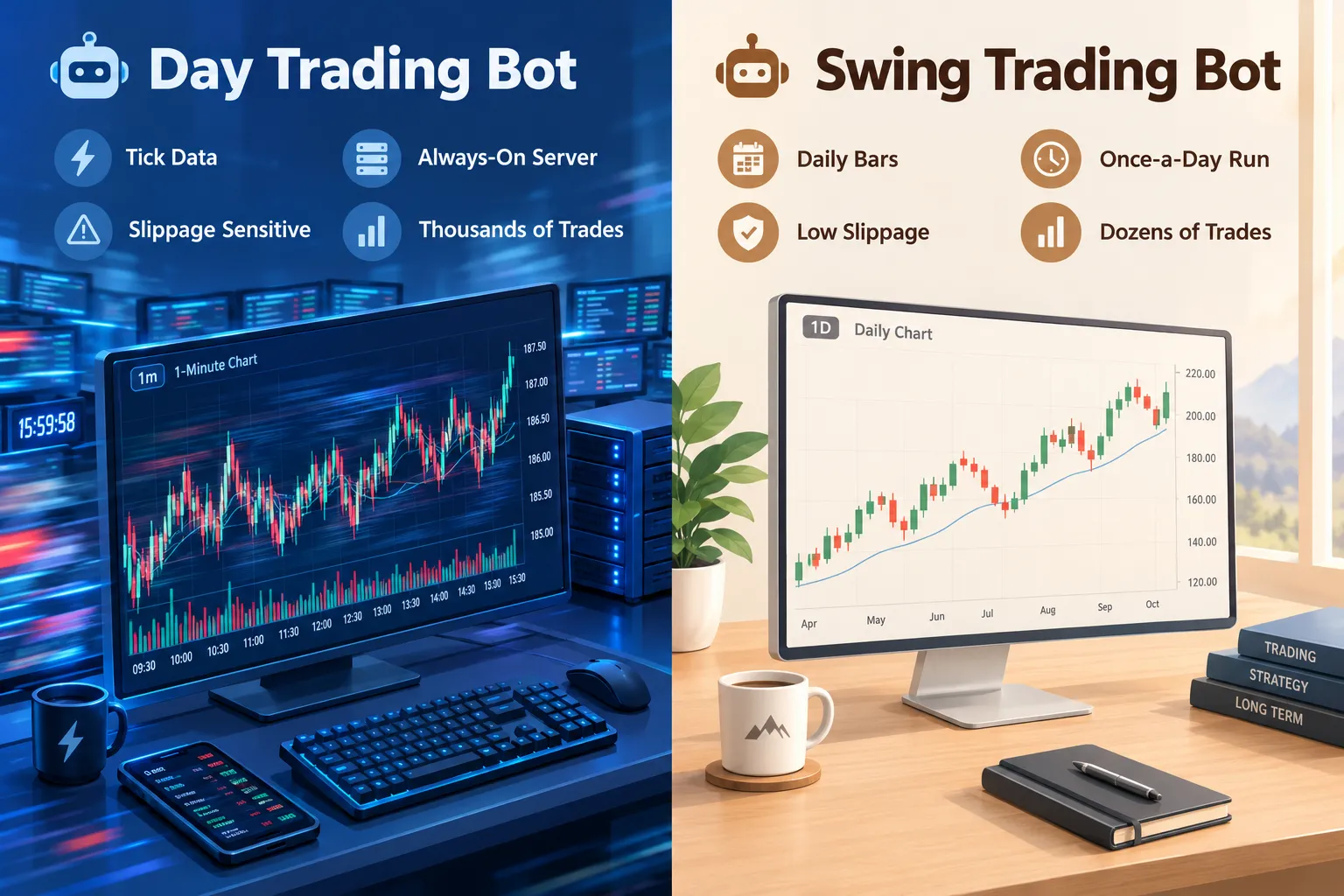
| Factor | Swing trading bot | Day trading bot |
|---|---|---|
| Data granularity | Daily or 4-hour bars | 1-minute, seconds, or tick |
| Typical data cost | Often free or bundled with charting | Paid feeds, often the largest line item |
| Trades per year | Roughly 20 to 200 | Easily 500 to 5,000+ |
| Slippage sensitivity | Low. A 0.2% fill error on a 6% move barely registers | High. A 0.2% error can erase the entire edge |
| Hosting needs | A scheduled job once or twice a day | Always-on, low-latency, co-located if serious |
| Backtest honesty | Easier. Fewer microstructure assumptions to get wrong | Hard. Order book behavior is nearly impossible to simulate |
| Time to statistically meaningful sample | Years of history needed | Weeks of history, but noisier edges |
| Monitoring burden | Check once a day | Continuous |
The slippage math that makes the difference
Say your swing trading bot targets an average 6% gain per winning trade. A half-percent of combined slippage and commission costs you about 8% of the gross move. Annoying, survivable.
Now run a day-trading bot targeting 0.4% per trade. That same half-percent of friction doesn’t dent the edge, it inverts it. You’re now paying for the privilege of being right.
Common mistake: backtesting a swing strategy with zero costs because “it’s only a few trades.” Model 0.1% round-trip minimum on liquid large caps, more on anything thin or low float. If the edge dies when you add realistic costs, it was never there.
Edge case: swing bots can still get wrecked on illiquid names. A stock trading 80,000 shares a day will not absorb your market order at the close the way a backtest assumes. Add a minimum average dollar volume filter and stop pretending.
How Do You Build a Swing Trading Bot With Claude and TradingView?
The practical path is four steps: write the rule in plain English, have Claude convert it into Pine Script for TradingView, create a TradingView alert from that strategy, then route the alert via webhook to a broker or execution service. No computer science degree needed, but you do need to be ruthless about specifying what you mean.
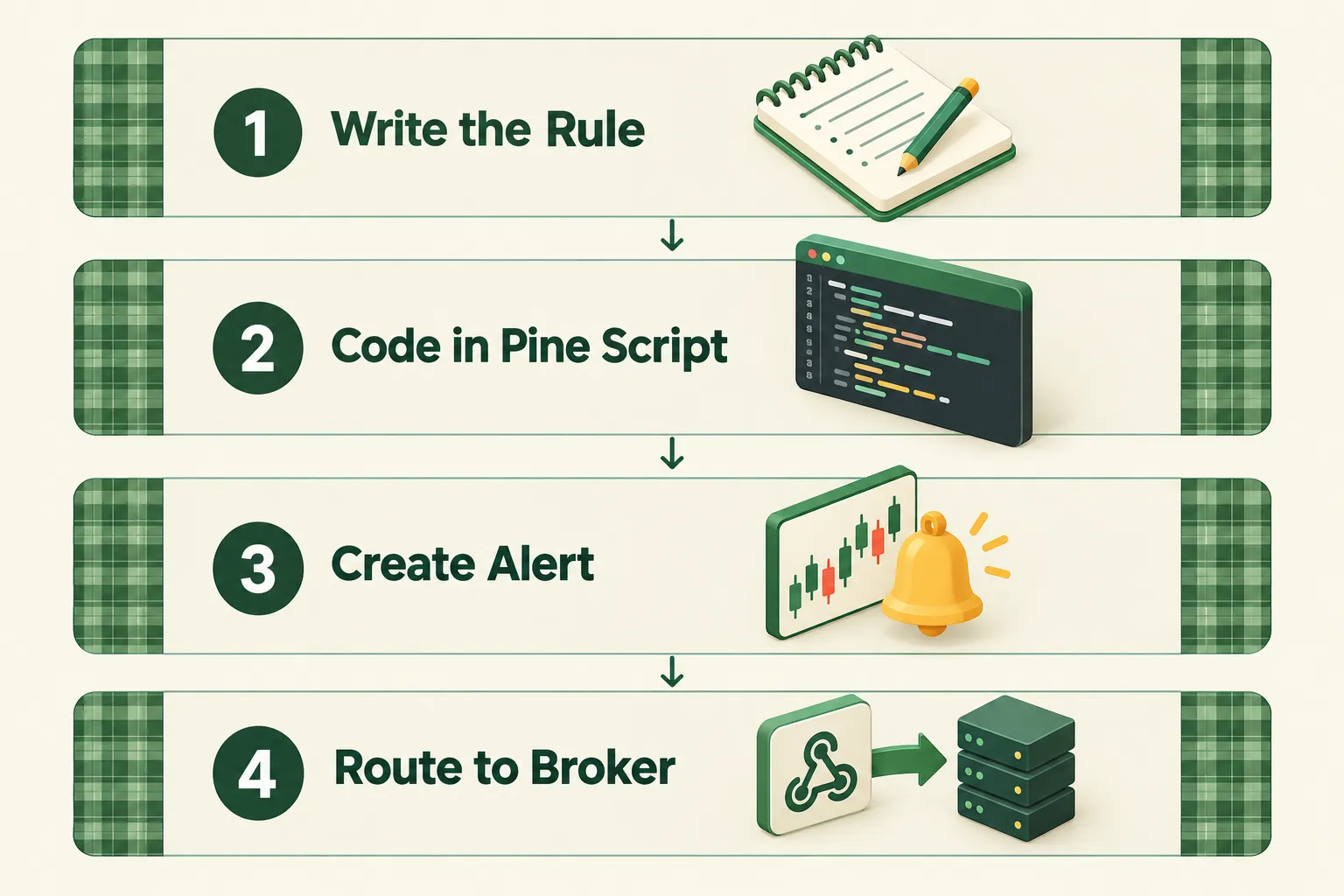
Step 1: Write the rule in plain English first
Before you touch any AI, write the rule like you’re explaining it to a new hire who takes everything literally.
Bad: “Buy breakouts from consolidation with good volume.”
Usable: “On the daily chart, if today’s close is the highest close of the last 20 bars, and the 10-day average true range is below its own 50-day average (tight consolidation), and today’s volume is at least 1.5x the 20-day average volume, enter long at the next open. Stop at 2x ATR below entry. Exit at 4x ATR profit or after 15 bars, whichever comes first.”
That second version is codeable. The first one isn’t, and any bot built from it will be the AI’s guess at your intent, not your intent.
Step 2: Have Claude write the Pine Script
Pine Script is TradingView’s own scripting language for indicators and strategies. Claude handles it well for straightforward rule sets. Give it your written rule verbatim, specify you want a strategy() script rather than an indicator(), state the Pine version you want, and ask it to include position sizing and stop logic explicitly rather than assuming defaults.
Then verify. Open the strategy tester, scroll the trade list, and manually check five entries against the chart. If Claude misread “highest close of 20 bars” as “highest high of 20 bars,” you’ll see it in 90 seconds. People skip this step and then blame the model.
Three things to always state in your prompt:
- Whether signals act on bar close or intrabar (always bar close for a swing trading bot, otherwise you’ll backtest on data that didn’t exist yet)
- Your commission and slippage assumptions so the strategy tester includes them
- Whether you want pyramiding on or off (off, for a first bot)
Step 3: Turn the strategy into an alert
TradingView alerts fire when your strategy generates an order. The alert message is where you put a structured payload describing the ticker, side, and size, so the receiving system knows what to do. Check TradingView’s official alert documentation for the current placeholders and the alert limits on your plan tier, since both change.
Alert limits matter more than people expect. Lower-tier plans cap the number of simultaneous active alerts. For a swing trading bot watching 25 tickers, that cap is your real constraint. Confirm the current numbers on TradingView’s official pricing and feature pages before you build around them.
Step 4: Route the alert to a broker via webhook
A webhook is just a URL that receives the alert message the instant it fires. The alert goes to a middleware service or your own small server, which reads the payload and submits the order through a broker API.
This is the part where discipline matters most. Put hard limits on the receiving side, not just in the Pine Script. Your server should reject any order that exceeds a maximum position size, exceeds a maximum number of open positions, or arrives for a ticker not on your approved list. A bug in the strategy, a duplicated alert, or a malformed payload shouldn’t be able to deploy your whole account into one name.
This matches the direction FINRA points to in its 2026 guidance: it flags excessive scope and authority as a core risk with automated execution agents. Bounded automation beats open-ended automation. Give the bot permission to do a small number of specific things, and nothing else.
What the YouTube tutorials claim
Several creators have published walkthroughs of this exact stack. Treat the build steps as instructional and the performance figures as unverified marketing.
- Lewis Jackson has published videos demonstrating using AI chat models to generate Pine Script trading strategies for TradingView, covering the prompt-to-script-to-backtest loop.
- Mind Math Money publishes TradingView and Pine Script strategy tutorials aimed at beginners, including indicator building and strategy testing.
- Investors way has posted content on automating TradingView alerts into broker execution.
None of those channels’ results constitute evidence a strategy works in your account, on your tickers, with your costs. Any number in a video thumbnail is a thumbnail, not a track record.
If you’d rather skip the build entirely, our rundown of fully automated AI trading bots covers the off-the-shelf options and where they fall short.
Can You Run a Swing Trading Bot on Alpaca Instead?
Yes. Alpaca offers a commission-free US equities API with a paper trading environment, which makes it a common choice for a self-coded swing trading bot. Instead of TradingView generating the signal, your own script pulls daily bars, evaluates the rule, and submits orders directly. Check Alpaca’s official docs and pricing pages for current account minimums, data plan tiers, and rate limits before building. Our Alpaca review covers what the free data feed does and does not include.
Why the API route suits swing trading specifically
A swing trading bot only needs to run once a day. That’s a scheduled job, not a streaming application. You can run it on a small cloud instance or a scheduled serverless function for a few dollars a month, triggered shortly after the close or shortly before the next open.
A sane daily schedule looks like this:
- After the close, pull updated daily bars for your watchlist.
- Evaluate exit rules on open positions first, before anything else.
- Evaluate entry rules on candidates, ranked by whatever filter you chose.
- Check portfolio-level limits: max open positions, max total exposure, max exposure per sector.
- Submit orders as market-on-open or limit orders for the next session.
- Log every decision, including the ones where it chose not to trade.
That last point is the one everyone skips. Log the non-trades. When your bot mysteriously stops entering, the log of rejected candidates tells you whether the rule stopped matching or the code broke.
Paper first, and not for a week
Run the full loop in Alpaca’s paper environment with live data for at least a full quarter, or until you’ve logged 30 completed trades, whichever is longer. You’re not testing profitability there. You’re testing whether the plumbing works: do orders fire, do stops get placed, does the scheduler actually run on a half-day market session, does it behave correctly when a ticker is halted.
Common mistake: paper trading for two weeks in a calm, trending market, concluding the system works, then going live into a choppy tape. Two weeks tells you the code compiles. It tells you nothing about the strategy.
Decision rule: choose the Alpaca API route if you’re comfortable writing or heavily editing Python and you want full control over portfolio-level risk logic. Choose the TradingView plus webhook route if you want to iterate on chart rules visually and would rather not maintain a server.
What Is Overnight Gap Risk and How Does a Bot Handle It?
Overnight gap risk is the chance a stock opens at a price far from the previous close, jumping straight past your stop without ever trading at it. This is the structural difference between swing trading and day trading, and it’s why your stop loss is a request, not a guarantee. Earnings releases, FDA decisions, guidance cuts, and weekend geopolitical news all produce gaps.
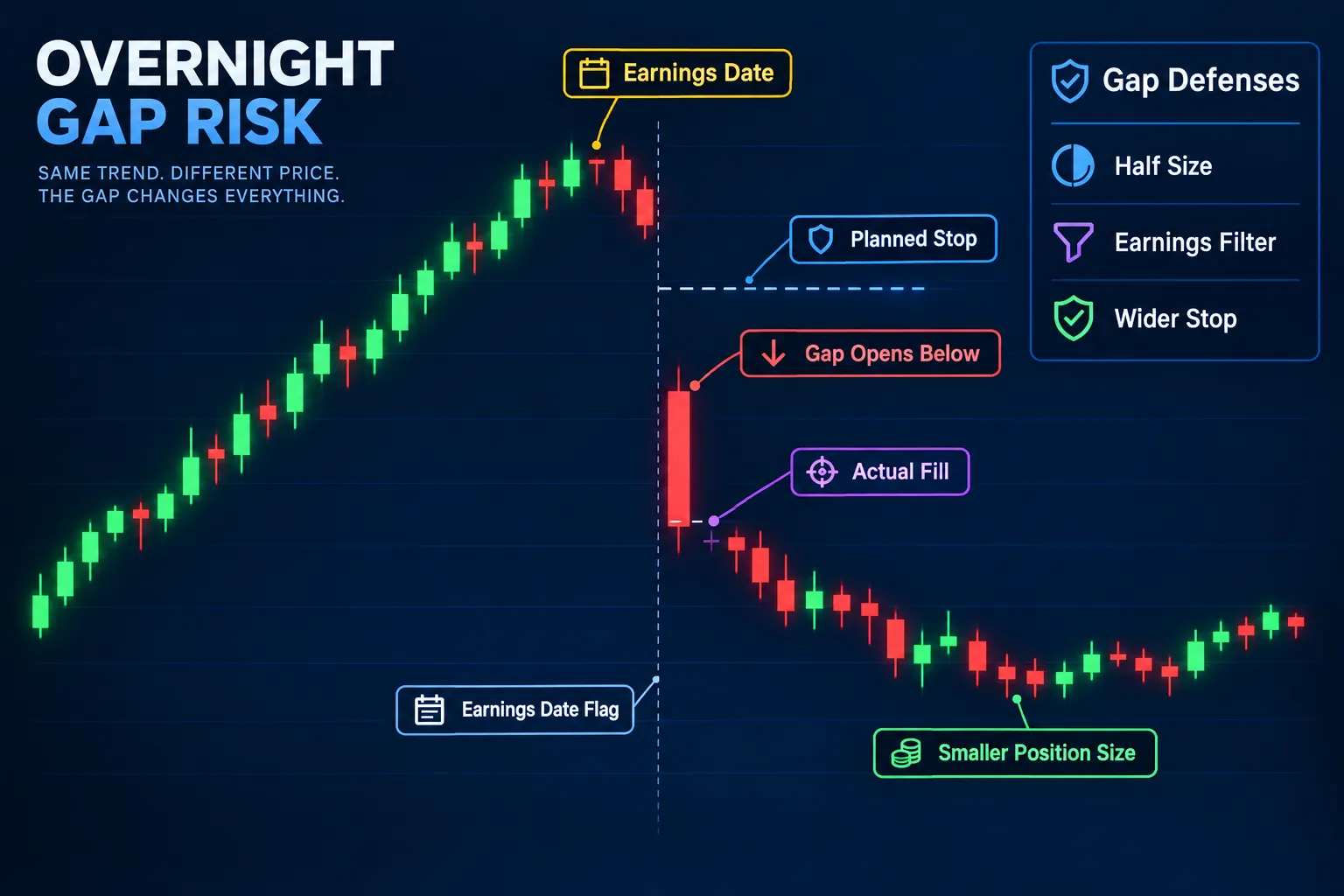
A worked example with illustrative numbers
These are made-up figures for illustration, not a real trade or a prediction.
- Account: $20,000 (example)
- Risk per trade: 1%, so $200 (example)
- Entry: $50.00 (example)
- Stop: $45.00, a 10% stop (example)
- Position size: $200 risk divided by $5 per share risk = 40 shares, a $2,000 position
Your planned worst case is a $200 loss. Then the company pre-announces a guidance cut overnight and the stock opens at $38. Your stop triggers and fills near the open.
Actual loss: 40 shares times $12 = $480. That’s 2.4% of the account, not 1%. You took 2.4x the risk you budgeted, and you did nothing wrong procedurally.
Now run the same scenario with a 20-position portfolio where a sector-wide event gaps six names at once. That’s the tail your position sizing needs to survive.
Four defenses to build into the bot
-
Size for the gap, not the stop. Assume your realistic worst case is roughly 2x your stop distance on a single name. Size so that a 2x overshoot is still tolerable. Risking 0.5% per trade instead of 1% is not timid, it’s arithmetic.
-
Filter out earnings. The single highest-probability gap event is scheduled and public. Build a rule that blocks new entries within N days of a confirmed earnings date, and either closes or halves existing positions ahead of the report. Pull dates from a maintained calendar source and check them daily, since companies move dates.
-
Use stop-market, not stop-limit, for protective exits. A stop-limit order on a gapping stock can simply not fill, leaving you holding a position that keeps falling. A stop-market gets you out at a bad price, which beats not getting out.
-
Cap correlated exposure. Three semiconductor names in a breakout bot are one position wearing three hats. Limit positions per sector and limit total portfolio exposure, enforced at the portfolio level before any order is submitted.
Edge case worth planning for: halts. If a stock halts mid-session on news and reopens 25% lower, your stop does nothing during the halt. Your protection is position size, not order type. This is exactly the scenario FINRA describes when it notes that conditions outside a model’s training data, like unusual volatility or geopolitical events, can make automated systems behave in unintended ways.
Your stop defines your intention. Your position size defines your actual risk.
How Do You Backtest and Forward Test a Swing Trading Bot?
Backtest on at least 10 years of daily data across both bull and bear conditions, require a minimum of 100 completed trades, include realistic costs, then validate with walk-forward analysis before paper trading the live system for a quarter. Anything less and you’re measuring luck.
The minimum standards
| Check | Minimum bar | Why it matters |
|---|---|---|
| Trade count | 100+ completed trades | Below 30, a single outlier drives the whole result |
| History span | 10 years, including 2018, 2020 and 2022 | Three distinct stress periods with different characters |
| Costs modeled | 0.1% round trip minimum | Zero-cost backtests flatter every strategy |
| Parameter count | 5 or fewer tunable inputs | More knobs means more curve fitting |
| Out-of-sample result | Within reasonable range of in-sample | A large gap means you fit to noise |
| Worst drawdown | Simulated and emotionally survivable | You will quit at the drawdown you didn’t plan for |
Walk-forward, in plain English
Curve fitting is when you tune parameters until the backtest looks beautiful on data you already have. The strategy then falls apart live because you optimized for history, not for behavior.
Walk-forward analysis fixes this by splitting your history into chunks. Optimize parameters on 2014 to 2017, then test them untouched on 2018. Roll forward: optimize on 2015 to 2018, test on 2019. Repeat. The combined out-of-sample results are the only numbers worth believing.
If your strategy only works on one parameter setting, it doesn’t work. A real edge shows a broad plateau of acceptable results across nearby settings. A 14-period lookback that prints money while 13 and 15 lose is a statistical accident wearing a costume.
This is also where interpretable rules beat opaque models. AQR’s research on time-series momentum examined dozens of futures and forward contracts across equities, currencies, commodities, and government bonds and found that past returns carried predictive value over roughly a one-year horizon. Simple, testable, repeatedly examined. That’s a stronger foundation than an unexplainable neural net output.
Then forward test with real-time data
A backtest uses data that’s already been revised, adjusted, and cleaned. Live data arrives messy. Forward testing in a paper account catches the problems a backtest structurally cannot: data feed outages, delayed bars, split adjustments that break your lookback, scheduler failures on half-days.
Run it for a quarter minimum. Keep a trade journal next to the bot’s log and note every discrepancy between what the bot did and what you expected. That list is your bug backlog.
Which AI Is Best for Swing Trading?
There is no single best AI for swing trading, and anyone selling one answer is selling something. Split the question by task: use a general language model like Claude for writing and debugging strategy code, use purpose-built scanners and ranking tools for generating candidate lists, and use your own tested rules for the actual trade decision.
By job:
- Writing and debugging strategy code. General-purpose models including Claude handle Pine Script and Python strategy logic well. They’re genuinely good at translating a precise English rule into working code and at explaining what an existing script does.
- Scanning and ranking candidates. Dedicated screeners and AI ranking tools are built for this and have the data pipelines a chat model lacks. We compare the field in the best AI trading tools of 2026 put head to head.
- Charting and alert generation. Platform-native tools. See our TrendSpider vs TradingView charting comparison for the practical differences.
- Making the final call on a trade. Your written rules. Not a chat model’s opinion on a ticker.
Where ai swing trading gets oversold
A language model does not have real-time market data unless you give it some, and even then it isn’t doing quantitative forecasting. Asking a chatbot “should I buy NVDA” produces fluent text, not analysis. FINRA explicitly lists hallucinations and inadequate domain knowledge among the risks of AI agents in trading contexts, and the CFTC advisory is blunt that AI cannot predict sudden market changes.
The defensible claim: AI makes you faster at building and testing systems. It does not make the market more predictable.
There’s also a crowding concern FINRA raises: if many AI systems learn from similar information, they can produce herding or synchronized trades that amplify volatility. If your “AI edge” is the same prompt everyone else is running, it isn’t an edge.
For a wider view of what paid AI tools actually deliver, see AI trading software: what you pay for vs what you get.
How Much Does a Swing Trading Bot Cost to Run?
A self-built swing trading bot can run from $0 to roughly $500 a year depending on the stack; commercial subscription bots typically run higher. Check every vendor’s official pricing page, since tiers and feature gates change frequently.
The cost buckets:
- Charting and alerts. TradingView has a free tier and several paid tiers; the alert count and multi-chart limits are what push swing traders up a level. Confirm current tiers on the official page.
- Broker and execution. Alpaca offers commission-free US equities trading with a free paper environment; market data plans are tiered separately. Check the official docs.
- Hosting. A once-daily scheduled job costs little, often a few dollars a month or free on low-volume serverless tiers.
- Webhook middleware. Services that connect TradingView alerts to broker APIs typically charge a monthly subscription. Prices vary widely.
- Commercial bot subscriptions. Pricing ranges enormously and frequently bundles features you won’t use.
Our directory of free AI trading bots is a reasonable place to see what you can get without opening the wallet.
The real cost is not the subscription. It’s the months spent running a half-tested system live. A $30 monthly tool that stops you making one undisciplined trade has already paid for a year.
Is Automated Swing Trading Safer Than Day Trading?
Automated swing trading carries lower execution risk and lower friction cost than automated day trading, but higher single-event gap risk. Safer is the wrong frame. The risks are different shapes.
Where swing automation is genuinely lower risk:
- Far fewer trades, so fewer chances for a bug to compound
- Low slippage sensitivity, so your live results track your backtest more closely
- You review decisions once a day instead of watching a screen for six hours
- No pattern day trader considerations to work around on a small cash account
Where it’s higher risk:
- Overnight and weekend gaps can bypass stops entirely
- Positions held for days accumulate exposure to events you can’t see coming
- A bug can sit undetected longer, because you’re checking once daily
Decision rule: if you have a full-time job and can’t watch markets intraday, a swing trading bot is the structurally correct choice. If you’re drawn to day trading mainly because it feels more active, that’s a psychology problem, not a strategy preference. Our comparison of scalp trading vs swing trading breaks down the tradeoff further.
Swing Trading Bot vs Manual Trading: Which Makes More Money?
Neither wins by default. The bot wins on consistency and emotional neutrality; the human wins on context and the ability to stand aside when conditions are obviously broken. Most serious traders run a hybrid.
| Dimension | Swing trading bot | Manual swing trading |
|---|---|---|
| Rule consistency | Perfect | Degrades under stress |
| Speed and coverage | Scans hundreds of names daily | Maybe 30 charts a night |
| Reads unusual context | Poor. Follows rules into regime changes | Good, when you’re disciplined |
| Revenge trading risk | Zero | The main destroyer of accounts |
| Failure mode | Silent bug, or applying rules in the wrong market | Overtrading, widening stops, skipping setups |
| Record-keeping | Automatic and complete | Usually abandoned by week three |
The hybrid most people land on: the bot generates the candidate list and calculates position sizes, the human approves or rejects entries each evening, and the bot manages stops and exits with no override allowed. You keep human judgment at the gate and remove it from the place it does the most damage, which is managing a losing position.
Common mistake: adding a manual override for exits. That’s the exact decision automation was supposed to protect you from.
Swing Trading Bot Stocks vs Crypto: Which Is Better?
For a first swing trading bot, US equities are the easier environment: cleaner historical data, defined market hours, regulated brokers, and fewer catastrophic infrastructure failures. Crypto offers 24/7 trading and no gap risk at the open, but trades through a weekend you’re asleep for and carries exchange and custody risk that stocks do not.
Equities advantages:
- Reliable split-adjusted and dividend-adjusted historical data
- Defined close, which makes a once-daily bot schedule trivial
- SIPC-member brokers, which covers custody failure (not market losses)
- Liquidity in large caps that your orders won’t move
Crypto advantages:
- No overnight gap at a market open, since there is no open
- Continuous data, which gives you more bars per year for testing
- Low barriers to API access
Crypto risks that matter for an automated system: exchange outages exactly when volatility spikes, thin order books on smaller pairs, and the fact that your bot can get liquidated at 3am while you sleep. Equities gap at the open; crypto gaps whenever it feels like it.
Decision rule: build your first swing trading bot on liquid US large caps. Add crypto later if you want, after the plumbing and the risk logic are proven. Our swing trading tools hub covers equity-side resources.
Do You Need Coding Skills to Set Up a Swing Trading Bot?
No, but you need precision. AI models write the Pine Script or Python for you. What they can’t do is decide what your rule actually means, verify the output is correct, or notice that your backtest is using tomorrow’s close.
What you genuinely need:
- The ability to state a rule with zero ambiguity
- Enough comfort reading code to check that a condition matches your intent
- Patience to verify five trades manually against the chart before trusting the tester
- Willingness to log and read error messages instead of restarting and hoping
The no-code options: TradingView alerts plus a webhook middleware service get you a working swing trading bot without writing a line yourself, though you’ll still be writing Pine Script conditions or using a visual strategy builder. Commercial platforms offer visual builders with drag-and-drop rules.
The honest caveat about no-code: you inherit the platform’s assumptions about order handling, fills, and risk limits. When something behaves unexpectedly, you can’t inspect it. That’s an acceptable trade for a first bot and a bad one for a serious system.
How Much Starting Capital Do You Need for a Swing Trading Bot?
Technically a few hundred dollars with fractional shares at a commission-free broker. Practically, somewhere around $5,000 to $10,000 before risk management arithmetic works properly on a diversified swing book.
The math: with 1% risk per trade on a $1,000 account, you’re risking $10 per trade. On a stock with a $5 stop distance, that’s two shares. Position sizing becomes impossible to express accurately, and a single unexpected gap can take out a chunk of the account.
With $10,000 at 0.5% risk, you’re risking $50 per trade across maybe 8 to 12 concurrent positions. That’s enough granularity for sizing to do its job.
The actual first step costs nothing. Paper trade the bot for a quarter. Alpaca’s paper environment and TradingView’s strategy tester are both free. If you can’t commit to that, the capital question is irrelevant.
How Do You Avoid Swing Trading Bot Scams and Spot Red Flags?
Treat any specific return promise as disqualifying. The CFTC advisory on AI trading bots states plainly that AI cannot predict sudden market changes and warns against claims of promised returns, 100% win rates, or extraordinary profits. FINRA’s alert on auto-trading services from unregistered entities names consistent monthly returns above 10% as a classic warning sign.
Red flags, in rough order of severity:
- Guaranteed or fixed monthly returns. The Mirror Trading International case cited by the CFTC involved a purported automated forex bot promising at least 10% monthly, with more than 23,000 people allegedly defrauded of over $1.7 billion in bitcoin.
- A 100% win rate, or a win rate above roughly 80% with no explanation of the loss profile.
- Unregistered operators. Check registration through official regulator databases before sending money.
- “Proprietary AI” with no method described. FINRA flags “AI washing,” where ordinary software is marketed as advanced AI.
- Requests for your broker login credentials rather than a read-limited or trade-limited API key. Credential theft is on FINRA’s named risk list.
- Backtests only, no live results. An un-audited vendor backtest is a marketing asset, not evidence.
- Screenshot profits with no verifiable statement. Anyone can screenshot a paper account.
- Deposit pressure and countdown timers. Urgency is a sales technique, not a market condition.
- No way to withdraw funds without “upgrading.” This is the exit scam signature.
- Testimonials from accounts with no history. Check the posting history of the person praising it.
FINRA also warns that losses can occur before the investor even notices the transactions, which is why your own portfolio-level limits matter more than any vendor’s assurances.
Our breakdown of which AI trading bots are legit vs scams goes deeper on vetting specific products.
Play stupid games, win stupid prizes. The returns promised in these pitches have never existed. Not in 2026, not in 1996.
Swing Trading Bot for Beginners: Where Do You Start?
Start by trading a single rule manually for 50 trades before automating anything. Then paper trade the automated version for a quarter. Only then does live capital make sense.
The ordered path:
- Pick one setup. Breakout from tight consolidation, pullback to the 20-day moving average, whatever you can describe in one paragraph. One setup, not four.
- Trade it manually for 50 occurrences. Journal every one. You’re learning whether the rule produces trades you can actually execute and whether the edge exists before you spend a month coding.
- Write the rule with zero ambiguity. Entry condition, stop placement, position size formula, exit condition, and every filter.
- Backtest it. 10+ years, 100+ trades, realistic costs, walk-forward validation.
- Code it. Claude plus Pine Script, or Python plus the Alpaca API. Verify five trades by hand.
- Paper trade the full system. One quarter minimum, with daily logs.
- Go live at a quarter of your intended size. Scale up only after 30 live trades behave like the paper run.
That’s six to nine months. If that sounds slow, compare it to the cost of discovering your bug with real money in a drawdown.
Common beginner mistake: building the bot first and figuring out the strategy later. The code is the easy part now. The rule is the hard part, and it always was.
What Mistakes Break Swing Trading Bots?
Most swing trading bot failures aren’t exotic. They’re the same six errors, repeated.
- Curve fitting to history. Fix: walk-forward validation and five parameters or fewer.
- Ignoring transaction costs. Fix: model 0.1% round trip minimum, more on illiquid names.
- Lookahead bias. Using the day’s close to generate a trade on that same day’s close. Fix: act on the next bar’s open, always.
- Survivorship bias in the test data. Testing on today’s index members ignores every company that got delisted. Fix: use a point-in-time universe, or at minimum know your results are flattered.
- No portfolio-level limits. Twelve correlated longs is one trade. Fix: cap positions per sector and cap total exposure, enforced before order submission.
- Manual override on exits. Fix: if you’re going to override, override entries only. Let the exits run.
- Never checking the logs. A bot that silently stopped trading three weeks ago is a problem you discover at the worst time. Fix: a daily heartbeat alert confirming the job ran, even when it did nothing.
- Running the same bot through a regime change. A breakout bot in a choppy tape bleeds by design. Fix: a market filter, such as only taking longs when the index is above its 200-day moving average.
Frequently Asked Questions
Which is the best AI for swing trading?
There isn’t one best AI; pick by task. Use Claude or a similar model for writing and debugging strategy code, dedicated screeners for candidate generation, and your own tested rules for the trade decision. Any tool claiming to be the single best AI for predicting swing moves is making a claim no regulator or published research supports.
Can ChatGPT make a trading bot?
Yes, ChatGPT and similar models can write functional Pine Script or Python for a swing trading bot from a clearly specified rule. They cannot decide what your strategy should be, verify the logic matches your intent, or catch lookahead bias in your backtest. Always manually check several generated trades against the chart before trusting the output.
Does a swing trading bot work?
A swing trading bot reliably executes whatever rules you give it, which improves consistency and removes emotional errors. It does not create an edge that wasn’t there. If the underlying strategy loses money when traded manually, automating it produces faster, more consistent losses.
Is it illegal to make an AI trading bot?
Building and running an automated bot for your own personal account is generally legal in the US. The rules change if you manage other people’s money or sell trading signals, which can trigger registration requirements. FINRA’s position is technology-neutral: using AI does not remove existing securities law, supervision, or recordkeeping obligations. Consult a securities attorney before taking outside capital.
How much money do you need for a swing trading bot?
Paper trading costs nothing, and that’s where you should start. For live trading, roughly $5,000 to $10,000 makes position sizing arithmetic work across 8 to 12 concurrent positions at 0.5% risk each. Below about $2,000, a single gap can do disproportionate damage to the account.
How many trades should a backtest have before I trust it?
At least 100 completed trades across 10 or more years covering multiple market conditions. Below 30 trades, a single outlier drives the entire result, and you’re measuring luck rather than edge.
Our Take
Swing timeframes are the most honest place to build your first trading bot. Daily bars don’t hide behind microstructure. The data is cheap, the costs are modest relative to the moves, and the backtest you run tomorrow has a real chance of resembling what actually happens in your account. A day-trading bot flatters you with a beautiful equity curve that slippage quietly deletes.
The gap risk is real and it’s the price of admission. Pay it with smaller positions and an earnings filter, not with a wider stop.
Build the rule. Paper trade it for 90 days. Then, and only then, write a check.
Built a swing bot you want pressure tested? Submit it for review and we will run it against the same gap and slippage checks used here.
Stay alpha.
The FullStack Alpha research desk tests AI trading bots on paper and live accounts. Reviewed and edited by Jay Rocco, Founder and Editor.
