

The FullStack Alpha research desk tests AI trading bots on paper and live accounts. Reviewed and edited by Jay Rocco, Founder and Editor.
By FullStack Alpha Editorial Team | Reviewed by Jay Rocco, Chief Editor
Most prop firms that allow algo trading fall into two camps: forex/CFD evaluation firms running MetaTrader (FTMO, FundedNext, The5ers) and futures firms running API or platform integrations (Topstep and similar). Nearly all of them permit a bot you wrote or own, and nearly all of them ban copy trading, high-frequency bursts, latency arbitrage and anything that leans on a pricing glitch instead of actual price action. The rules differ firm by firm, and they change. Read the automation clause on the firm’s own rules page before you pay a single evaluation fee, because that one paragraph decides whether your strategy is allowed, throttled, or quietly disqualified at payout.
What You Should Know
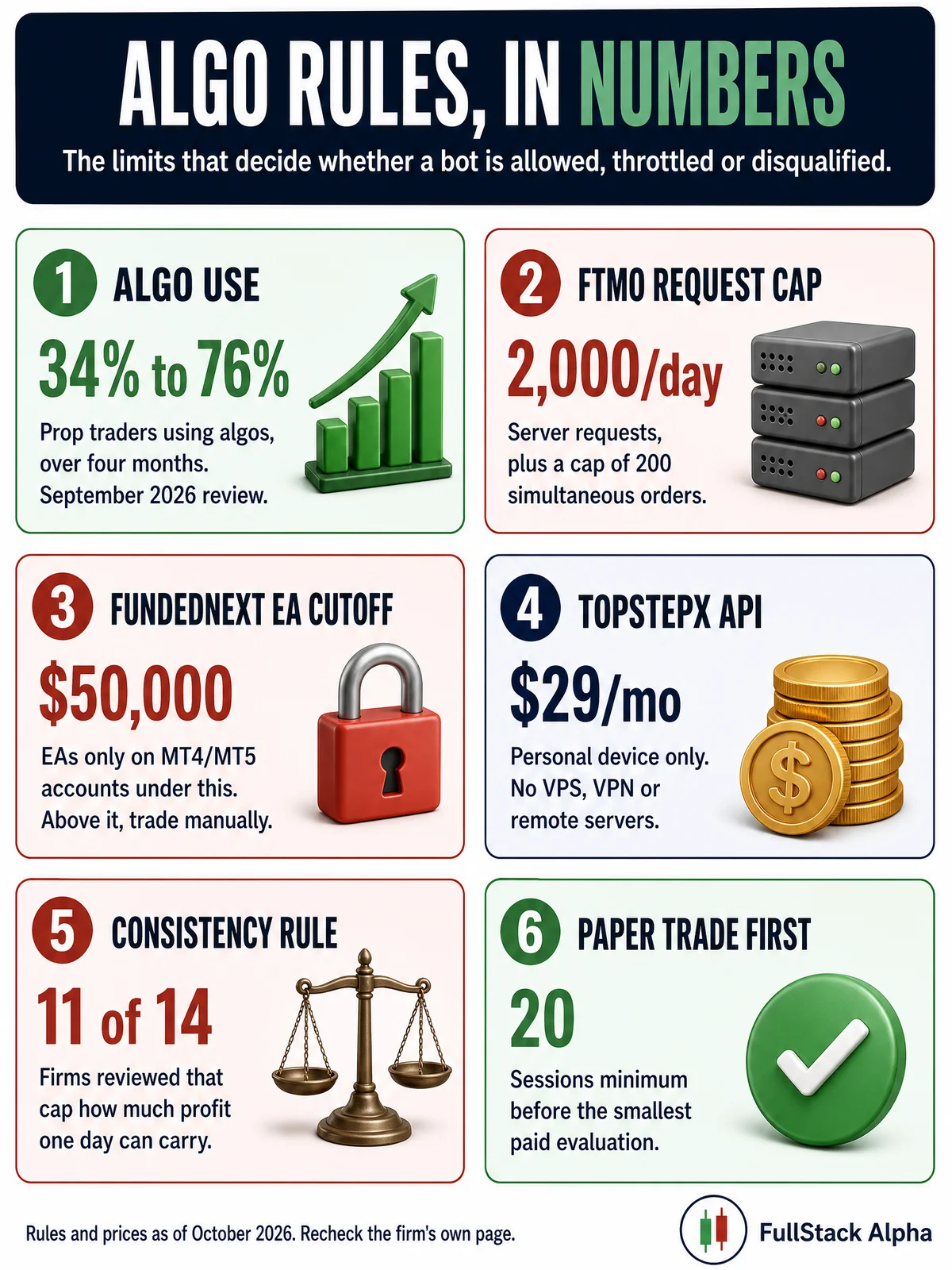
- Algo use among prop traders jumped from 34% to 76% over four months, per a September 23, 2026 industry review of prop firm rulebooks.
- FundedNext allows EAs only on MT4/MT5 accounts under $50,000, with an extra EA fee; accounts of $50,000+ must be traded manually (FundedNext Help Center, September 2026).
- FTMO caps EA activity at 2,000 server requests per day and 200 simultaneous orders, per its own FAQ and forbidden practices pages.
- Topstep’s TopstepX API costs $29 per month and requires all activity to originate from your personal device. VPS, VPN and remote servers are prohibited (Topstep Help Center, updated September 2026).
- 11 of 14 firms reviewed enforce a consistency rule, limiting how much of your profit can come from one outlier day, per that same September 2026 review.
Which Prop Firms Allow Algo Trading?
Prop firms that allow algo trading do exist in both the forex and futures worlds, but “allowed” always comes with a conditions list. The table below reflects what each firm’s own documentation stated as of the date checked. Policies move. Re-check before you buy.
| Firm | Bots allowed | Key restriction | Date checked | Where to verify |
|---|---|---|---|---|
| FTMO | Yes, EAs and algos on MetaTrader and cTrader | 2,000 server requests/day cap; 200 simultaneous orders; no latency or feed exploits; shared third-party EAs can trip capital allocation limits | Oct 23, 2026 | FTMO FAQ + Forbidden Trading Practices pages |
| FundedNext | Yes, but narrow | MT4/MT5 only, accounts under $50,000, paid EA add-on; $50k+ must be manual; $300,000 max allocation per EA strategy | Oct 23, 2026 | FundedNext Help Center EA article |
| FundedNext (cTrader / Match-Trader) | No | Automation prohibited on these platforms regardless of account size | Oct 23, 2026 | Same Help Center article |
| Topstep | Yes, via TopstepX API | $29/month API fee; trades must originate from your personal device; no VPS, VPN or remote servers | Oct 23, 2026 | Topstep Help Center, TopstepX API access |
| The5ers | Yes, if you own the source code | No copied signals, no tick scalping, no latency or hedge arbitrage, no HFT, no emulators, no hidden stop-loss structures | Oct 23, 2026 | The5ers rules page (per Velotrade 2026 review) |
| HyroTrader | Yes, crypto, updated Sept 29, 2026 | Your own strategy only via exchange-demo API, agent-token or Model Context Protocol interfaces; purchased systems, copy trading and third-party signals banned | Oct 23, 2026 | HyroTrader terms page |
How to read that table without fooling yourself
Three patterns repeat across every firm on the list.
Ownership beats purchase. The5ers and HyroTrader both draw the line at whether you own the logic. A marketplace EA you bought for $300 is, in their language, a copied strategy. Write it, or at minimum own the source.
The platform is part of the rule. FundedNext is the cleanest example. The exact same bot is permitted on MT5 and prohibited on cTrader. Picking a platform at signup can disqualify your strategy before you place a trade.
Request volume is a compliance metric, not a performance one. FTMO’s 2,000-requests-per-day ceiling counts opens, modifications, closes and pending-order edits. A scalper that nudges a trailing stop every tick will hit that number before lunch and get flagged as hyperactive. That’s a rules violation, not a drawdown problem.
Decision rule: if your strategy fires more than roughly 100 orders a day or modifies stops continuously, assume you need written confirmation from support before you pay. Get it in a ticket, not a Discord reply.
Common mistake: assuming “EAs allowed” on the marketing page means allowed at your account size. FundedNext markets automation broadly. The $50,000 manual-only cutoff lives in a help article most buyers never open.
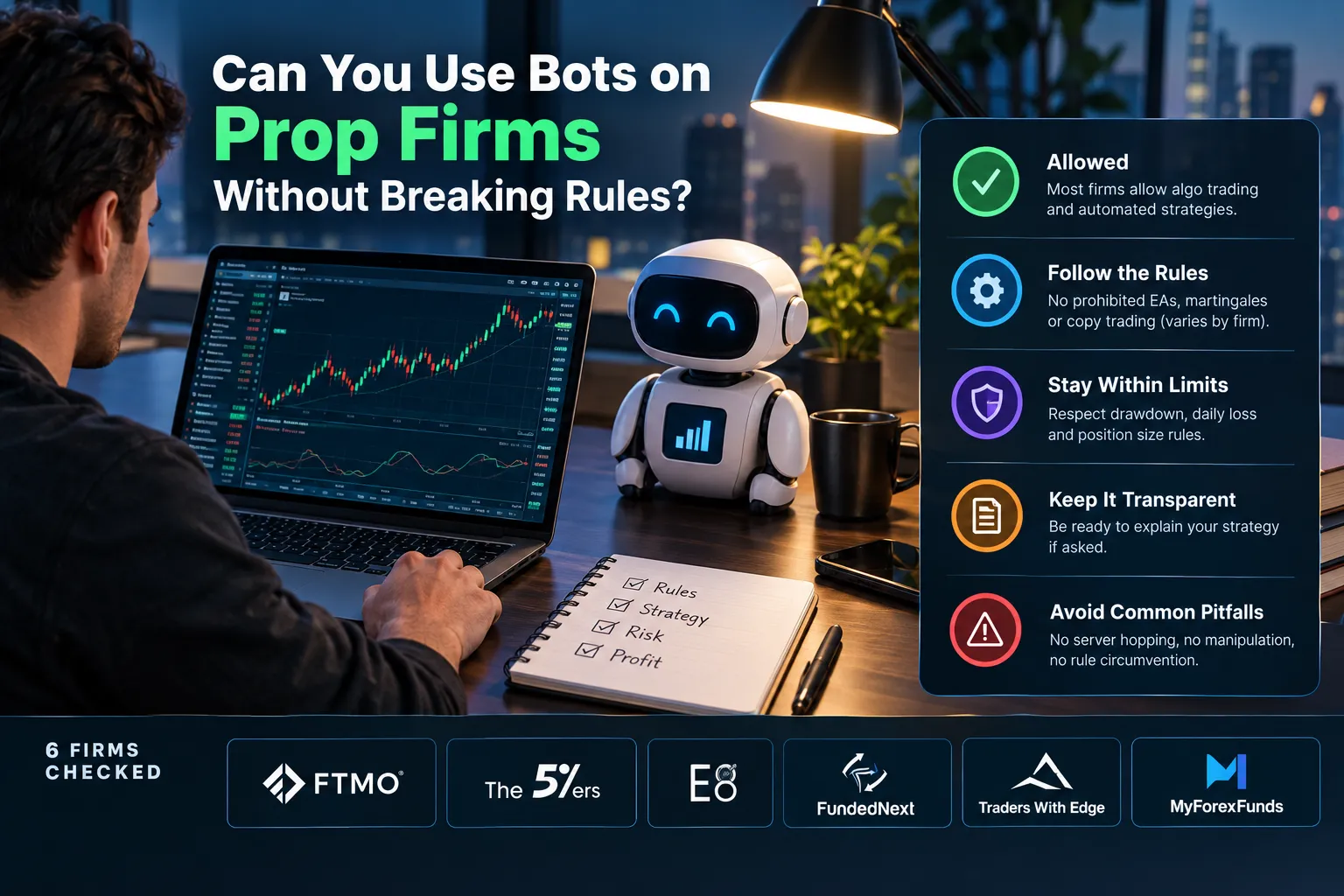
Can You Use Bots on Prop Firms Without Breaking Rules?
Yes, you can use bots on prop firms, as long as the bot trades like a human would and not like an exploit. The clauses that get traders disqualified are remarkably consistent across the industry, and almost none of them are about whether automation is allowed. They’re about what kind.
Here’s the standard clause set you’ll find in prop firms that allow bots:
No copy trading or shared signals. If ten accounts run the same EA on the same tick, the firm’s risk book is concentrated in one strategy. FTMO handles this through its maximum capital allocation limit: widespread use of the same third-party EA can get you denied a funded account even if you passed the evaluation cleanly. The5ers and HyroTrader simply ban purchased and third-party systems outright.
No high-frequency trading. Recent 2026 rulebook updates increasingly separate ordinary automation from exploitative automation. HFT, server overload and simulated-market advantages are named specifically. A trend-following or mean-reversion EA holding positions for minutes or hours is materially more compatible than a tick scalper.
No latency or feed exploitation. Delayed price feeds, arbitrage between the firm’s demo server and the live market, reverse and hedge arbitrage. These show up by name in both FTMO’s forbidden practices and The5ers’ policy. The logic is simple: the firm is pricing off a feed, and if you’re making money off the gap rather than off the market, you’re trading the broker, not the tape.
No hidden stop-loss structures. The5ers calls this out directly. Stops that exist only in your script, with nothing on the server, make the firm’s risk engine blind.
Human oversight expected. Topstep’s requirement that all activity originate from your personal device is the sharpest version of this. No VPS. No remote box humming in a datacenter while you sleep. You’re supposed to be there.
A bot that only makes money because the broker’s price feed is a half-second behind isn’t a strategy. It’s a bug report with a profit motive.
The clause most people skip
Consistency rules. That September 2026 review found 11 of 14 firms limiting how much of total profit can come from a single day. Algos are unusually prone to tripping this, because a mean-reversion system can sit flat for two weeks and then catch one violent reversion that accounts for 60% of the run. Passing the drawdown test and failing the consistency test is a genuinely common ending.
Edge case: some firms count stop-loss and take-profit modification tools as automation even when no entry is automated. FundedNext does. If you run a trailing-stop utility on a $75,000 FundedNext account, you’re technically in breach.
If you’re still building the strategy side before worrying about firm rules, our breakdown of fully automated AI trading bots covers what the current crop actually executes versus what it just alerts on.
What Do the Creator Videos Say About Prop Firm Bots?
Treat creator videos as claims, not verification. The useful ones walk through the actual rules page on screen so you can read the clause yourself. The less useful ones show an equity curve and a discount code.
Two worth watching, credited as the channels appear on their video pages:
DaviddTech covers automated strategy builds and bot deployment workflows, including how a signal gets from a charting script to a live order. The channel’s framing is build-first: what the system does, where it connects, what breaks. Useful for understanding the plumbing. It is not a compliance review, and nothing shown on the video page constitutes confirmation that a given firm permits a given setup.
Osama Algo Trader publishes on algorithmic strategy development and automation for retail-scale accounts. Same caveat applies.
How to use creator content without getting burned
- Note the upload date. A video from eight months ago describing FundedNext’s EA policy predates the September 2026 reaffirmation of the $50,000 cutoff.
- Check whether they show the rules page. If the creator pulls up the firm’s own help article on screen, you can pause and read it. If they paraphrase, assume drift.
- Watch for the affiliate link. Not disqualifying, but it tells you which direction the summary will lean.
- Verify one specific number yourself. Pick the request cap, the fee, or the account-size limit, and go find it on the firm’s domain. If it doesn’t match, discount the rest.
Common mistake: taking a backtest shown in a video as evidence the bot will clear an evaluation. Backtests don’t model daily loss caps, trailing drawdown, or consistency rules. Different test entirely.
What Setup Do Bots Need for Prop Firm Accounts?
A prop firm trading bot needs four things: a platform the firm actually supports, a data feed the firm accepts, an execution route that doesn’t violate the device or server rules, and a kill switch you can reach from your phone. Miss any one and the strategy is irrelevant.
Platform. This is firm-dictated, not preference. FTMO runs MetaTrader 4, MetaTrader 5 and cTrader. FundedNext permits automation on MT4 and MT5 only. Topstep routes through its TopstepX API at $29 per month. Choosing the wrong platform at signup is the most expensive five-second decision in prop firm automated trading.
Data feed. Whatever the firm provides is what your bot sees. Running a strategy developed on one vendor’s tick data against a firm’s feed introduces slippage and fill differences your backtest never priced in. If you built the logic on TradingView and intend to execute at a futures firm, expect the fills to disagree with the chart.
Webhook route. The common retail pattern: a strategy script fires an alert, the alert posts to a webhook, a bridge application translates it into an order on the platform. Clean in theory. Two problems in practice.
- Webhook delivery is best-effort. A dropped alert means a missed entry or, worse, a missed exit on an open position.
- The bridge usually runs on a server. Topstep explicitly prohibits VPS and remote servers, so a cloud-hosted bridge is a direct violation even if the logic is entirely legitimate.
Risk layer. Your bot must enforce the firm’s daily loss limit and trailing drawdown internally. Do not rely on the platform to stop you. If the firm’s limit is hit, the account is done, and “my code didn’t check” isn’t an appeal.
A minimum viable stack
| Component | What it does | What to confirm first |
|---|---|---|
| Charting / signal source (e.g. TradingView) | Generates the entry and exit signal | Whether the firm’s platform accepts external signals at all |
| Execution platform (MetaTrader, NinjaTrader, firm API) | Places and manages the order | Firm supports it for automation at your account size |
| Bridge or EA | Converts signal to order | Runs locally if the firm bans remote servers |
| Internal risk module | Blocks trades past daily loss and drawdown | Limits are hard-coded from the firm’s current rules page |
| Manual kill switch | Flattens everything | Reachable in under 30 seconds from a phone |
NinjaTrader is the usual futures-side choice for traders who want strategy code and execution in the same environment. TradingView is the usual signal-side choice for traders who want to prototype fast. Neither is a rules exemption.
Decision rule: if the firm bans VPS, build everything local and accept that your bot sleeps when your machine does. If that kills the strategy, the firm is wrong for you. Pick a different one rather than hiding a server.
Traders coming from a manual process often underestimate how much of the work is execution hygiene rather than signal generation. Our guide to position sizing mistakes that wipe out new traders covers the part most algos get wrong before the entry logic even matters.
How Do You Test a Bot Against Prop Firm Drawdown Rules?
You test it by simulating the firm’s account constraints, not the market’s. A strategy can be profitable over 200 trades and still fail an evaluation because of one day’s drawdown or one outsized winner. Here’s the sequence.
- Write down the exact constraints. Profit target, daily loss limit, maximum trailing drawdown, minimum trading days, consistency rule percentage if one exists. Pull each from the firm’s rules page, with the date you checked it.
- Backtest the raw strategy with realistic costs. Include commission, spread, and a slippage assumption at least double what your platform defaults to. Optimistic fills are how good-looking backtests become failed evaluations.
- Replay the backtest as an account simulation. Start at the evaluation balance. Apply the trailing drawdown day by day. Mark every date the account would have been closed. This is the step almost no one does, and it’s the one that matters.
- Measure the consistency ratio. Take your single best day’s profit and divide it by total profit. If that number exceeds the firm’s threshold, your strategy needs position-size smoothing or a daily profit cap, not a better entry.
- Count server requests per day. If you’re going to an FTMO account, the 2,000-request ceiling is real. Log opens, modifications, closes and pending-order edits separately.
- Paper trade it forward for at least 20 sessions. Live data, live latency, no money. Fills will disagree with the backtest. Find out now.
- Run the smallest paid evaluation you can. Treat it as the real test, because it is.
The log to keep
One row per trading day, no exceptions:
| Field | Why it matters |
|---|---|
| Date | Ties every entry to a rules version |
| Starting equity | Anchors the trailing drawdown calculation |
| Peak intraday drawdown | Catches the limit breach the daily P&L hides |
| Closing P&L | Feeds the consistency ratio |
| Order count | Checks against the request cap |
| Largest single trade result | Flags outlier dependence early |
| Rule flags | Anything you’d have to explain to compliance |
No promised returns here, and none implied. The point of this log is survival through an evaluation, not profit. Most algo strategies that fail prop evaluations fail on constraint, not on edge.
Common mistake: optimizing the strategy until it passes the simulated evaluation. That’s curve-fitting to a rulebook, which is even less durable than curve-fitting to price. If the strategy only clears the drawdown rule on one specific parameter set, it doesn’t clear it.
What Is the Best Prop Firm for Algo Trading?
There isn’t one best prop firm for algo trading, there are four different right answers depending on what your bot does. Based only on the confirmed rules above:
If you run MetaTrader EAs with moderate order frequency: FTMO. It’s the most permissive on the list in terms of what counts as a legitimate strategy, supports MT4, MT5 and cTrader, and publishes its limits numerically rather than vaguely. The 2,000-request and 200-order ceilings are generous for anything that isn’t tick scalping. The catch is the capital allocation limit on widely-shared EAs, which only matters if you’re running something off a marketplace.
If you trade futures and can keep execution local: Topstep. The TopstepX API at $29 per month is a real, documented route for automation, which is rarer in futures than people assume. The device requirement is strict and genuinely enforced, so this only works if you’re trading from your own machine during your own hours.
If you’re under $50,000 and want a cheap MetaTrader evaluation: FundedNext. Workable in exactly one configuration. MT4 or MT5, sub-$50k, EA fee paid. Outside that box, it’s the most restrictive firm here, and the cTrader and Match-Trader prohibition catches people who picked a platform on vibes.
If you wrote your own system and want the fewest ownership questions: The5ers. Its automation permission is explicitly tied to owning the source code. If you built it, that’s a clean yes. If you bought it, that’s a clean no.
If you’re on crypto: HyroTrader, which updated its terms September 29, 2026 to allow your own strategy via exchange-demo APIs, agent-token interfaces, or Model Context Protocol interfaces. Purchased systems and third-party signals remain off the table.
Who this isn’t for: if your edge is latency, feed timing, or running identical logic across twenty accounts, no firm on this list wants you, and the ones that seem to allow it will find out at payout. Play stupid games.
Is Algo Trading Harder or Easier at Prop Firms Than Retail?
Harder, mechanically, and that’s by design. A retail account has one constraint: don’t go to zero. A prop account layers on a daily loss limit, a trailing drawdown, a minimum trading-day count, a consistency rule, order-frequency caps, platform restrictions and device requirements. Your strategy has to survive all of them simultaneously.
What gets easier is capital access. A strategy with a genuine edge and a $3,000 account is a hobby. The same strategy on a funded account is a business, minus the part where you funded it.
The trade is real: you accept tighter constraints in exchange for size you don’t own. A system that needs room to breathe through a 15% drawdown is incompatible with a firm that caps you at 5%, no matter how good it is over three years.
Where machine learning fits
Most firms don’t have a specific clause banning machine learning strategies. They have clauses banning behaviors. An ML model that outputs a directional signal every four hours is, from the firm’s risk system, indistinguishable from a trend-following EA. The same model retrained intraday and firing hundreds of micro-orders looks like HFT, and that’s banned almost everywhere.
Decision rule: the firm doesn’t care how the signal was generated. It cares about order count, holding period, and whether the fill depended on a pricing gap. Judge your ML strategy by those three, not by the model architecture.
For a wider view of what automated tooling currently does well versus what the marketing claims, see our head-to-head on the best AI trading tools of 2026.
Which Broker or Software Fits Algo Trading?
Only facts confirmed above, with the honest gaps marked.
| Tool | Role in an algo stack | Confirmed constraint |
|---|---|---|
| MetaTrader 4 / MT5 | EA hosting and execution | The only platforms where FundedNext permits automation; also supported by FTMO |
| cTrader | Charting and execution | Supported for algos at FTMO; automation prohibited at FundedNext |
| Match-Trader | Execution platform | Automation prohibited at FundedNext regardless of account size |
| TopstepX API | Direct API execution for futures | $29/month; trades must originate from your personal device; no VPS, VPN or remote server |
| TradingView | Signal generation and alerting | Widely used as a webhook signal source; check the official page for whether your firm accepts externally-routed orders |
| NinjaTrader | Futures strategy development and execution | Check the official page for current prop firm integration status at your chosen firm |
Note what’s missing: pricing for FTMO, The5ers and HyroTrader evaluations. Those change often enough that quoting them here would be guessing. Check the official page.
If you’re still deciding which charting layer to build signals on, our TrendSpider vs TradingView comparison covers the automation side of both.
What Mistakes Do Algo Traders Make at Prop Firms?
The failures cluster in six places, and only one of them is a bad strategy.
- Buying before reading the automation clause. The single most common and most avoidable. The clause is usually in a help article, not on the sales page.
- Picking the wrong platform at signup. FundedNext’s cTrader prohibition ends evaluations that would have been fine on MT5.
- Running the bridge on a VPS at a firm that bans servers. Topstep names this explicitly. Suspension or removal from the program.
- Ignoring the consistency rule. Passing the profit target on one enormous day, then failing the payout review. 11 of 14 firms enforce some version of this.
- Not hard-coding the daily loss limit into the bot. The platform will let your code keep trading past the line. The firm won’t let you keep the account.
- Treating a backtest as an evaluation forecast. Backtests model price. Evaluations model constraints. Different problems.
Edge case worth flagging: running the same EA on two accounts at the same firm, or at two firms with shared risk infrastructure. This reads as account correlation and can trigger a copy-trading flag even when you own the code outright.
Are There License Requirements for Algo Trading?
For trading your own money or a prop firm’s evaluation capital, no license is generally required in the US. You’re a retail participant, not an advisor. That changes the moment you start managing other people’s money or selling signals, where registration requirements under FINRA and state regulators can apply.
Three places people get this wrong:
Selling your bot. Distributing a trading system with performance claims can pull you into regulated territory depending on how it’s marketed. Check before you sell, not after.
Trading on behalf of others. Running someone else’s prop account is a violation of nearly every firm’s terms regardless of licensing, and adds a regulatory layer on top.
Firm-level rules are contractual, not legal. Breaking FTMO’s request cap isn’t illegal. It’s a breach of agreement that voids your payout. Different consequence, same empty wallet.
If you’re uncertain where the line sits for your situation, FINRA and Investor.gov publish plain-English guidance on when activity crosses into regulated advisory work. That’s a lawyer question, not a Discord question.
How Much Can You Actually Make From Algo Trading at a Prop Firm?
No one can tell you, and anyone who gives you a number is selling something. What can be stated factually: prop firms pay a profit split on net profits above the evaluation threshold, after the firm’s own payout schedule and rules review. The split percentage, the payout cadence and the eligibility conditions vary by firm and by account tier. Check the official page for each.
What’s worth modeling honestly is the cost side, which is knowable. Evaluation fees. FundedNext’s EA add-on. Topstep’s $29 monthly API fee. Data subscriptions. Reset fees if you fail and retry. Those are real, recurring, and they come out of your pocket whether the bot works or not.
A reasonable framing: treat the first three evaluations as tuition, not investment. If the strategy survives three attempts with the full constraint log kept, you have evidence. If it doesn’t, you have a cheaper answer than funding it yourself.
Roughly 70% of active day traders lose money, and automation doesn’t change the distribution, it changes the speed. A bot executes a bad edge faster and more consistently than you ever could.
Frequently Asked Questions
Are there prop firms that let you trade stocks?
Yes, though they’re less common than futures and forex firms. Most retail-facing prop evaluation firms concentrate on futures contracts and forex/CFD instruments because the margin mechanics suit the evaluation model. Equity-focused firms exist but often have different structures, including higher capital requirements or employment-style arrangements rather than a paid evaluation. Check the instrument list on any firm’s official page before assuming stocks are included.
Are prop trading firms legal?
Yes, prop trading firms operate legally in the US and internationally. The evaluation-style firms most retail traders encounter are typically selling access to a simulated or firm-funded account under a contractual agreement, not acting as brokers or advisors. Legality is not the same as quality. Read the payout terms and the rules governing disqualification, because that’s where the actual risk sits for a trader.
Which software is best for algorithmic trading?
It depends entirely on which firm you’re trading with, because the firm dictates the supported platform. MetaTrader 4 and MT5 are the required platforms for automation at FundedNext and are supported at FTMO. Topstep routes automation through its TopstepX API. TradingView is commonly used for signal generation, and NinjaTrader is a frequent futures choice. Confirm platform support with your firm first.
Can ChatGPT code a trading bot?
It can produce working strategy code, and it routinely produces subtly broken strategy code too. Large language models are useful for scaffolding, translating logic between platforms, and debugging syntax. They’re unreliable for risk logic, order-state handling and edge cases around partial fills. Review every line that touches position sizing or stop placement yourself, then paper trade it before it sees a funded account.
Which broker should I use for algo trading?
At a prop firm you generally don’t choose the broker, the firm does. Your choice is the firm and the platform within it. For independent algo trading outside a prop structure, pick based on API quality, fill transparency and data cost rather than headline commissions. The all-in cost including data fees is usually the number that matters.
Do prop firms monitor algorithmic strategies?
Yes, continuously. Firms log order frequency, modification counts, holding periods, correlation between accounts and the timing of fills relative to their price feed. FTMO’s 2,000-request-per-day classification of hyperactive EAs is an example of automated monitoring producing a compliance verdict. Assume every order you send is logged and reviewable at payout.
Our Take
Read the automation clause before you pay. Not the homepage, not the affiliate review, not the YouTube summary. The help article on the firm’s own domain, dated, screenshotted, saved. Then hard-code that firm’s daily loss limit and drawdown into your bot before you write a single line of entry logic.
Most traders who fail at prop firms that allow algo trading don’t fail because the strategy was weak. They fail because they treated the rulebook as fine print and the backtest as proof. The constraint set is the test. Build for it.
Pick one firm from the table above, pull its rules page, and write the six numbers down today. Then paper trade it first.
Planning to run a bot on a prop account and unsure the rules allow it? Submit your bot and the firm and we’ll check it against the written policy.
Stay alpha.
The FullStack Alpha research desk tests AI trading bots on paper and live accounts. Reviewed and edited by Jay Rocco, Founder and Editor.
