

The FullStack Alpha research desk tests AI trading bots on paper and live accounts. Reviewed and edited by Jay Rocco, Founder and Editor.
By FullStack Alpha Editorial Team | Reviewed by Jay Rocco, Chief Editor
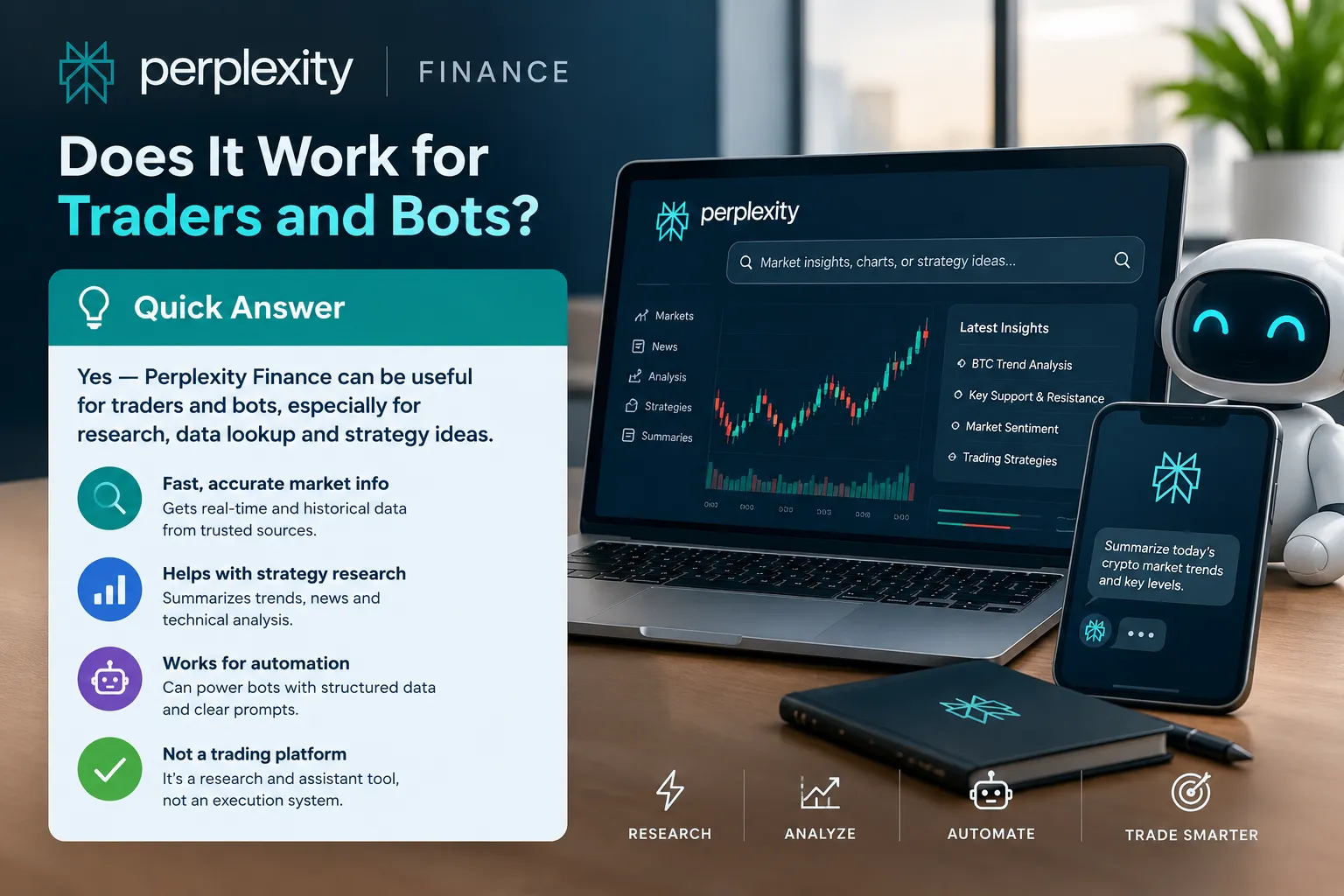
Perplexity Finance is a research layer, not a trading system. It pulls near-real-time quotes, fundamentals, earnings transcripts, analyst estimates, filings and ETF data, then answers questions in plain English with citations attached. For swing traders and anyone doing homework before a trade, that’s genuinely useful. For scalpers, order routing, or tick-level bot logic, it isn’t built for the job and Perplexity doesn’t claim otherwise. The Finance Search tool landed in the Perplexity Agent API on May 6, 2026, and costs $5 per 1,000 tool invocations as of October 2026.
What You Should Know
- Finance Search shipped in the Perplexity Agent API on May 6, 2026, combining licensed financial datasets, real-time market data and cited web sources.
- Tool cost is $5 per 1,000 invocations (about half a cent per call) per Perplexity’s October 2026 documentation, with model tokens billed separately on top.
- The Agent API endpoint is
POST https://api.perplexity.ai/v1/agentandfinance_searchcan be chained with web search and URL fetching in one workflow. - No order routing. Ever. Perplexity has no broker integration, no execution, no position management. Your broker still does all of that.
- On October 2, 2026, Perplexity Computer added TradingView Lightweight Charts for inline candlesticks, volume and moving averages. Charting is not Level 2 market access.
What Is Perplexity Finance?
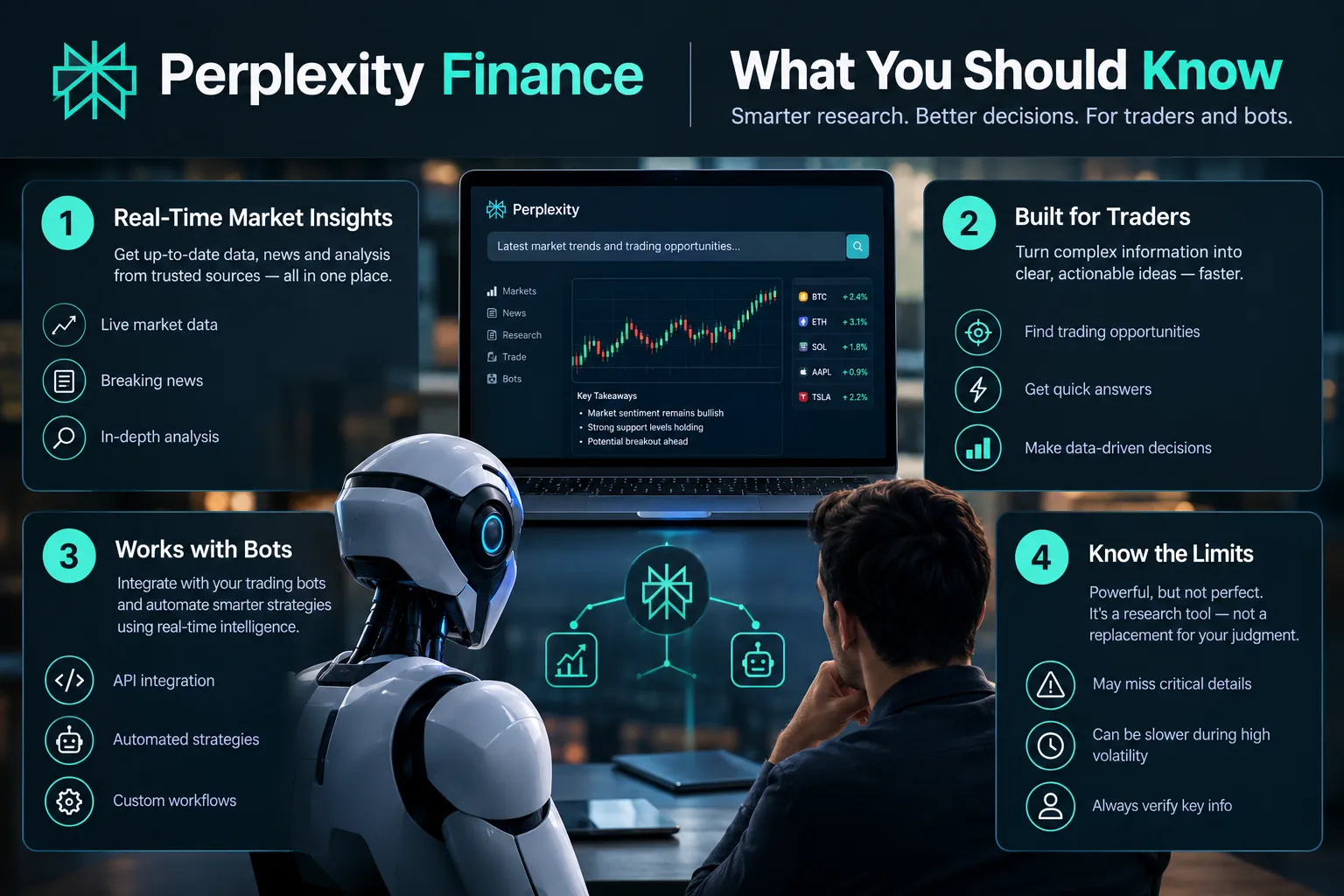
Perplexity Finance is the finance-specific side of Perplexity’s AI search product, plus a finance_search tool inside the Agent API that developers can call programmatically. It answers market questions in natural language and shows you where each number came from.
Think of it as a research analyst who reads fast, never sleeps, and occasionally cites the wrong page. Useful. Not infallible.
What it actually retrieves
Per Perplexity’s Finance Search documentation (materially updated October 19-22, 2026), the tool can pull:
- Near-real-time prices, plus pre-market and after-hours data
- OHLCV ranges from 1-minute bars up to 1-month bars
- Financial statements and fundamentals
- Earnings data and earnings call transcripts
- Analyst estimates
- Insider activity and corporate actions
- ETF details and constituents
- Segment-level KPIs
The consumer-facing Perplexity Finance pages add market overview sections, an earnings calendar, a watchlist, politician-trading disclosures, prediction-market data and fixed-income coverage. Coverage depth varies by symbol, exchange, asset class and the underlying data provider, which matters more than most people realize.
What perplexity ai stocks research feels like in practice
Ask it “what drove the move in a stock after last quarter’s earnings,” and it will typically pull the reported figures, surface the relevant filing or transcript section, and explain the reaction with links. That’s a 20-minute manual job compressed into about 30 seconds.
Ask it “what’s the best stock to buy tomorrow,” and you’ll get a hedged, citation-stuffed non-answer. Correctly so.
Perplexity Finance is strongest when the question has a verifiable answer sitting in a document somewhere.
On October 2, 2026, Perplexity Computer integrated TradingView Lightweight Charts, so you can now ask for candlesticks, volume overlays, moving averages and cross-asset comparisons as conversational follow-ups. Nice for presentation and quick visual context. It’s not a replacement for a real charting platform with drawing tools, alerts and depth of market.
What Does Perplexity Finance Cost?
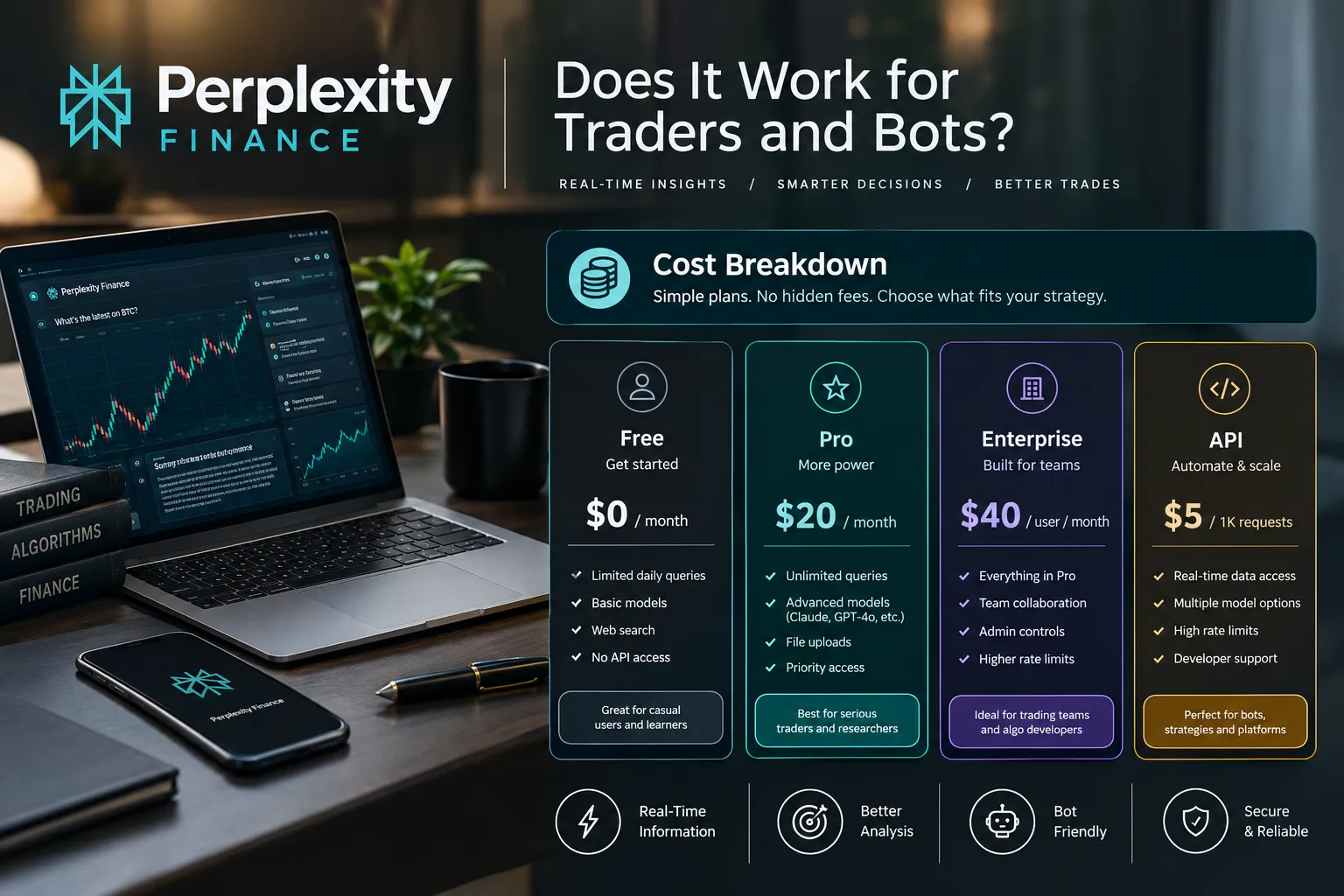
The consumer Finance pages are accessible on Perplexity’s free tier, with heavier usage and advanced models sitting behind the paid Pro subscription. The API side is separately metered: $5 per 1,000 Finance Search invocations as of October 2026, which works out to $0.005 per tool call.
Check the official Perplexity pricing page for current consumer subscription tiers, since those change more often than the API rate card.
The part that catches developers out
One prompt is not one invocation. A question like “compare the last three quarters of revenue for two companies and explain the margin gap” can trigger several Finance Search calls, and each one meters. Your model-token charges stack on top of the tool fee.
So the headline half-cent is the floor, not the ceiling.
| Cost layer | What triggers it | Notes |
|---|---|---|
| Finance Search tool | Each finance_search invocation | $5 per 1,000 calls (Oct 2026 docs) |
| Model tokens | Input plus output on every request | Billed separately, varies by model |
| Web search / URL fetch | Chained tools in the same agent run | Metered on their own terms |
| Consumer Pro plan | Interactive use in the browser | See Perplexity’s official pricing page |
Decision rule: if you’re running fewer than a few thousand research queries a month, the API cost is rounding-error territory compared to one bad trade. If you’re planning to poll quotes on a loop, you’ve picked the wrong tool and the bill will tell you so.
Common mistake
People compare the $0.005 tool fee against a $2,000/month data terminal and conclude they’ve found a bargain. Different products. One answers research questions; the other delivers a licensed, low-latency feed with uptime guarantees. Price-to-value only means something inside the same category.
How Do You Use Perplexity Finance Step by Step?
Open the Finance section, enter a ticker, ask one narrow question, then verify the citation before you act on anything. That’s the whole loop. The discipline lives in step four.
Here’s how to use Perplexity Finance without turning it into another tab you ignore:
- Go to the Finance section. You should see market overview panels, an earnings calendar and a search field for tickers. If you only see the standard chat box, you’re in general search, not Finance.
- Enter a single ticker. You should get a quote, a chart and summary fundamentals. Confirm the exchange and the quote timestamp. A quote without a timestamp is a quote you shouldn’t trade off.
- Ask one question at a time. Multi-part prompts produce multi-part mush. “Summarize the most recent earnings call and name the three largest revenue segments” beats “tell me everything about this company.”
- Check the citations. Every claim should carry a link. Click two of them. If a number in the answer doesn’t appear on the page it points to, the answer is wrong and you just caught it for free.
- Ask a follow-up for the chart you want. Since the TradingView Lightweight Charts integration on October 2, 2026, you can request candlesticks, a volume overlay, a moving average, or a different time range conversationally.
- Save the ticker to a watchlist. Treat it as a research queue, not a buy list. Your actual watchlist should still live where your alerts and stops live.
- Move to your broker to act. Perplexity doesn’t place orders. Entry, exit, position sizing and stop loss all happen somewhere else.
Perplexity Finance prompts that actually work
Narrow, verifiable, document-anchored. That’s the pattern.
- “What were the reported revenue and EPS figures in the most recent quarterly report for [ticker], and link the filing.”
- “Summarize management’s guidance commentary from the latest earnings call transcript for [ticker].”
- “List insider transactions reported for [ticker] in the last 90 days with filing dates.”
- “What corporate actions, splits or dividends, are on record for [ticker] this year?”
Prompts that waste your money
- “Will [ticker] go up tomorrow?”
- “Give me the best setup for this week.”
- “Is this a good entry?”
An AI that retrieves documents cannot tell you where price goes next. Asking anyway is how analysis paralysis gets a new costume. If you want a process for sizing the trade once you’ve done the research, the mechanics in the position sizing mistake that wipes out most new traders matter a lot more than any prompt.
Can Perplexity Finance Screen Stocks and Summarize Earnings?
Earnings summarization is where Perplexity Finance is strongest, because the answer lives in a document it can retrieve and cite. Screening is where it’s weakest, because a real screener runs deterministic filters against a full universe and a language model does something fuzzier.
Task reliability table
| Task | Works | Needs a check | Risk if you skip the check |
|---|---|---|---|
| Earnings call summary | Yes, strong | Did it use the latest call? | Summarizing a stale quarter |
| Reported financials | Yes | Does the figure match the filing? | Trading a misread line item |
| Filing lookup | Yes | Is the cited section the right one? | Quoting the wrong disclosure |
| Analyst estimates | Usually | Whose estimates, and as of when? | Stale consensus |
| ETF constituents | Usually | Rebalance date | Outdated holdings |
| Stock screening | Partially | Is the universe complete? | Missing candidates entirely |
| Intraday scanning | No | Latency, not accuracy | Late entries, chasing |
| Price prediction | No | Nothing to check | Confusing fluency with edge |
How to test it yourself, not take anyone’s word
Don’t trust a review, including this one. Run a verification sprint:
- Pick ten tickers you already know well across different market caps and two exchanges.
- For each, ask Perplexity Finance one factual question with a single correct answer (last reported revenue, dividend ex-date, top ETF holding).
- Independently check every answer against the primary source, the filing or the exchange page.
- Log hits, misses and “technically right but outdated.”
- Repeat for five low-liquidity or non-US names, where coverage thins out fastest.
Fifteen questions, maybe 40 minutes. You’ll learn more about whether perplexity finance trading research fits your workflow than any benchmark will tell you.
About that benchmark
Perplexity says Finance Search ranked at the top of FinSearchComp T1, a time-sensitive financial-data retrieval benchmark measured after market close, with the highest accuracy and lowest cost per correct answer in its tested cohort. Take it seriously. Also take it as vendor-reported: the public announcement doesn’t publish the full dataset, sample size, confidence intervals or an independently reproduced score.
And the benchmark measures retrieval accuracy, not returns. A system can fetch the correct EPS figure and still lose you money through latency, slippage, transaction costs or plain bad interpretation. Nothing in the available material demonstrates a live, risk-adjusted edge. Retrieval accuracy and trading performance are separate claims and should never be merged into one.
Does Perplexity Finance Have an API for Bots?
Yes. finance_search is available in the Perplexity Agent API at POST https://api.perplexity.ai/v1/agent, and it can be chained with web search and URL fetching inside a single agent run. What it does not have is order routing, position management, margin handling or any broker connection.
What the perplexity finance api gives a bot
- Structured retrieval of quotes, OHLCV bars, fundamentals, earnings, estimates, insider activity, corporate actions and ETF data
- Multi-step reasoning across chained tools, for example: pull the latest earnings figures, fetch the filing, explain the price reaction
- Cited sources on outputs, so your logs show provenance instead of vibes
- Per-call metering at $5 per 1,000 invocations, so cost scales predictably with research volume
What it does not give a bot
- No execution. No
place_order. Your broker API does that. - No guaranteed tick-level latency. Near-real-time is not the same as real-time.
- No Level 2 depth, no order book, no market-maker data.
- No uptime or data-quality SLA framed for live trading systems.
- No universal symbol coverage. Some tickers and fields simply return nothing.
The sane architecture for perplexity trading workflows
Put Perplexity in the research layer, never the execution layer:
Signal generation (your scanner or model) → context enrichment (Finance Search: what’s the catalyst, what did the filing say, is there insider activity) → rule check (your own risk rules) → execution (broker API).
That ordering is the whole game. If a language model sits between your signal and your fill, you’ve added latency and non-determinism to the one part of the stack that needs neither. Builders working on this layer can see how the fully automated end of the market is structured in our rundown of fully automated AI trading bots, and the budget end in free AI trading bots.
Edge case worth naming
Agent API calls are non-deterministic by design. Run the same prompt twice and you may get two differently-worded answers. That’s fine for a research note. It is a nightmare for a system that needs the same input to produce the same output every time. If your bot requires determinism, parse structured fields and never let free-text output drive a trade decision.
Does Perplexity Finance Work for Day Traders and Scalpers?
Mostly no. Day traders and scalpers need deterministic, low-latency data and fast execution. Perplexity Finance is a retrieval and reasoning layer with documented delay, variable coverage and no execution path.
Here’s the honest split:
- Scalpers: no. A response measured in seconds is a lifetime when you’re working a one-minute chart.
- Day traders: useful pre-market and post-close. Catalyst checks, gap research, earnings context for the watchlist. Not during the session when you’re reading the tape.
- Swing traders: this is the sweet spot. Multi-day holds give retrieval latency room to be irrelevant, and the research depth genuinely helps.
- Position investors and fundamental analysts: strong fit. Filings, segment KPIs, estimates, transcripts, all cited.
A practical test before you build it into a routine: measure your own alert-to-click gap with the trader reaction time test. If you’re already 800 milliseconds behind your own alerts, adding a research query mid-trade isn’t going to fix anything.
If your edge depends on being fast, Perplexity Finance is not part of your edge. If your edge depends on being right about why something moved, it might be.
Does Perplexity Finance Provide Real-Time Market Data, and Does It Cover Crypto?
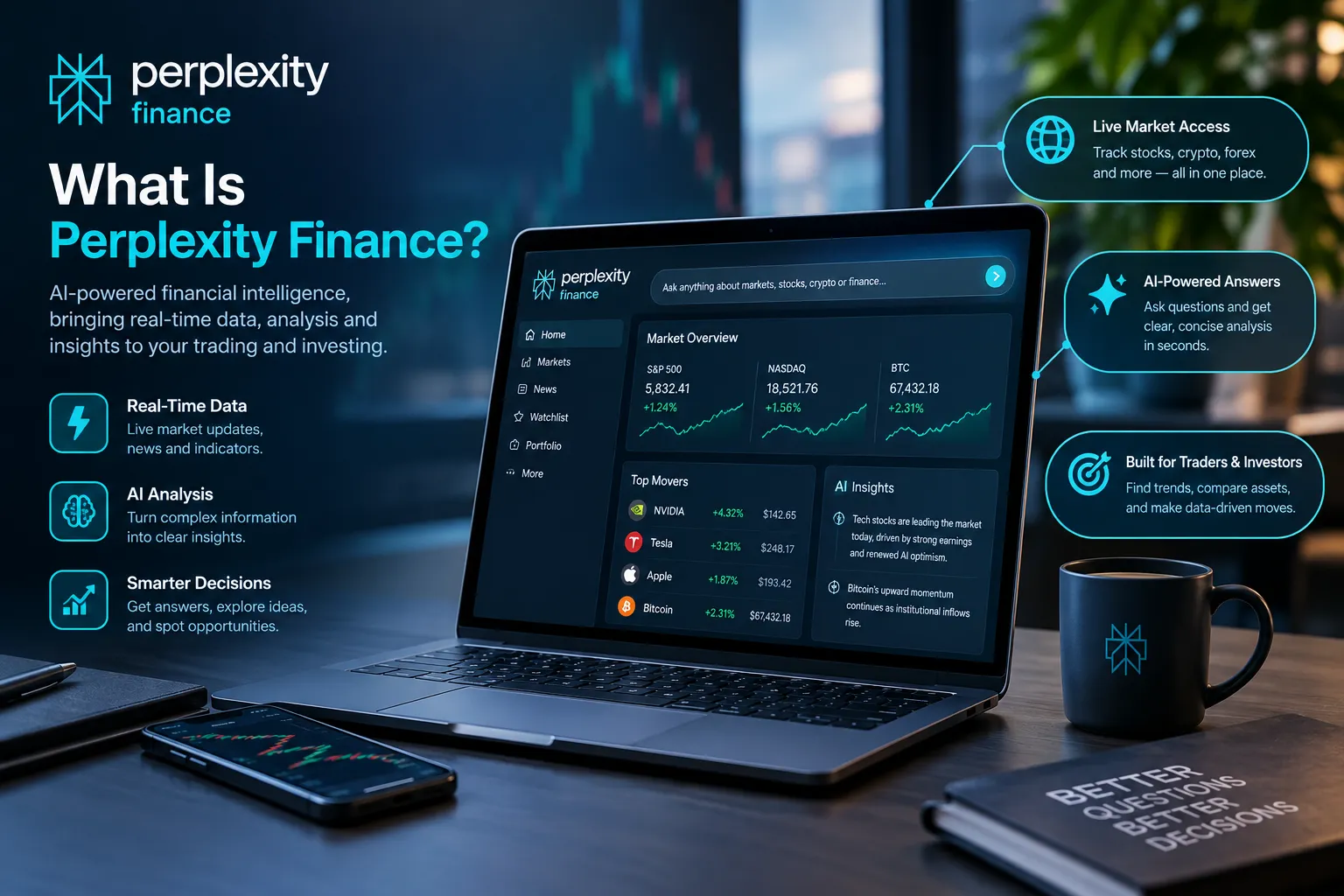
Perplexity’s documentation describes near-real-time prices with pre-market and after-hours data, plus OHLCV bars from one minute to one month. “Near” is doing load-bearing work in that sentence, and the company says so rather than hiding it.
On asset coverage:
- US equities and major ETFs: strongest coverage, deepest fundamentals, most reliable earnings and filing retrieval.
- International equities: works, but coverage and freshness vary by exchange and provider. Verify the timestamp every time.
- Fixed income: the consumer Finance pages expose a fixed-income section. Depth is nothing close to a professional bond desk.
- Crypto: price and market data surface in Finance queries, but crypto lacks the filings, transcripts, estimates and segment KPIs that make the tool strong on equities. You get quotes and news, not fundamental documents, because the documents mostly don’t exist.
Decision rule: if the asset has an SEC filing behind it, Perplexity Finance adds real research value. If it doesn’t, you’re using a well-cited quote machine.
For anyone evaluating data plumbing for a bot rather than a browser, the tradeoffs are similar to the ones covered in our look at Yahoo Finance API alternatives.
Perplexity Finance vs Bloomberg Terminal and Other Platforms
Perplexity Finance is a low-cost research alternative to a terminal, not a terminal replacement. Independent commentary from August 2026 landed on the same conclusion: Bloomberg’s durable advantages are its institutional messaging network, fixed-income depth, professional workflows and execution ecosystem. None of those are things an AI search product is trying to replicate.
| Platform | Price posture | Best for | The catch |
|---|---|---|---|
| Perplexity Finance | Free tier plus paid Pro; API metered per call | Fast cited research, earnings synthesis, filing lookup | No execution, variable coverage, near-real-time not real-time |
| Bloomberg Terminal | Institutional, five figures annually | Fixed income, chat network, professional workflow, execution | Price and learning curve put it out of retail reach |
| Dedicated scanner (e.g. Trade Ideas class) | Monthly subscription | Intraday setups, real-time scanning, alerting | Built for scanning, weak on narrative research |
| Broker platform | Usually bundled free | Orders, routing, fills, positions, margin | Research tools are typically an afterthought |
Worth seeing how dedicated scanners stack up against each other before you assume an AI chat tool replaces one: compare Lune vs Trade Ideas or Koyfin vs InsiderFinance for the research-platform angle.
The clean framing is research before execution. Perplexity helps you find catalysts, read filings, compare companies and monitor earnings. A broker still handles orders, routing, fills, margin, positions and compliance. Those are two different buildings.
Where Does Perplexity Finance Fall Short?
Three places, and they’re all structural rather than fixable with a better prompt.
Data freshness. Near-real-time is the documented standard, and freshness varies by symbol, exchange and provider. A quote that’s a few seconds stale is irrelevant for a two-week swing and fatal for a scalp. Always read the timestamp.
Citation errors. This is the one that bites. Retrieval systems sometimes attach a real link to a number that doesn’t appear on that page, or cite the right company and the wrong quarter. The citations create confidence, and confidence is exactly what you should not hand over for free. Click through on anything you plan to risk money on.
No execution, no risk layer. There’s no position sizing, no stop placement, no portfolio exposure math, no compliance. It’s a research assistant that will happily describe a trade it cannot take, manage, or get you out of.
Two smaller ones worth naming: coverage gaps on thin and non-US names, and non-determinism, which makes free-text output a poor foundation for automated logic.
Common Mistakes People Make With Perplexity Finance
The most expensive mistake is treating a cited answer as a verified answer. The second most expensive is asking it to predict.
- Trusting the citation without clicking it. Links look like proof. They’re a starting point.
- Asking for predictions. Retrieval accuracy and forecasting are unrelated capabilities. Fluent language is not a forecast.
- Using it mid-session on a fast setup. By the time you’ve read the summary, the move is done and you’re chasing an overextended chart.
- Replacing a screener with it. Language models produce plausible lists, not complete ones. A real screener runs the full universe against hard filters.
- Polling quotes on a loop through the API. Expensive, slow, and wrong tool. Use a market data feed.
- Collecting it as yet another tab. Six research tools and still no plan is the problem, not the solution. Pick the three you’ll use, write the rules down, run it 30 days.
If you’re in that last camp, the honest read on what traders are running day to day is in the AI tools for stocks traders won’t admit they’re using.
Is Perplexity Finance Worth It for Retail Traders?
For swing traders, fundamental researchers and anyone who hates reading 80-page filings, yes, at the price. For scalpers, intraday traders and bot builders expecting an execution layer, no.
Worth it if you:
- Hold positions for days to weeks and research before you enter
- Trade earnings season and want transcript and guidance context fast
- Build research agents where half a cent per call is noise
- Currently spend an hour a week manually digging through filings
Not worth it if you:
- Need tick-level data or Level 2 depth
- Trade a fast intraday strategy where seconds decide outcomes
- Want a complete screener with deterministic filters
- Expect anything resembling order placement
Paper trade the workflow first. Run your Perplexity-informed research process alongside your normal one for a month, log both, then compare. Letting results argue back is cheaper than letting conviction do it. If you need somewhere to run that test, our breakdown of paper trading apps covers the options, and the best AI trading apps covers what sits next to it.
What Do Traders Say About Perplexity Finance on Reddit?
Sentiment on perplexity finance reddit threads runs across r/algotrading, r/Daytrading, r/stocks and r/investing, and it splits along a predictable line: people using it for research report it saves real time, people expecting a trading edge report disappointment.
Rather than quote threads that may have been edited, deleted or voted into obscurity since publication, here’s what to check yourself and how to read it:
- r/algotrading is where API questions land. Search for the endpoint name and read the complaints about latency and determinism, not the praise.
- r/Daytrading skews negative on any non-execution tool, which is useful signal, because that community tests speed hard.
- r/stocks and r/investing skew more positive on research use, which also fits the tool’s actual strengths.
- Reddit carries a complaint bias. People post when frustrated. Thin discussion on a tool is its own finding, and AI finance tools generally have shallower unsolicited discussion than brokers or scanners.
Read the gap between solicited reviews and unsolicited forum threads. That gap is usually the finding. A tool praised on vendor-sourced review sites and quietly criticized on Reddit is a different product from one rated consistently in both.
For the structured version of this, see our Perplexity Finance tool breakdown.
What Are the Alternatives to Perplexity Finance?
If Perplexity Finance doesn’t fit, the alternative depends on which job you were hiring it for: research, scanning or execution.
| Alternative | Price posture | Best for | The catch |
|---|---|---|---|
| Dedicated real-time scanner | Monthly subscription, mid to high | Intraday setups, live alerts, deterministic filters | No narrative research, steep learning curve |
| Research terminal (Koyfin class) | Free tier plus paid tiers | Fundamentals, charts, screens, dashboards | Manual work; no AI synthesis of transcripts |
| Trade journaling platform | Low monthly | Reviewing your own executed trades | Backward-looking only; no idea generation |
Each solves one job well. None solves all three, which is why the tool-stack problem never fully goes away. Comparisons worth reading: TradesViz vs TraderSync for journaling, ProRealTime vs Trade Ideas for charting against scanning, and the full list of Perplexity Finance alternatives. Broader AI options are catalogued in the best AI for trading and the AI trading apps category.
Frequently Asked Questions
What is Perplexity Finance?
Perplexity Finance is the finance-focused part of Perplexity’s AI search product, plus a finance_search tool in the Agent API. It retrieves quotes, fundamentals, earnings transcripts, analyst estimates, filings, insider activity and ETF data, then answers questions in natural language with citations attached to each claim.
Is Perplexity Finance free?
The consumer Finance pages are available on Perplexity’s free tier, with heavier usage behind paid Pro. The API is separately metered at $5 per 1,000 Finance Search invocations as of October 2026, plus model-token charges. Check Perplexity’s official pricing page for current consumer plan details.
Does Perplexity Finance have an API?
Yes. Finance Search became available in the Perplexity Agent API on May 6, 2026, at the endpoint POST https://api.perplexity.ai/v1/agent. It can be chained with web search and URL fetching in a single agent run. There is no order routing or broker integration of any kind.
Can Perplexity pick stocks?
No. It retrieves and summarizes financial data, it does not forecast prices. Perplexity’s reported FinSearchComp T1 benchmark result measures retrieval accuracy after market close, not investment returns. Correct data retrieval and profitable trading decisions are separate things.
How do you use Perplexity Finance?
Open the Finance section, enter a single ticker, ask one narrow factual question, click through at least two citations to verify, then act through your broker. Narrow document-anchored prompts work. Prediction prompts waste money and give you false confidence.
Can trading bots integrate with Perplexity Finance?
Yes, through the Agent API, as a research or enrichment layer. Use it to add context to a signal your own system already generated, then route orders through your broker API. Never place a language model between signal and execution.
Our Take
Perplexity Finance is a research assistant with a good memory and a fast reader’s eye. It is not a trading system, and the only people pretending otherwise are selling something.
Used right, it collapses an hour of filing-digging into a few minutes with citations you can verify. Used wrong, it becomes the seventh tab you open and the second source of false confidence in your process. The difference is whether you click the links.
Build the process first. The tools are the easy part.
Related: compare the brokers that handle the execution side in the FullStack Alpha broker reviews, and browse more research tool breakdowns at AI Stock Trading Bots.
Built a bot worth testing? Submit it here.
Stay alpha.
The FullStack Alpha research desk tests AI trading bots on paper and live accounts. Reviewed and edited by Jay Rocco, Founder and Editor.
