

Jay Rocco is the Founder and Editor of FullStack Alpha. He has tested 200+ AI stock tools since 2022 and run 15+ AI trading platforms on live accounts with his own money. He reviews the software. He does not tell you what stocks to buy.
Last updated: September 29, 2026
Quick Answer
Interactive Brokers paper trading is a free simulated account that comes preloaded with $1,000,000 in virtual buying power and mirrors live market data and order types. Every new IBKR client gets one automatically; older accounts may need to request it through Client Portal.[1][3] It’s the standard staging ground for testing trading bots, API scripts, and new strategies before a single real dollar is on the line.[7][9]
On AI Stock Trading Bots: go deeper in our Paper Trading guide, and see How We Test for the method behind every score.
Key Takeaways
- Interactive Brokers paper trading gives you $1,000,000 in simulated equity by default, and it resets when the value drops too low or on request.[1][4]
- New IBKR accounts get a paper account automatically once the live account is approved and funded. Older accounts may need to request one.[2][3]
- Paper accounts are margin accounts by default. You cannot switch them to cash-only.[3][5]
- Fills are simulated from the top of the book only. Some order types (VWAP, Auction, RFQ, Pegged to Market) aren’t supported.[1][4]
- You can test bots and API scripts through TWS or the Client Portal Gateway using dedicated paper credentials.[7][10]
- Mutual funds and penny-priced US options aren’t tradeable in paper mode.[1][4]
- Paper trading is free. It costs nothing beyond having a funded (or approved) IBKR account.[3]
- This is education, not financial advice. Simulated results don’t guarantee anything about live performance.
What Is Interactive Brokers Paper Trading?
Interactive Brokers paper trading is a simulated brokerage account that lets you place trades with fake money against real, live market prices. It’s built into Trader Workstation (TWS), IB Gateway, and Client Portal, and it runs alongside your real account without touching it.[1]
The official IBKR documentation is blunt about what this actually is: a simulator, not a shadow exchange. Trades never route to a real exchange or clearing house. Settlement is virtual. Fills are modeled, not executed.[1][2]
That distinction matters. A paper fill tells you what should happen under normal conditions. It does not tell you what happens when liquidity dries up at 3:58 PM on a Friday. Keep that gap in your head every time you look at a paper P&L.
How Do You Set Up an Interactive Brokers Paper Trading Account?
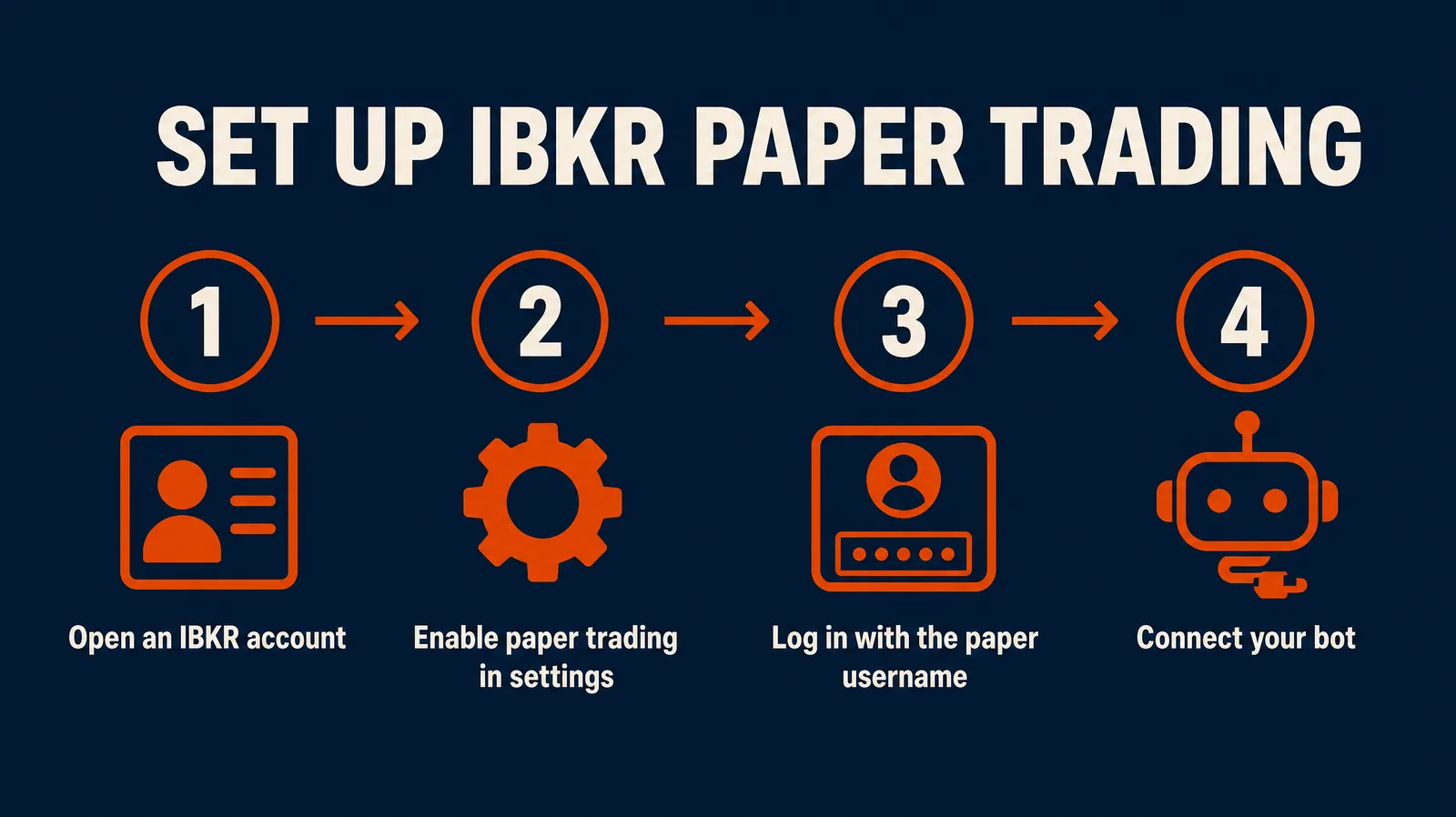
Setting up an Interactive Brokers paper trading account is now largely automatic. Once your live account application is approved and funded, IBKR provisions a linked paper account you can access through TWS, IB Gateway, or Client Portal.[2][3][5]
If you opened your account before this became standard, or you don’t see a paper account in your dashboard, here’s the fix:
- Log into Client Portal and go to Settings, then Paper Trading Account.[8]
- Request a paper account if one isn’t already listed.[2]
- Note your paper username and paper account number. You’ll need both for API work.[7][8]
- Launch TWS or IB Gateway and log in with the paper credentials, not your live ones.
- Confirm the account is linked to live market data if you want realistic price action instead of delayed quotes.[4][7]
One clean setup, five minutes, no fee. That’s the whole barrier to entry.
How Much Virtual Money Do You Get With Interactive Brokers Paper Trading?
Interactive Brokers paper trading accounts start with $1,000,000 in “Equity with Loan Value,” a balance that moves up and down as if the trades were real.[1][3][4] That’s the default for every new paper account, no tiers, no upgrade path to more.
A few practical notes on the balance:
- It fluctuates with your simulated positions, just like a live margin account.
- If it drops too low from bad trades, you can reset it through Client Portal.
- $1,000,000 is a testing sandbox, not a target. Sizing a paper trade the way you’d size a $2,000 live account is the entire point.
Practical takeaway: trade your paper account at the size of the real account you actually plan to fund. Testing a strategy with $1,000,000 in buying power when your live account will hold $5,000 teaches you nothing about your real risk-reward.
Is Interactive Brokers Paper Trading Free?
Yes. Interactive Brokers paper trading costs nothing beyond having an approved account.[3] There’s no separate subscription, no simulator fee, no premium tier that adds more virtual cash.
The only cost most traders overlook is market data. If you want live, real-time quotes feeding your paper account instead of delayed data, you may need an active market data subscription on your linked live account, since IBKR ties data entitlements to the account, not the simulation mode.[4][7]
What Limits and Restrictions Does Interactive Brokers Paper Trading Have?
Interactive Brokers paper trading has real functional limits, and most of them come down to one thing: it simulates fills, it doesn’t execute them. That changes behavior at the edges.
| Limit | What it means |
|---|---|
| Top-of-book fills only | No access to deep order book data; simulated fills can be more forgiving than a real fill in a choppy tape |
| Some order types unsupported | VWAP, Auction, RFQ, and Pegged to Market orders don’t work in paper mode[1][4] |
| Margin-only structure | All paper accounts are margin accounts by default; this cannot be changed to cash[3][5] |
| No mutual funds | Mutual fund trading isn’t available in the simulator[1][4] |
| No penny-priced US options | Sub-penny and penny option pricing isn’t simulated[1] |
| Limited portal functions | Some Client Portal features are restricted for paper accounts, though core TWS tools stay intact[1][5][6] |
Common mistake: assuming a stop order will behave identically in paper and live mode. Stops and complex orders are always simulated in paper trading, so slippage and fill behavior can differ meaningfully from a real order hitting a real market.[1][4]
How Long Can You Keep a Paper Trading Account Active on Interactive Brokers?
A paper trading account stays active as long as it’s linked to your live IBKR account and you log into it periodically. IBKR doesn’t publish a hard expiration date for paper accounts tied to an active live account.[8]
What can trip you up: extended inactivity across your entire IBKR relationship, or closing the live account it’s linked to, can affect paper account access. If you’re planning a multi-month bot test, log in every few weeks even if you’re not actively trading, just to keep the account current.
Can You Use Paper Trading to Test Trading Bots on Interactive Brokers?
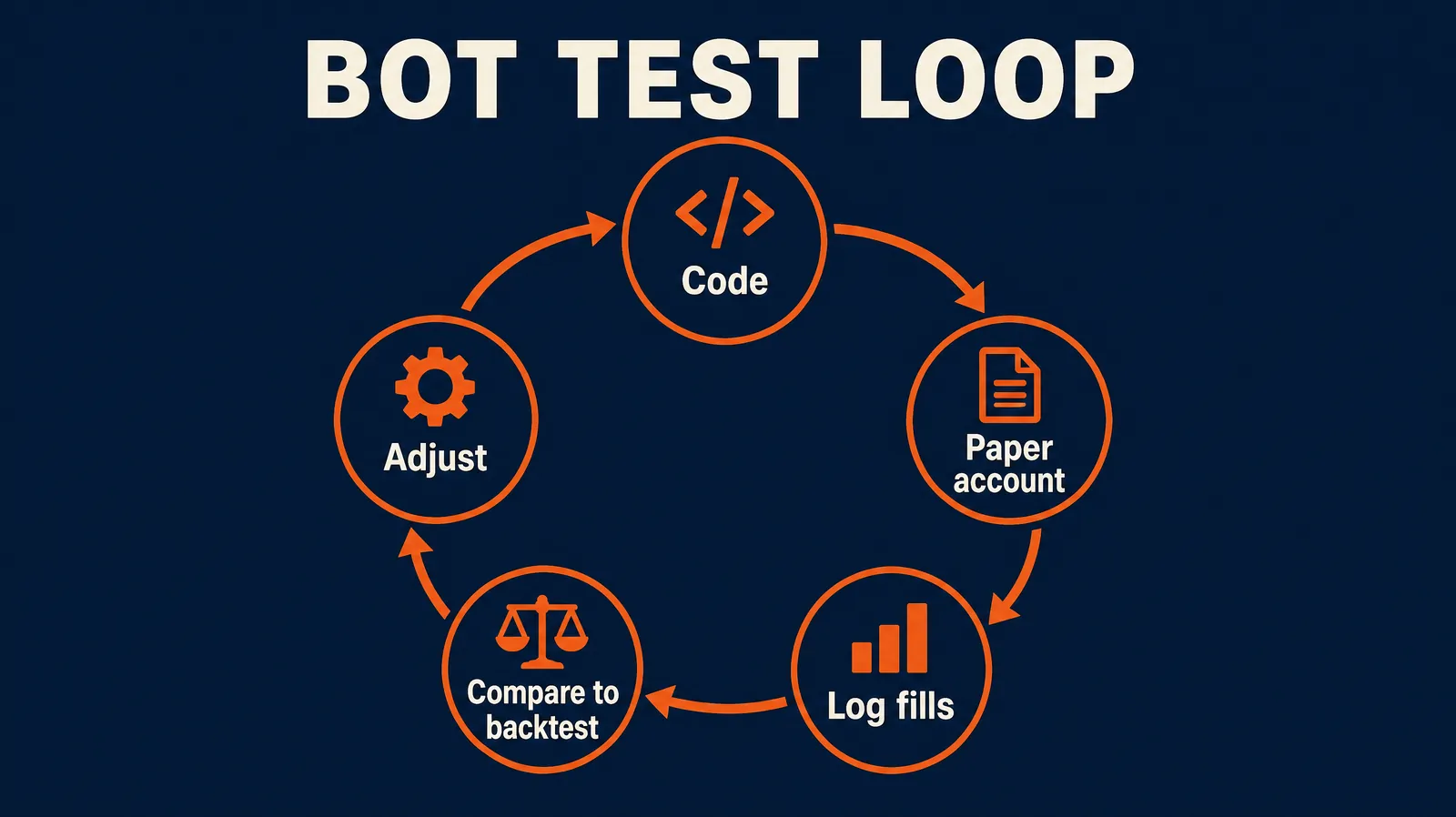
Yes, and it’s exactly what IBKR’s own API documentation recommends. The Web API and TWS API guides explicitly tell developers to authenticate and run bots against the paper environment first, before ever pointing a script at a funded account.[7]
Here’s the practical workflow:
- Grab your paper username and paper account number from Client Portal settings.[7][8]
- Connect your script or bot to TWS or IB Gateway on the paper port (commonly 7497 for TWS paper trading).[10]
- Enable API access and disable read-only mode so orders can actually route.[10]
- Set hard caps in your config: max trades per day, max portfolio exposure, and confirm
PAPER_TRADING=truebefore you run anything.[10] - Log every connection and order attempt so you can audit behavior later.
Practical takeaway: paper trade it first, always. A bot that’s never seen a real fill, a real spread, or a real API disconnect has no business touching a funded account. If you’re building or evaluating an execution bot, the best AI trading bot roundups and this breakdown of what to check before you automate trades are worth reading before you write a line of code. Building it yourself? Start with our Build a Trading Bot guide.
Can You Run Algorithmic Trading Strategies on an Interactive Brokers Paper Account?
Yes. Nearly every TWS order type and contract type available to live traders is also available in paper mode, which is why quants and retail developers use it as the default staging environment for algorithmic strategies.[1][5][6]
Best practice from experienced bot builders:
- Run separate Gateway instances for paper and live so you never accidentally cross-wire credentials.
- Schedule test runs around market close to catch end-of-day behavior without real exposure.
- Validate Python bots and any AI-driven signal logic in paper mode for weeks, not hours, before flipping to a funded account.
If you’re still building the strategy logic itself, start with how to find a trading edge before you risk a single dollar and how to backtest a trading strategy without fooling yourself. A bot without a tested edge is just an expensive way to lose money faster.
How Realistic Is Interactive Brokers Paper Trading Compared to Live Markets?
Interactive Brokers paper trading is realistic for price action, charting, and order mechanics, but it’s not realistic for execution quality. Because fills are simulated from the top of the book, you often get cleaner, faster fills than you would in a genuinely choppy tape.[1][4]
Where the gap shows up:
- Slippage: Paper mode tends to understate slippage on fast-moving or low float names.
- Partial fills: Real markets can leave you half-filled during volatility. Paper mode often doesn’t replicate that faithfully.
- Psychology: The biggest gap isn’t technical. It’s emotional. Losing simulated money doesn’t trigger the same revenge trading impulse that losing real money does.
Decision rule: treat paper trading as a mechanics test, not a psychology test. It tells you if your system works. It won’t tell you if you’ll actually follow it under pressure.
What’s the Difference Between Paper Trading and Live Trading on Interactive Brokers?
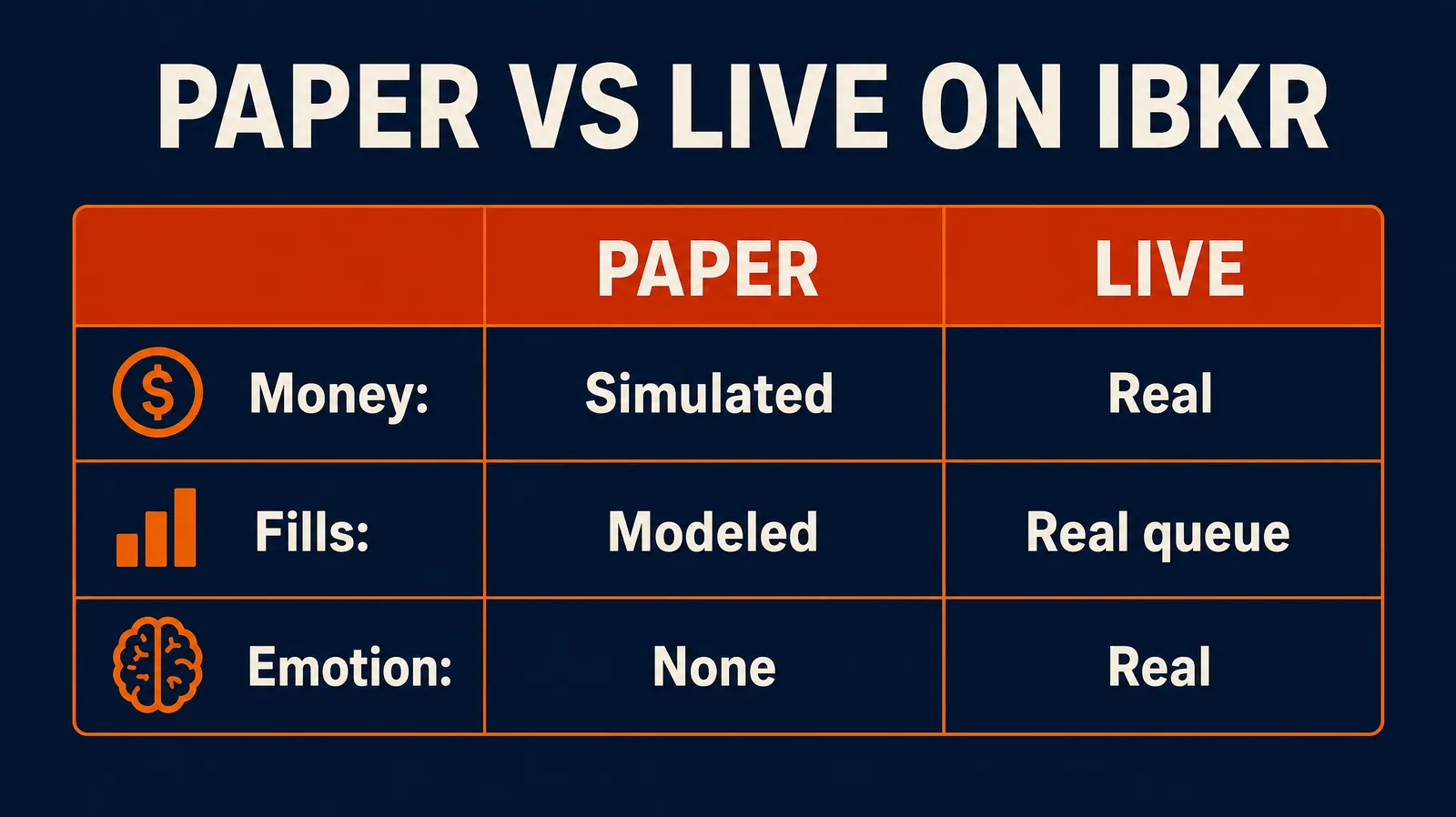
The core difference is that paper trading never touches a real exchange, so no trade is legally executed, cleared, or settled.[1][2] Live trading does all three, with real money, real regulatory reporting, and real consequences for getting stopped out.
Beyond that, the practical differences are: paper accounts are margin-only, some order types and asset classes are restricted, and portal functionality is trimmed down compared to a live account.[3][4][5]
Can You Switch From Paper Trading to Real Money on Interactive Brokers?
You don’t “convert” a paper account into a live one. You fund your actual live IBKR account separately, and the paper account keeps running alongside it as a permanent testing environment.[2][3]
That structure is a feature, not a bug. You keep the sandbox even after you go live, so you can keep testing new setups without disturbing the account that holds your actual capital.
Why Isn’t My Paper Trading Account Working on Interactive Brokers?
The most common reason a paper account “isn’t working” is logging in with live credentials instead of the separate paper username, or connecting a bot to the wrong port.[7][10] Check these first:
- Confirm you’re using the paper-specific username and account number from Client Portal, not your live login.[8]
- Verify API access is enabled and read-only mode is off if you’re running a bot.[10]
- Check that your live account is still active and approved. Some paper account functions are tied to a live account in good standing.[3]
- If data looks delayed or frozen, confirm the paper account is linked to a live data feed.[4][7]
What Are Common Mistakes People Make With Interactive Brokers Paper Trading?
The single biggest mistake is oversizing. Trading the full $1,000,000 balance instead of the size of your actual planned account builds habits that don’t transfer.[1] Beyond that:
- Ignoring order type gaps. Building a strategy around VWAP or Pegged to Market orders that simply don’t exist in paper mode, then getting surprised when live behavior differs.[1][4]
- Skipping the stress test. Never running the bot or strategy through a genuinely choppy, low-liquidity session.
- Treating a winning streak as proof. A clean run in paper mode with forgiving simulated fills isn’t the same as surviving a real bull trap or a dead cat bounce with real slippage.
- Never resetting the account. Letting a blown-up paper balance sit there instead of resetting and running the test again with tighter risk management.
Systems over hacks: the point of paper trading isn’t to prove you’re right. It’s to find out where you’re wrong before it costs anything.
Is Interactive Brokers Paper Trading Good for Beginners?
Yes, with a caveat. It’s an excellent way to learn order entry, platform navigation, and basic risk management without financial risk, which is exactly the use case IBKR’s own training material highlights.[9] The caveat: it won’t teach the emotional discipline that live trading demands, because losing fake money doesn’t hurt.
Beginners get the most value by treating paper trading as platform training, not strategy validation. Learn TWS. Learn order types. Learn how support and resistance actually look on a live chart. Then size a real account small and build discipline with money that’s actually yours.
Our Take
Interactive Brokers paper trading is a free, $1,000,000 simulated account built into TWS, IB Gateway, and Client Portal that mirrors live pricing without real execution.[1][3] It’s a solid platform trainer for beginners and the standard staging environment for anyone building or testing an automated bot.[7][9]
The next step is simple: open the paper account, wire it up to a bot or strategy sized like your real account, and run it for weeks, not hours, before you touch live capital. If you’re evaluating which automated tools are worth that testing time, start with automated trading bot results and the fully automated AI trading bot directory, and read one builder’s honest, unfiltered attempt in my AI built me a trading bot and neither of us knows what we’re doing before you write your own.
This article is education, not financial advice. Paper trading results don’t predict live performance, and no simulated strategy guarantees a real return.
There are 200+ AI trading tools catalogued in the FullStack Alpha directory, filterable by category, price, and what they actually do.
Browse the FullStack Alpha directory of 200+ AI stock tools
Affiliate disclosure: some links on this page may earn FullStack Alpha a commission at no extra cost to you.
Keep Going
More from AI Stock Trading Bots: Paper Trading · Broker APIs · Build a Trading Bot.
Written and edited by Jay Rocco, Founder and Editor of FullStack Alpha. 200+ AI stock tools tested since 2022. Educational content only, not financial advice. See our Financial Disclaimer and How We Make Money.
Free weekly email
Join the FullStack Alpha newsletter
One email a week. The AI trading tools we tested, what broke, and what is worth your money. NO BS, no stock picks. Stay alpha.
Unsubscribe anytime. We never sell your email.
Stay alpha.
References
[1] IBKR Campus: Paper Trading Account (glossary)
[2] IBKR Campus: Request a Paper Trading Account
[3] IBKR Campus: Signing Up for a Paper Trading Account
[4] IBKR Guides: Paper Trading Account
[5] Interactive Brokers: PaperTrader
[6] Interactive Brokers: Trader Workstation
[7] IBKR Web API Docs: Paper Account Authentication
[8] IBKR Guides: Account Management for Paper Trading Accounts
[9] IBKR Campus: IBKR Paper Trading Account course
[10] Humbled Trader: AI Trading Bot With Claude and IBKR
Frequently Asked Questions
Does everyone get a paper trading account automatically?
New IBKR accounts get one automatically once the live account is approved and funded. Older accounts may need to request one through Client Portal.
Do paper trading accounts expire?
There's no published fixed expiration for an active, linked account, but prolonged inactivity across your IBKR relationship can affect access.
Can I use the paper account for options and futures?
Most contract types available in TWS are available in paper mode, with the exception of penny-priced US options and a handful of restricted order types.
Does paper trading use real-time data?
It can, if the paper account is linked to a live data feed on your account. Otherwise you may see delayed quotes.
Is API access the same in paper and live mode?
The connection process is similar, but you use separate paper credentials and typically a different port for testing. IBKR explicitly recommends validating bots in paper mode first.
Can I lose real money in a paper trading account?
No. Trades never route to a real exchange, so no real capital is at risk in paper mode.
Jay Rocco is the Founder and Editor of FullStack Alpha. He has tested 200+ AI stock tools since 2022 and run 15+ AI trading platforms on live accounts with his own money. He reviews the software. He does not tell you what stocks to buy.
