

The FullStack Alpha research desk tests AI trading bots on paper and live accounts. Reviewed and edited by Jay Rocco, Founder and Editor.
By FullStack Alpha Editorial Team | Reviewed by Jay Rocco, Chief Editor
A fully automated ai trading app does exist, but not in the form most ads sell. Real automation means software places orders inside rules you set, through a licensed broker, with a capped amount of money. Interactive Brokers launched exactly that on October 21, 2026, and it requires 10 manually approved trades before the automation turns on. The claim to distrust first is any app promising a profit number, a win rate, or “hands-off income” with no stated method.
What You Should Know
- Interactive Brokers launched IBKR Autonomous Trading on October 21, 2026, letting connected AI platforms submit orders across more than 75,000 stocks, options and ETFs without per-trade approval.
- IBKR caps the capital. Automation runs inside a separately funded AI Partition limited to 10% of account equity, with a $1,000 minimum and $25,000 maximum.
- The SEC charged entities behind Cryptoaiml and TSAI Pro on September 29, 2026, alleging that advertised “AI-generated” signals and rented AI bots involved no real trading at all.
- The UK’s FCA added BitMarkets AI to its warning list on October 2, 2026, saying the firm may have promoted financial services without authorization.
- The BIS warned on October 21, 2026 that institutions running similar AI models could create crowded trades and synchronized selling during stress.
Key Takeaways
- A fully automated ai trading app that places real orders exists through broker-level integrations and rules-based platforms. The automation is real. The outcome is not promised.
- “Fully automated” and “profitable” are two separate claims. Vendors blur them on purpose.
- Most apps marketed as AI traders only send signals. You still click the button, and that’s a semi-automated workflow.
- No regulator publishes a success rate for AI trading. Anyone quoting one is quoting themselves.
- Real automation platforms tell you the capital limits, the order types, and the exclusions. Marketing tells you the returns.
- You can lose money with automation faster than manually, because the software never gets tired, scared, or bored.
- Free tiers usually mean paper trading, delayed data, or a capped strategy count. Free is a starting point, not a system.
- Automation suits people who already have rules worth automating. It’s a terrible first step for someone with no process.
Is There a Fully Automated AI Trading App That Trades for You?
Yes. An ai trading app that trades for you without you approving each order now exists at the brokerage level, and it works nothing like the ads. The honest version is boring, capped, and loaded with guardrails.
Interactive Brokers put the clearest example on the board. On October 21, 2026, IBKR launched Autonomous Trading, where eligible clients connect supported AI platforms that can monitor more than 75,000 stocks, options and ETFs worldwide and submit supported orders without a human approving each one. That’s genuine automation. Not a chatbot that writes a watchlist. Actual order submission.
Now read the fine print, because the fine print is where the product actually lives.
The money sits behind a wall. The AI operates inside a separately funded AI Partition, not your whole account. Allocation is capped at 10% of account equity, with a $1,000 minimum and a $25,000 maximum across partitions. The AI gets decision authority over a slice. It never gets account authority over everything.
You have to prove you can trade first. Customers must complete at least 10 manually approved trades of $100 or more across two weeks before autonomous mode switches on. Eligible accounts are individual non-margin accounts. Joint, retirement, advisor-managed, organizational and IBKR Lite accounts are excluded.
The product list is narrow. The initial implementation supports stocks and certain equity, ETF and index options, with market, limit, stop and stop-limit orders. It excludes margin trading, short selling, fractional shares, penny stocks and Canadian stocks.
That is what a credible fully automated ai trading app looks like in 2026: limited capital, limited products, limited order types, and a gate you have to walk through on foot before the machine drives.
Automation is a permission structure, not a profit structure. The broker is limiting your downside exposure, not forecasting your upside.
Compare that with the version sold on social media: unlimited account access, a vague “proprietary AI,” a screenshot of green numbers, and a referral code. Same two words, completely different product.
Practical takeaway: before you believe any app trades for you, find the page that names the capital cap, the order types, and the account exclusions. If that page doesn’t exist, the automation probably doesn’t either.
What Separates an Execution App From a Signal App?
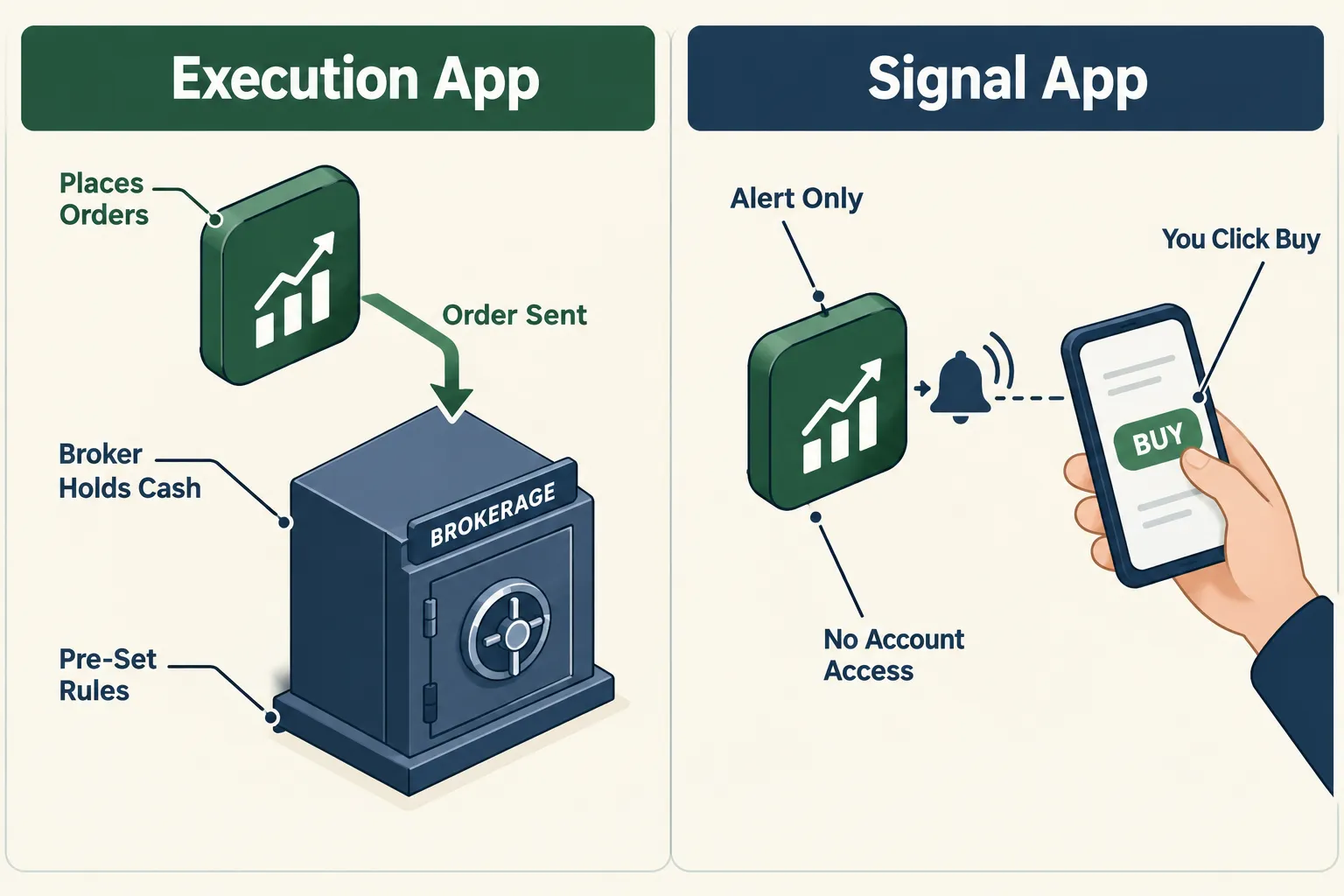
An execution app sends orders to a broker. A signal app sends you a notification and waits. That single difference decides whether you’re running automation or just receiving alerts with extra steps.
Most products marketed as a fully automated ai trading app are signal apps wearing a costume. They generate ideas, rank tickers, maybe draw support and resistance levels on a chart (the price areas where buyers and sellers have repeatedly stepped in), then hand the decision back to you. Useful. Not automated.
| App type | Places orders | Who decides | Who holds the money | Examples by category |
|---|---|---|---|---|
| Broker-native automation | Yes, without per-trade approval | AI inside broker-set limits | Your broker, in a ring-fenced partition | IBKR Autonomous Trading |
| Rules-based strategy platform | Yes, on your pre-written rules | You, in advance | A connected licensed broker | Automated strategy builders connected to a brokerage |
| API-connected custom bot | Yes, if you code and host it | Your code | Your broker (Alpaca and similar API brokers) | Developer-built agents on a trading API |
| Signal / scanner app | No | You, manually | Your broker, untouched | Screeners, AI stock pickers, alert services |
| Copy / social follow tools | Sometimes, broker dependent | Another trader | Your broker | Social trading features |
| Unregistered “AI bot” offers | Often nothing at all | Unknown | Often the promoter | The category regulators keep charging |
The ownership question is the one that matters. In a legitimate setup, your cash stays at a regulated brokerage and the software only has permission to submit orders. In the fraud cases regulators have charged, the money moved to the promoter and the “trading” existed only as numbers on a dashboard.
Decision rule: if the app asks you to deposit funds with the app instead of connecting to a broker you independently opened, stop. That’s not automation architecture. That’s a custody problem.
Common mistake: assuming a “one-click execute” button counts as automated. It doesn’t. If you have to be awake, that’s semi-automated. For the difference in what you’re actually buying, our breakdown of what AI trading software costs versus what it delivers walks through the gap.
Which Apps Can Actually Place Trades Automatically in 2026?
A short list, not a long one. The apps that genuinely submit orders fall into three buckets: broker-native automation, rules-based strategy platforms wired to a licensed broker, and custom agents built on a trading API.
Prices and limits change constantly on these products, and vendor marketing pages change faster. Confirm every number on the official page before you fund anything. Where a figure isn’t published clearly, the honest answer is: check the official page.
| App / platform | What it automates | AI role | Broker | Price | Date checked |
|---|---|---|---|---|---|
| IBKR Autonomous Trading | Order submission without per-trade approval, inside a capped AI Partition | Connected third-party AI platforms generate and submit supported orders | Interactive Brokers (self-clearing) | Check the official IBKR page for commissions and any program fees | October 23, 2026 |
| Composer | Builds and runs rules-based strategies (“symphonies”) that rebalance automatically | AI assists in building and describing strategy logic; execution follows your rules | Connected brokerage; see Composer’s official page | Check the official pricing page | October 23, 2026 |
| Public | Brokerage with AI-assisted research and agent features | Research, summarization and agent workflows; confirm execution scope on the official page | Public Investing (self-directed brokerage) | Check the official page | October 23, 2026 |
| Robinhood agent features | Brokerage app with AI-assisted features; confirm current execution permissions | Varies by feature; confirm on the official page | Robinhood Financial | Check the official page | October 23, 2026 |
| Alpaca-connected custom bots | Whatever your code tells it to do, including full order lifecycle | Whatever model you build in; Alpaca supplies the API, not the strategy | Alpaca (API-first brokerage) | Commission-free US equities tier plus paid tiers; check the official page | October 23, 2026 |
A note on Alpaca, because it shows the state of the field. Between August and October 2026, Alpaca’s AI ecosystem grew noticeably, including an AI Trading Agents Hackathon from August 28 to September 4 with a $5,000 prize pool. Developers built autonomous agents on Alpaca’s Trading API, MCP server and CLI. What they mostly demonstrated was paper trading, dashboards, research pipelines and explicit risk gates.
That’s workflow automation, not proven edge. Building an agent that can place orders is now a weekend project. Building one that makes money over a full cycle is still the hard part, and no one at that hackathon published independently audited live results proving otherwise.
Our running coverage of the category sits in the AI trading apps archive, and the tells that separate a real product from a funnel are listed in our AI trading bot red flags guide.
Edge case worth knowing: broker-native automation like IBKR’s excludes short selling and margin in its initial rollout. If your strategy depends on shorting, the “fully automated” version of it doesn’t exist there yet.
For deeper breakdowns of individual platforms, see our running list of AI trading platforms we’ve tested and the head-to-head on the best AI trading tools of 2026. Our scored broker and tool reviews publish the breakdown before any link.
Which AI Trading Apps Only Send Signals?
Most of them. The majority of products advertised as an ai stock trading app are research and alert tools: they scan, score and notify. They never touch your brokerage account, which is also why they’re generally lower risk.
How to tell from the app’s own terms, without guessing:
- Read the account connection flow. Signal apps ask for your email. Execution apps ask you to authorize a brokerage connection or open an account with a named broker.
- Search the terms of service for “discretionary.” Apps that trade for you have to address trading authority somewhere in the legal text. Apps that don’t, say they provide information only.
- Look for the disclaimer “for informational purposes only.” That phrase is a legal declaration that no one is managing your money.
- Check the order types page. If there isn’t one, there are no orders.
- See whether the app references a clearing firm or a custodian. No custodian, no execution.
None of this makes a signal app bad. A clean scanner that surfaces a tight consolidation (a stock trading in a narrowing range before it moves) can be more useful than a half-baked bot. The problem is pricing and positioning: paying automation prices for an alert feed.
Common mistake: buying a signal service because the homepage says “AI-powered trading,” then realizing three weeks later you still have to be at your desk at 9:30 a.m. Read the connection flow before the pricing page.
Decision rule: choose a signal app if you want better inputs into your own decisions. Choose an execution platform only if you already have written rules you’d be comfortable running untouched for 30 days. Our guide to screeners that are replacing manual swing trade picks covers the signal side properly.
What Do Regulators Say About AI Trading App Claims?
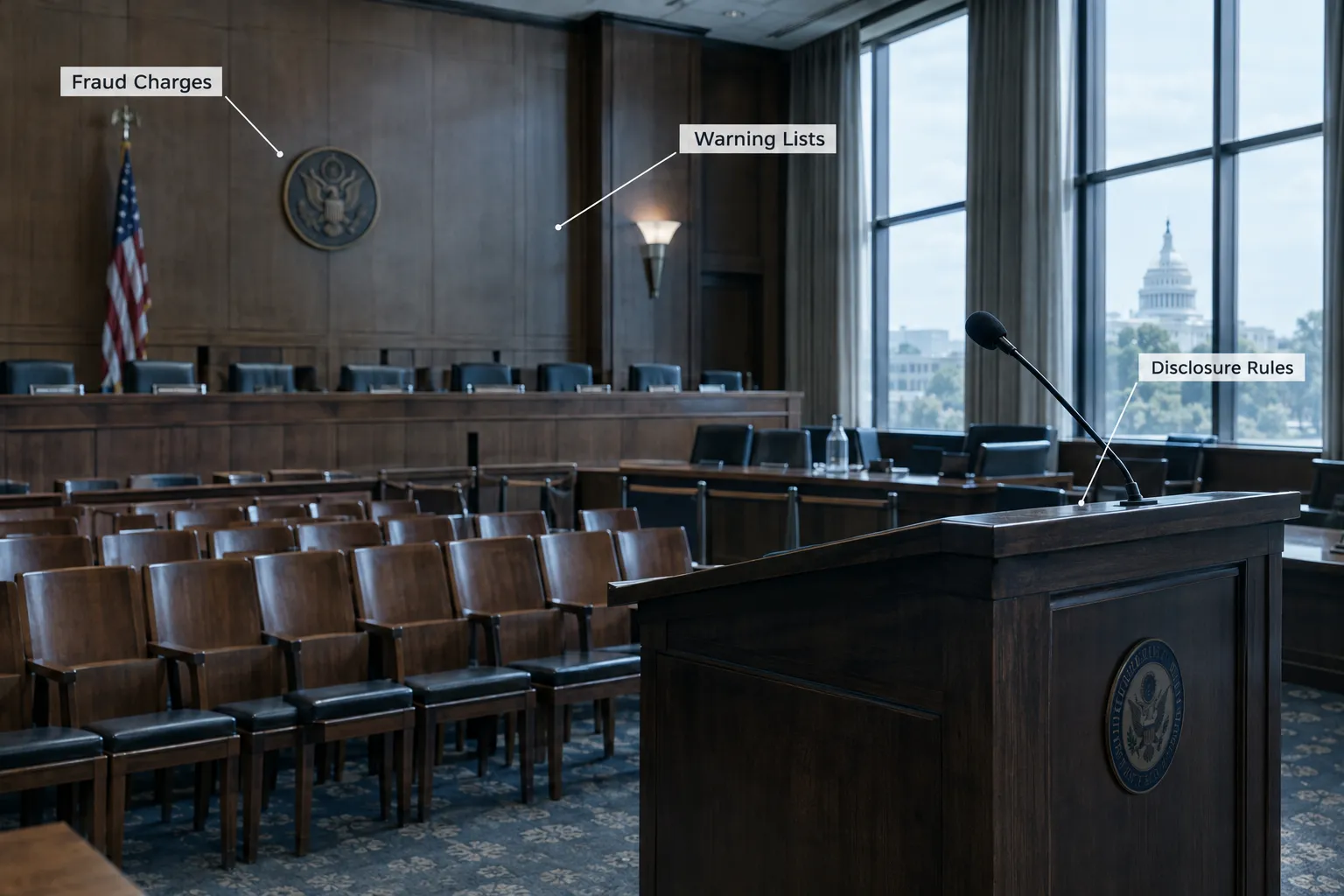
Regulators aren’t saying AI trading is illegal. They’re saying AI language has become a fraud vehicle, and the enforcement record in 2026 backs that up with dates and names.
SEC, September 29, 2026. The SEC charged multiple entities behind Cryptoaiml and TSAI Pro over alleged schemes totaling at least $15 million, promoted through WhatsApp and other platforms. The complaint alleges these operations marketed “AI-generated” trading signals and rented AI trading bots, that no genuine trading occurred, that displayed profits were fictitious, and that withdrawals were blocked behind advance-fee demands. A related SEC litigation release describes claims of guaranteed profits, fake regulatory credentials, recruitment incentives, and AI bots that did not exist.
Read that again: the bots did not exist. The AI wasn’t bad. It was absent.
FCA, October 2, 2026. The UK regulator added BitMarkets AI / BitMarkets Trading Group to its warning list, stating the firm may have been promoting financial services without authorization. Warning lists are the cheapest due diligence on earth and almost no one checks them.
IMF, July 2026. The Fund warned that AI-driven trading could amplify market stress, because multiple systems may react rapidly and similarly to the same information. The risk isn’t only one model being wrong. It’s many models being wrong in the same direction at the same second.
BIS, October 21, 2026. Same warning, sharper framing: institutions using similar models, data or decision rules could create crowded trades and synchronized shifts in risk appetite. In a sell-off, similar AI decisions reinforce each other.
On cftc ai trading and futures specifically, the CFTC’s consistent public posture has been that AI does not change the rules: fraud is fraud, and registration requirements apply to anyone soliciting managed futures or pooled funds. FINRA’s communications rules apply to member firms the same way, meaning promotional claims about AI performance have to be fair, balanced, and substantiated. If a firm can’t substantiate it, it can’t say it.
On ai trading disclosure: the creator economy is the gap. A paid promotion for a trading app on short-form video is an advertisement, and the SEC’s anti-touting provisions require disclosure of compensation for promoting securities. The number of “my AI bot made me money this week” videos carrying a proper disclosure is, generously, small.
Practical takeaway: before funding any fully automated ai trading app, run three free checks. Search the firm on the SEC’s action database, check the FCA warning list if the firm has any UK presence, and search the brand name plus “charged” or “warning.” Five minutes. Costs nothing.
How Do You Spot Marketing Language in an AI Trading App?
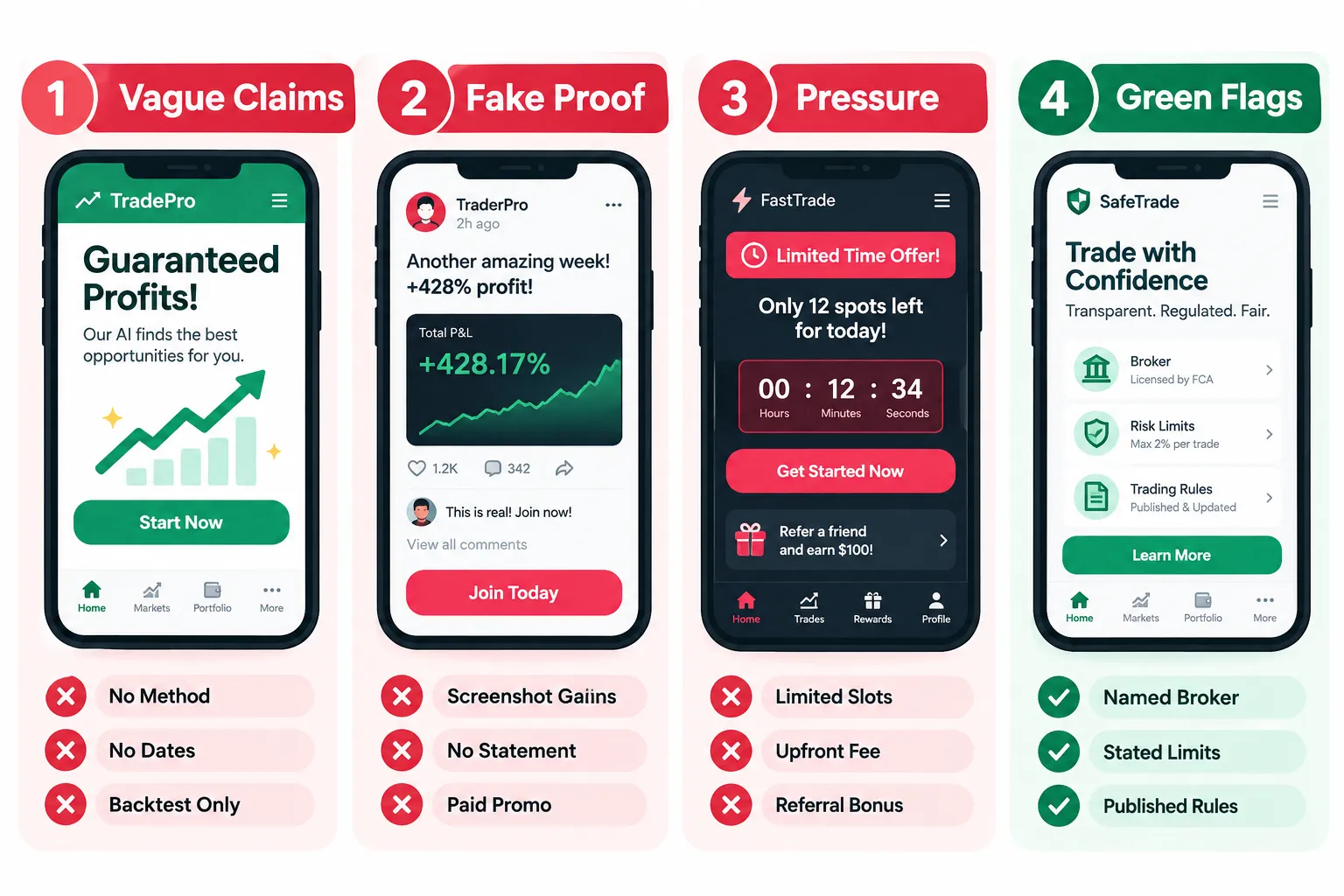
Marketing language has a tell: it describes the outcome and skips the mechanism. Real product documentation does the opposite. It describes exactly what the software can and can’t do, and stays silent on what you’ll earn.
| Phrase | What it usually means | Question to ask |
|---|---|---|
| ”Proprietary AI algorithm” | They won’t say what it does, possibly because it’s a public model with a dashboard | What inputs does it use, and what’s the decision rule? |
| ”Backtested results” | Curve-fitted to past data, which is free to do and proves little | What are the live, post-launch results, and over what dates? |
| ”Up to X% returns” | The single best period, presented as the norm | What was the worst drawdown, and when? |
| ”Hands-free passive income” | Marketing to people who don’t want to learn | Who bears the loss when it’s wrong, and what’s the cap? |
| ”Guaranteed profits” | A phrase the SEC cites in fraud complaints | Walk away. Securities returns can’t be guaranteed. |
| ”Trusted by thousands” | Unverifiable user count | Show me an audited track record, not a testimonial wall. |
| ”Bank-grade security” | Says nothing about custody | Which licensed broker or custodian holds the cash? |
| ”Limited spots available” | Urgency manufacturing | Why would a software product have inventory limits? |
Follow-up checklist, in order:
- Find the broker. Name it. If no licensed broker appears anywhere, stop here.
- Find the capital limit. Legit automation caps exposure. Unlimited access to your account is a red flag, not a feature.
- Find the order types. Market, limit, stop, stop-limit. If unlisted, there’s probably no execution layer.
- Find the exclusions. Real products publish what they don’t support. Marketing never does.
- Find the withdrawal terms. Any fee required before you can withdraw matches the pattern in the SEC’s September 2026 complaint.
- Find the disclosure on the promoter. Was the person recommending this paid? If it’s not stated, assume yes.
- Paper trade it first. Thirty days, no money, written rules. If the vendor won’t allow paper trading, ask why.
The sharpest single question: “What does this app do when it’s wrong?” A real product answers with stop losses, position sizing rules and partition caps. A marketing page changes the subject.
Play stupid games, win stupid prizes. The games here are funding a platform you can’t name the custodian for.
Is There a Free AI Trading App Worth Using?
Yes, but “free” almost always means paper trading, delayed data, or a capped number of strategies. A free ai trading app is a great place to test your rules and a poor place to expect live automation with no limits.
What free tiers typically include, confirmed category by category:
- Paper trading access. Simulated orders against real market data, so you can run a strategy for 30 days without risking a dollar. This is the most valuable free feature in the entire category and the one people skip.
- Delayed market data. Free usually means 15-minute delayed quotes. For a swing strategy holding days to weeks, that’s survivable. For intraday automation, it’s useless.
- Limited strategy slots. Build one or two automated strategies free, pay for more.
- Screener access with capped filters. Common across free scanner tiers.
- Developer API sandboxes. Alpaca-style API brokers let you build and test agents without a funded account.
The honest answer on best ai trading app free is that no single app wins, because free tiers are built to upsell, not to be complete. The better move is a stack: a free screener for the watchlist, a free paper-trading account for the strategy, and your existing broker for execution once the rules survive a month of testing.
Decision rule: if you can’t make a strategy work on a free paper account for 30 days, paying $99 a month won’t fix it. The subscription doesn’t supply the discipline.
Common mistake: treating a free trial as a test. Fourteen days of a bull run tells you nothing. You need the strategy to survive a choppy tape, a gap down, and at least one earnings season.
Our directory of free AI trading bots and our free trading tools and calculators are both good starting points if you want to build that stack without opening a wallet.
Can Automated Trading Apps Lose Your Money, and Who Should Avoid Them?
Yes, and faster than you can manually, because software executes without hesitation. Automation removes emotional delay in both directions. It cuts losers fast when the rules are good and compounds bad rules at machine speed when they aren’t.
The main failure points, named:
- Bad rules, executed perfectly. The most common one. The bot isn’t broken. Your logic is.
- Overfitting. A strategy tuned until it looks perfect on past data and falls apart on new data.
- Connectivity failure. The app disconnects mid-position, leaving an open trade with no stop managing it.
- Data latency. A scan that surfaces a move four minutes late is a history lesson, not a trade.
- Regime change. A trend-following system in a sideways market bleeds out by a thousand small losses.
- Correlated behavior. The IMF and BIS both flagged this in 2026: when many systems run similar models on similar data, they sell at the same time, which makes the selling worse.
- Custody risk. The worst one. If the platform holds the money and the platform is a fraud, strategy quality is irrelevant.
Why most people lose money with trading bots isn’t mysterious. They deploy a strategy they didn’t write, don’t understand, and can’t evaluate. When it draws down, they switch to another one. Then another. That’s revenge trading with extra automation.
Who should use automation:
- Traders with written, tested rules that they already follow manually
- People whose main leak is inconsistency, not strategy
- Anyone with a repeatable mechanical setup and defined risk per trade
- Developers who want to test ideas systematically at scale
Who should not:
- Anyone who can’t describe their edge in one sentence
- Anyone looking for passive income with zero trading experience
- Anyone trading money they need within 12 months
- Anyone who’d be tempted to override the bot mid-trade
On passive income with zero experience: automation doesn’t substitute for knowledge, it amplifies whatever knowledge you already have. If that’s zero, you’re amplifying zero. The honest path for a beginner is a boring one, and broad index investing has handled that need for decades without an app.
How much to start with? IBKR’s own structure gives you a usable benchmark: a $1,000 minimum into the AI Partition and no more than 10% of account equity. That’s a broker’s risk team setting the number, not a marketer. Treat 10% of your trading capital as a sane ceiling for anything automated and new, regardless of platform. And know that fully automated ai trading app setups with tiny accounts get eaten by fees and slippage faster than strategy quality shows up.
What Mistakes Do People Make Setting Up Their First Automated App?
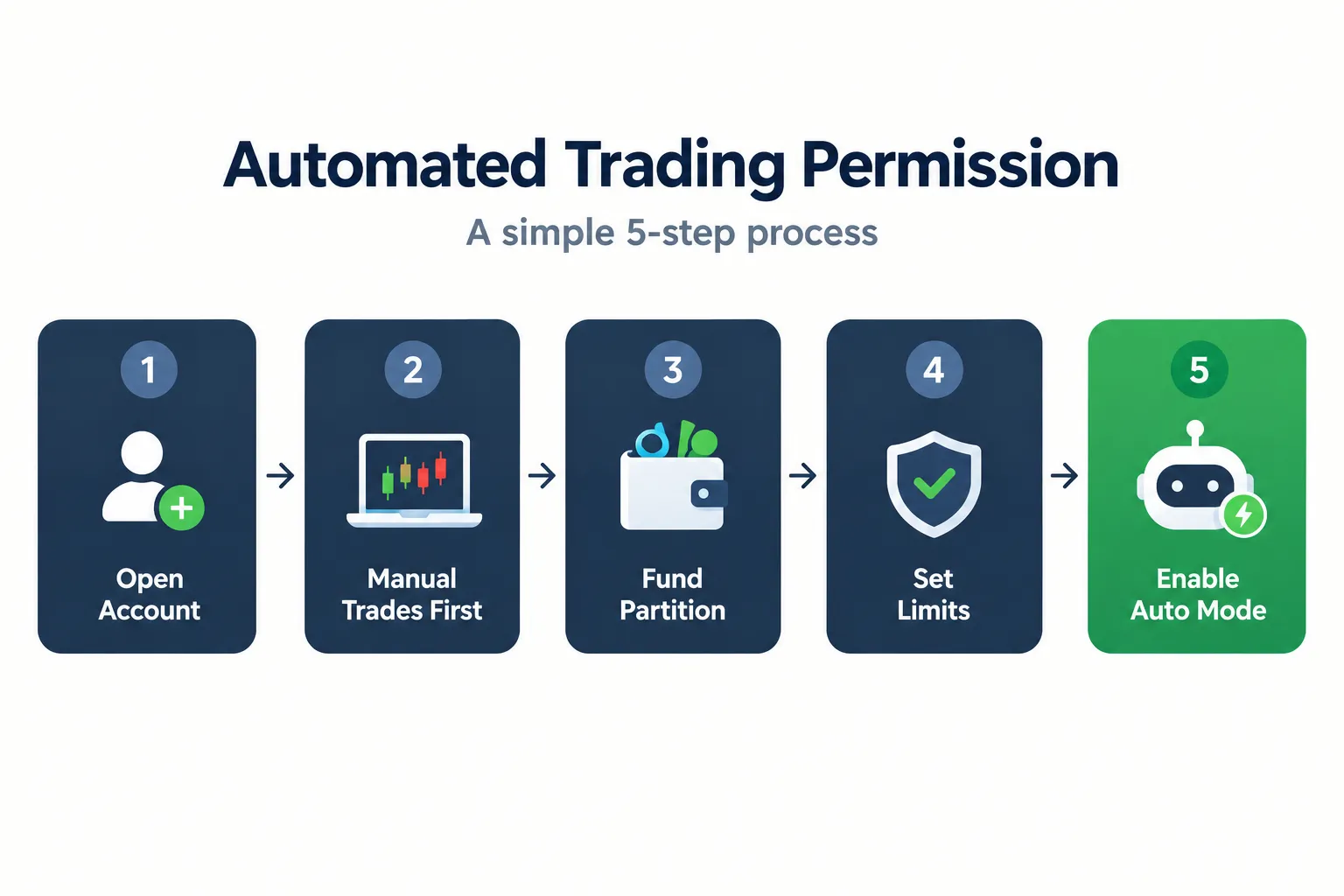
The first-month mistakes repeat with stunning consistency. Almost all of them come from skipping the testing phase because the dashboard looked impressive.
- Going live on day one. Paper trade the strategy for 30 sessions minimum. Non-negotiable.
- No position sizing rule. Position sizing is how much of your account goes into one trade. Without it, one bad fill ends the experiment.
- No stop loss in the logic. A stop loss is the pre-set exit that caps a losing trade. If the bot can enter but can’t exit, it’s half a system.
- Running too many strategies at once. Three strategies, three different drawdowns, zero ability to tell which one broke.
- Overriding the bot. Manually closing a position the system wanted to hold destroys the data you were collecting.
- Ignoring the exclusions. Writing a strategy that shorts, then connecting to a platform that doesn’t support short selling.
- Funding more than you’d lose. If the amount would hurt, the cap is too high.
- Never checking the logs. Automation isn’t absence. Review the fills weekly.
- Chasing a new strategy after one bad week. Analysis paralysis with a credit card attached.
- Skipping the regulator check. Five free minutes that could have saved the entire account.
Quick example: a trader builds a breakout strategy (buying when price pushes above a resistance level on volume), sets it to 10% of equity, paper trades it through September, sees a 14% drawdown in a choppy stretch, and adjusts the entry filter before going live with $1,500. That’s the process working. The version where he funds $15,000 on day one because the backtest looked clean is the version that ends badly.
Our side-by-side of Option Alpha versus Atomik Trading shows how two automation platforms handle rule-building differently, which is worth reading before you pick one.
What About Creator Videos Claiming Fully Hands-Off Automation?
Creator videos are advertisements more often than they’re reviews, and the automated-trading category is one of the most heavily promoted corners of short-form finance content.
The reference point worth noting is the Delta Exchange content circulating on YouTube about automated trading systems. It’s crypto-focused, so it sits outside what this site covers on stocks, options, futures and ETFs, and it’s referenced here only as an example of how these videos are structured. The pattern transfers.
| What’s claimed | What’s usually shown | What’s usually skipped |
|---|---|---|
| The system trades automatically | A dashboard with positions open | Whether the account is live or simulated |
| Strong results | A screenshot or equity curve | Dated, broker-issued statements |
| Easy setup | The configuration screen | Fees, slippage, and funding minimums |
| It works in any market | A favorable recent stretch | The worst drawdown and when it happened |
| Anyone can do it | A smooth walkthrough | Whether the creator was paid to promote it |
Treat everything in those videos as a claim, not a finding. Claims aren’t automatically false. They’re just unverified, and unverified is exactly what a disclosure rule exists to flag. The SEC’s anti-touting provisions require disclosure of compensation for promoting securities, which is a rule a lot of finance creators appear unfamiliar with.
Decision rule: if a video shows profits but not a dated brokerage statement, treat the number as advertising copy. If the creator won’t say whether they were paid, assume compensation and discount accordingly.
Frequently Asked Questions
What is AI trading software?
AI trading software is any tool that uses statistical models or machine learning to analyze market data and either recommend or execute trades. Most of it recommends. A smaller slice executes through a connected licensed broker. The term covers everything from a stock screener with a scoring model to a broker-level system that submits orders without per-trade approval.
Is there an AI app that actually trades for you?
Yes. Interactive Brokers launched Autonomous Trading on October 21, 2026, allowing connected AI platforms to submit orders across 75,000+ stocks, options and ETFs without approving each trade. It runs inside a capped AI Partition limited to 10% of account equity, between $1,000 and $25,000, and requires 10 manual trades over two weeks first.
Does the AI trading app really work?
Depends on the definition of “work.” The execution works, meaning orders get placed reliably through a regulated broker. Whether the strategy makes money is a completely separate question with no published answer. Automation is a reliability claim. Profitability is a performance claim. Vendors merge the two deliberately.
What is the success rate of AI trading?
No regulator or independent audited study publishes a success rate for AI trading apps. Any figure you see in an ad is self-reported by the company selling the product, and the SEC’s September 29, 2026 complaint against Cryptoaiml and TSAI Pro alleges that displayed profits in some cases were entirely fictitious. Treat unverified win rates as marketing.
Which AI trading bot is the best?
There’s no single best one, because the right tool depends on what you’re automating. Rules-based platforms suit traders with defined strategies. API brokers like Alpaca suit developers. Broker-native automation suits people who want guardrails enforced by the custodian. Best starts with knowing your own rules.
Are fully automated trading apps legal?
Automated trading is legal in the US and widely used by institutions. What’s illegal is fraud, unregistered solicitation, guaranteed-return claims, and undisclosed paid promotion. The FCA’s October 2, 2026 warning on BitMarkets AI is an example of a firm flagged for potentially promoting financial services without authorization.
How much money do I need to start?
IBKR’s AI Partition sets a $1,000 minimum as a reference point. Beyond platform minimums, the practical floor is whatever amount lets position sizing and fees make sense, and the practical ceiling for anything new is around 10% of your trading capital.
Can I make passive income with no trading experience using automation?
No. Automation executes rules, it doesn’t create them. With no experience, you’re outsourcing judgment to a system you can’t evaluate, which is how people stay in losing strategies for months. Learn the process manually first, then automate what already works.
Our Take
Automation is real. A promised result is marketing. That’s the whole article in two sentences.
The infrastructure shift in 2026 is genuine and it matters: brokers are starting to separate AI decision authority from account authority, with capital partitions, product restrictions and manual-trading prerequisites. That’s a serious safety model, and it’s a direct rebuke to the “hand a chatbot your API key” crowd. But notice what none of it does. None of it says the AI will be right.
So judge every fully automated ai trading app on one axis: does it tell you what it can do, or what you’ll earn? The first is a product. The second is a pitch. Write your rules, paper trade them for 30 days, cap the money at 10%, and let the results argue back.
Discipline beats prediction. Cut the noise, keep the alpha.
Found an app that claims full automation, or one that actually delivers it? Send it over and we’ll test it against the same checks in this article.
Stay alpha.
The FullStack Alpha research desk tests AI trading bots on paper and live accounts. Reviewed and edited by Jay Rocco, Founder and Editor.
