

The FullStack Alpha research desk tests AI trading bots on paper and live accounts. Reviewed and edited by Jay Rocco, Founder and Editor.
A forex trading bot is software that places trades for you based on rules someone wrote. It automates. It does not predict. The CFTC has been blunt about this: marketing that claims a bot delivers guaranteed returns, 100% win rates, or thousands of percent in gains is a recognized fraud pattern, not a product category [1]. A seller’s backtest curve and a folder of screenshots are the two weakest forms of evidence in this market, because both are trivially manufactured. Here are four checks to run first.
Key takeaways
- A forex trading bot executes rules. It cannot know what the next central bank meeting will do [2].
- A backtest fitted to past data often collapses forward. MetaTrader’s own documentation tells you to test optimized settings on a separate, untouched period.
- Third party verified live results with read-only access beat any screenshot.
- Maximum drawdown matters more than total return. A 50% drawdown needs a 100% gain to get back to flat.
- Total cost includes license, VPS, spread, swap and commission. Scalpers die on spread.
What Is a Forex Trading Bot and How Does It Work?
Most retail bots are expert advisors (EAs): small programs written in MQL that attach to a chart inside MetaTrader 4 or MetaTrader 5. The EA reads price action, checks its conditions, then fires an order through your broker. That’s it. No crystal ball.
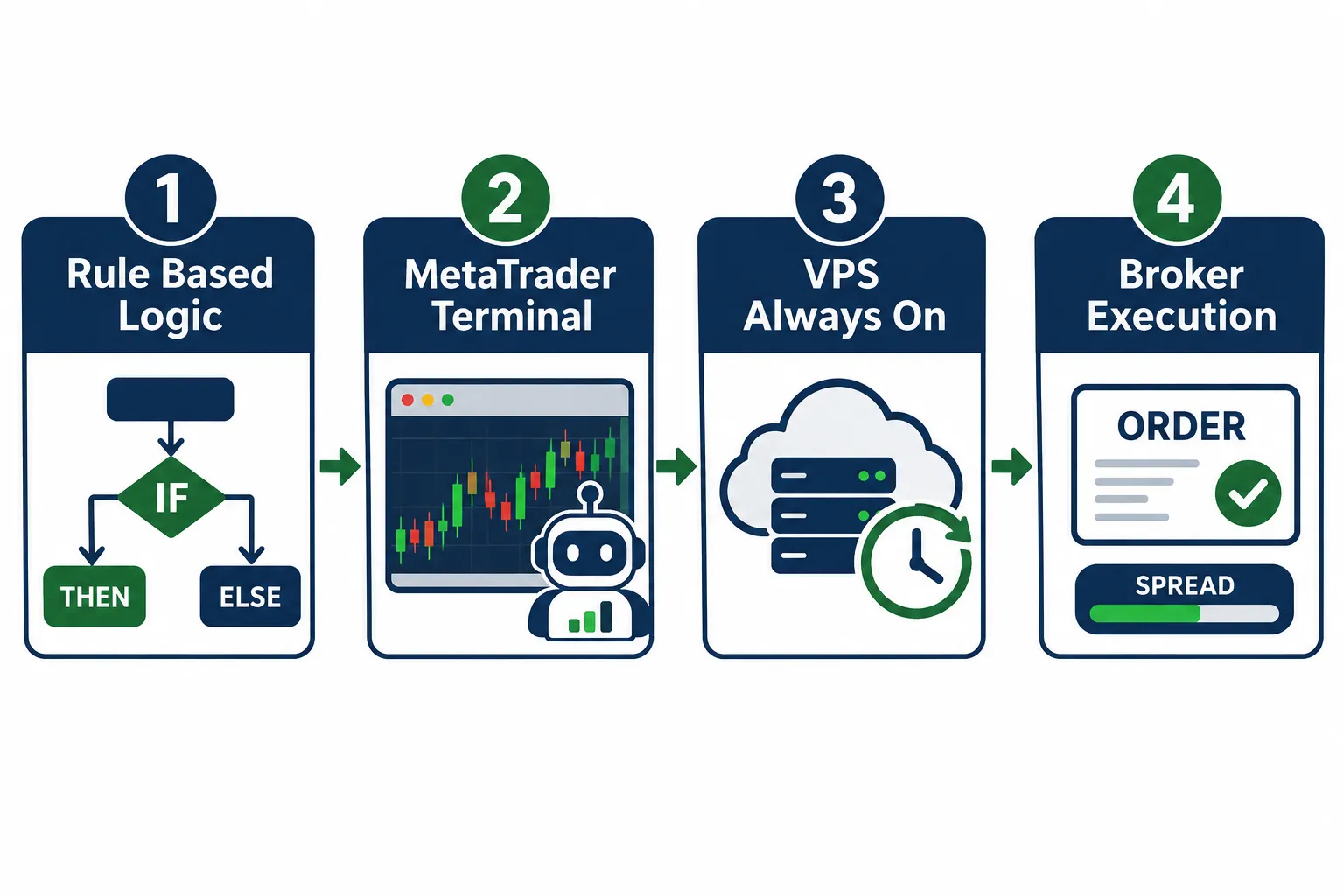
Two broad families exist. Rule based bots follow fixed logic: moving average cross, breakout above a range, grid levels. AI labeled bots claim some model adapts over time. The label is unregulated, so “AI” on a sales page proves nothing about what’s inside. Plenty of what gets sold as a proprietary model is a public library with a subscription button bolted on.
One practical detail beginners miss: an EA only trades while the terminal is running. That’s why people rent a VPS, a virtual private server that keeps MetaTrader online around the clock. Budget for it.
If you want the broader picture of how automation differs across markets, this breakdown of what to know before you automate trades is a reasonable starting point.
Do Forex Trading Bot Results Hold Up on a Live Account?
Often, no. The gap between a forex trading bot backtest and its live equity curve is where most accounts get hurt.
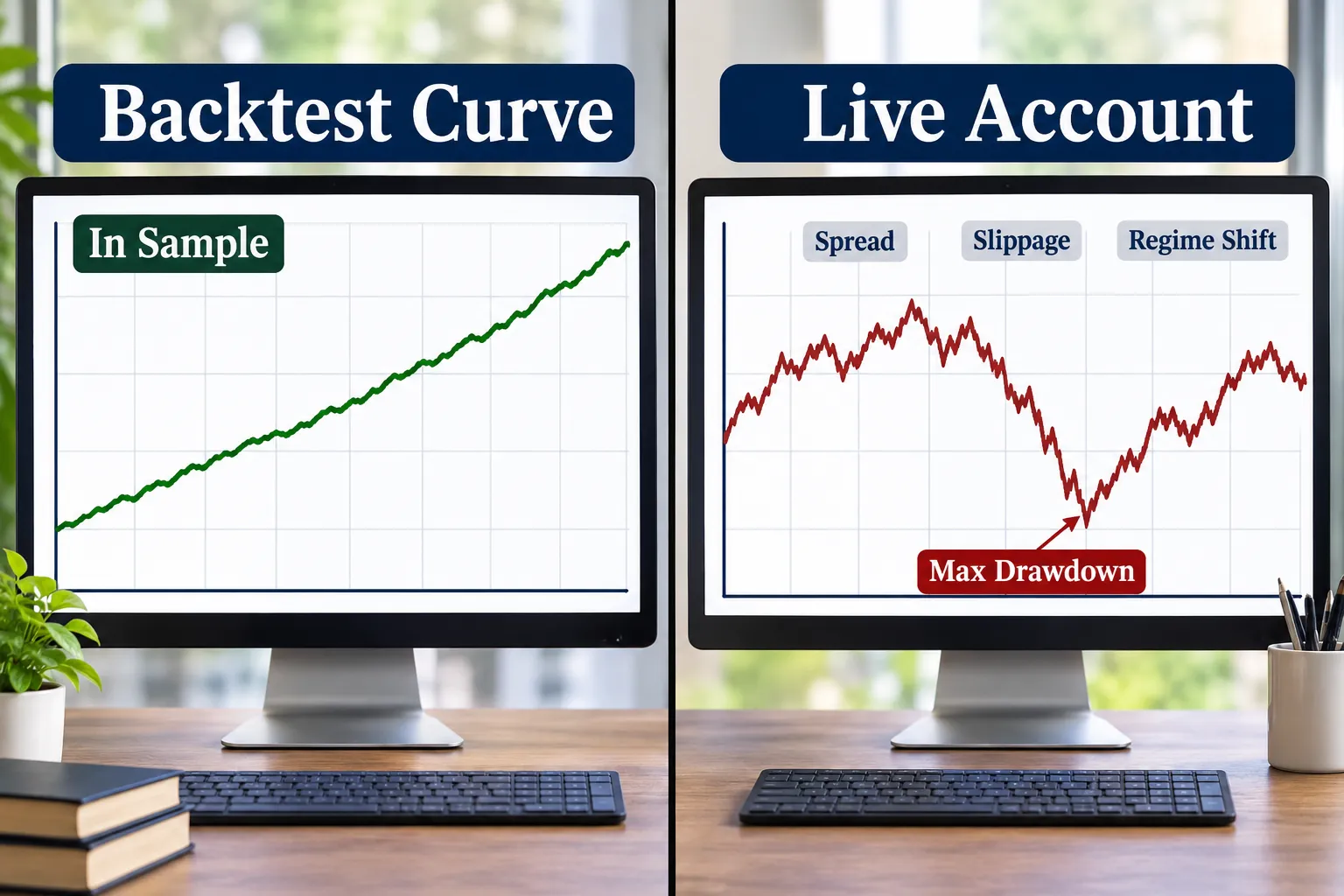
Overfitting is the main culprit. Run enough parameter combinations across the same ten years of data and something will look perfect. It fit the noise. MetaTrader’s Strategy Tester documentation handles this by separating the optimization window from a later, non-optimized period, and the platform’s guidance is to retest the best settings on that untouched stretch before going live. Parameter stability across a range of settings is a better sign than one glorious peak.
Then there’s the mechanics. Backtests assume fills at the modeled price. Live accounts eat spread widening at the New York close, slippage on news, swap on overnight holds, and requotes. An xauusd scalping bot showing a flawless simulated curve on gold can lose its whole edge to two extra pips of spread.
Third ingredient: regime change. The Bank for International Settlements has flagged that when many participants run similar models and decision rules, they act together, amplifying moves and building crowded trades. A strategy that worked in a trending year can get shredded in a choppy tape.
Demo is step one, not proof. Demo fills are generous. Forward testing on a small live account with real spread is the honest test. There’s a structured version of this in this guide to forward testing versus backtesting.
Check 1: Is the Track Record Verified by a Third Party?
Screenshots are pixels. A Telegram channel posting green trades is marketing. A forex trading bot review on a vendor’s own site is an advertisement wearing a lab coat.
What counts is a third party verified account. Myfxbook and similar services connect to the broker account using an investor password, which is read-only access that lets the tracker pull trade history without allowing withdrawals. That verification badge means the data came from the broker, not from the seller’s spreadsheet.
Read it properly:
- Date range. Six months is a sample. Sixteen months across different volatility regimes is evidence.
- Trade count. Forty trades prove nothing statistically.
- Account type. Demo-verified is not live-verified. Check which one.
- Gaps. Missing months usually hide the bad months.
- Deposits. Fresh capital injected during a drawdown flatters the percentage return.
Same discipline applies to open source code. A forex trading bot from GitHub is free to read, which is an advantage, but free code still needs an audit. These safety checks before running a GitHub trading bot cover what to look at.
Check 2: What Is the Maximum Drawdown?
Return is the number sellers lead with. Drawdown is the number that decides whether you survive long enough to collect it.
Maximum drawdown is the largest peak-to-trough fall in account equity. The math is unforgiving and non-symmetrical. Lose 20% and you need 25% to recover. Lose 50% and you need 100%. Lose 70% and you need 233%.
Three things to check. First, ask whether drawdown is measured on balance or on equity: balance ignores open losing positions, so a grid bot with eight underwater trades can show a pretty balance curve and a terrifying equity curve. Second, how long the deepest drawdown lasted. Four months underwater breaks more traders than the loss itself does. Third, whether the strategy ever cuts losers. Martingale and no-stop grid systems can run years of small wins, then hand back everything in one session.
Opinion: any forex trading bot sold without a published maximum drawdown figure should be treated as having an unknown one, and unknown means assume the worst case is total.
Check 3: Who Regulates the Seller and the Broker?
In the United States, retail forex is overseen by the CFTC and the National Futures Association. The CFTC’s guidance on reducing forex fraud risk is to verify registration before sending money and to be suspicious of anyone pushing you to act fast [3]. Its forex fraud advisory describes the recurring pattern: promised high returns, limited risk, and pressure tactics [4].
The agency’s AI advisory is sharper still. It tells people to check the firm’s history, the domain’s age, who actually runs it, registration status, fees, and the risk of the underlying asset before handing over funds [1]. Its broader forex education makes the structural point: no program can predict the future, and correlations that held for years can vanish when conditions shift [2]. The CFTC has also warned about unexpected fees appearing once money is in [5].
Two separate checks, not one. The seller can be unregistered and so can the broker. If the broker holding your money is offshore with no US registration, your recourse if deposits vanish is close to zero [6]. Regulators globally are now circling automated execution: reporting in October 2026 indicated the Global Foreign Exchange Committee was reviewing AI and autonomous trading implications, with findings expected into early 2027 [7].
Check 4: What Does It Really Cost?
The license price is the smallest line. Add it all up before deciding anything.
| Bot type | How it trades | Main risk | What to verify |
|---|---|---|---|
| Grid | Places layered buy and sell orders across a price range | Trend runs one way and open losses stack | Equity drawdown, not balance drawdown |
| Martingale | Doubles size after a loss to recover | One long losing streak can take the account | Maximum consecutive losses, margin buffer |
| Trend following | Enters on breakouts, holds the move | Long flat periods and whipsaw in choppy tape | Win rate versus average win size |
| Scalper | Many small trades, tight targets | Spread, slippage and commission eat the edge | Live spread data, broker execution speed |
| AI labeled | Claims an adaptive model | The label is unverifiable marketing | Published method, out-of-sample results |
Recurring costs: the license or monthly subscription, a VPS to keep the terminal running, per-lot commission on raw spread accounts, the spread itself, and swap on positions held overnight. A free forex trading bot still carries every cost in that list except the license.
Free versus paid is not a quality signal in either direction. Some of the most widely sold commercial EAs, Forex Fury among them, publish results that still require the same verification steps above. Price tells you about marketing budget, not about edge.
Conclusion
Run the bot on a demo account for a fixed period, 60 days minimum, with the exact settings and lot size you intend to use live, and log every trade. If the equity curve looks nothing like the seller’s chart, you just saved yourself the tuition. Systems over hacks.
Want to compare automated tools side by side before picking one? The trading bot category in the FullStack Alpha directory catalogues 200+ AI trading tools by type and price, including AI trading bots and AI trading platforms.
Browse the directory at aistockpickerapps.com
Educational content only. Not financial advice. Trading forex and CFDs carries substantial risk of loss.
References
- Aitradingbots. cftc.gov.
- Forexfrauds. cftc.gov.
- Reduce Risk of Forex Fraud. cftc.gov.
- Fraudadv Forex. cftc.gov.
- Customeradvisory Coronafees. cftc.gov.
- Forex Scams. forexrater.com.
- Fx Market AI Governance Reviews. cryptobriefing.com.
Frequently Asked Questions
Are forex trading bots profitable?
Some strategies work for a period. Many do not. The CFTC states plainly that automated programs cannot predict the future and that relationships found in historical data can break when conditions change. Treat any specific profit claim as unverified until a third party verified live record says otherwise.
Is it possible to make $1,000 a day in forex?
Not reliably, and not as a plan. Daily income targets push oversized positions, which is how small accounts end. Regulators flag promises of high returns with limited risk as a core fraud marker. No number here is a forecast.
Do AI forex trading bots work?
"AI" is a label, not a standard. Some systems genuinely use machine learning, many don't. The CFTC's advisory exists precisely because AI branding is being attached to bot fraud, and recommends verifying the firm, its people and its registration before funding anything.
Are forex trading bots legal in the US?
Automated trading itself is legal. The regulated parts are who you trade through and who sells you the product. Check CFTC and NFA registration before sending money.
Can a forex trading bot run on MT5 for free?
Yes. MetaTrader 5 supports free EAs, and plenty of open source code exists. You'll still pay the spread, likely a VPS, and you'll still need to verify the logic yourself.
Is this article financial advice?
No. This article is educational content only and not financial advice. Trading forex and CFDs carries substantial risk of loss.
The FullStack Alpha research desk tests AI trading bots on paper and live accounts. Reviewed and edited by Jay Rocco, Founder and Editor.
