

Jay Rocco is the Founder and Editor of FullStack Alpha. He has tested 200+ AI stock tools since 2022 and run 15+ AI trading platforms on live accounts with his own money. He reviews the software. He does not tell you what stocks to buy.
Last updated: September 30, 2026
Quick Answer: The barchart api is a REST/JSON market data service from Barchart OnDemand that delivers real-time quotes, historical OHLCV data, options chains, futures prices, and news to trading bots via a simple apikey parameter. Subscription plans range from free tiers on third-party marketplaces to commercial enterprise agreements. For a solo bot builder, the three affordable entry points are the Parse.bot marketplace free tier (200 credits/month), a direct OnDemand subscription, or a competitor like Polygon.io (now Massive) or Alpha Vantage, each with real latency tradeoffs that will cost you money if you ignore them.
The Short Version
- The barchart api covers equities, options, futures, commodities, forex, and crypto across 71 documented API paths in the OnDemand platform
- Free market data is not actually free: 15-minute delayed feeds can cause a bot to enter a position that has already moved against it by the time the signal fires
- Parse.bot’s marketplace tier gives 200 free credits/month for Barchart data, distinct from the official OnDemand platform which requires a commercial agreement
- Polygon.io (rebranded as Massive) offers a free tier and a Starter plan around $29/month with unlimited calls on US stocks, but Starter data is 15 minutes delayed; real time needs a higher tier
- Alpha Vantage caps free users at 25 API calls per day, which is not enough for any active intraday bot
- The barchart api’s Event-Based API adds Socket.IO real-time alerting for price thresholds and news triggers, making it relevant for signal and alert workflows
- Latency is the hidden subscription fee: a 15-minute delay on a breakout setup is not a data feed, it is a post-mortem
Which Data Feed Fits Your Bot?
What Is the Barchart API and What Does It Give a Trading Bot?
The barchart api is the developer-facing layer of Barchart OnDemand, a market data platform that has supplied institutional and professional data since the 1980s. It exposes financial data as REST endpoints returning JSON (also XML and CSV), hosted at ondemand.websol.barchart.com, and authenticated with a single apikey query parameter.
For a trading bot, the practical inventory looks like this:
- Quotes: real-time and delayed equity, futures, forex, and crypto prices
- Historical data: OHLCV bars going back years, configurable by interval (daily, weekly, intraday)
- Options chains: full strike/expiry matrices with Greeks
- Futures and commodities: grain, energy, metals, and financial futures, which is where Barchart’s institutional roots run deepest
- News and filings: the
getNewsendpoint pulls headlines and full-text from AP, Canadian Press, Dow Jones, and others, filterable by symbol, category, and keyword - Corporate actions: dividends, splits, earnings dates
- Event-Based API: REST and Socket.IO endpoints that fire alerts when user-defined conditions are met, such as a price crossing a threshold or a news event hitting a symbol
The APIs.io catalog lists 12 distinct Barchart API categories and 71 paths described in OpenAPI spec. That is a wide surface area. Most bot builders will use three or four endpoints consistently, but knowing the rest exist matters when your strategy expands into options flow or commodity spreads.
The practical takeaway: if your bot trades US equities and options, the barchart api gives you everything in one place. If it trades grain futures or commodity spreads, Barchart is one of the few retail-accessible feeds with real depth there.
How Much Does the Barchart API Cost?
Barchart OnDemand does not publish a simple public pricing page with monthly dollar amounts. The official platform targets institutional and professional subscribers and requires a separate commercial agreement. This is the part that trips up solo bot builders who expect a Stripe checkout page.
There are two practical access routes in 2026:
Route 1: Parse.bot marketplace (the low-cost entry point) Parse.bot lists a Barchart API entry with a tiered credit system: Free (200 credits/month), Hobby, Developer, Team, and Company (up to 100,000 credits/month). This is a third-party marketplace layer, not Barchart’s own platform. The data is real, but the credit-based pricing means you need to map your bot’s call volume to credits before committing.
Route 2: Direct OnDemand subscription SaaSworthy and APIs.io both list Barchart OnDemand as a subscription and enterprise plan product. Pricing is quote-based, which typically means a sales conversation. For a solo developer, this is the path to real-time institutional-grade data, but it is not the path for a $50/month budget.
The two real drawbacks worth naming:
- No transparent self-serve pricing for the core OnDemand platform. You cannot comparison-shop without a sales call, which is friction most solo developers skip, then regret later when they hit a rate limit.
- The free tier (via Parse.bot) is 200 credits/month. Depending on how Barchart counts a credit per call, an active intraday bot can exhaust that in a single morning session.
The 3 Data Feeds a Trading Bot Can Actually Afford
Most bot builders do not need Bloomberg Terminal data. They need clean, reliable, low-latency data at a price that does not eat their trading capital before the bot makes a single trade. Here are the three realistic options.
Feed 1: Barchart API via Parse.bot (Free to ~$50/month)
Best for bots that run end-of-day or swing strategies with moderate call volume. The 200 free credits/month is a real sandbox for testing. If your bot checks 20 symbols at the open and close, you will likely stay inside the free tier for weeks of development. Scaling to the Hobby or Developer tier adds volume without requiring an enterprise contract.
Choose this if: you are building a swing-trading bot, you need commodity or futures data that competitors do not cover well, and you want to test before committing to a paid tier.
Feed 2: Polygon.io, Now Massive (Free to ~$29/month Starter)
Polygon.io, which rebranded as Massive, is the most developer-friendly market data api for US equities. The free tier is rate limited. The Starter plan at roughly $29/month opens unlimited API calls, but its stock data is 15 minutes delayed. Real-time data sits on higher tiers, so confirm current pricing before you plan an intraday bot around it. Documentation is clean, Python and JavaScript SDKs are maintained, and the WebSocket feed is reliable.
Choose this if: you trade US equities only, you want unlimited calls for development under $30/month, and you do not need futures or commodity coverage.
Feed 3: Alpha Vantage (Free to ~$50/month)
Alpha Vantage is the best free option for bot builders who are still in the paper-trading phase. The free tier gives 25 API calls per day, which is not enough for live trading but is enough to validate a strategy’s data requirements. The premium tiers are affordable, and coverage includes technical indicators calculated server-side, which reduces bot-side computation.
Choose this if: you are still testing, you want pre-computed technical indicators, or you are running a low-frequency strategy that checks signals once per day.
The honest ranking: Polygon.io/Massive wins on developer experience for US stock bots. Barchart API wins on asset class breadth. Alpha Vantage wins on cost for low-frequency strategies. Pick based on what your bot actually trades, not on which one has the best landing page.
What Free Market Data Really Costs You in Latency
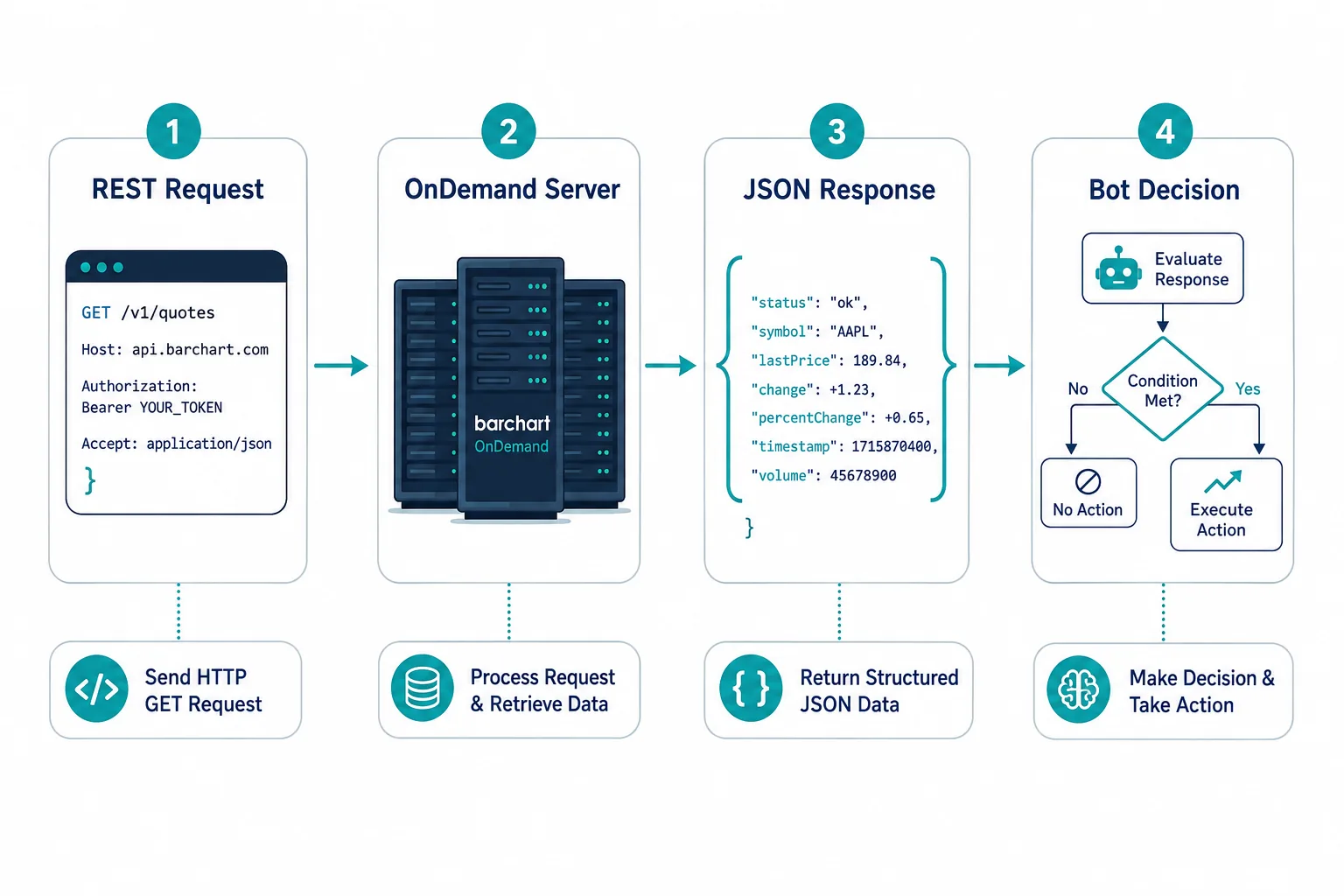
Free data is not free. It is a 15-minute delay with a $0 invoice.
A 15-minute delayed feed means your bot sees a breakout that happened 15 minutes ago. By the time the signal fires, the stock is overextended, the early buyers are already taking profits, and your bot is catching a falling knife or buying a bull trap at the worst possible entry. That is not a data problem. That is a risk-management problem caused by a data problem.
The math is simple. If your bot averages 10 trades per month and even two of those entries are 15 minutes stale, the slippage and bad fills on those two trades can cost more than a real-time data subscription in a single quarter.
Where latency actually matters:
- Intraday momentum strategies: price action moves in seconds. A 15-minute delay makes the entire strategy non-functional.
- Gap fill plays at the open: the gap fills or it does not within the first 30 minutes of the session. A delayed feed misses the entire setup.
- Earnings season: a stock can move 20% in the first minute after a report. Delayed data is useless here.
- Free alert services: most free alert apps use delayed data. If you are relying on a free alert service to trigger your bot, check the data source before assuming it is real-time.
Where latency matters less:
- End-of-day swing setups where the entry is placed after market close
- Weekly options strategies where the decision window is days, not minutes
- Fundamental screening where you are looking at earnings, not ticks
The practical takeaway: match your data tier to your strategy’s time frame. A swing trader running a basing pattern scan does not need sub-second data. A scalper running a low-float momentum strategy absolutely does. Paying for real-time data you do not need is waste. Using delayed data for a strategy that requires real-time is worse.
Barchart API vs Other Data Providers
The barchart api is not the only market data api in the room. Here is how it stacks up against the three most common alternatives a bot builder will consider.
| Provider | Free Tier | Paid Entry | Latency | Best For |
|---|---|---|---|---|
| Barchart API | 200 credits/mo (Parse.bot) | Quote-based (OnDemand) | Real-time on paid plans | Futures, commodities, broad coverage |
| Polygon.io / Massive | Rate limited | ~$29/mo Starter | 15-min delay on Starter; real time on higher tiers | US equities, bot development |
| Alpha Vantage | 25 calls/day | ~$50/mo Premium | Delayed free; real-time paid | Low-frequency, technical indicators |
| Intrinio | Limited sandbox | ~$79/mo | Real-time on paid plans | Fundamentals, institutional-quality data |
The honest call: Barchart API wins on asset class breadth, especially for anyone trading futures or commodities alongside equities. Polygon.io/Massive wins on price transparency and developer experience for pure equity bots. Alpha Vantage wins on cost for strategies that run once a day. Intrinio wins on fundamental data quality but costs more than most solo bot budgets want to spend.
One thing worth noting: the barchart api’s Event-Based API with Socket.IO support puts it ahead of Alpha Vantage for trigger-based workflows. If your bot needs to fire on a news event or a price threshold crossing, that Socket.IO layer matters. Alpha Vantage does not have an equivalent.
For more context on how AI tools layer on top of market data feeds, the AI trading software active traders use breakdown covers the full stack beyond just the data layer.
Is the Barchart API Worth It for a Trading Bot in 2026?
The barchart api is worth it for a specific type of bot builder: one who needs multi-asset coverage across equities, options, futures, and commodities, and who is willing to work through a commercial agreement to get institutional-grade data.
For a pure US equity day-trading bot on a tight budget, Polygon.io/Massive or your broker’s own feed is the cleaner choice. The pricing is transparent and the documentation is excellent.
For a bot that trades grain futures alongside tech stocks, or needs commodity price data that most competitors do not carry well, the barchart api is hard to replace. Barchart’s institutional roots in commodity markets mean the data quality and depth there is better than what you will find from a startup API provider.
The Event-Based API is the most interesting development for 2026. Trigger-based workflows, where the bot fires on a condition rather than polling on a schedule, reduce API call volume and latency simultaneously. That is a real architectural advantage for bots running signal or alert logic.
The setup that makes sense: use the Parse.bot free tier to validate your bot’s data requirements, then decide whether the call volume and asset class mix points toward a direct OnDemand agreement or a Polygon.io/Massive subscription. Do not pay for real-time futures data if your bot only trades SPY.
If you are still deciding whether your bot’s strategy holds up before spending anything on data, do AI trading bots actually make money is worth reading first. And for the broader question of what tools belong in a day-trading stack, the day trading tools directory covers the full field.
Getting Started: Barchart API Authentication and Documentation
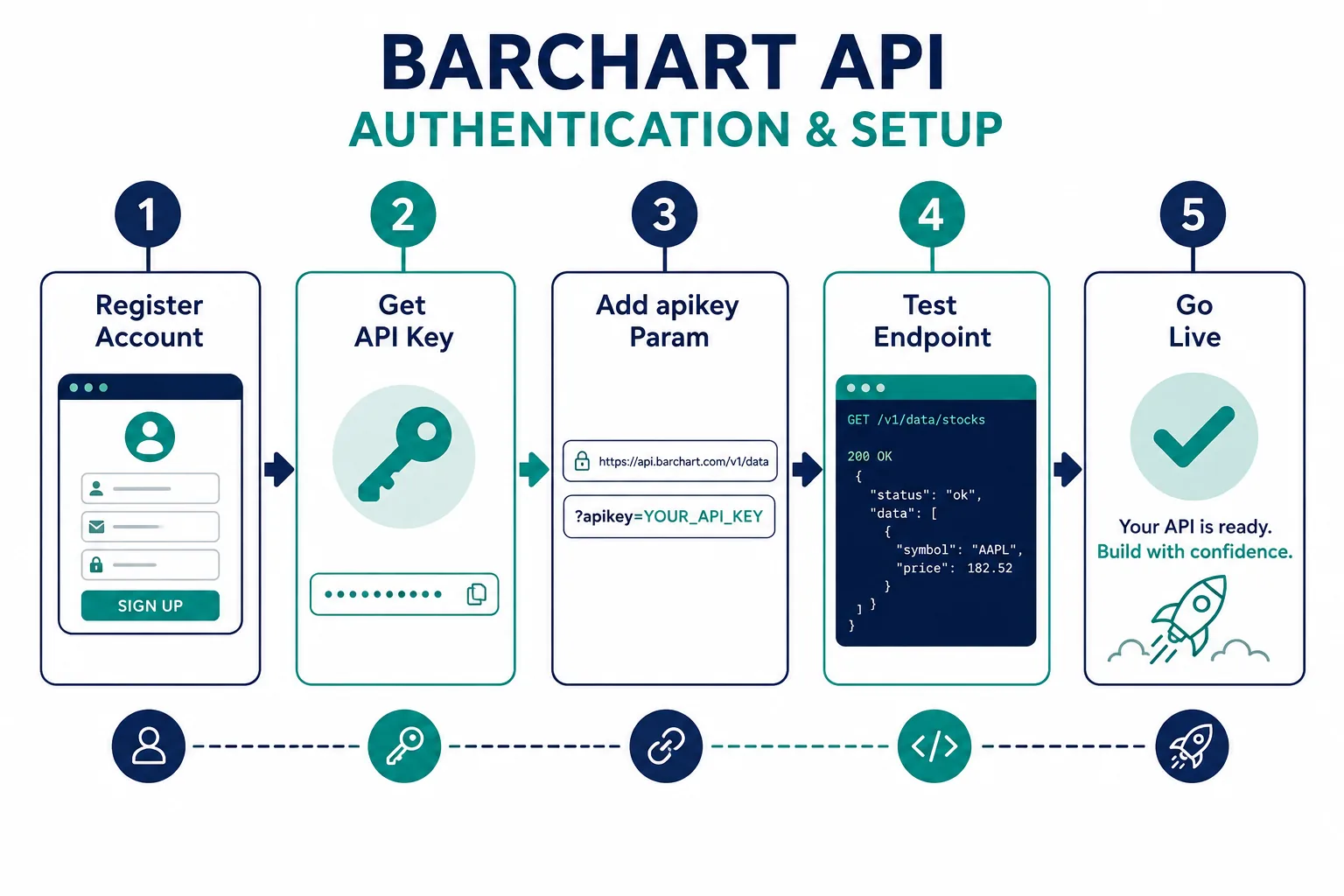
Authentication on the barchart api is simple: every request appends ?apikey=YOUR_KEY to the endpoint URL. No OAuth, no token refresh cycles. One parameter, every call.
The base URL for OnDemand is ondemand.websol.barchart.com. A basic quote request looks like:
GET https://ondemand.websol.barchart.com/getQuote.json?apikey=YOUR_KEY&symbols=AAPL,MSFTThe response comes back as JSON with fields for last price, change, volume, bid, ask, and extended session data.
For Python users: there is no official Barchart SDK on PyPI, but the REST interface works cleanly with the requests library. A basic polling loop is 10 lines of code.
For JavaScript users: the Socket.IO Event-Based API is the natural fit for Node.js bots. The WebSocket layer eliminates polling and fires callbacks when conditions are met.
Documentation: the official docs live at barchart.com/ondemand and cover all 71 paths. The getHistory endpoint handles historical OHLCV data; the getQuote endpoint handles real-time and delayed quotes; getNews handles the news feed with symbol and keyword filtering.
How far back does historical data go? Barchart’s getHistory endpoint supports daily data going back decades for major US equities and futures. Intraday history (minute bars) typically covers one to two years depending on the plan tier. For backtesting a strategy that needs 10 years of daily data, the barchart api is well-equipped. For tick-level backtesting, you will need to confirm coverage with the OnDemand team directly.
For a comparison of how charting and scanning tools use similar data pipelines, the TrendSpider vs TradingView AI charting comparison shows how front-end tools layer on top of feeds like this one.
Common Barchart API Errors and How to Fix Them
A few errors show up repeatedly in developer forums and the algotrading subreddit:
403 Forbidden: Your API key is invalid or has expired. Double-check the key in your request parameter. If you are on the Parse.bot marketplace tier, confirm the key is from that platform, not from a direct OnDemand account.
429 Too Many Requests: You have hit the rate limit for your plan tier. The free tier (200 credits/month via Parse.bot) is the most common culprit. Solutions: reduce polling frequency, cache responses for symbols you check repeatedly, or upgrade the tier.
Empty or null response on a valid symbol: Some symbols, particularly OTC names and thin futures contracts, are not in Barchart’s coverage universe. Test with a liquid symbol like AAPL or ES futures before assuming the endpoint is broken.
Stale data on a “real-time” endpoint: If your plan tier delivers delayed data, the timestamp in the response will reflect the delay. Check the tradeTime field in the JSON response against the current timestamp to confirm you are getting the latency you paid for.
Symbol format issues for futures: Barchart uses its own futures symbology (e.g., ZCZ26 for December 2026 corn). If you are pulling from a different data source for symbol lookup, the formats may not match. Use Barchart’s getFuturesContracts endpoint to resolve symbols before querying prices.
Our Take
The data layer is where most bot builders make their first expensive mistake. They spend weeks on strategy logic, pick a broker API, and then bolt on whatever free data feed they found first. Then they wonder why the bot’s signals do not match what they see on their charts.
The barchart api is a serious market data api with real depth in futures, commodities, and multi-asset coverage. For solo bot builders, the Parse.bot marketplace entry point makes it accessible without a sales call. For US equity bots in development, Polygon.io/Massive is the sharper choice. For low-frequency strategies still in development, Alpha Vantage’s free tier is enough to validate the logic.
The decision rule is simple: match the data tier to the strategy’s time frame, confirm the latency before going live, and do not pay for real-time futures data if your bot only trades SPY options.
Three actions to take now:
- Map your bot’s call volume: how many symbols, how many times per day, what asset classes. That number determines which tier you actually need.
- Test with the Parse.bot free tier or Polygon.io’s free tier before paying anything. Validate that the data format matches what your bot expects.
- Check the timestamp on every response in your test runs. Confirm the latency matches the tier you signed up for before going live.
Systems over hacks. The bot is only as good as the data it runs on.
For a broader look at AI tools that sit on top of market data feeds, check out honest AI stock tool reviews from real users in 2026 and the Capitalise.ai review for an example of how automation layers on top of data providers. If you are building a scanner rather than a bot, 7 swing trade scanners that find setups before they break out covers the front-end tools that use similar data pipelines.
Final Verdict
The barchart api earns its place in a bot builder’s stack when multi-asset coverage and futures data are requirements, not nice-to-haves. For pure US equity bots, Polygon.io/Massive or your broker’s own feed is the more practical starting point. The lack of transparent self-serve pricing on the core OnDemand platform is a real friction point for solo developers, and the free tier via Parse.bot is thin for active bots. That said, few affordable market data APIs match Barchart’s commodity and futures depth. Choose based on what your bot trades, not on brand recognition.
The FullStack Alpha directory catalogues 200+ AI stock tools by category and price, filterable by what you actually need. Browse the directory at aistockpickerapps.com
FullStack Alpha may earn a commission from affiliate links in this article. This does not affect editorial scores or recommendations.
References
- Ondemand, https://www.barchart.com/ondemand
- Fyi Barchart Discontinuing Free Apis, https://www.reddit.com/r/algotrading/comments/kbk0y9/fyi_barchart_discontinuing_free_apis/
- Barchart Plans Pricing, https://apis.io/plans/barchart/barchart-plans-pricing/
- 252001 Api Inquiry Response, https://help.barchart.com/support/solutions/articles/252001-api-inquiry-response
- Pricing, https://www.saasworthy.com/product/barchart-ondemand/pricing
- Case Study CIH, https://www.barchart.com/cmdty/resources/case-studies/cih
- Parse.bot Barchart API, (Parse.bot marketplace listing, last updated August 28, 2026)
- Market Data APIs Barchart OnDemand, (Barchart OnDemand documentation, last updated August 26, 2026)
- GetNews endpoint documentation, (Barchart OnDemand News API docs, example calls dated 2026-05-18)
- APIs.io Barchart provider profile, https://apis.io/plans/barchart/barchart-plans-pricing/
By Jay Rocco, Founder and Editor, FullStack Alpha.
Stay alpha.
Frequently Asked Questions
What is the barchart api pricing in 2026?
Barchart OnDemand does not publish self-serve pricing publicly. The platform targets institutional subscribers and requires a commercial agreement for direct access. Via the Parse.bot marketplace, a free tier offers 200 credits/month, with paid tiers scaling to 100,000 credits/month. For a solo bot builder, the Parse.bot entry point is the most accessible starting point before committing to a direct OnDemand contract.
Is there a free stock data API that works for a trading bot?
Yes, with caveats. Polygon.io's free tier gives unlimited API calls with 15-minute delayed data. Alpha Vantage's free tier gives 25 calls per day with delayed data. The barchart api via Parse.bot gives 200 credits/month. None of these free tiers support real-time intraday trading. They are suitable for strategy validation, backtesting, and end-of-day swing setups, not for intraday momentum bots.
Can I use the barchart api with Python?
Yes. The REST interface works with Python's `requests` library without an official SDK. Append your `apikey` to each request URL, parse the JSON response, and you are operational in under 20 lines of code. For Socket.IO-based real-time alerts, use the `python-socketio` library.
What are the barchart api rate limits?
Rate limits depend on the plan tier and access route. The Parse.bot marketplace uses a credit system (200 free credits/month up to 100,000/month at the Company tier). Direct OnDemand plans have call-per-minute and monthly limits defined in the commercial agreement. There is no single public number because limits are tier-specific.
What is the best market data API for an intraday trading bot?
For US equities on a budget, Polygon.io Starter (~$29/month) is the strongest combination of price, latency, and documentation. For multi-asset bots covering futures and commodities, the barchart api via a direct OnDemand agreement is harder to replace. For low-frequency strategies, Alpha Vantage's paid tiers are cost-effective.
Do free trade alerts apps use real-time data?
Most best stock alert app free services use delayed data, typically 15 minutes. Before connecting any free alert service to a bot, check the data source and timestamp in the alert payload. If the alert is 15 minutes stale, the setup your bot is reacting to may no longer exist.
How do I get AI stock signals from the barchart api?
The barchart api does not generate ai stock signals natively. It provides the raw data (quotes, news, options flow) that a signal layer sits on top of. The Event-Based API lets you define conditions (price thresholds, news events) and receive alerts when they trigger, which is the closest the platform gets to a signal service. Building a signal layer on top of that data is the bot builder's job.
Does the barchart api cover options and futures?
Yes. Options chains with Greeks, futures contracts across commodities and financials, and commodity spot prices are all available. This is one of Barchart's strongest differentiators versus competitors that focus primarily on US equities.
Jay Rocco is the Founder and Editor of FullStack Alpha. He has tested 200+ AI stock tools since 2022 and run 15+ AI trading platforms on live accounts with his own money. He reviews the software. He does not tell you what stocks to buy.
