

The FullStack Alpha research desk tests AI trading bots on paper and live accounts. Reviewed and edited by Jay Rocco, Founder and Editor.
By FullStack Alpha Editorial Team | Reviewed by Jay Rocco, Chief Editor
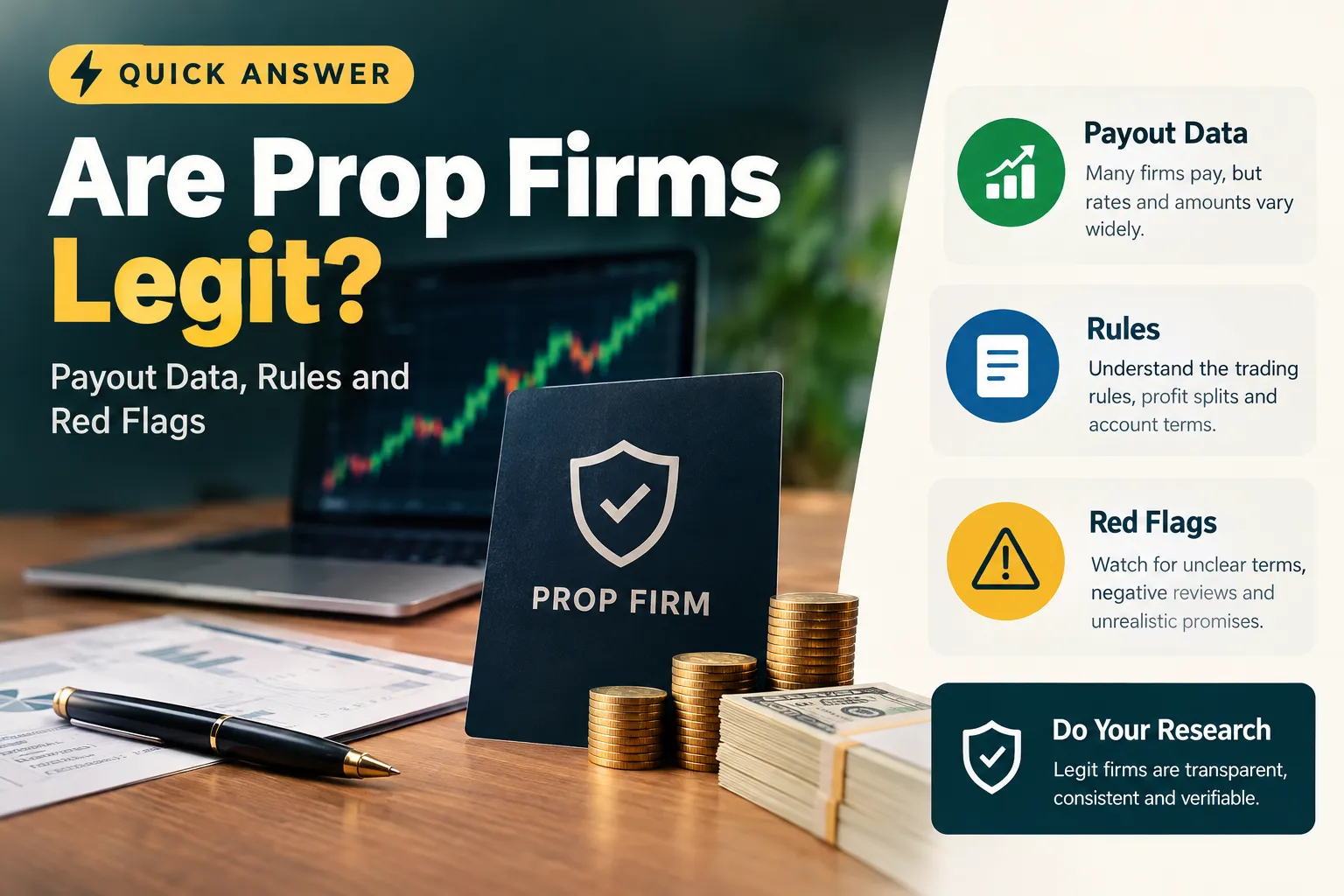
Are prop firms legit? Most of the large ones are real businesses that really do send money, and the published numbers prove payouts happen at scale. In October 2026, Finance Magnates reported Goat Funded Trader claiming $26 million paid to 22,279 traders, and blockchain-tracked payouts from the ten largest firms hitting $115 million in Q1 2026. The catch isn’t fraud for most firms. It’s that the evaluation fee is the product, the rulebook is written by the house, and a consistency rule or trailing drawdown can cancel a payout you thought you’d earned. Read the terms page before you read the marketing page.
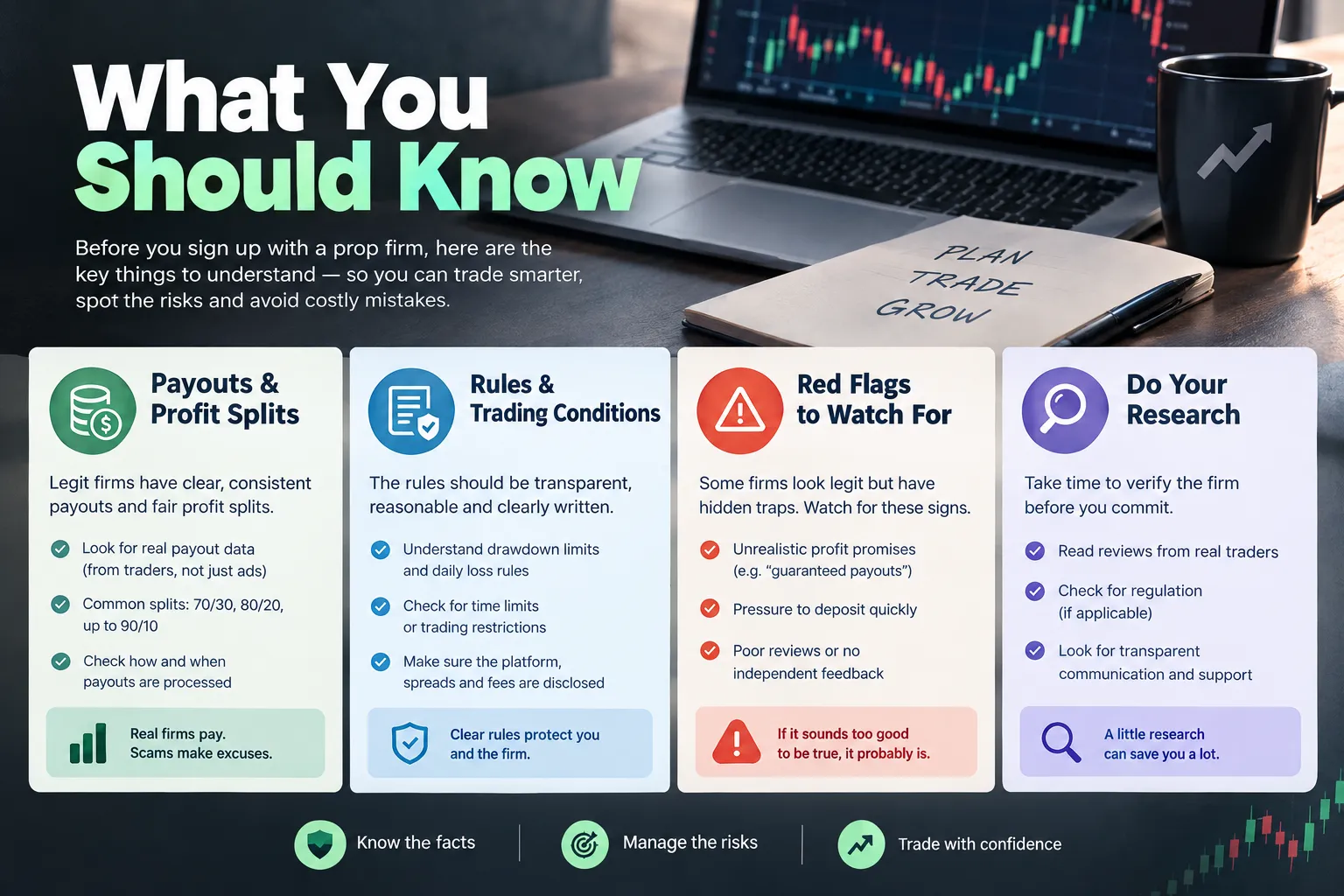
What You Should Know
- Payouts are real and traceable. Finance Magnates reported on October 21, 2026 that blockchain-tracked payouts from the ten largest prop firms reached $115 million in Q1 2026.
- “Paid traders” is not the same as “customers paid.” Goat Funded Trader’s own figures imply 22,279 payouts against 594,997 challenge buyers in the tracked window, roughly 3.7%, though the firm’s methodology doesn’t necessarily capture every historical payout.
- The most-quoted industry dataset is vendor-derived. FPFX Tech data, associated with CEO Justin Hertzberg and covering 10 firms and about 100,000 traders, reported around 14% passing an evaluation, about 45% of funded traders getting a payout, and roughly 7% of all entrants getting paid. Trader Scale argued in September 2026 that no regulator dataset or academic census backs this up.
- Pass rates differ because the denominators differ. Topstep published 16.8% of Trading Combines passed; Tradeify reported about 17.2%; Take Profit Trader reported 36.22%. Some count attempts, some count unique traders.
- Legal risk exists around the fee model. TradingBay reported on October 15, 2026 that Steven Lawton alleged spending $404,941 across 8,099 purchases without receiving a payout, claiming Apex Trader Funding acted as an unregistered commodity pool operator. Allegations, not findings.
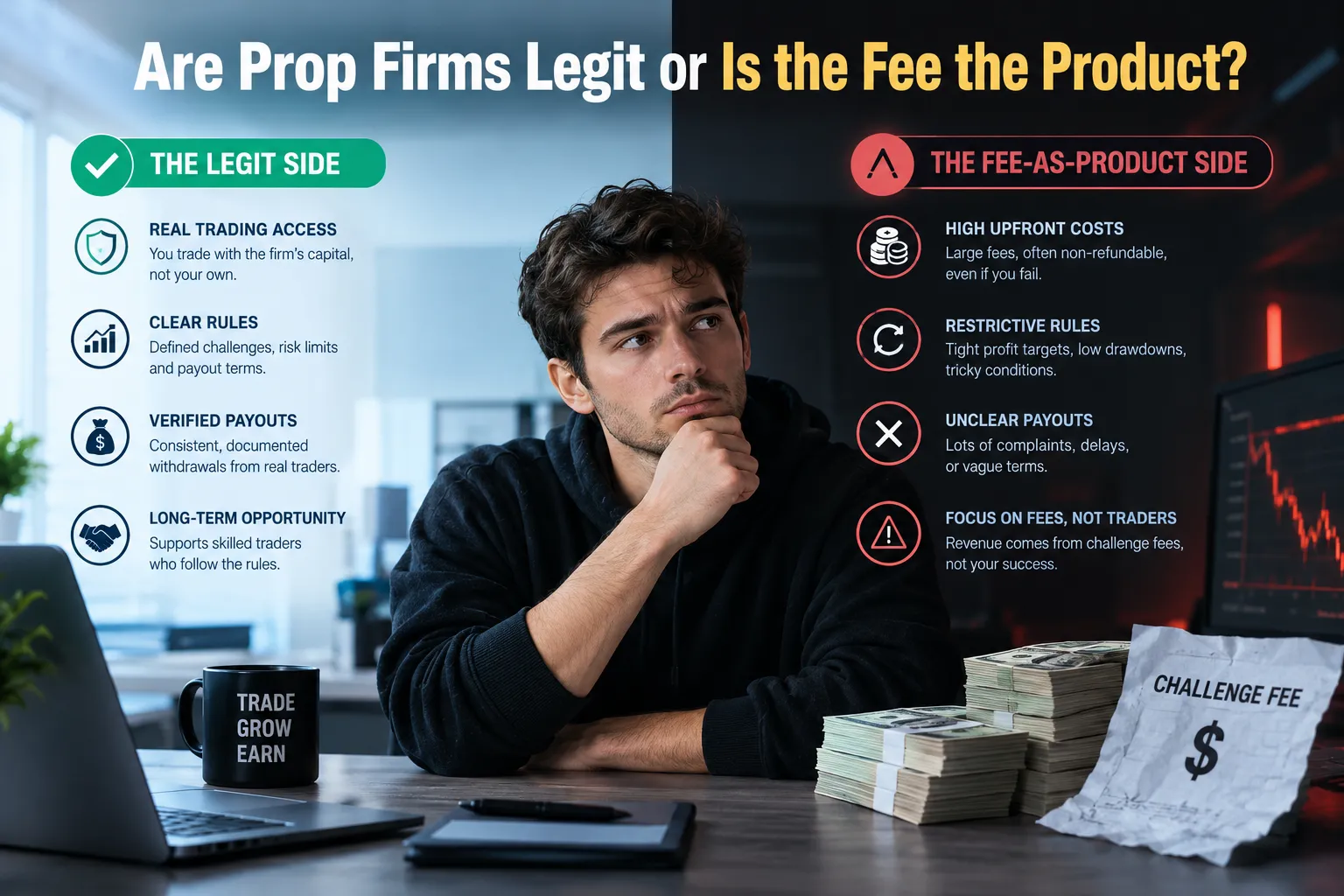
Are Prop Firms Legit or Is the Fee the Product?
Are prop firms legit as businesses? Yes, the big ones are legitimate companies with real revenue, real customer service and real bank transfers going out. The honest question isn’t whether they exist. It’s where their revenue comes from, and for most retail-facing evaluation firms, the answer is the fee.
Here’s the model in plain English. You pay for an evaluation, a simulated account with a profit target and a loss limit. Hit the target without breaking a rule, and you get a funded account, usually still simulated, sometimes routed live. Make money on that, request a payout, and the firm splits the profit with you.
Notice what’s missing from that chain. No one handed you $100,000. The FPFX-derived analysis put the average payout at roughly 4% of nominal account size, meaning a “$100,000 account” is a sizing label, not a pile of capital with your name on it. What determines your actual economics is the drawdown limit, the payout cap, the profit split and the eligibility rules. The headline number is branding.
A “$100,000 account” at a prop firm is a risk parameter, not a balance. Treat it like a leverage setting, not a bank statement.
Where the revenue actually comes from
Two models exist, and firms rarely say which one they run:
- Fee-dominant. Most income comes from failed evaluations. Your loss is their margin. Not illegal, not automatically a scam, but the incentive runs against you.
- Trade-dominant. The firm genuinely profits when its best traders profit, often by mirroring their orders in live markets. Rarer, harder to verify from outside.
A fee-dominant firm isn’t a fraud. A restaurant that sells gym memberships in January knows most people won’t show up, and that’s still a real business. But you should price the trade honestly: you’re buying a lottery-shaped product with a skill component, not a job offer.
What the regulators are actually doing
Regulatory treatment hangs on the business model, not the words “prop firm.” The Industry Spread summarized the split: a firm running purely simulated evaluations may not be a broker or an investment manager at all, while a business acting as counterparty in retail off-exchange forex, routing live futures orders, or giving individualized advice can trip registration duties. There’s no single universal “prop-firm license” to check for.
The CFTC is visibly active in the adjacent space. Its enforcement page lists charges filed August 11, 2026 against Goliath Ventures Inc. and its CEO over an alleged $400 million fraud scheme, not a retail prop-firm case, but a reminder of the environment firms soliciting trading-related payments operate in. On September 17, 2026, the CFTC also issued a no-action position for certain passive software providers that route users’ trades through registered futures intermediaries, under specified conditions. That is not a blanket blessing for simulated prop firms, and anyone marketing it that way is selling you something.
Practical takeaway: stop asking “are prop firms legit” as a yes/no. Ask whether a specific firm publishes its terms, honors them in writing, and shows verifiable payout proof. The business model is legal. The individual contract is what bites.
Do Prop Firms Actually Pay Out?
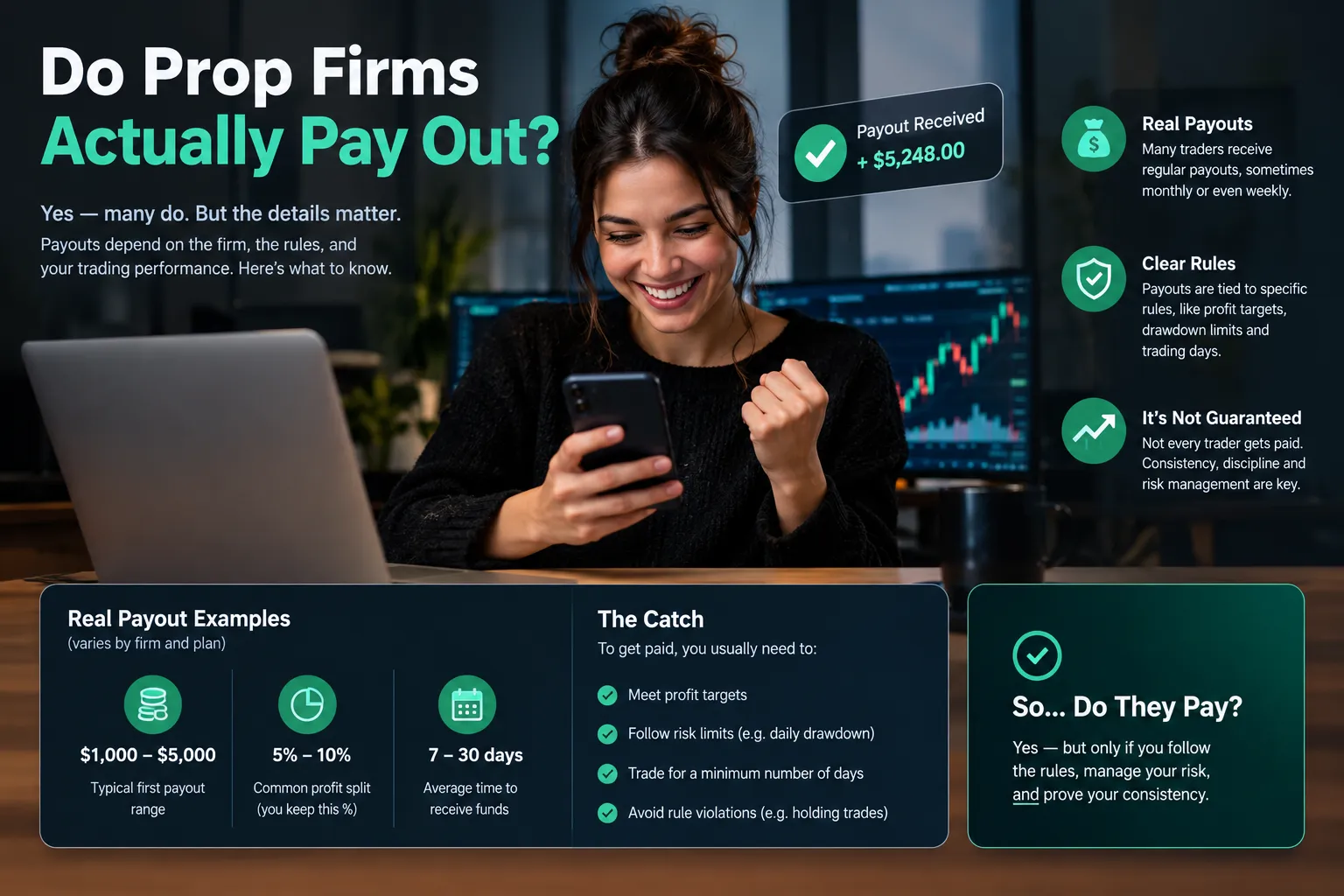
Yes. Prop firm payouts are real, documented and large in aggregate. Finance Magnates reported on October 21, 2026 that blockchain-tracked payouts from the ten largest firms reached $115 million in Q1 2026, and that Goat Funded Trader claimed $26 million paid to 22,279 traders. The problem isn’t whether money moves. It’s that almost every payout total you’ll see is self-reported.
That same Finance Magnates report flagged the transparency gap directly, noting FundedNext and Hola Prime had turned to Deloitte for verification. When firms start paying a Big Four auditor to count their own payouts, that tells you how much the uncounted claims were worth.
The percentage no one agrees on
Here’s where you need to be careful, because the same dataset gets quoted three different ways.
| Published figure | Source | What it measures |
|---|---|---|
| ~14% pass an evaluation | FPFX Tech data (10 firms, ~100k traders) | Share of entrants clearing the challenge |
| ~45% of funded traders get a payout | FPFX Tech data | Share of those who already passed |
| ~7% of all entrants get a payout | FPFX Tech data | The two above, multiplied |
| 16.8% of Trading Combines passed | Topstep, 2025 | Attempts, not unique traders |
| ~17.2% pass rate | Tradeify, 2025-2026 | Firm-reported |
| 36.22% pass rate | Take Profit Trader | Firm-reported, different denominator |
| 33.3% of funded traders paid in 2025 | Topstep | Company-specific, not industry-wide |
| ~3.7% of challenge buyers paid | Implied by Goat Funded Trader’s own numbers | 22,279 payouts / 594,997 buyers, tracked window only |
Look at the spread: 3.7% to 36.22% isn’t a range, it’s a measurement problem. The Prop Journalist noted the core reason: some firms count attempts, others count unique traders, which makes direct comparison unreliable. A trader who buys four resets shows up as four failures at one firm and one trader at another.
And the famous “7% get paid” line deserves a warning label. Trader Scale argued in September 2026 that there’s no academic study, no regulator dataset and no formal industry census behind it, and that most circulating statistics trace back to vendor blogs or company disclosures. The FPFX numbers are the best available, and they’re still vendor-derived, not audited.
How to read a payout claim without getting played
- “$26 million paid” is a numerator with no denominator. Always ask: out of how many paying customers?
- “Number of accounts paid” ≠ “percentage of customers paid.” One trader with six accounts is six payouts.
- Check the window. A figure covering 2024-2026 behaves very differently from an all-time total.
- Prefer third-party verification. Deloitte-reviewed or blockchain-tracked beats a graphic on a landing page.
- Screenshot galleries prove nothing. They’re the trading equivalent of a before-and-after photo with different lighting.
Decision rule: if a firm publishes a payout total but refuses to publish the number of funded accounts or evaluation buyers behind it, treat the total as marketing. Not a lie, necessarily. Just unaudited advertising. The same instinct applies when you’re vetting software, which is why we published a full breakdown of which AI trading bots are legit versus scams.
Which Rule Traps Cancel Payouts?
Most traders who don’t get paid didn’t lose money. They broke a rule they skimmed past at checkout. The five that end the most accounts: the prop firm consistency rule, the drawdown type, news windows, bot policy and inactivity clauses.
The consistency rule is the quiet account killer
The prop firm consistency rule caps how much of your total profit can come from a single day or a single trade, often somewhere in the 20-40% range depending on the firm. Check the official page for the exact figure, because it varies and firms change it.
Why it exists: it stops someone from gambling one oversized trade, hitting target, and cashing out. Why it hurts good traders: real price action isn’t evenly distributed. If you trade breakouts, one clean setup can carry your whole month. You followed your process, you managed risk, and the rule tells you the win was too big.
The fix is boring. Spread your profit across more trading days. If one day puts you over the concentration limit, keep trading small and flat until your denominator catches up. That’s not a hack, that’s just reading the contract before you sign it.
Drawdown type matters more than drawdown size
Not all loss limits behave the same, and this is where traders get stopped out by the rulebook rather than the market.
| Rule | What it does | How to check |
|---|---|---|
| Consistency rule | Caps the share of total profit from one day or trade; a breach can void a payout even when you’re net up | Terms page, usually under “Payout Eligibility.” Ask support for the exact percentage in writing |
| Trailing drawdown | Your loss floor rises with your peak balance, sometimes intraday. Give back an open profit and you can breach while still green | Ask: does it trail on closed equity or unrealized peak? The answer changes everything |
| Static drawdown | Loss floor stays fixed at the starting level. Far more forgiving, less common on cheap accounts | Terms page. If it isn’t stated, assume trailing |
| News window restriction | Bans entries or holds around high-impact releases (CPI, FOMC, NFP). Breaching can void the account | Look for a named economic calendar and the exact minutes before and after |
| Bot / EA / copy-trade policy | Restricts automation, HFT, latency arbitrage and copying between accounts. Often enforced at payout review, not entry | Search the terms for “automated,” “expert advisor,” “copy” and “arbitrage” |
| Inactivity clause | Account closes after a set number of idle days. Fee is usually not refunded | Terms page, often buried near account termination |
The trailing drawdown is the one that catches experienced traders. Say your account peaks up $2,000 intraday on an unrealized gain, then you let the trade come back to breakeven. Under an unrealized-peak trailing rule, your loss floor just moved up $2,000 and you’re suddenly much closer to a breach than your P&L suggests. You did nothing wrong by any normal risk management standard. The rulebook disagreed.
News windows and bots
News restrictions sound reasonable until you realize earnings season and macro prints are exactly when volatility creates the cleanest setups. Firms restrict them because slippage and gap risk wreck their hedging, not because they’re protecting you. If your entire edge is event-driven, a firm with hard news windows is structurally wrong for you, no matter how good the price looks.
Automation policies are stricter than most traders assume, and they’re frequently enforced at the payout review stage rather than at signup. A firm can let a bot run for six weeks, collect your fee, and then flag it when you ask for money. If you plan to automate anything, get written approval first, and check whether copy-trading across your own accounts counts as a breach.
Common mistake: assuming the rules you passed the evaluation under carry over to the funded account. They often don’t. The funded-stage rulebook is usually a separate document. Read both.
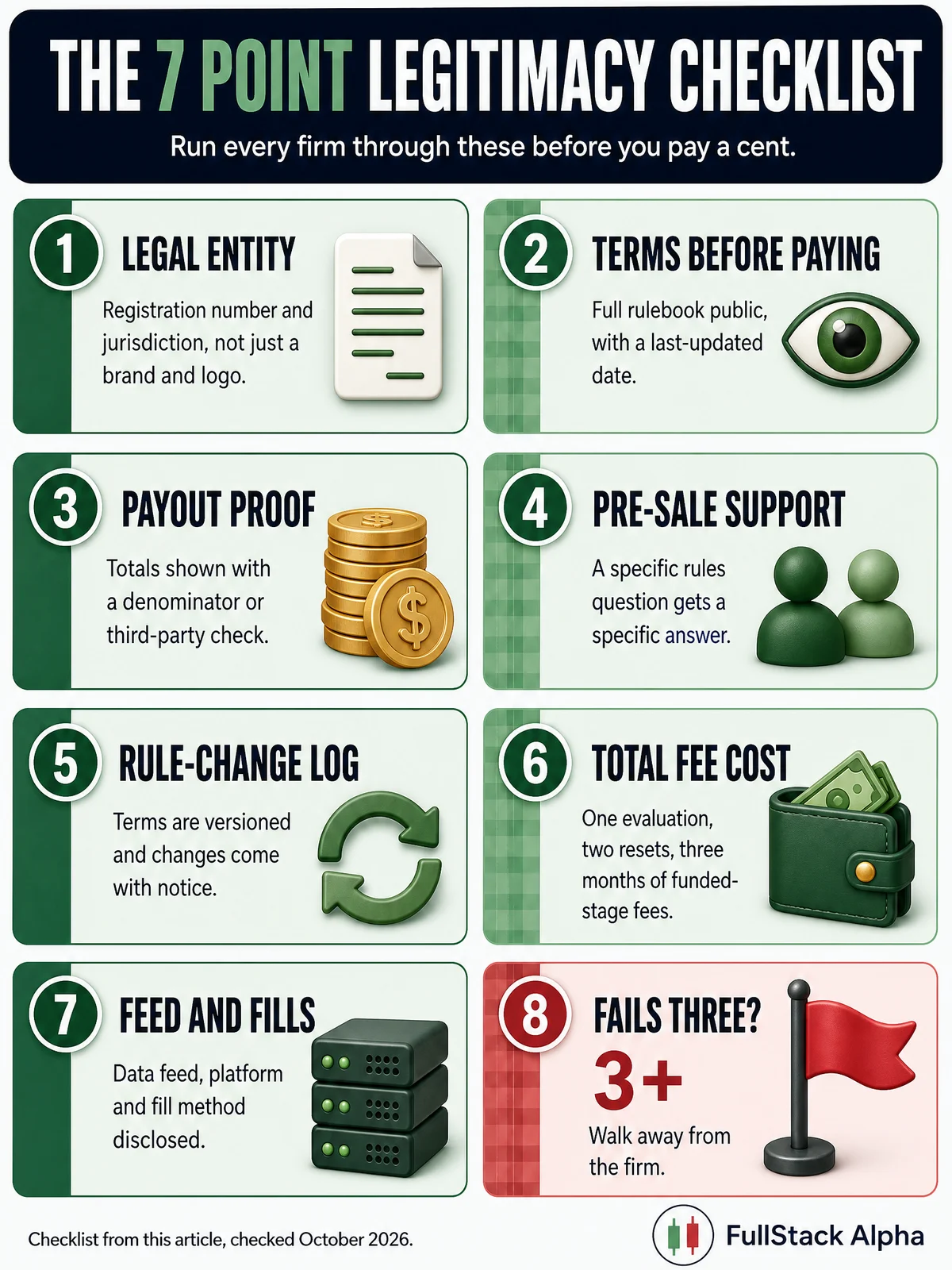
What Is the 7 Point Legitimacy Checklist?
Run every firm through these seven checks before you pay a cent. If a firm fails three or more, walk. This is the practical answer to “are prop firms legit” at the individual-company level.
1. Company registration. Find the legal entity name, jurisdiction and registration number. It should appear in the footer or terms, not just a brand name and a logo. The fix: if you can’t identify who you’re contracting with in under two minutes, you have no counterparty. Don’t buy. A brand name on a checkout page is not a company.
2. Published terms you can read before paying. The full rulebook, drawdown type, consistency rule, news policy, payout schedule, should be public and accessible pre-purchase. The fix: save a dated PDF of the terms on the day you buy. If the rules change later, you have the version you agreed to. Firms that hide terms behind a login are telling you something.
3. Payout proof with a denominator. Look for third-party verification: Deloitte-style audit, blockchain-tracked transfers, or at minimum a published count of funded accounts alongside the dollar total. The fix: ask support directly for the number of funded accounts behind the headline payout figure. Save the reply. A firm that won’t answer has answered.
4. Support that responds before you’re a customer. Email a specific rules question pre-purchase. Something like: “Does your trailing drawdown calculate on closed equity or unrealized peak?” The fix: time the response and judge the specificity. A canned reply that dodges the question is exactly the reply you’ll get during a payout dispute, when it costs you.
5. A rule-change log. Legitimate operations version their terms and announce changes with notice. The worst pattern in the industry is a quiet mid-challenge rule edit. The fix: check whether the terms page shows a “last updated” date. No date, no accountability. Search the firm’s Discord or announcements channel for a changelog.
6. Fee clarity, including the ones after the first. The evaluation fee is the advertised number. Reset fees, activation fees, monthly data fees and payout processing fees are the real cost. The fix: add up the total cost of one evaluation plus two resets plus three months of funded-stage fees. That’s your actual budget. Compare that to what the same money buys in commission-free capital at a broker.
7. Data feed and platform disclosure. Simulated accounts need real market data. Find out which feed, which platform, and whether the fills are simulated against live quotes or a synthetic book. The fix: ask whether your order flow is routed, mirrored or purely simulated. The honest firms will tell you. If fills are synthetic, your backtested edge may not survive contact with their engine, the same reason we push traders to verify data quality before trusting any tool’s output.
The quick version
Print this. Use it on every firm:
- Named legal entity and registration number
- Full terms readable before purchase, with a last-updated date
- Payout totals with a denominator or third-party verification
- Pre-sale support answering a specific rules question
- A public rule-change log
- Total cost including resets, activation and data fees
- Disclosed data feed, platform and fill methodology
Three or more fails, skip it. Play stupid games.
What Do Reddit Users Say About Prop Firms?
Prop firm Reddit discussion skews negative, and that’s a feature, not a bug. People post when they’re angry, so subreddits like r/Daytrading, r/FuturesTrading and r/propfirms capture complaints that solicited review sites never surface. Read it as unsolicited signal, weighted for that bias.
The recurring themes traders raise across those communities, as user reports rather than verified facts:
- Payout review delays. Traders describe requests sitting in “under review” far past the published schedule, usually on larger withdrawals.
- Rules enforced retroactively. Accounts flagged for automation or copy-trading weeks after the behavior, at the payout stage.
- Trailing drawdown confusion. The single most common “I didn’t lose money but I failed” complaint.
- Consistency-rule surprises. Traders discovering the cap only after a strong month, when the payout gets trimmed or denied.
- Support quality cratering after purchase. Fast pre-sale answers, slow post-payout ones.
The counterweight: plenty of verified payout screenshots circulate too, and some firms have multi-year threads of people getting paid on schedule. Reddit shows you the failure modes, not the base rate. Use it to find the questions worth asking support, not to rank firms.
A better method than vibes: search site:reddit.com [firm name] payout denied and read the threads where the firm’s own staff replied. How a company handles a public complaint tells you more than any testimonial page. We apply the same read-the-complaints-first discipline across every tool in our AI research and analysis tools breakdowns.
Edge case worth knowing: some of the loudest complaint posts come from traders who genuinely broke a rule and didn’t understand it. That doesn’t make the firm the villain. It makes the rulebook the villain, which is exactly why point 2 of the checklist exists.
Are Prop Firms Worth It?
Are prop firms worth it? For a disciplined trader with a tested, documented edge and no capital, yes, the fee can be cheaper than the alternative. For everyone else, it’s a fast, expensive way to discover you don’t have a system yet.
It can suit you if
- You’ve got a written strategy with at least a few months of tracked results, live or paper-traded.
- You trade futures or forex, where leverage at a retail broker is genuinely capital-intensive.
- Your account is under about $10,000 and you can’t size properly on your own money.
- You treat the fee as a tuition cost you’ve already mentally written off.
- Your strategy survives the firm’s specific rules, no news dependency, no single-day profit concentration.
Skip it if
- You can’t state your edge in one sentence. If you don’t know why you make money, a funded account just accelerates the discovery.
- Your strategy depends on event-driven entries that the firm’s news window bans.
- You’ve never traded the instrument live. Paper trade it first, then pay for an evaluation.
- You’re buying it to feel like a professional. That’s a costume, not a career.
- You’d need three or four resets to afford a real attempt. That money is a brokerage deposit in disguise.
The honest comparison
A $150 evaluation fee buys you a shot at trading size you couldn’t otherwise access. The same $150 in a brokerage account buys you very little leverage but no rules, no consistency cap, no payout review and no counterparty who profits when you fail.
Run the arithmetic on repeat attempts. Three evaluations and two resets can easily exceed $500 without a single payout. The Lawton complaint reported by TradingBay is the extreme version of this: $404,941 across 8,099 purchases over roughly three years. That’s an allegation in an active matter, not a proven finding, but it illustrates how fee spend compounds when a trader keeps buying attempts instead of fixing the process.
Decision rule: if you wouldn’t trade the same strategy with your own money at the same size, don’t buy an evaluation. The firm’s capital doesn’t make a bad setup good. It just raises the stakes on a process you haven’t proven.
For swing traders especially, the fit is often poor, holding periods clash with daily loss limits and inactivity clauses. If that’s your style, build the process first with proper swing trading tools and revisit the funded route later.
What Happens If You Lose Money on a Prop Firm Account?
Under typical published terms, you lose the evaluation fee and your account access. You do not owe the firm the simulated losses, and there’s no loan to repay. Confirm this on the specific firm’s terms page, because the clause wording varies.
How the sequence usually runs:
- You breach a limit, daily loss, maximum drawdown, or a rule violation like a news-window entry.
- The account is closed or locked, often automatically and immediately.
- Open positions are flattened at whatever the platform fills.
- The fee is not refunded. This is nearly universal.
- You’re offered a reset at a discounted price. That’s the upsell, and it’s where fee spend compounds.
Two things to check in the terms before you need them:
- Is there any clawback clause on prior payouts? Some firms reserve the right to reverse payouts if they later determine a rule was breached during the earning period. Rare, but it exists. Search the terms for “clawback,” “reverse” and “recoup.”
- Does a breach ban you from the firm permanently? Most don’t, but some restrict re-entry after certain violation types.
Edge case: losing money on a live-routed account is a different legal animal from losing on a simulated one. If the firm routes real orders through a registered futures intermediary, read the account agreement carefully, the liability language may not match the simulated-evaluation version. Most retail-facing evaluation firms are simulated. Verify which one you’re in.
Common mistake: buying the reset the same day you blow up. That’s revenge trading with a credit card. Sit out a week, review your journal, find the actual rule or behavior that broke, then decide.
Frequently Asked Questions
Do prop firms actually pay out?
Yes. Finance Magnates reported in October 2026 that blockchain-tracked payouts from the ten largest firms reached $115 million in Q1 2026, and Goat Funded Trader claimed $26 million paid to 22,279 traders. The limitation is that most payout totals are self-reported, which is why FundedNext and Hola Prime engaged Deloitte for verification.
Are prop firms actually worth it?
Only if you already have a tested, documented strategy and genuinely can’t access the size you need at a broker. The fee is cheap relative to funding a futures account properly, and expensive relative to zero, which is what most untested traders should be spending. If you’d need multiple resets to make a real attempt, that money belongs in a brokerage account instead.
Which prop firm is the most trusted?
No single firm holds a verified “most trusted” title, and any ranking claiming one is selling something. Judge firms individually on third-party payout verification (Deloitte review or blockchain tracking), published terms with a last-updated date, and how they handle public complaints. Topstep, Tradeify and Take Profit Trader have each published pass-rate figures, which is more disclosure than most, but publishing a number is not the same as having it audited.
What percentage of people get a payout from a prop firm?
The most-cited figure is roughly 7% of all entrants, from FPFX Tech data covering about 10 firms and 100,000 traders. That same dataset reported about 14% passing an evaluation and roughly 45% of funded traders receiving a payout. Trader Scale noted in September 2026 that no regulator dataset or academic study backs these numbers, so treat them as the best available vendor estimate rather than a census.
What happens if you lose money on a prop firm account?
Under typical published terms you lose the evaluation fee and the account, and you don’t owe the firm the simulated losses. There is no loan and no debt. Check the specific firm’s terms for clawback language covering prior payouts, and verify whether your account is simulated or live-routed, because the liability wording can differ.
What is a prop firm consistency rule and why does it matter?
A consistency rule caps the share of your total profit that can come from a single day or trade, often in the 20-40% range depending on the firm. It matters because breaching it can void a payout even when your account is net profitable. Check the exact percentage on the official terms page and get it confirmed in writing by support.
How long does it take to get paid by a prop firm?
Published schedules commonly range from on-demand or daily to biweekly, but the schedule matters less than the cap. A daily payout with a low ceiling can deliver less monthly cash than a biweekly payout with a higher one, especially if you have to rebuild a safety buffer after each withdrawal. Check both the frequency and the maximum per cycle on the official page.
Are prop firms legit under US regulation?
Legality depends on the business model, not the label. The Industry Spread noted there’s no universal “prop-firm license”; a purely simulated evaluation firm may not require broker registration, while a firm acting as forex counterparty, routing live futures orders, or giving individualized advice can trigger registration duties. The CFTC’s September 17, 2026 no-action position for certain passive software providers applies narrowly and is not a blanket approval for prop firms.
Our Take
Are prop firms legit? The large ones are real businesses that really pay, and the $115 million in blockchain-tracked Q1 2026 payouts settles that part of the argument. But the fee is the product at most evaluation firms, the rulebook is written by the house, and the published pass rates swing from 3.7% to 36.22% depending on who’s counting what. That spread isn’t data. It’s a measurement vacuum where marketing lives.
So stop asking whether the industry is legit and start auditing the individual firm. Run the seven-point checklist, registration, published terms, payout proof with a denominator, pre-sale support, a rule-change log, total fee math, and disclosed data feed. Three fails, walk away. Save a dated PDF of the terms the day you buy.
And before any of that: prove the edge on your own money or in a sim for three months. A funded account doesn’t fix a missing process. It just makes the bill arrive faster. Systems over hacks.
Related: if you would rather fund your own account, compare brokers in the FullStack Alpha broker reviews, and find more vetting guides at AI Stock Trading Bots.
Holding a prop firm’s terms and not sure which clause will bite? Send us the firm or your bot and we’ll run the seven-point check on it.
Stay alpha.
The FullStack Alpha research desk tests AI trading bots on paper and live accounts. Reviewed and edited by Jay Rocco, Founder and Editor.
