

The FullStack Alpha research desk tests AI trading bots on paper and live accounts. Reviewed and edited by Jay Rocco, Founder and Editor.
By FullStack Alpha Editorial Team | Reviewed by Jay Rocco, Chief Editor
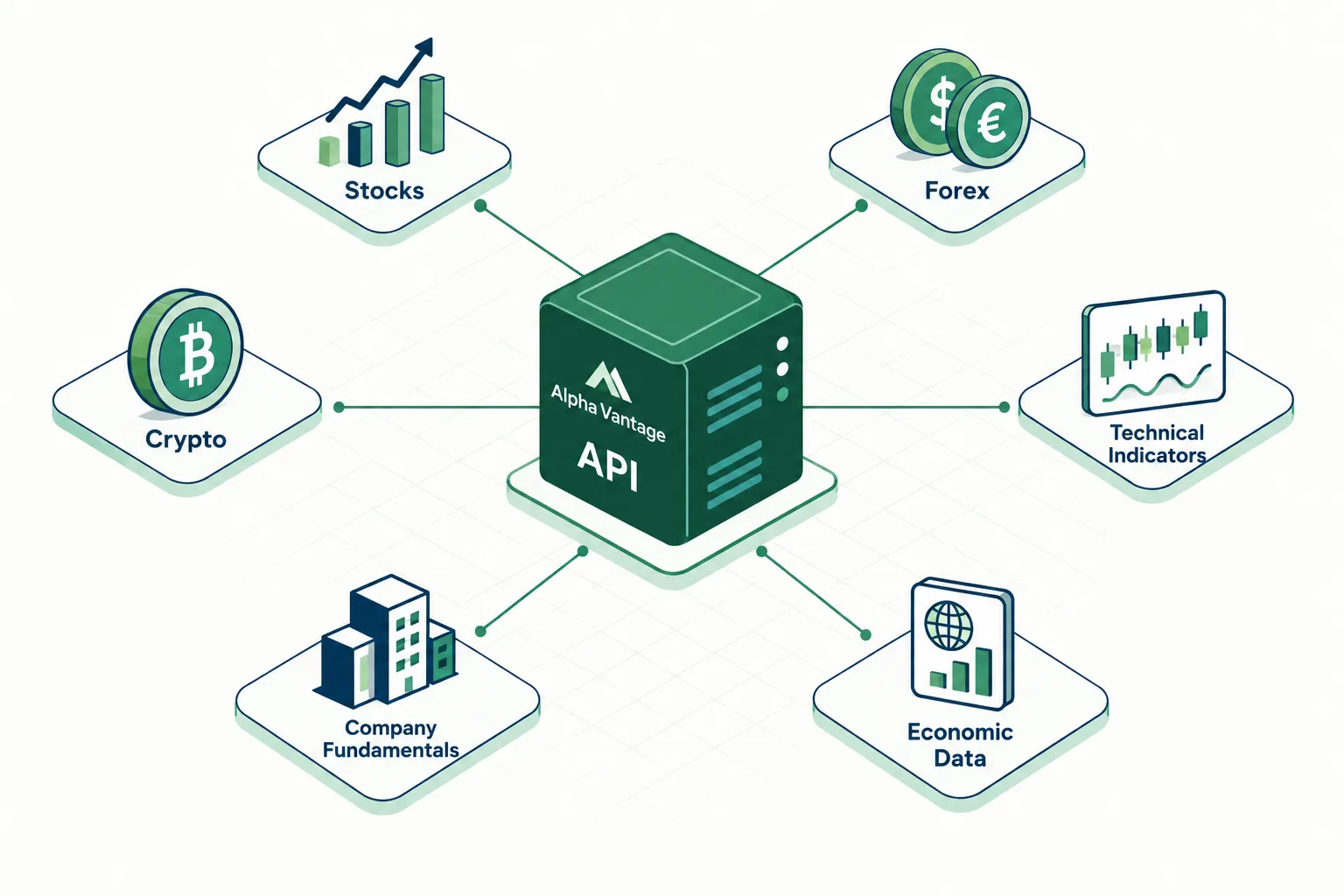
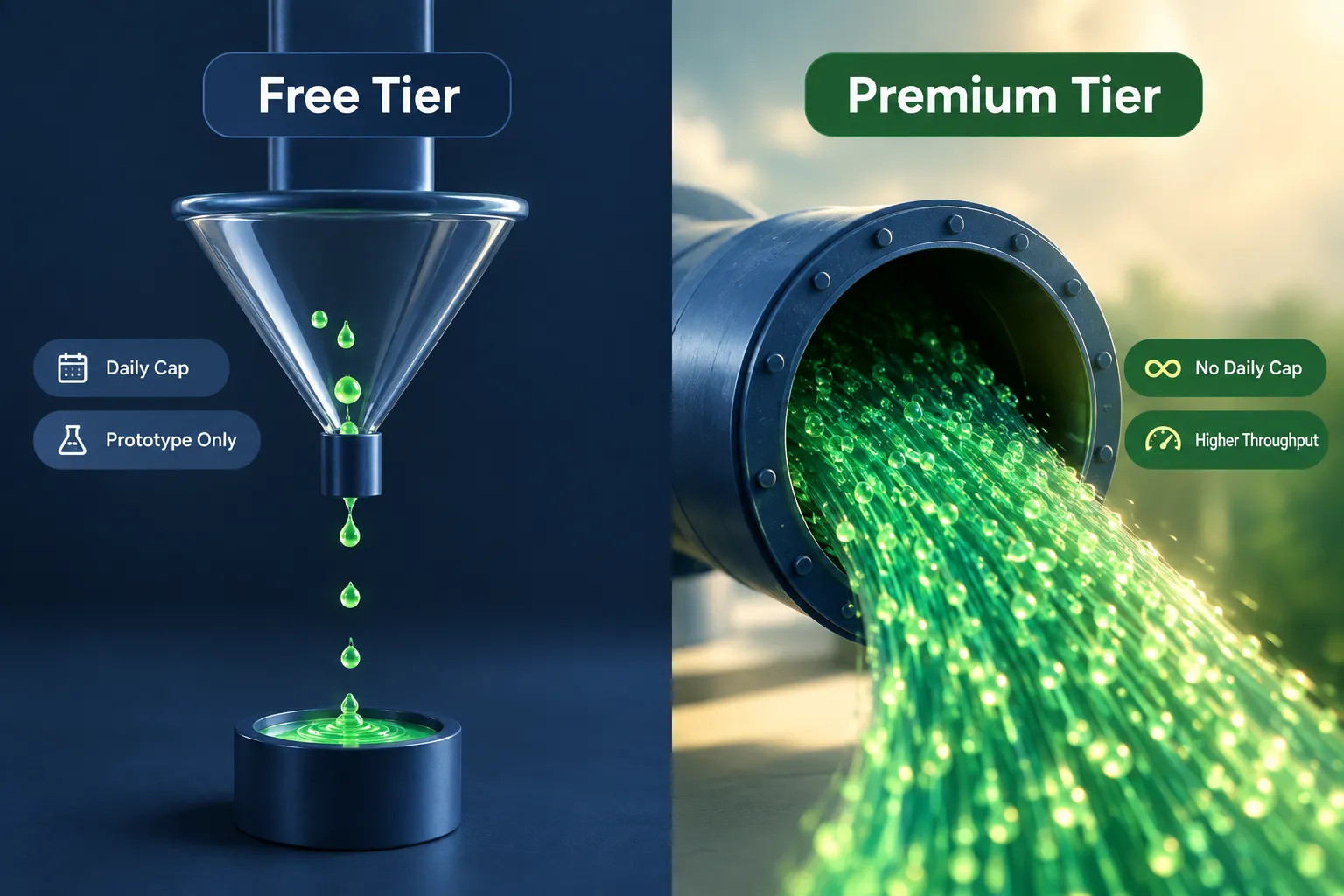
The Alpha Vantage API is a REST-based market data service that serves stock prices, forex, crypto, technical indicators, company fundamentals and economic data through a single API key. Its official support page states the free tier allows 25 API requests per day (checked October 2026), which is a prototyping allowance, not a production quota. Premium plans remove the daily cap and raise per-minute throughput, but real-time and delayed U.S. equity and options data require separate entitlement steps. If you need streaming quotes, tick-level depth, or a bot that refreshes a watchlist every minute, look at Polygon (now branded Massive) or your broker’s own data feed instead.
What You Should Know
- 25 requests per day is the current official free allowance, per the Alpha Vantage support page retrieved October 2026.
- 100+ datasets are advertised by Alpha Vantage, spanning equities, forex, digital assets, fundamentals, technical indicators, economic indicators and news data.
- Premium plans advertise no daily limits, with higher or even unlimited per-minute requests available by arrangement, per the official premium page.
- Entitlements are separate from your plan. Paid users must separately complete steps for real-time U.S. equities, 15-minute-delayed U.S. data, real-time U.S. options and historical index data.
- Alpha Vantage runs an official MCP server, which connects its data to chatbots, coding assistants and agentic AI tools like Claude. Premium users are told to reconnect it after changing keys.
What Is the Alpha Vantage API?
The Alpha Vantage API is a request-based financial data service. You send an HTTP request with your API key and a function name, and it returns JSON or CSV. No streaming required, no terminal to install, no sales call.
It’s been one of the default on-ramps for hobbyist quants and finance students for years, mostly because the barrier to entry is an email address.
What the alpha vantage stock api actually covers
The company advertises more than 100 data offerings. The useful buckets:
- Equities. Daily, weekly, monthly and intraday time series for U.S. and international tickers. This is the piece most people mean when they say alpha vantage stock api.
- Forex. Currency pair exchange rates, both real-time quote endpoints and historical series.
- Digital assets. Crypto price series across major pairs.
- Technical indicators. Dozens of them, calculated server-side. RSI, MACD, Bollinger Bands, moving averages of every flavor. You ask for the indicator, it hands back the values. No math on your end.
- Company fundamentals. Income statements, balance sheets, cash flow, earnings, overview data.
- Economic indicators. Treasury yields, CPI, unemployment, Fed funds rate, GDP.
- News and sentiment data. Market news tagged by ticker and scored.
That indicator library is the real draw. Most free APIs hand you raw prices and leave you to compute a 14-period RSI yourself. Alpha Vantage computes it and returns the series. For a student, a backtester, or someone building a screener that runs once a night, that’s a genuine shortcut.
The honest framing: Alpha Vantage is an indicator and research API that happens to serve prices, not a low-latency market feed that happens to include indicators. Independent comparisons consistently land on the same read: breadth is the strength, speed is not.
Who runs it? Alpha Vantage is an independent data company that distributes through its own API, its website, and now an official MCP server. It is not an exchange, not a broker, and not a regulated market data vendor in the way your broker’s feed is. That distinction matters later.
Decision rule: choose Alpha Vantage if your project needs many types of data from one key. Skip it if your project needs the same data refreshed many times an hour.
Is the Alpha Vantage API Free and What Are the Free Limits?
Yes, there’s a permanent alpha vantage free tier, and its official allowance is 25 API requests per day as of October 2026. There is no credit card required and no trial clock. There is also no way to stretch 25 calls into a live dashboard.
That number is the whole story. Older tutorials across the internet still quote 5 calls per minute and 500 per day. That was an earlier policy. Check the official support page before you build against any number you read in a blog post, including this one.
| Plan | Daily and per-minute limit | What’s blocked | Date checked |
|---|---|---|---|
| Free (standard key) | 25 requests per day, per the official support page | No daily headroom for polling; premium-only endpoints and entitlements unavailable | Oct 23, 2026 |
| Free (verified open-source or educational project) | Unlimited requests, per Alpha Vantage, subject to their verification | Still subject to entitlement rules for licensed U.S. data | Oct 23, 2026 |
| Premium | No daily limits advertised; higher or unlimited per-minute by arrangement | Real-time U.S. equities, 15-min delayed U.S. data, real-time U.S. options and historical index data each require separate entitlement steps | Oct 23, 2026 |
What 25 calls a day buys you
Let’s do the arithmetic no one does before they start coding.
- A 25-ticker watchlist, refreshed once a day. That’s your entire quota. One refresh. Done by 9:31am.
- A single ticker polled every 15 minutes during market hours. The session is 6.5 hours, so 26 calls. You’re over the limit before the close.
- Backfilling 10 years of daily data on 5 stocks. Doable, roughly 5 calls, since each daily series returns in one response. This is the free tier’s sweet spot.
- A Discord bot answering price requests for a small server. You’ll be rate-limited by lunch on a quiet day.
Common mistake: assuming the quota resets per endpoint. It doesn’t. A fundamentals call, a price call and an RSI call all draw from the same 25.
Edge case worth knowing: the free tier is genuinely generous on history. One request for TIME_SERIES_DAILY with full output returns 20+ years of bars in a single response. If you’re building a backtest and only need a one-time pull, 25 calls a day over a week gets you 175 securities of full history for free. That’s a legitimate use, and it’s the one most people overlook while they’re busy complaining about the limit.
Alpha Vantage also says verified open-source and educational projects can receive unlimited requests. If you’re building something public and non-commercial, apply. It’s the cheapest upgrade path available.
How Much Does the Alpha Vantage API Cost?
Alpha Vantage sells tiered premium subscriptions priced by throughput, and the official premium page is the only place to read the current numbers. Check alphavantage.co/premium for live alpha vantage pricing before you budget, tiers and prices change, and a stale number in a blog post is how people end up surprised on a renewal.
What the official premium page does state clearly, as of October 2026:
| What you’re buying | What the official page says | Date checked |
|---|---|---|
| Daily request cap | No daily limits on paid plans | Oct 23, 2026 |
| Per-minute throughput | Higher tiers raise requests per minute; unlimited per-minute available by arrangement | Oct 23, 2026 |
| Real-time U.S. equities | Separate entitlement step required, not automatic with payment | Oct 23, 2026 |
| 15-minute delayed U.S. data | Separate entitlement step required | Oct 23, 2026 |
| Real-time U.S. options | Separate entitlement step required | Oct 23, 2026 |
| Historical index data | Separate entitlement step required | Oct 23, 2026 |
| MCP server access | Available; premium users must reconnect after changing API keys | Oct 23, 2026 |
The entitlement thing no one reads until it bites
This is the part that generates support tickets. Paying for a premium plan buys you throughput. It does not automatically buy you licensed U.S. market data.
Real-time and 15-minute-delayed U.S. equity data is regulated by the exchanges, FINRA and the SEC. Alpha Vantage flags this directly on its support materials, and it’s also their argument against “free” alternatives: a free unofficial feed may quietly expose you to licensing costs or compliance questions if you ever turn it into a product.
So the sequence is: subscribe, then complete the entitlement step for the specific data class you need. Skip step two and you’ll have a fast key returning data you didn’t expect.
Decision rule on alpha vantage pricing: if your bot only needs end-of-day data and fundamentals, the lowest paid tier plus a daily job is almost certainly enough. If you need intraday refreshes on more than a handful of names, price the top tiers against Polygon before you commit, because at that level you’re paying for throughput you could buy more cheaply elsewhere.
A cheaper question first: do you even need an API? If you want a screener rather than a data pipe, a tool like Finviz Elite compared against the free version solves the same job for less effort and no code. Plenty of traders build an API pipeline to recreate a screener that already exists.
How Do You Get an Alpha Vantage API Key Step by Step?
Getting a free alpha vantage api key takes about 60 seconds and requires nothing but an email address. No card, no verification call, no waiting list.
Here’s the walkthrough, and what you should see at each stage.
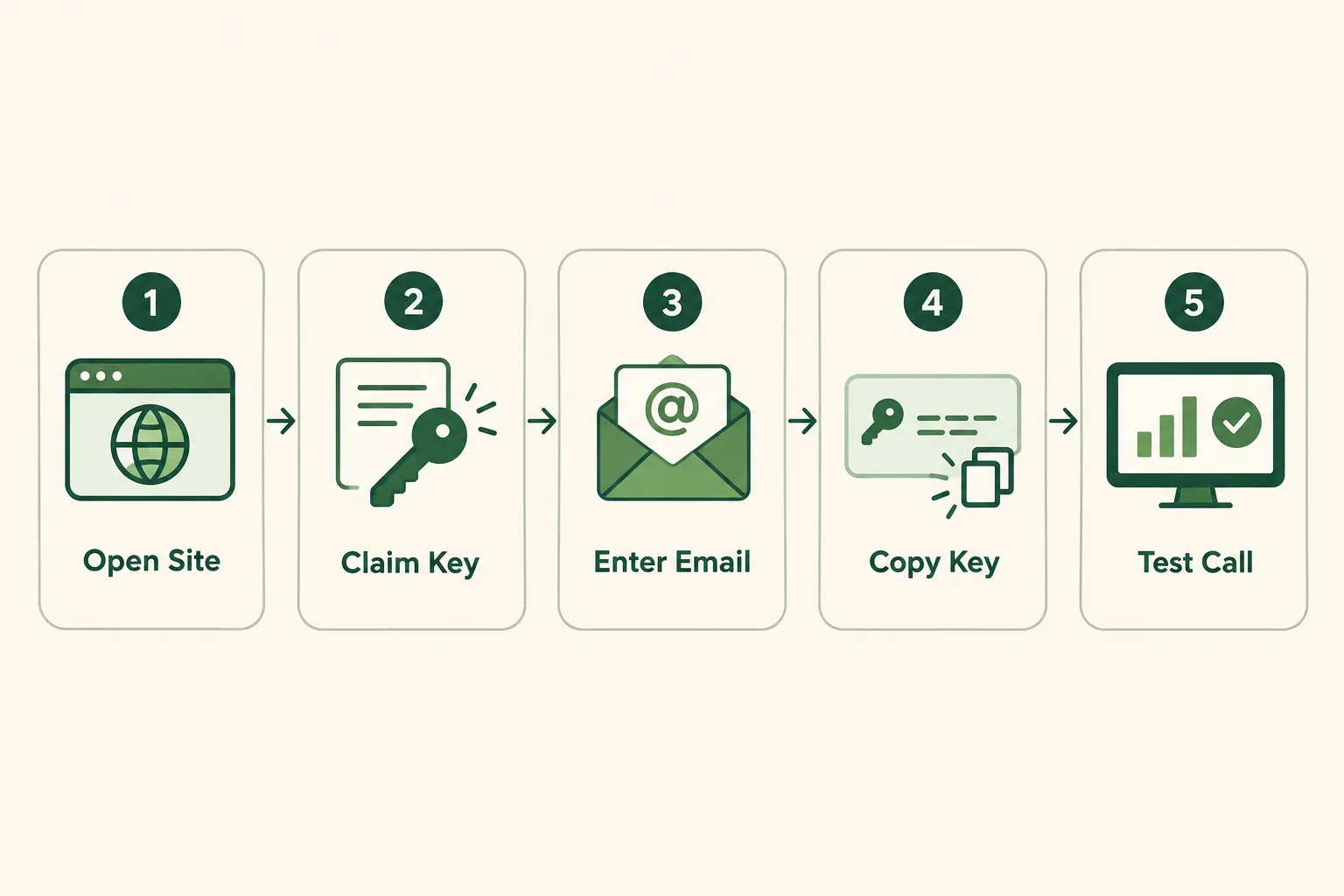
- Go to alphavantage.co. You should land on a homepage with a prominent button labeled something like “Get Your Free API Key Today.” It’s hard to miss; it’s the main call to action on the page.
- Click through to the API key page. You’ll see a short form, not a full signup flow. Alpha Vantage asks what you are (student, investor, software developer, educator), your organization, and your email.
- Fill in the four fields honestly. If you’re building an open-source or educational project, say so here. That’s the path toward the unlimited-request verification Alpha Vantage offers for qualifying projects.
- Submit and read the screen, not your inbox. The key is displayed on the confirmation page immediately. It’s a short alphanumeric string. Copy it somewhere safe right then. People close the tab and then go hunting through their email for a message that may not arrive.
- Test the key with a single request. Open a browser tab and hit the query endpoint with a simple daily time series function, your chosen ticker, and your key appended as the
apikeyparameter. If it works, you’ll see a JSON block with a “Meta Data” section at the top and a dated series of open, high, low, close and volume values beneath it. - Read the error, don’t panic. Alpha Vantage returns errors as JSON notes rather than HTTP status codes. A response containing a “Note” or “Information” field usually means you hit the rate limit. A response with an “Error Message” field usually means a malformed function name or a bad ticker symbol. Both return HTTP 200, which breaks naive error handling.
Store the key as an environment variable, not in your source file. Push a repo with a hardcoded key and it’s scraped within hours. Bots crawl GitHub for exactly this. Play stupid games.
Edge case: if you request a new key for the same email, the old one may continue working. Don’t assume rotation happens automatically, and if you’re on premium with MCP connected, reconnect the MCP server after any key change. Alpha Vantage calls this out explicitly in its premium documentation.
Can Claude or a Python Bot Use the Alpha Vantage API?
Yes. Alpha Vantage runs an official MCP server, which lets AI assistants like Claude query its data directly, and the REST API works with any Python HTTP library. Both routes work. Both inherit the same rate limit.
The MCP route
MCP stands for Model Context Protocol. It’s a standard way for an AI assistant to connect to an outside data source and call it as a tool during a conversation. Alpha Vantage promotes its MCP server for connecting its datasets to chatbots, coding assistants and agentic AI tools.
In plain terms: you connect the Alpha Vantage MCP server inside Claude’s settings using your API key, and then you can ask Claude in conversation for a ticker’s recent price action, an RSI reading, or a company’s latest earnings, and it pulls live from Alpha Vantage rather than from its training data.
That’s useful. It’s also where the 25-call ceiling gets ugly fast.
The limit that bites: an AI agent is chatty. Ask Claude to “compare the momentum of five semiconductor names” and it may fire a price call and an indicator call for each one. Ten requests, one question. Two more questions like that and the free key is spent for the day.
If you’re running Alpha Vantage through MCP for anything beyond occasional lookups, you need a paid key. There’s no clever workaround.
The Python route
Python talks to Alpha Vantage over plain HTTP. Build the query string with the function name, the symbol and the key, send a GET request, parse the JSON. There’s also a community alpha_vantage package that wraps the endpoints and can hand you a pandas DataFrame directly.
Three things every Python user should build in from day one:
- Cache every response to disk. Daily bars don’t change intraday. Fetch once, reuse all day. This single habit is the difference between 25 calls being plenty and 25 calls being nothing.
- Handle the JSON error fields explicitly. Check for “Note,” “Information” and “Error Message” keys before you parse the data. Your bot will otherwise silently store empty frames.
- Add deliberate spacing between calls. Even with a paid key, hammering endpoints in a tight loop invites throttling.
Common mistake: writing a backtest loop that re-fetches the same symbol’s history on every iteration. That’s how people burn a daily quota in four seconds and then write a Reddit post about how the API is broken. The API is fine. The loop isn’t.
For a bot that places orders, the data API is only half the stack. You still need a broker with an execution API, which is covered in the Alpaca beginner’s walkthrough.
Where Does the Alpha Vantage API Fall Short for Bots?
The alpha vantage api falls short for automated trading in four specific ways: the rate limit, intraday depth, data latency, and the complete absence of order routing. None of these are secrets. All of them matter more than people expect.
1. Rate limits throttle anything that monitors. Twenty-five calls a day cannot sustain a live strategy. Even on premium, the REST request model means you’re polling for data rather than receiving it. A bot watching 50 tickers for a breakout has to ask 50 times, repeatedly, instead of being told once when price moves. Example: a simple momentum scanner checking 20 names every 5 minutes needs roughly 1,560 calls per session. That’s not a free-tier conversation.
2. Intraday depth is thin compared to tick-level feeds. Alpha Vantage serves intraday bars down to one minute. It does not serve exchange-level trades and quotes the way Massive (formerly Polygon) does. Example: if your strategy depends on reading order flow or the spread at the moment of a breakout, bar data tells you what already happened and not what’s happening.
3. Delayed or end-of-day data unless entitled. Real-time and 15-minute-delayed U.S. data require separate entitlement steps even on paid plans. Example: a trader who assumed premium meant live quotes builds an intraday bot, then discovers the fills in their paper log were computed against stale prices. The backtest looked great because the data was lying by 15 minutes.
4. No order routing, ever. Alpha Vantage is data only. It cannot place, modify or cancel a trade. Example: your bot identifies a clean setup at 10:14am and then… does nothing, because you still need a broker API wired in alongside it. Most people discover this after they’ve already built the signal engine.
5. Fundamental data provenance is limited. A 2026 StockFit comparison argues Alpha Vantage’s normalized fundamentals don’t expose raw SEC XBRL facts or accession-number-level sourcing. For a casual screener, fine. For forensic analysis, regulated reporting or research you need to reproduce, that missing audit trail is a real constraint.
A signal built on delayed data is a weather report from yesterday. It reads fine. It just can’t help you today.
What Are Better Options Than the Alpha Vantage API?
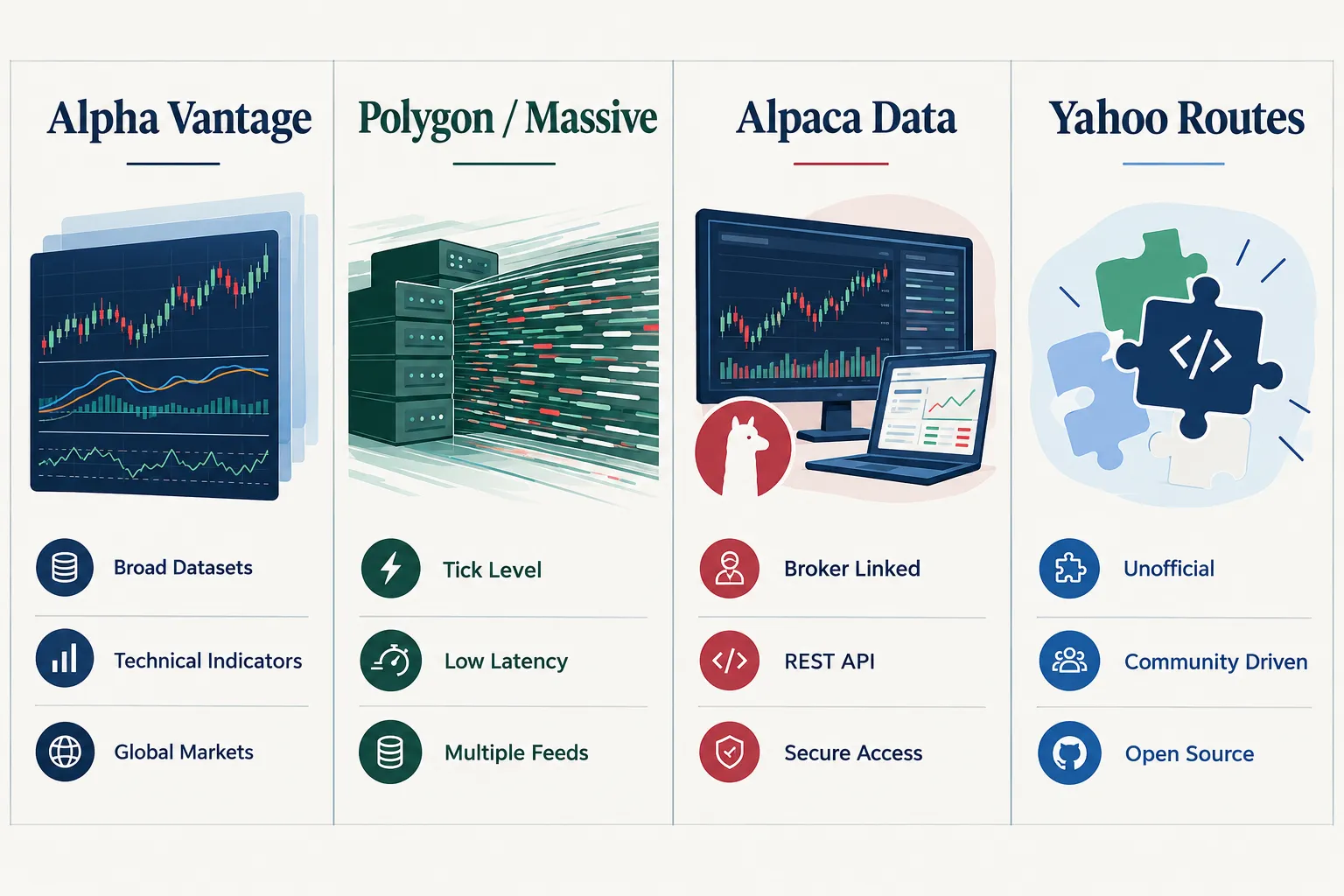
Better depends entirely on what you’re building. For tick-level intraday and WebSocket streaming, Massive (formerly Polygon) is the stronger choice. For a bot that trades as well as watches, Alpaca gives you data and execution behind one key. For zero-budget hobby projects, unofficial Yahoo Finance routes remain the most common free fallback, with the trade-offs that word “unofficial” implies.
| Alternative | Free access | Best for | The catch |
|---|---|---|---|
| Massive (Polygon) | Free tier available; check current limits on the official plans page | Exchange-level trades and quotes, WebSockets, REST, flat files, U.S. futures and expanded options coverage; also runs an MCP server for AI assistants | Real-time and full-depth access sits on paid tiers. Free tier is delayed and capped. Check the official page for current numbers |
| Alpaca market data | Free basic market data tier tied to an Alpaca account | Bots that need data and order execution from one provider, paper trading first | Basic tier uses IEX-sourced data rather than full consolidated tape unless you upgrade. Coverage is U.S.-focused |
| Yahoo Finance routes | Free via community libraries, no key required | Quick prototypes, backtests, personal dashboards, learning | Unofficial and unsupported. Endpoints break without notice, there’s no SLA, and commercial use is a licensing question you don’t want to answer in court |
How to choose without overthinking it
- Choose Alpha Vantage if you want many dataset types from one key, you’re happy with daily or near-daily refreshes, and server-side technical indicators save you real work.
- Choose Massive/Polygon if your strategy is intraday, you need streaming rather than polling, or you’re working with options and futures data. Deeper breakdown in the Polygon API guide.
- Choose Alpaca if the end goal is a bot that places orders, not just one that watches. One account, one key, data plus execution. The Alpaca tool profile covers what it includes.
- Choose Yahoo routes if nothing is at stake and you’d rather spend zero dollars while you learn. Then migrate before real money touches it. Alternatives are compared in the Yahoo Finance API alternatives breakdown.
- Also worth a look: Barchart for futures and commodities coverage, covered in the Barchart API guide.
Don’t pick on free quota alone
The biggest free allowance is not automatically the best choice. Several generous free tiers restrict usage to personal or non-commercial projects, omit exchange entitlements entirely, or serve delayed and incomplete data without saying so loudly. If your side project ever becomes a product with paying users, the license terms you ignored at the start become the first thing a lawyer asks about.
Licensing is boring right up until it’s expensive.
Which Broker Gives a Free API for Stock Data?
Several U.S. brokers include API access with a funded account at no extra charge, with Alpaca being the most developer-friendly entry point and Interactive Brokers the most capable for serious multi-asset work. Access is usually free; market data entitlements may not be.
| Broker | API access | What it covers | Note |
|---|---|---|---|
| Alpaca | Free with account, including paper trading | U.S. stocks, ETFs, options, crypto; REST and WebSocket; basic market data tier included | Built API-first. Paper account works without funding |
| Interactive Brokers | Free with funded account | Global equities, options, futures, forex, bonds | Steeper setup. Real-time data subscriptions billed separately |
| Tradier | Free developer sandbox; brokerage API with account | U.S. equities and options | Sandbox lets you build before funding |
| Webull | API access available to account holders | U.S. equities and options | Check current availability and terms directly with the broker. Our Webull review covers the platform side |
The rule that saves money: brokers rarely charge for API access. They charge for real-time data entitlements, exactly like Alpha Vantage does. Paper trading and delayed data are usually free. Live streaming quotes usually aren’t.
Paper trade the bot first. Always. A strategy that can’t survive two weeks on simulated fills won’t survive one morning on real ones. More broker API options are collected in the broker API guide and the ongoing broker API coverage.
Frequently Asked Questions
What is an API for stocks?
A stock API is a service that delivers market data to a program instead of a screen. Your code sends a request naming a ticker and a data type, and the service returns structured data like JSON. It replaces manual lookups, so a script can pull prices, fundamentals or indicators for hundreds of symbols without anyone clicking anything.
Is Alpha Vantage good?
Alpha Vantage is good for research, backtesting and educational projects, and weak for live intraday trading. Its strengths are dataset breadth, server-side technical indicators and a free key you can get in a minute. Its weaknesses are the tight free quota, the REST polling model, and entitlement requirements for licensed U.S. real-time data.
How can I get a free Alpha Vantage API key?
Go to alphavantage.co, click the “Get Your Free API Key” button, fill in the short form with your role, organization and email, and submit. The key appears on the confirmation page immediately. Copy it before closing the tab, and store it as an environment variable rather than hardcoding it into a repo.
Is the Alpha Vantage API free?
Yes, there’s a permanent free tier allowing 25 API requests per day as of October 23, 2026, per the official support page. No credit card is needed. Verified open-source and educational projects can qualify for unlimited requests. Premium plans remove the daily cap and raise per-minute throughput.
Do I need to pay for Alpha Vantage if I use it lightly?
No. If you pull daily data once a night for a short watchlist, or backfill history occasionally for a backtest, the free tier handles it. Cache responses to disk and 25 calls stretches further than it looks. Pay only when you need repeated intraday refreshes or AI-agent queries.
Why is the Alpha Vantage API so slow or timing out?
Usually it’s the rate limit, not the server. Alpha Vantage returns limit messages as a “Note” or “Information” field inside a normal HTTP 200 response, so code that only checks status codes sees a success and parses nothing. Check for those fields, cache results, and space your requests.
Can I use Alpha Vantage for a production trading app?
Only on a paid plan with the correct data entitlements completed, and only for strategies that don’t need streaming data. Alpha Vantage provides no order routing, so you’ll need a broker API alongside it. For intraday or options execution, a tick-level provider is the safer foundation.
Which broker gives an API for free?
Alpaca, Interactive Brokers and Tradier all provide API access at no additional charge to account holders, and Alpaca’s paper-trading API works before you fund anything. Access is generally free; real-time market data entitlements are billed separately at most brokers, so read the data pricing separately from the API terms.
Our Take
The free alpha vantage api is a fine place to learn and a bad place to live. Twenty-five calls a day is enough to backfill history, test an idea, or power a nightly screener. It is not enough to watch a tape, feed an AI agent, or run anything with money behind it.
Switch when one of three things happens: your script hits the limit more than twice a week, your strategy needs data fresher than the previous close, or your project stops being a project and starts having users. At that point the question isn’t free versus paid, it’s which provider matches the job. Daily research and indicators, stay on Alpha Vantage premium. Intraday and options, go to Massive. Bot that trades, go to Alpaca and get data and execution behind one key.
And build the cache before you build the strategy. Most “the API is broken” complaints are really “my loop had no memory.”
Related: every bot and data stack we test lives on the AI Stock Trading Bots home page, and the broker and platform reviews on AI Stock Picker App cover the execution side once your data pipe works.
Built something on top of a market data API? Submit your bot and we’ll put it through the same testing as everything else in the directory: aistocktradingbots.com/contact.
Stay alpha.
The FullStack Alpha research desk tests AI trading bots on paper and live accounts. Reviewed and edited by Jay Rocco, Founder and Editor.
