

The best ai trading bot github repos are research frameworks, not money printers, and the top one passed 108,000 stars without ever claiming it can trade your account. That number tells you a lot about demand and almost nothing about edge. Searching for ai trading bot github repos is the easy part. Separating a serious engineering project from a star-farmed demo is the work, and that’s what this piece covers.
Quick Answer
Five open source projects are worth your afternoon: TradingAgents, ai-hedge-fund, OpenBB, NautilusTrader, and FinRobot. Four of the five are research or data tools. Only NautilusTrader is built as a production execution engine. Run every one of them in paper mode first, read the license, and check the last commit date before you clone anything. None of them promise returns, and the ones that do should be closed immediately.
Key Takeaways
- TradingAgents (TauricResearch) had 108,676 stars on September 26, 2026, per the GitHub API (via ultralab.tw). Its GitHub repository page has the live count.
- ai-hedge-fund (virattt) had 63,752 stars on the same September 26, 2026 GitHub API check, and its readme calls itself a proof of concept for educational purposes.
- HKUDS/Vibe-Trading had 34,055 stars on September 26, 2026 and is MIT licensed. The same lab’s AI-Trader docs warn about a fake X account and a fake token using the project name.
- OpenBB is the open source research and data layer most builders under-use, with a major 5.x release line in 2026.
- NautilusTrader is the only repo here described as production-grade, Rust-native, and multi-venue, and it is on a 2.0 release candidate track.
- Remarks published by the ECB in October 2026 warn that agentic trading systems can produce correlated behavior and herding.
- Alpaca’s official MCP server repo is the realistic path from an ai trading bot github project to a paper brokerage account.
What should you check before running any trading repo from GitHub?
Check five things in this order: the license, the last commit date, the open issues, how the project handles API keys, and whether a paper mode exists. If any one of those fails, close the tab. A repo with tens of thousands of stars and a last push from 2023 is abandonware with good marketing. That rule applies to every ai trading bot github result you click, no exceptions.
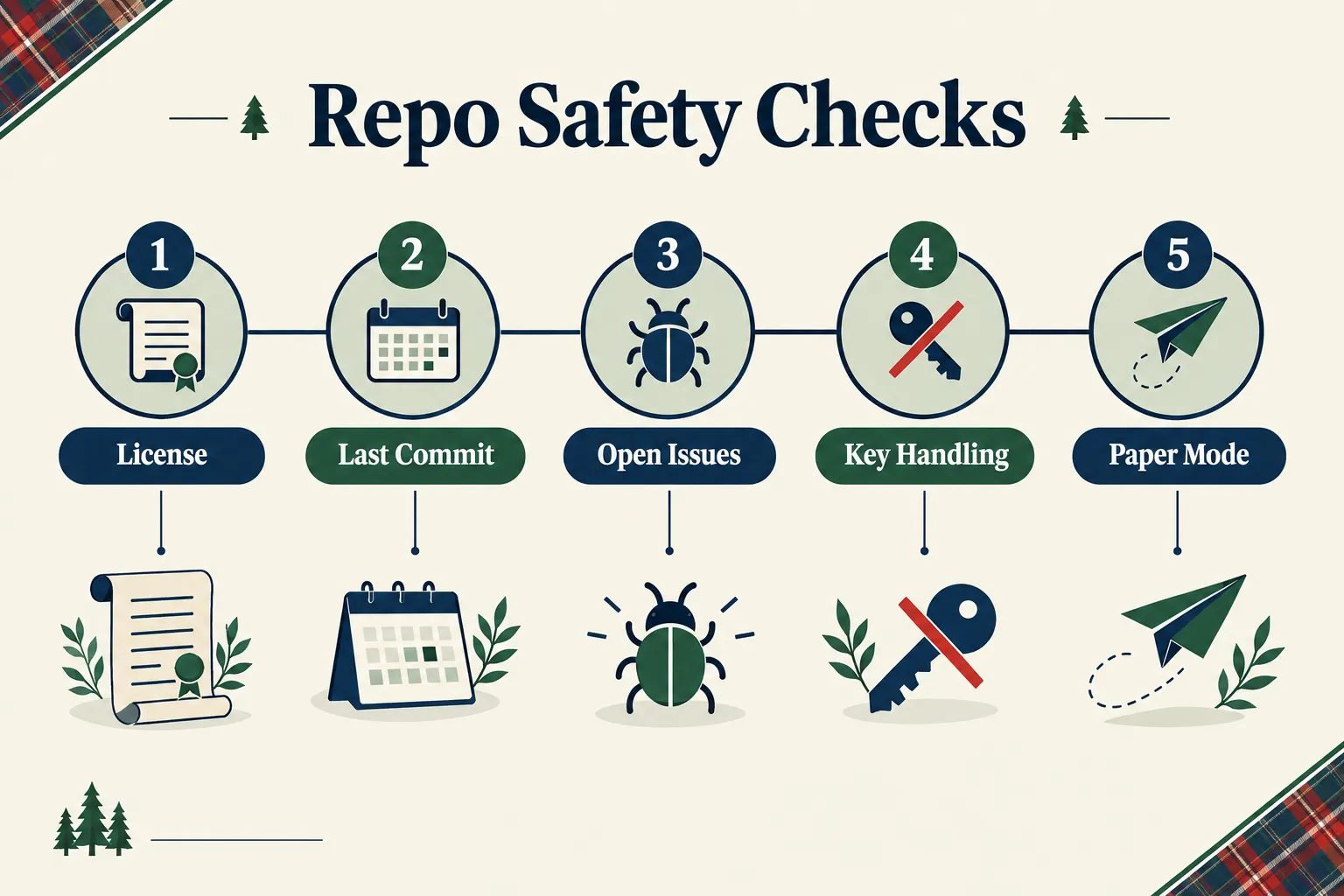
Walk the checklist like a pre-trade routine:
- License. MIT, Apache 2.0, or LGPL means you can read and modify the code. No license file means you have no rights at all.
- Last commit. Markets changed in the last 90 days. If the code didn’t, that’s your answer.
- Open issues and pull requests. Hundreds of stale issues with no maintainer replies is a dead community.
- Key handling. The config should read from environment variables, never hardcoded strings in a
config.json. Python scripts that want your live secret pasted inline are a hard no. - Paper mode. If the readme has no paper or sandbox path, the project was never meant to touch real money.
Never paste live API keys into code you did not read. That one rule prevents most of the horror stories. Our guide to generating and scoping Alpaca API keys covers how to issue a paper-only key that physically cannot place a live trade.
What does an ai trading bot github search actually return?
The phrase ai trading bot github usually returns three very different things: LLM agent research frameworks, data and research platforms, and actual order-execution engines. Knowing which category you’ve cloned is the single most useful filter, because the first two cannot place a trade at all. Searches for ai trading github or ai-trader github land in the same three buckets, just with more noise.
Browse GitHub’s ai-trading-system topic and you’ll see the split immediately. Sort the same topic by stars ascending and the long tail is mostly one-weekend demos. The trade topic and the ai-trade topic mix in forex and Quotex-style scripts. The tradingbot2026 topic and the trading-bot-bsc-solana topic are heavy on open source crypto trading bot sniper code, which is a different risk profile entirely. Crypto gets a mention here as a reference point only, not a recommendation.
A useful starting map is the Awesome AI4Finance list, which catalogs the academic side of this space. Treat it as a reading list for ai trading bot github research, not a buy list.
Signal over noise: star count measures curiosity, not profitability. An ai trading bot github page with a huge star count and no paper mode is still a no.
Which 5 open source AI trading repos are worth your time?
These five earn the clone because they ship real code, document their limits, and have active maintainers. Four are research tools. One places live orders. If you only open one ai trading bot github repo this month, make it one of these.
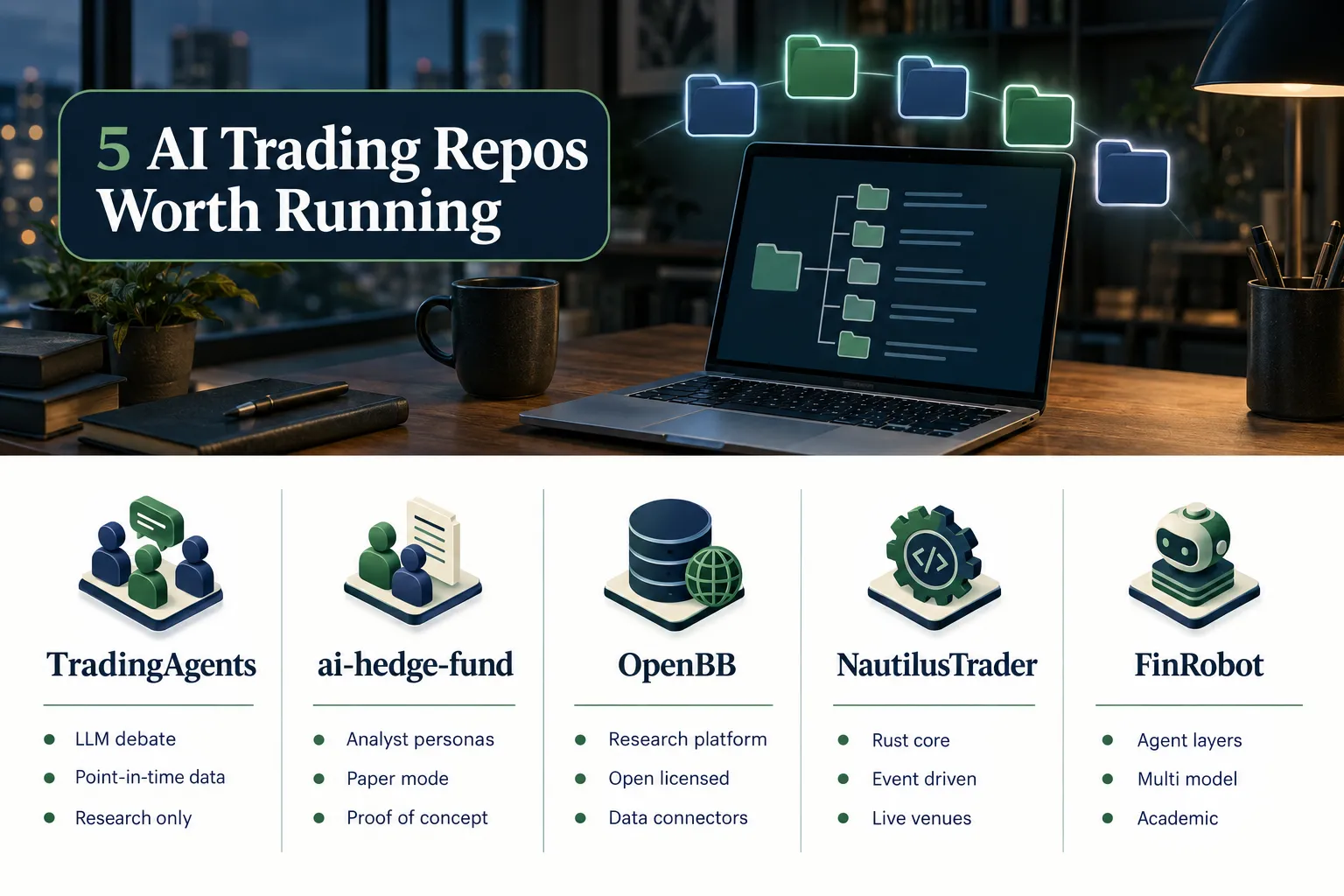
| Project | What it is | License / docs | Can place live orders | Cost |
|---|---|---|---|---|
| TradingAgents | Multi-agent LLM research framework | Documented in repo docs and changelog | No, research output only | Free, plus LLM API usage |
| ai-hedge-fund | Analyst-persona agent simulation | Readme states proof of concept | Paper and backtest modes | Free, plus model API usage |
| OpenBB | Open source investment research platform | Permissive open source license | No, research and data layer | Free core |
| NautilusTrader | Production event-driven execution engine | LGPL, extensive documentation | Yes, multiple venues | Free, infra costs apply |
| FinRobot | AI4Finance agent platform | Open source, academic-leaning | No, agent layer only | Free |
A few specifics worth knowing. TradingAgents shipped v0.6.0 on October 3, 2026, adding HTML reports, provider selection by model tier, and an alternative company-news path for when the Yahoo Finance feed drops. Its v0.5.0 release in September added point-in-time controls and as-filed SEC EDGAR fundamentals, which matters more than any new feature because it reduces lookahead bias.
ai-hedge-fund released 2.4.0 on September 24, 2026, and its roadmap describes a persistent fund object with a hash-chained ledger and a kill switch. A kill switch in the design docs is a good sign about the author’s priorities.
OpenBB is the research backbone most people under-use. It is the data layer an ai agent for trading github project usually lacks. We’ve written a full breakdown of what the OpenBB platform does and who it suits.
How to run each ai trading bot github repo: a numbered tutorial
Each repo gets its GitHub link, a screenshot taken October 4, 2026, and a plain-English quick start. Keys live in a .env file, never in code.
1. TradingAgents
Repo: https://github.com/TauricResearch/TradingAgents · Research paper: arXiv 2412.20138
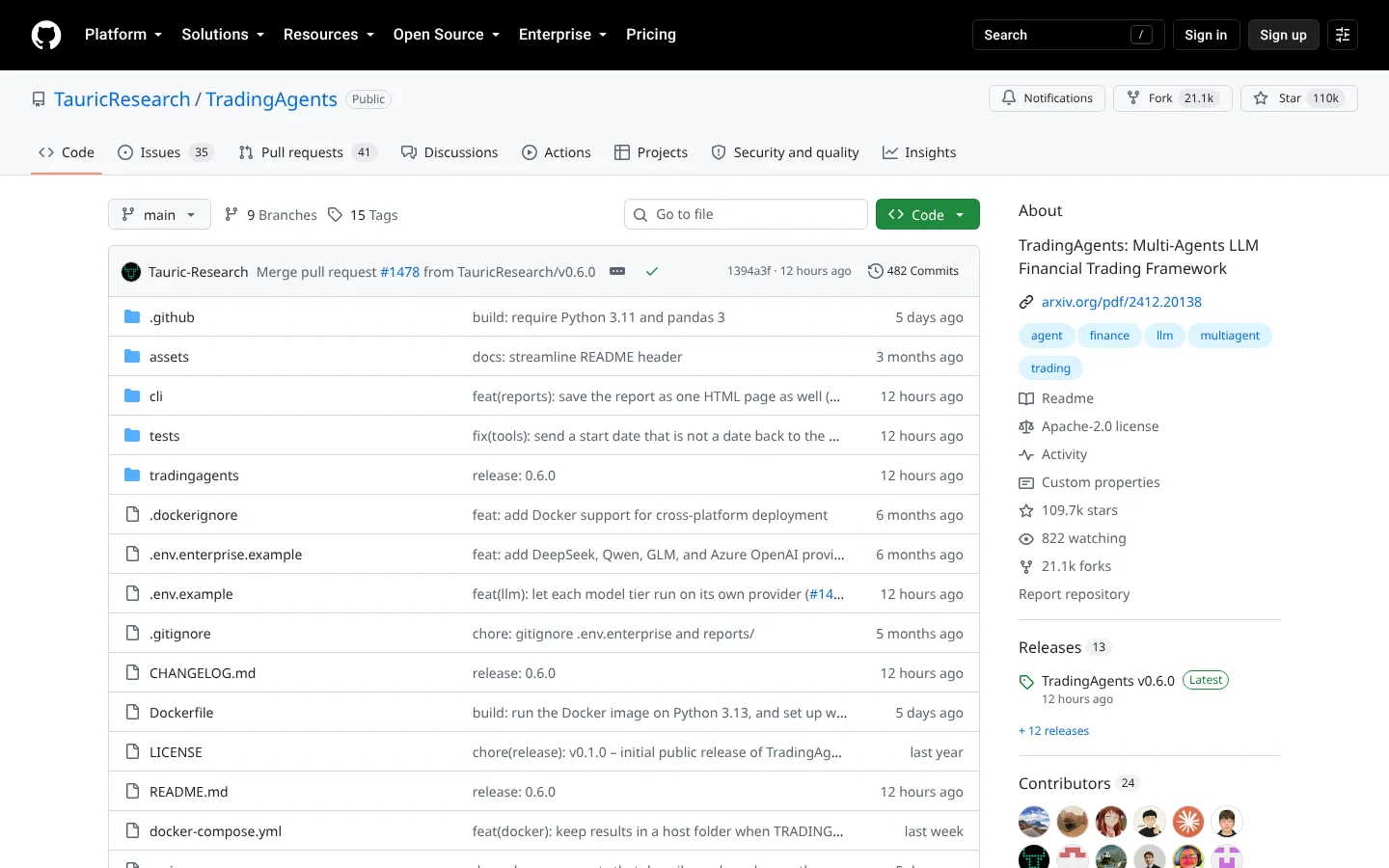
109.7k stars as of October 4, 2026. Approved orders go to a simulated exchange, never your broker.
Quick start in plain English
- Install Python 3.11 or later,
git clonethe repo, and install it in a virtual environment. - Copy
.env.exampleto.envand add one LLM key. FRED and Alpha Vantage keys are optional. - Run
tradingagentswith one ticker, a past date, and the shallowest research depth. - Expect analyst reports, a bull and bear debate, a rating, and an HTML page.
- Ctrl+C stops it. No broker is connected, so the LLM bill is the only meter.
2. ai-hedge-fund
Repo: https://github.com/virattt/ai-hedge-fund
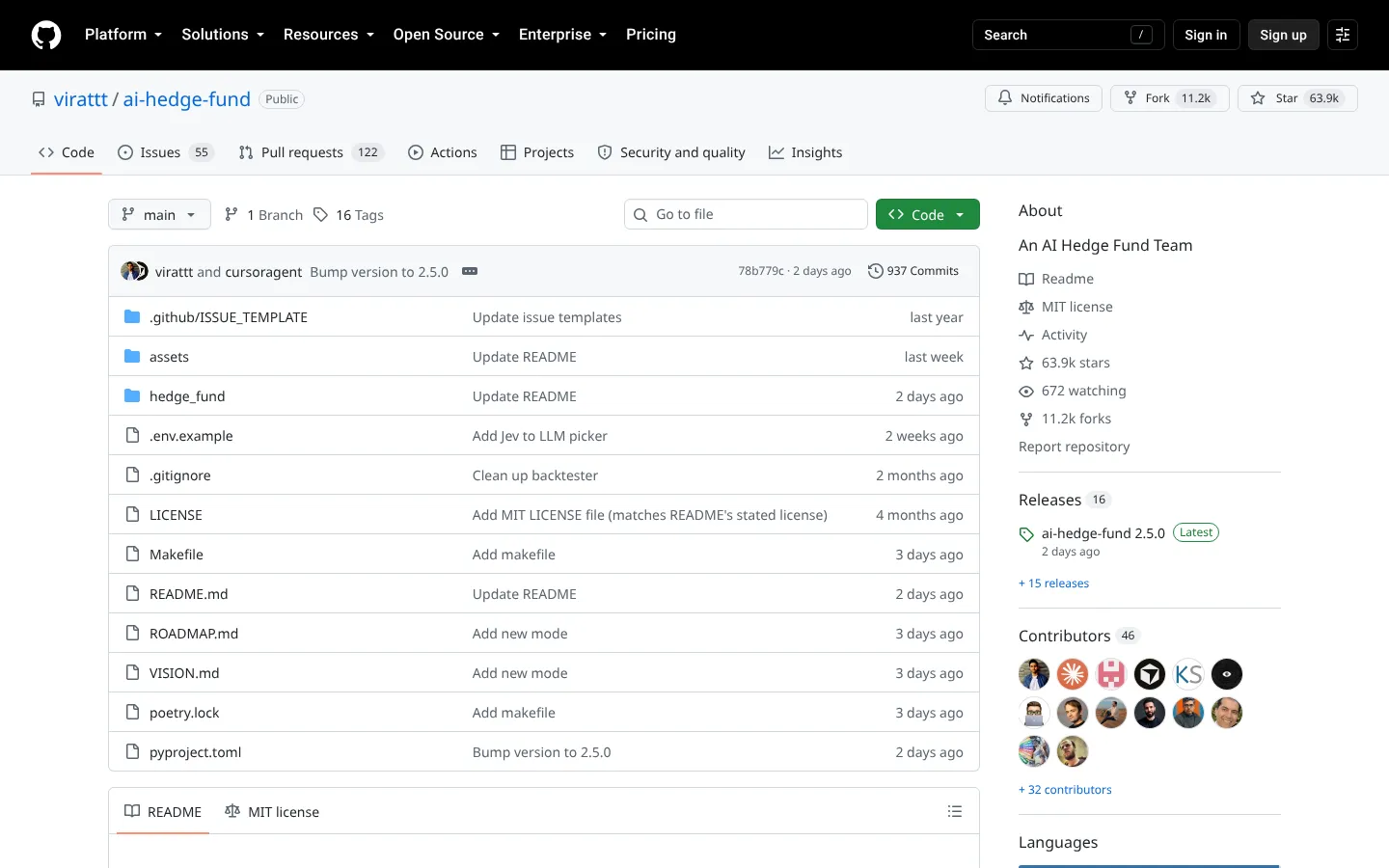
63.9k stars as of October 4, 2026. The readme is blunt: “the system does not actually make any trades.”
Quick start in plain English
- Install the
aihfpackage with pipx or uv, or clone it and use Poetry to read the code first. - Run
aihf. It asks for a Financial Datasets key and one model key and saves them to~/.hedge-fund/.env, outside the project. - Pick Paper trading (fake money, real market days) or Backtesting.
- Expect an approval step before each decision, plus a hash-chained session ledger.
- Hit the kill switch (the h and r keys), then quit.
3. OpenBB
Repo: https://github.com/OpenBB-finance/OpenBB · Docs: docs.openbb.co
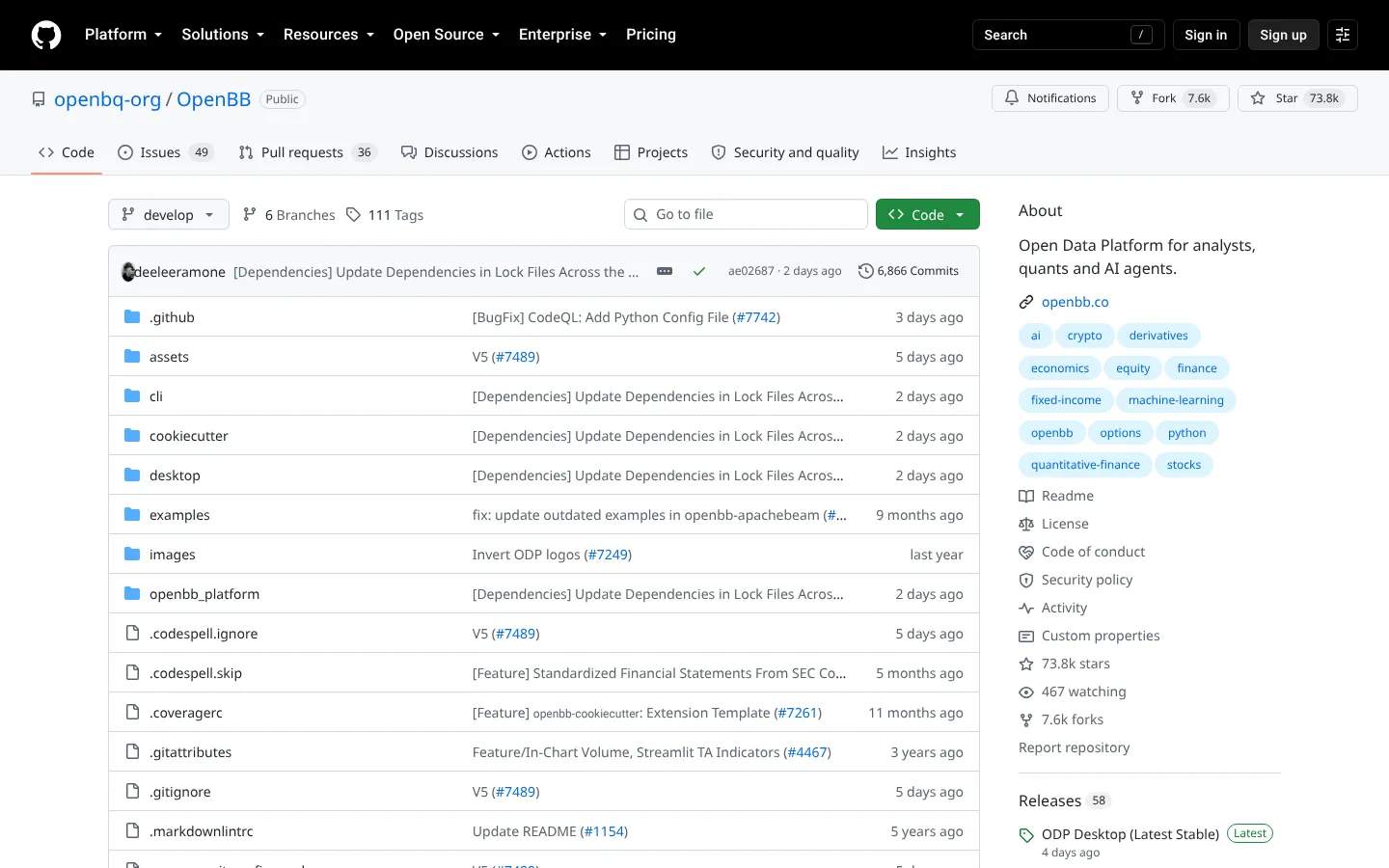
73.8k stars as of October 4, 2026. Feeds Python, a REST API, and MCP servers for AI agents. No order button.
Quick start in plain English
- In a fresh Python 3.10 to 3.14 virtual environment, run
pip install openbb. - Put premium data keys in OpenBB settings or environment variables, never in a shared notebook.
- Pull one AAPL price history to confirm data flows.
- Optional: run
openbb-apito serve data locally on port 6900 for an agent. - Ctrl+C stops the server. Nothing trades, so nothing else to switch off.
4. NautilusTrader
Repo: https://github.com/nautechsystems/nautilus_trader · Docs: nautilustrader.io/docs
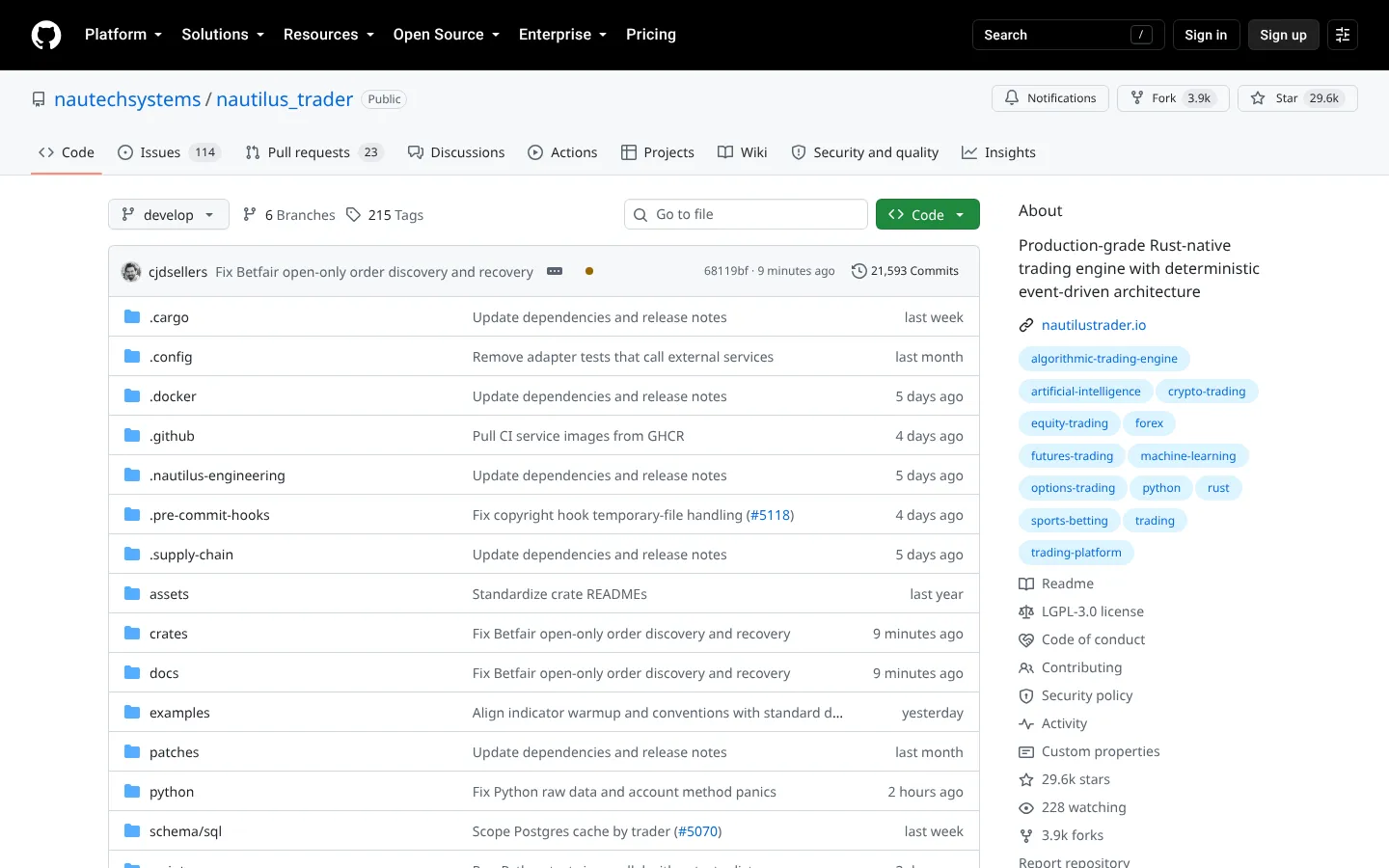
29.6k stars as of October 4, 2026. The only repo here that routes real orders.
Quick start in plain English
- On Python 3.12 or later, install
nautilus_traderwith pip and the--preflag. Without it you get v1, which does not match the docs. - Run a bundled backtest example first. It needs no keys.
- For live testing, point the Interactive Brokers adapter at IB Gateway on an IBKR paper account, credentials in
.env. - Expect event logs, fills, and positions, with identical strategy code in backtest and live.
- Stop the node, then confirm in the broker that nothing is left open. The maintainers do not recommend 2.0 release candidates for real capital.
5. FinRobot
Repo: https://github.com/AI4Finance-Foundation/FinRobot · Site: finrobot.ai
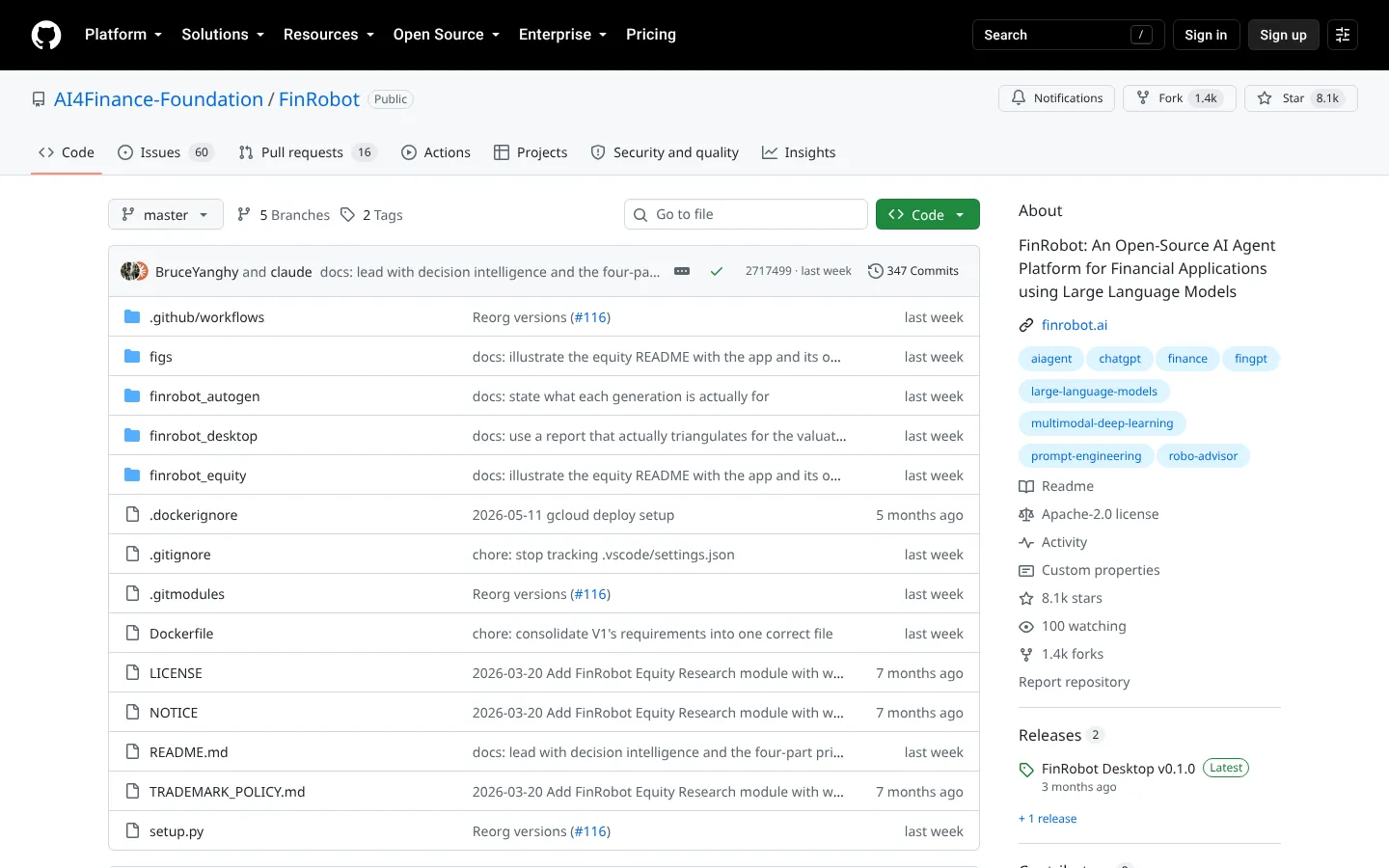
8.1k stars as of October 4, 2026. The readme calls V2 Desktop the production system and V0 the educational one.
Quick start in plain English
- Apple Silicon Macs can download the Desktop v0.1.0 app. Everyone else: install Python, uv, and Node.js,
git clonethe repo, and openfinrobot_desktop. - Add model and data keys as that folder’s readme describes, and keep the filled-in file out of git.
- Run the
dev.shscript and open localhost on port 5173. - Research one ticker. Expect a 13-chapter report where DCF and comps math is done by code, not the LLM.
- Ctrl+C stops both servers. The local API has no login, so never expose it online.
AI trading bot GitHub repos compared side by side
| Repo | What it does | Language | License | Last activity (checked Oct 4, 2026) | Paid API keys (LLM / data) | Places real orders |
|---|---|---|---|---|---|---|
| TradingAgents | Multi-agent LLM research | Python | Apache 2.0 | v0.6.0 released Oct 3 | LLM yes / data optional | No, simulated only |
| ai-hedge-fund | Investor-persona agents | Python | MIT | 2.5.0 released early Oct | LLM yes / Financial Datasets key | No |
| OpenBB | Market data layer | Python | Apache 2.0 | Commits within the week | LLM no / premium feeds only | No |
| NautilusTrader | Backtest and live engine | Rust and Python | LGPL-3.0 | Commits same day | LLM no / venue and data fees vary | Yes |
| FinRobot | Agent equity research | Python, React UI | Apache 2.0 | Commits last week | LLM yes / FMP data key | No |
How do TradingAgents and ai-hedge-fund actually make decisions?
Both assign specialized LLM agents to different jobs, then combine their output into a trade decision. TradingAgents runs analysts, researchers, and a risk layer that debate before a call is made. ai-hedge-fund mimics analyst personas with different investing philosophies and aggregates their votes.
TradingAgents v0.5.2 added parallel analysts and a non-interactive CLI, and v0.6.0 added asynchronous settlement of prior decisions while analysts are still working. The project’s docs list Python 3.14 support, while the Docker image runs Python 3.13. That’s the kind of detail that saves you two hours of dependency debugging.
The honest limitation: language confidence is not tradable probability. A 2026 review on reported alpha from LLM trading agents argues that headline returns have to survive temporal-integrity tests, realistic costs, execution timing, dynamic-universe checks, and contamination controls before they mean anything. A model that sounds certain is still just a model that sounds certain.
If you want a plain-English version of how a single LLM handles this, see our walkthrough of building a Claude-driven trading bot.
How do you run a trading agent github project safely on paper?
Clone the repo, read the readme end to end, install dependencies in a fresh virtual environment, set keys as environment variables, and switch the config to paper or online mode with no live credentials present. Run it for at least 30 trading days before you even think about real capital.
A workable sequence:
- Fork or clone over https, then read the docs folder, not just the readme headline.
- Create a virtual environment. Most of these projects are Python-first and will fight your system install.
- Put every secret in a
.envfile. Add it to.gitignorebefore your first commit. - Point the service at a paper broker. Alpaca’s paper endpoint is the common default, and Alpaca’s official MCP server repo is the cleanest bridge.
- Log every signal and every fill to flat files so you can audit the behavior later.
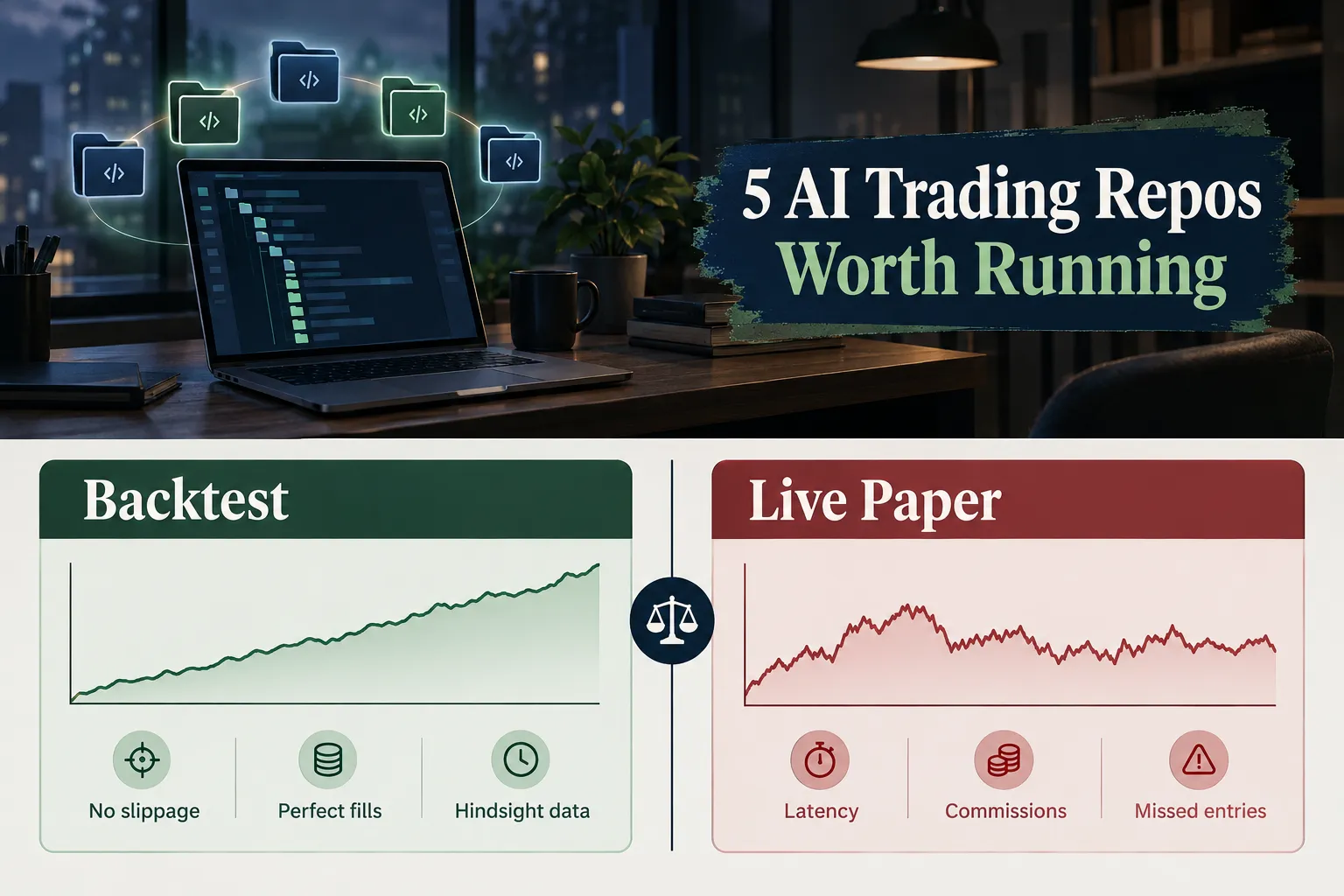
Backtest results are a hypothesis, not a track record. Historic data has no slippage, no commissions, and no hesitation. Our guide on backtesting a strategy without fooling yourself covers the traps, and Python algorithmic trading basics covers the tooling. Python is the right language for the vast majority of retail builds: the data libraries are mature and the community is enormous. Most trading bot github python projects follow the same layout, so once you’ve read one, the next one goes faster. Rust and C++ only matter if you’re competing on microseconds, which you aren’t.
Which repos are research toys and which can place real orders?
NautilusTrader is the only project on this list built to place real orders at scale. TradingAgents, ai-hedge-fund, OpenBB, and FinRobot are research, data, or simulation layers that need an execution adapter bolted on.
NautilusTrader describes itself as production-grade, Rust-native, multi-asset, and multi-venue with a deterministic event-driven architecture. It is shipping 2.0 release candidates, so check the changelog before you pin a version. Its supported venue list spans equities, futures, and spot and futures crypto exchanges, with community-tested adapters for the rest.
Which exchanges open source bots support depends entirely on the adapter layer, not the AI. For US stocks and options, Alpaca and Interactive Brokers dominate the open source adapter space. Futures routing usually goes through a dedicated broker. Spot and futures crypto exchanges are the most heavily supported simply because their public APIs are the most permissive.
Choose NautilusTrader if you need deterministic execution and can read Rust stack traces. Choose TradingAgents or ai-hedge-fund if you want to study agent reasoning without risking a dollar. Either way, the ai trading bot github repo is the starting point, not the finished system.
Safety checklist before you run any GitHub trading bot
The five-point check above decides whether to clone. This list decides whether to run.
- Start on paper or demo. At least 30 trading days, every signal logged.
- One API key per bot. Trade permission only, withdrawals off, revocable in one click.
- Secrets in
.env, listed in.gitignorebefore the first commit. A scanner like Gitleaks catches slips. - Find the order path. Can’t find the file that sends orders in 20 minutes? Don’t run it.
- Cap size and daily loss twice, in the bot’s config and in your broker settings.
- Test the kill switch on paper and confirm open orders actually cancel.
- Cap your LLM spend with a monthly limit; multi-agent runs bill per ticker, per run.
- Confirm you cloned the real repo. Check the owner name against the official docs. Impersonators target popular projects.
Top 5 Favorite Features
These are the five features across the set that genuinely change how useful a repo is, ranked by how much they protect you from yourself.
- Point-in-time data controls (TradingAgents v0.5.0). Stops the agent from seeing tomorrow’s news while evaluating yesterday’s trade. This is the difference between research and self-deception.
- Hash-chained ledger and kill switch (ai-hedge-fund roadmap). An auditable trade log plus a hard stop. Boring, and the most important feature here.
- Deterministic event-driven core (NautilusTrader). Same inputs produce the same outputs, every run. Without this, debugging a live bot is guesswork.
- Open data connectors (OpenBB). One interface across many providers, which kills the worst part of any build: data plumbing.
- Non-interactive CLI and parallel analysts (TradingAgents v0.5.2). Lets you grid-test across tickers and dates instead of babysitting one run at a time.
What we like / What we don’t like
Short version: the engineering quality in the top repos is real, and the gap between that quality and a deployable edge is still wide. Two honest drawbacks per project, because every tool has them.
What we like
- Active maintenance. TradingAgents and ai-hedge-fund both pushed releases in September and October 2026.
- Honest readmes. ai-hedge-fund calls itself a proof of concept instead of a hedge fund.
- Paper-first design in the better projects, with explicit backtest and paper modes.
- Permissive licenses. MIT and LGPL mean you can actually inspect and fork the code.
What we don’t like
- TradingAgents: LLM API costs scale fast across multi-agent runs, and research output still needs a separate execution layer you have to build.
- ai-hedge-fund: proof-of-concept status means no production guarantees, and persona-based reasoning is hard to attribute when it fails.
- OpenBB: it’s a research platform, not a bot, so expect to write your own strategy logic, and the data connectors you want may need their own paid keys.
- NautilusTrader: the learning curve is steep and the Rust core raises the debugging bar. It’s also pre-2.0, so APIs can shift.
- FinRobot: academic framing, thinner production documentation, and fewer real-world deployment reports than the others.
- Across the board: star counts attract impersonators. The AI-Trader docs warning about a fake X account and a fake token is a live example of what happens when a repo gets popular.
What do real users say?
Public commentary clusters around two themes: the agent frameworks are impressive to read and expensive to run, and nobody with a working edge publishes it for free. The repos themselves are the most credible witnesses, and their own documentation is unusually candid.
ai-hedge-fund’s readme describes the project as a proof of concept for educational purposes. The AI-Trader docs warn of a fake X account and fake token using the project name. Those are self-reported facts from the maintainers, not reviews.
Regulators have been louder than users. Supervisors have flagged data poisoning, explainability, model drift and vendor dependence as risks of self-learning trading models. Correlated agent behavior was raised in October 2026 remarks published by the ECB and in a related BIS speech. That’s the risk of a thousand forks of the same trading agent github repo all reading the same headlines.
Nothing here is illegal. Automated trading is legal in the US and most major markets as long as you follow your broker’s terms, don’t engage in manipulative patterns like spoofing, and report your taxes. Fintech builders should read up on regulatory preparation for early-stage firms before anything goes commercial.
Competitors and alternatives
If writing Python isn’t your idea of a good weekend, hosted platforms do the same job with a subscription and a support desk. The trade is control for convenience.
| Option | Who it fits | Code required | Where it falls short | Typical cost |
|---|---|---|---|---|
| Open source repos | Developers, retail quants | Yes, Python and some Rust | You are the support team | Free plus API and infra |
| Hosted bot platforms | Traders who want rules, not code | No | Black-box logic, limited customization | Monthly subscription |
| Broker-native automation | Existing brokerage users | Minimal | Fewer strategy types | Often bundled |
For the paid side of the market, see our reviews of AI trading bots and what to know before automating trades, whether AI trading bots actually make money, and the free AI trading bots directory. Running cost math matters too: our breakdown of what a trading bot actually costs includes data and API fees most builders forget.
Our Take
The best ai trading bot github strategy is boring: clone TradingAgents to study how agents reason. Clone NautilusTrader if you’re serious about execution. Use OpenBB for data. Treat ai-hedge-fund as the teaching tool its own readme says it is. Skip anything promising a win rate.
Capital question: you need enough to make position sizing meaningful and little enough that losing it doesn’t change your life. Most people should start with a paper account and zero dollars for at least a quarter. Beginners should read code and run backtests. Advanced users should stress-test the data pipeline, because that’s where silent failures hide.
The biggest mistakes are predictable: no stop loss logic, no kill switch, over-fitted parameters, live keys in a public repo, and confusing a clean backtest with a clean setup. Play stupid games, win stupid prizes.
Five repos examined here. There are 200+ more tools catalogued by category, price and what they actually do. Browse the reviews → aistockpickerapp.com/reviews
Conclusion
The honest summary: the ai trading bot github side of this market has gotten genuinely good at engineering and is still nowhere near handing you an edge. TradingAgents, ai-hedge-fund, OpenBB, NautilusTrader, and FinRobot are all worth a read. Only one of them should ever touch a live order book without a rewrite.
Next step, today: pick one ai trading bot github repo, check its license and last commit date, create a paper-only Alpaca key, and run it for 30 sessions while logging every signal. Then compare the log to what the backtest promised. That single exercise teaches more than six months of reading star counts.
Fewer tabs, fewer repos, one process you actually follow.
This is education, not financial advice.
Your market edge starts with the right tool. Stay alpha.
Frequently Asked Questions
Is there an AI trading bot that actually works?
Some work as engineering, meaning they execute rules reliably. None reliably beat the market after costs. Recent research on LLM trading agents warns that reported alpha must survive cost, timing, and contamination checks before it counts. Treat every claimed win rate as unaudited until proven in paper trading.
Are AI trading bots illegal?
No. Automated and algorithmic trading is legal in the US and most major markets, provided you follow your broker's API terms of service, avoid manipulative conduct such as spoofing or layering, and report gains correctly. Regulators are studying agentic risks, not banning the tools.
How much does an AI trading bot cost?
Open source repos are free to download. Real costs come from LLM API calls, market data subscriptions, and server hosting, and they scale with how often you run the bot. Hosted commercial bots charge subscriptions instead. Check each vendor's official pricing page for current figures.
Can ChatGPT code a trading bot?
It can write working boilerplate: data fetching, indicator math, order placement stubs. It cannot supply an edge, and it will confidently produce code with subtle lookahead bias or missing error handling. Review every line, run it on paper, and never paste live API keys into generated code you haven't audited.
Is ai-hedge-fund safe to run?
Its own readme describes it as a proof of concept for educational purposes, and version 2.4.0 shipped September 24, 2026 with paper and backtest modes. Run it with paper-only credentials, keep secrets in environment variables, and never point it at a funded account until you understand every decision path.
What is TradingAgents on GitHub?
TradingAgents is a multi-agent LLM research framework from TauricResearch with 108,676 stars on September 26, 2026, per the GitHub API. Version 0.6.0, released October 3, 2026, added HTML reports and model-tier provider selection. It produces research decisions, not live orders, so execution is left to you.
Can I connect a GitHub trading bot to Alpaca?
Yes. Alpaca's official MCP server repository is the most direct bridge, and most Python projects support Alpaca's paper endpoint natively. Issue a paper-only key first, confirm order routing in logs, then decide whether live access is justified.
Contributing writer at AI Stock Trading Bots.
