

AI Stock Trading Bots News: New App and Pricing Changes Hitting Retail Traders This Month
Binance launched a three-part AI product suite on October 5, 2026, and StockHero shipped mobile app version 5.1.1 the same day while holding its top plan at $159.99 a month. That is the short version of this round of ai stock trading bots news: new app and pricing changes are arriving from two very different directions at once, and both carry caps most people will not read until they hit them.
One pushes automation deeper into the brokerage account itself. The other keeps charging a subscription for bots that ride on top of your broker. Different business models, same question for you: what does the free tier actually let you do before it taps you on the shoulder?
Key Takeaways
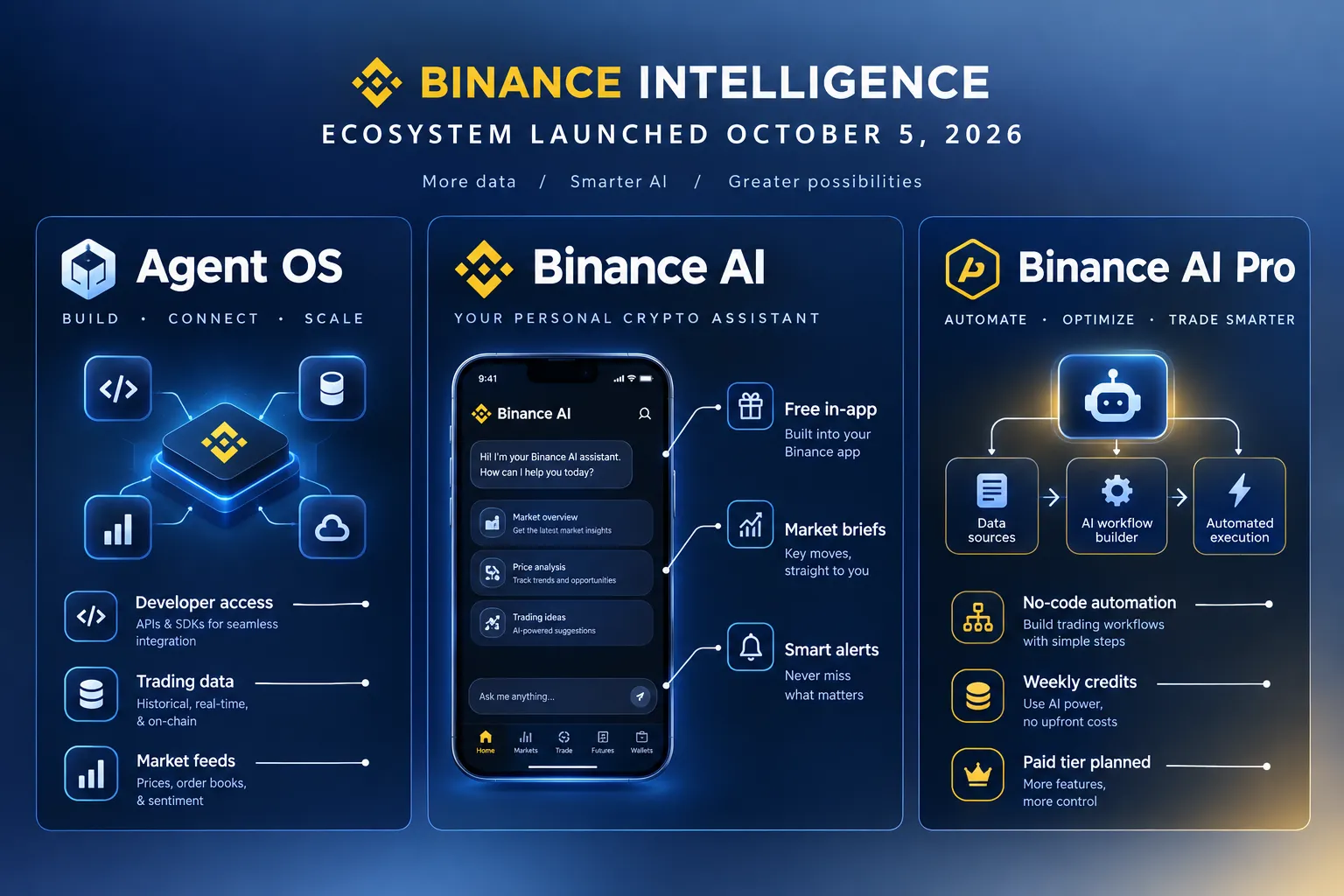
- Binance Intelligence launched October 5, 2026 with three pieces: Agent OS for developers, Binance AI as a free in-app assistant, and Binance AI Pro for no-code automated workflows.
- Binance AI Pro starts with a free tier on weekly-refreshed credits, with a paid subscription planned later. The company did not publish an eventual price.
- StockHero mobile app 5.1.1 shipped October 5, 2026, with plans at $49.99, $99.99, and $159.99 monthly, or roughly 17% to 20% off on annual billing.
- ESMA’s February 26, 2026 supervisory briefing says software picking even one order parameter can count as algorithmic trading under MiFID II, which pulls a lot of “AI assistant” features into scope.
- Free tiers are marketing, not generosity. The caps on bot count, data feed, and refresh rate decide whether a tool is usable or a demo.
What exactly changed in this round of ai stock trading bots news: new app and pricing changes?
Two product moves and one regulatory signal, all inside the same window.
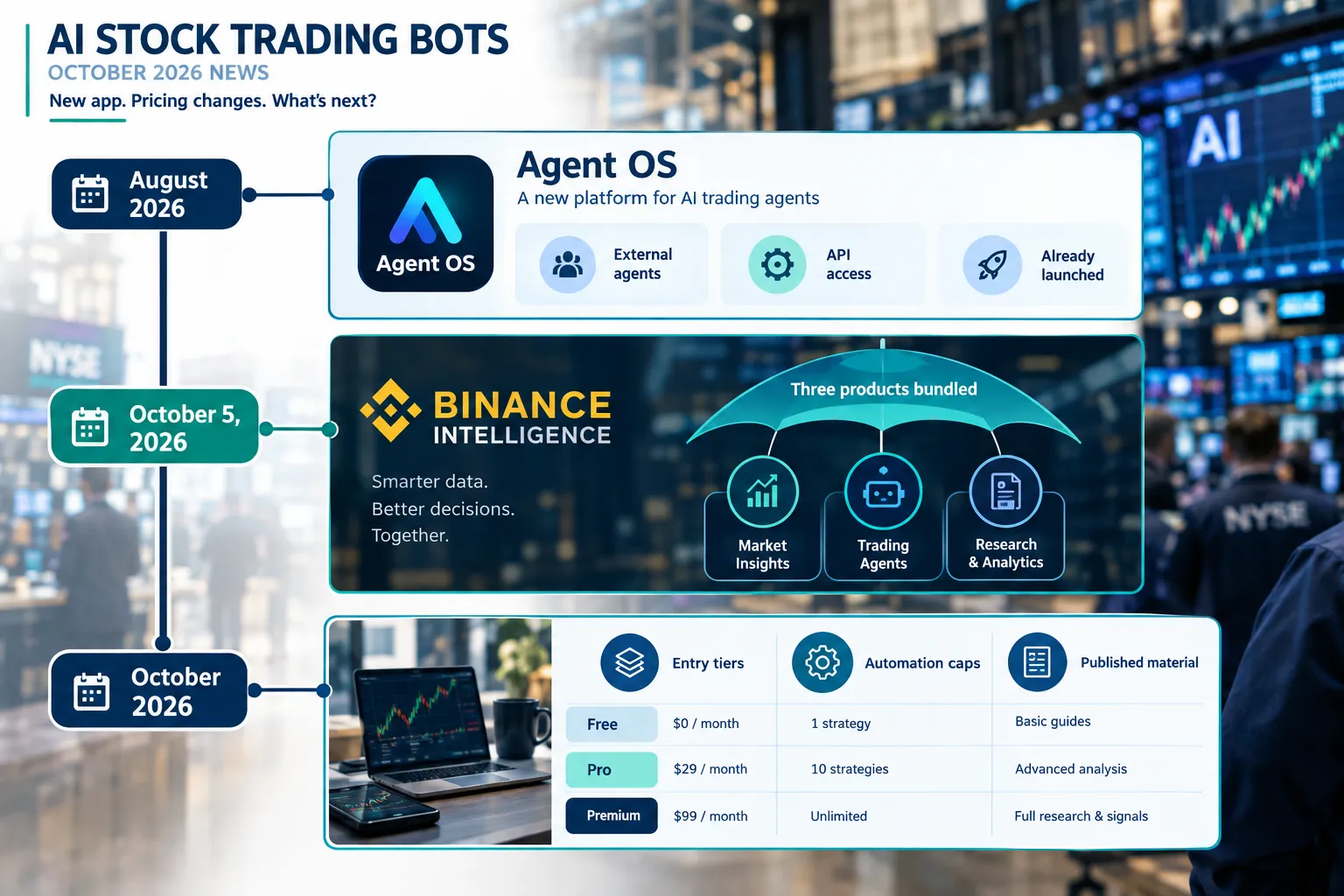
Binance announced Binance Intelligence on October 5, 2026, bundling three products under one roof. Agent OS, which had already launched in August 2026, gives external AI agents access to Binance trading and market data. Binance AI is a free in-app assistant with dashboards, market briefs, smart alerts, portfolio profit-and-loss recaps, sentiment, and chart annotations. The market brief covers crypto, stocks, and macro, and can be read or listened to.
Binance AI Pro is the part that matters to anyone running automation. It turns plain-language instructions into executable workflows without code. You describe a strategy, paper-trade it, review the results, then activate live execution inside budgets, permissions, and risk limits. The rollout started with eligible users in New Zealand, with broader availability following, and AI Pro arriving in the weeks after launch.
StockHero went the other way. It shipped mobile release 5.1.1 on October 5, 2026, following a September push promoting its redesigned Android and iOS apps for managing automated stock strategies from a phone. No price cut came with it. The pricing page checked in October 2026 still lists Lite at $49.99 a month, Premium at $99.99, and Professional at $159.99, with annual plans at $499.99, $999.99, and $1,599.99.
One company is giving away the assistant and metering the automation. The other is charging for the automation and improving the app. Both are rational. Only one of them is cheap to try.
How much do the new plans and tiers actually cost?
Here is the comparison, pulled from each company’s own published material as of October 2026.
| Product | Entry price | What the entry tier gets you | Automation cap |
|---|---|---|---|
| Binance AI | Free | Dashboards, market briefs, smart alerts, P&L recaps, sentiment, chart notes | No live execution |
| Binance AI Pro | Free tier on weekly-refreshed credits, paid plan planned | Plain-language strategy building, paper trading, live activation with limits | Credit-limited, price not published |
| Binance Agent OS | Developer access, launched Aug 2026 | External agent access to trading and market data | Mandatory subaccounts, no agent withdrawals |
| StockHero Lite | $49.99/mo or $499.99/yr | 14-day trial, unlimited backtests and signals, TradeStation automation | 2 active bots after payment |
| StockHero Premium | $99.99/mo or $999.99/yr | Broader broker support, TradingView integration, marketplace, AI chatbot | 15 active bots |
| StockHero Professional | $159.99/mo or $1,599.99/yr | 1-minute frequency, extended hours, grid bots, SMS and WhatsApp alerts | 50 active bots |
Two things jump out. StockHero’s Lite plan gives you unlimited backtests but only two live bots, which is a backtesting tool with a trading feature attached, not the other way around. And Binance AI Pro’s free tier runs on weekly credits, meaning the thing you are testing resets on a schedule you do not control.
Compare that to broker-native automation, where the data and execution are already bundled. We laid out the full monthly bill in our breakdown of what a trading bot actually costs to run, and the subscription is rarely the biggest line item.
At $159.99 a month, StockHero Professional costs about $1,920 a year. On a $10,000 account, that is 19.2% of capital going out the door before a single fill. The math only works at size or at frequency, and most retail accounts are neither.
Is a free AI trading tier actually free?
Not in the way you want it to be. Free tiers in this category are capped on the inputs that decide whether automation works at all.
The usual chokepoints: delayed or limited market data, a hard cap on active bots, a slow refresh rate, no extended-hours access, and no API calls past a daily ceiling. Any one of those turns a working strategy into a late one. Alpaca’s structure is the clearest example of the pattern, where free IEX data versus the $99 SIP feed changes what your bot can even see.
Binance AI Pro’s weekly-refreshed credits follow the same logic in a different wrapper. Credits meter how much the model thinks for you. Run a few strategy iterations in one sitting and you are waiting on a reset.
We catalogued the specific limits most vendors bury in their docs in our piece on the caps hidden inside AI trading bot free tiers. Read it before you judge any free plan as generous.
Practical takeaway: before you pay or commit, write down the three numbers that matter for your approach. Data delay in seconds. Maximum concurrent positions. Minimum bar interval. If the free tier fails any one of them, the free tier is a brochure.
What does the Public and Binance “agentic” push mean for your account?
It means software can place orders inside your brokerage account under rules you wrote in plain English, and the review step is becoming optional rather than mandatory.
Public is marketing itself as an agentic brokerage rather than an AI research app. Its agents can monitor markets, manage cash, and execute recurring or rule-based transactions inside the account. Public also says users can build agents that watch prediction markets and execute cross-asset trades from plain-English rules.
Binance’s Agent OS lists its safeguards openly: mandatory subaccounts, prohibited agent withdrawals, granular permissions, revocable access, and an emergency stop. That is a reasonable control set, and it tells you the company expects things to go sideways occasionally. Good. Any vendor that does not ship a stop button has not thought about the failure mode.
We covered the broker side of this shift in our report on brokers letting AI agents trade while you sleep, and the pattern is consistent: permissions get granted once and reviewed never.
The risk is not that the agent is wrong. It is that you forgot it was running. Set an external kill switch that does not depend on the vendor’s own dashboard staying up, because a platform outage and a runaway position tend to show up together.
Who is watching the regulators while all this ships?
ESMA, for one, and its view is broader than most product teams would like.
On February 26, 2026, the European Securities and Markets Authority published a supervisory briefing on algorithmic trading under MiFID II, explicitly covering AI-enabled systems. It focuses on governance, testing, pre-trade controls, outsourcing, and supervisory convergence across national regulators.
The definitional point is the one that bites. ESMA takes the position that even when a human approves an order, the activity can still count as algorithmic trading if software determines a single order parameter: price, quantity, timing, or whether to initiate the order at all. That sweeps in a lot of features currently labelled as assistants.
The briefing is nonbinding. It still sets supervisory expectations, and firms stay responsible for governance, testing, monitoring, outsourcing controls, and annual self-assessment even when the trading technology comes from a third party. Buying the algorithm does not outsource the accountability.
US enforcement has been less about definitions and more about fraud. Our coverage of the SEC case against Cryptoaiml and TSAI over roughly $15 million in fake AI trading bot claims shows where the regulators are spending their attention stateside. Different approach, same direction of travel.
What should investors watch next?
Dated items worth marking down:
- Binance AI Pro paid pricing. The company said a paid subscription is planned after the free credit tier. No price was published at the October 5, 2026 launch. Watch the Binance blog and in-app plan page.
- Binance AI geographic rollout. Launch began with eligible New Zealand users on October 5, 2026, with broader global availability stated as following. US availability has not been confirmed.
- StockHero release notes. Version 5.1.1 landed October 5, 2026. The docs site publishes each release, so check it before assuming a feature you rely on still behaves the same way.
- ESMA national implementation. The February 26, 2026 briefing is nonbinding guidance aimed at convergence. Watch for individual EU regulators folding it into their own supervisory programs through 2026.
- Broker API changes. Automation breaks on updates nobody announced loudly. Our writeup on what the September 9 IBKR Web API update broke for bots is the template for how quietly this happens.
How should a retail trader respond to new app launches and pricing changes?
Slowly, and in paper first. New releases are the worst possible moment to put real money behind someone else’s code.
A workable sequence:
- Read the release notes, not the blog post. The marketing page tells you what shipped. The release notes tell you what changed underneath, which is where your strategy lives.
- Price the whole stack, not the subscription. Data feed, broker fees, VPS if you host anything, plus the plan. StockHero Professional at $159.99 is the floor, not the bill.
- Paper trade the exact logic for at least 30 sessions. Simulated fills flatter you. Our piece on why paper trading proves nothing until slippage shows up explains where the gap appears.
- Scope permissions like you expect a bug. Subaccount only. No withdrawal rights. Revocable keys. Binance built those controls in for a reason.
- Write your stop rules before you activate anything. Position sizing and a hard daily loss limit beat any model output. Discipline beats prediction.
A new app does not change your edge. Your process does.
Our Take
Binance giving away the assistant and metering the automation is the smarter structure, and it is also the one more likely to get people into live execution before they are ready. A free credit tier that lets you describe a strategy in plain English, paper it, then flip it live is a very short runway between curiosity and real money.
StockHero’s position is harder to defend on price. Charging $49.99 a month for two live bots, while handing out unlimited backtests, prices the cheap part generously and the expensive part thin. The Professional tier at $159.99 makes sense if you genuinely need 50 bots, one-minute bars, and extended hours. Most readers of this site do not, and paying for capacity you will not use is the oldest tax in retail trading.
The ESMA briefing is the line item nobody is talking about and probably should be. If software picking the timing of your order counts as algorithmic trading, the label “AI assistant” stops being a regulatory shelter. Expect vendors to start writing more careful feature descriptions.
Our position: treat every launch as unproven until your own paper log says otherwise, and judge free tiers by their caps, not their price. Cut the noise, keep the alpha.
This is education, not financial advice. Nobody here is telling you what to buy.
Paying for a bot plan and quietly wondering if it earns its keep? Every submission gets checked against the vendor’s own docs and pricing page before it gets covered, no exceptions. Submit your bot: https://aistocktradingbots.com/contact/?topic=submit-bot
Frequently Asked Questions
Is Binance AI available in the United States? Binance said the rollout began with eligible users in New Zealand on October 5, 2026, with broader global availability to follow. US availability was not confirmed in the launch announcement. Check the in-app availability notice rather than assuming access.
How much will Binance AI Pro cost? Binance stated the initial free tier runs on weekly-refreshed credits with a paid subscription planned later. No eventual price was published at launch. Treat any figure you see quoted elsewhere as unverified until it appears on an official Binance page.
Is StockHero’s annual plan worth the commitment? The annual plans run about 17% to 20% below monthly billing based on the October 2026 pricing page. That discount only pays off if you still want the tool in month eight. Run the 14-day Lite trial first and judge it on fills, not features.
Do these AI tools pick stocks for me? That depends on the product and is a different question from whether they should. Our editorial position is that we review the software and do not recommend securities. For how the categories differ, see our breakdown of the five types of AI trading bot.
Does ESMA’s briefing apply to US traders? No. ESMA supervises under MiFID II in the European Union, and the February 26, 2026 briefing is nonbinding guidance for EU national regulators and investment firms. It matters to US readers mainly as a signal of how supervisors are starting to define AI-driven order handling.
What is the single most important setting on a new trading agent? The kill switch, followed by withdrawal permissions. An agent that cannot move money off the platform and can be stopped from outside its own dashboard limits the damage from both bugs and outages.
Conclusion
This round of ai stock trading bots news: new app and pricing changes tells you more about business models than about technology. Binance is giving away the research layer to sell the execution layer later. StockHero is charging for execution and shipping a better phone app. Neither move makes anyone a better trader.
What does: reading the caps before you commit, pricing the entire stack instead of the headline plan, and paper trading the exact logic for 30 sessions before any live key gets created.
Next step, today: open the pricing page of whatever tool you currently pay for, find your plan’s active bot limit and data delay, and write both numbers on the same sheet as your maximum daily loss. If the tool cannot support the rules you already trade by, the problem was never the app.
Stay alpha.
Meta title: AI Stock Trading Bots News: New App and Pricing Changes
Meta description: Binance Intelligence launched Oct 5, 2026 and StockHero shipped app 5.1.1. New AI trading bot app and pricing changes, plan caps and free tier limits explained.
Tags: ai trading bots, binance intelligence, stockhero pricing, trading bot pricing, agentic brokerage, esma mifid ii, ai trading news, broker automation, free trading bot tiers, paper trading, trading bot costs, public agentic brokerage
Contributing writer at AI Stock Trading Bots.
