

A $10,000 account ran an AI-built bot on video and finished at $9,900, while the plain benchmark would have sat at $9,980. The top comment on that video asked the only question that mattered: “How much tokens did you burn?” So, how much does a trading bot cost once you add the tokens, the data, the bridge and the fees? That’s the full monthly bill nobody puts in the thumbnail, and it’s why the Full Stack Alpha desk wrote How Much Does a Trading Bot Cost | The Full Monthly Bill for 2026. How much does a trading bot cost in 2026 depends on which of three very different buckets you land in, and most beginners pick the wrong one.
Quick Answer
How much does a trading bot cost per month in 2026? Three honest price points: $0 for a free-tier DIY build on Alpaca’s commission-free API with free IEX data and open-source backtesting (crypto exchanges also bundle free grid bots, where you pay trading fees instead of a subscription); $25 to $60 for a DIY stack built on a free AI tier, free data and a cheap signal bridge; and $100 to $400+ once you add premium market data, a paid bridge and cloud hosting. The software is the cheap part. Fee drag, token burn and bad assumptions are where the money actually goes, and the CFTC says plainly that AI doesn’t turn bots into magic money machines.
Key Takeaways
- A stock bot can start at $0 in subscription. Alpaca’s commission-free API, free IEX data and free open-source backtesting cover a paper-trading build. As a reference point, crypto exchanges give away grid and DCA bot tools, then earn on volume. One exchange-bot roundup put it bluntly: your bot may have worked all year for the exchange.
- A realistic DIY monthly bill runs $25 to $60. Claude Pro or ChatGPT Plus at $20/mo, free IEX data from Alpaca, and Railway hosting from a $5/mo minimum.
- Bridges are the sneaky line item. SignalStack gives 5 signals a month free and scales to $340/mo across 30+ brokers. TradersPost starts at $41.65/mo with 16+ brokers. PickMyTrade is $50/mo and strong for futures.
- Backtesting can be free. vectorbt and backtesting.py cost nothing, and QuantConnect’s free plan includes unlimited backtesting before its Researcher tier at $84/mo.
- Data is the biggest jump. Alpaca’s real-time IEX feed is free; the SIP upgrade is $99/mo. Databento plans start at $199/mo. OPRA options data runs far higher.
- Roughly 95% of retail “AI bots” are rule-based scripts with AI branding, according to one 2026 industry analysis. You’re often paying a subscription for an if-then statement.
- The SEC charged multiple entities on September 29, 2026 over alleged AI-trading-bot fraud totaling at least $15 million. Price is not the only risk in this market.
How much does a trading bot cost to run each month?
A trading bot costs between $0 and about $400 a month in 2026, and the band you land in is decided by one thing: whether you rent someone else’s execution or build your own. Exchange-native bot tools are free to run. A custom trading bot stack with premium data is where four figures a year shows up.
What is a trading bot and how does it work?
A trading bot is software that watches price data, applies rules you set, and sends buy or sell orders to a broker or exchange through an API, which is just a connection that lets two programs talk. No crystal ball. A grid bot places a ladder of buy orders below price and sell orders above it. A DCA bot buys fixed amounts on a schedule, often adding safety orders as price falls. A signal bot does nothing on its own; it waits for an alert from a chart platform and fires the order. Bot plus rules equals automation. Bot plus hope equals an expensive hobby.
Why do crypto exchange bots look free?
Because the software is a customer-acquisition cost. OKX bundles spot grid, futures grid, spot DCA martingale and a signal bot into the app at no subscription price, and Pionex bundles its grid bot, DCA bot and arbitrage bot the same way. Binance kept expanding native automation through September 2026, including Spot Algo Trading Bots and rebalancing services. Bybit went further and wrapped spot, futures, options, copy trading and bots behind a chat interface.
Free software, paid volume. Every grid order pays a fee. Many traders only notice after three months of churn.
Market truth: an exchange that gives you a free bot is buying your order flow at a discount. Practical takeaway: before you run a grid bot anywhere, open the official fee schedule and multiply one round trip by your expected number of grid fills per week.
How much does a trading bot cost (the real 2026 breakdown)
How much does a trading bot cost, line by line? Zero for a free-tier stock build on paper, roughly $25 to $60 for a sensible DIY build, and $150 to $400+ for a pro setup with paid data and a redundant bridge. Prices come from vendor pricing pages, not old blog posts, and anything not confirmed below should be verified on the vendor’s own pricing page.
The $0 bucket. For stocks: Alpaca’s commission-free API, free IEX data, vectorbt or backtesting.py, and your own laptop for paper trading. For crypto, as a reference point only: exchange-native grid and DCA bots with no subscription, where you pay trading fees, funding on perpetuals, and the spread. Several 2026 bot roundups now rank exchange-native tools above paid SaaS for beginners purely on cost.
The $20 to $60 bucket. This is where most self-builders live. Claude Pro at $20/mo or ChatGPT Plus at $20/mo writes and debugs the strategy code. Alpaca is commission-free for self-directed US stock and options API trading, and its real-time IEX plus historical tier is free. Railway hosts the bot from a $5/mo minimum, or you run it on your own laptop for nothing while you paper trade.
The $100 to $400+ bucket. Claude Max from $100/mo. Alpaca SIP data at $99/mo. QuantConnect Researcher at $84/mo. SignalStack at the top of its range, $340/mo. Databento at $199/mo. Stack three of those and the bill reads like a car payment.
Choosing the right AI trading bot plan
Choosing a plan is a sizing question, not a feature question. A $25,000 account paying $200/mo in software needs 9.6% a year just to break even on tools, before taxes and fee drag. How much does a trading bot cost relative to your account is the only version of the question that matters.
- Under $5,000 of capital: $0 to $25/mo. Exchange-native bots or a free-tier DIY build. Nothing else.
- $5,000 to $25,000: $25 to $60/mo. One AI assistant, free data, one bridge, cheap hosting.
- $25,000+ and trading futures or options: $100 to $400/mo. Paid data starts earning its keep.
Setting realistic expectations for what the money buys
A subscription buys execution and consistency, not an edge. Industry research is clear that the execution layer matters far less than strategy, data quality and risk controls. Backtests routinely omit spread, slippage, liquidity limits, API outages and taxes.
Our deeper look at what AI trading software actually delivers for the subscription price covers the gap between the sales page and the statement.
What do popular trading bots cost per month in 2026?
How much does a trading bot cost when you buy it off the shelf instead of building it? Below are 12 named products, stocks first, with the starting monthly price taken from each vendor’s own pricing page where we could read it. Prices are approximate and move often, so treat each one as a starting point, not a quote.
One pattern before the list: free tiers cluster at the research and routing layer. Anything that runs a strategy on live money for you starts around $40 to $190 a month.
1. StockHero
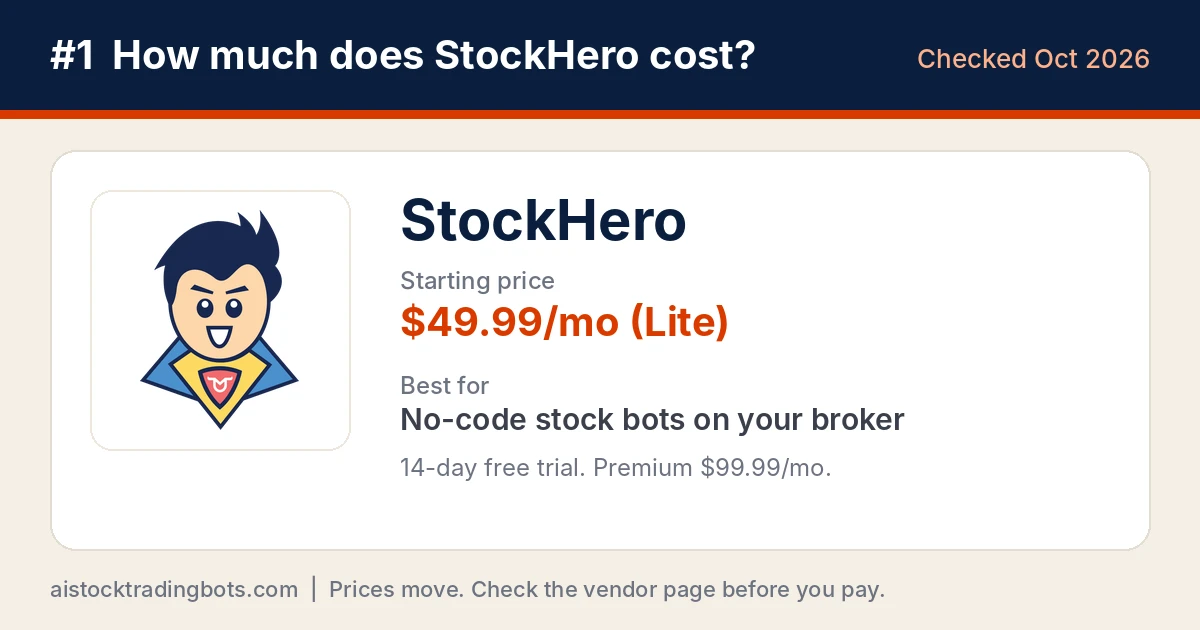
What it is: A no-code bot builder for stocks that connects to brokers including TradeStation, Webull, E*Trade and Alpaca. You pick a template or a marketplace bot, set the rules, and it trades your account.
Who it’s for: Swing traders who want automation without writing Python.
Starting monthly price: Lite is $49.99/mo ($499.99/yr) with 2 active bots. Premium is $99.99/mo with 15 bots plus DCA and advanced bots. Professional is $159.99/mo with 50 bots and the grid bot. Source: StockHero pricing.
Free plan or trial: 14-day free trial on Lite, with 1 active bot during the trial.
StockHero’s own blog headlines a 95% win rate for September 2026. That is vendor-claimed, one month long, and not independently audited.
2. Trade Ideas
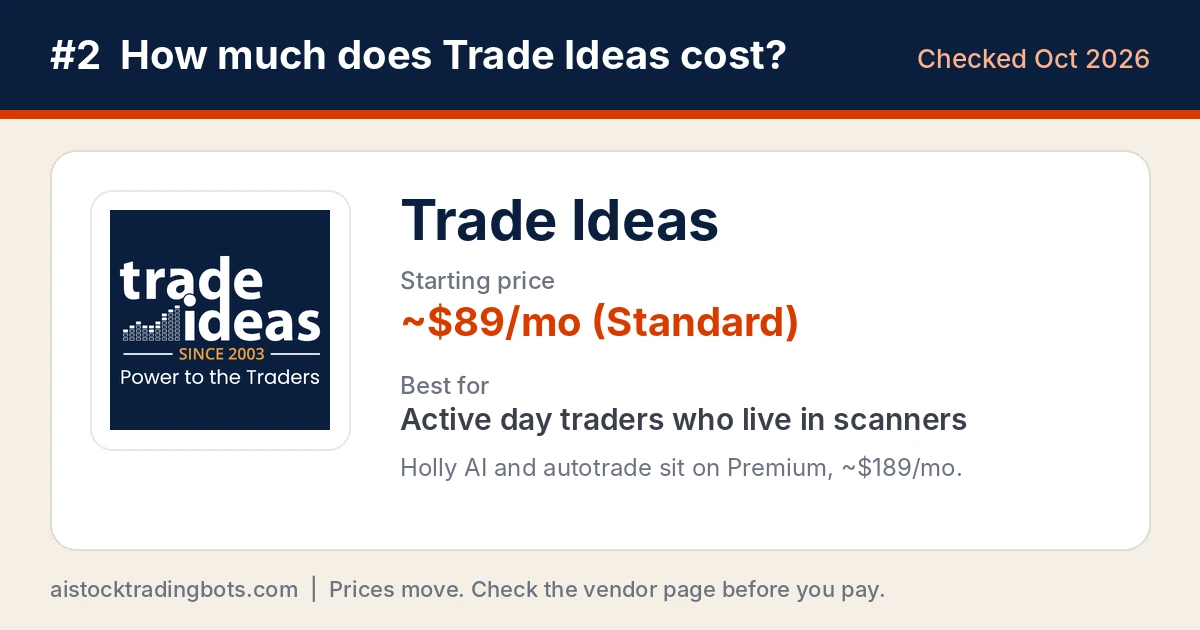
What it is: A real-time US stock scanner with an AI engine called Holly that surfaces trade setups, plus Brokerage Plus for automated execution.
Who it’s for: Active day traders who trade every session and live inside scanners.
Starting monthly price: Standard is about $89/mo billed annually ($1,068/yr). Premium is about $189/mo billed annually ($2,268/yr), and Premium is the tier that includes Holly AI and autotrading. Source: Trade Ideas pricing.
Free plan or trial: We found no free trial on the pricing page.
Trade Ideas tells buyers not to subscribe if they can’t afford $6.20 a day. Rare honesty from a pricing page.
3. TrendSpider
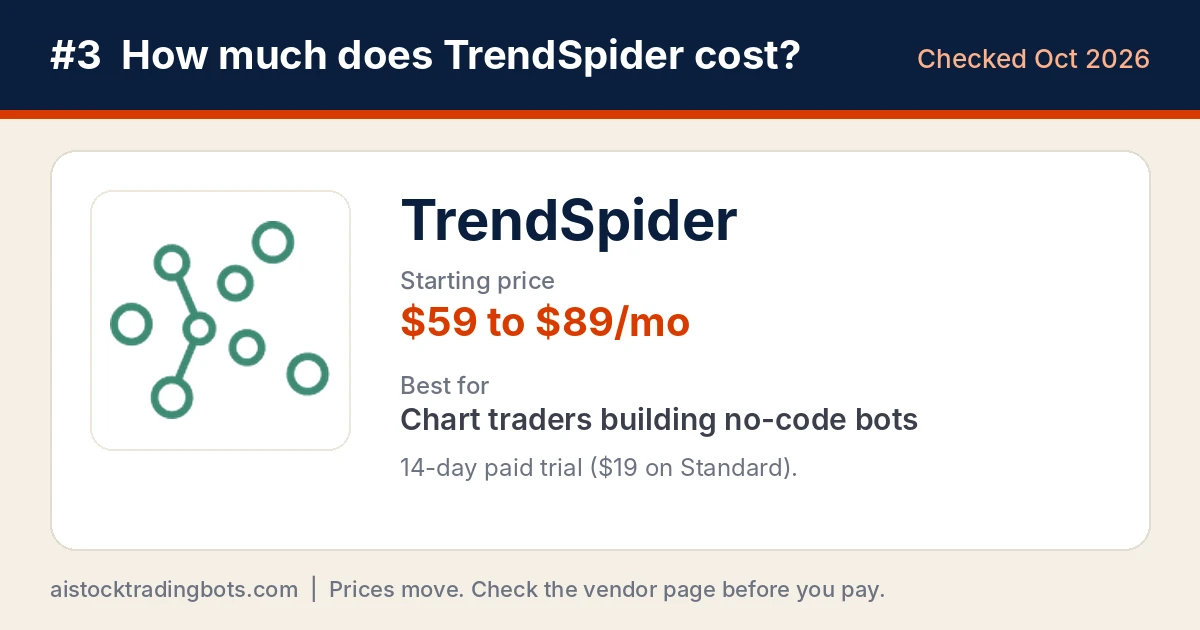
What it is: A charting and backtesting platform with automated trendlines, a no-code strategy tester, and cloud bots that fire alerts or orders.
Who it’s for: Technical traders who want to test and automate chart setups without code.
Starting monthly price: Standard runs $59 to $89/mo depending on annual or monthly billing. Premium is $99 to $149, Enhanced $133 to $199, Advanced $233 to $349. Non-professional users pay no extra fee for real-time US equities data. Source: TrendSpider pricing.
Free plan or trial: No free plan. The 14-day trial is paid, $19 on Standard.
4. Composer
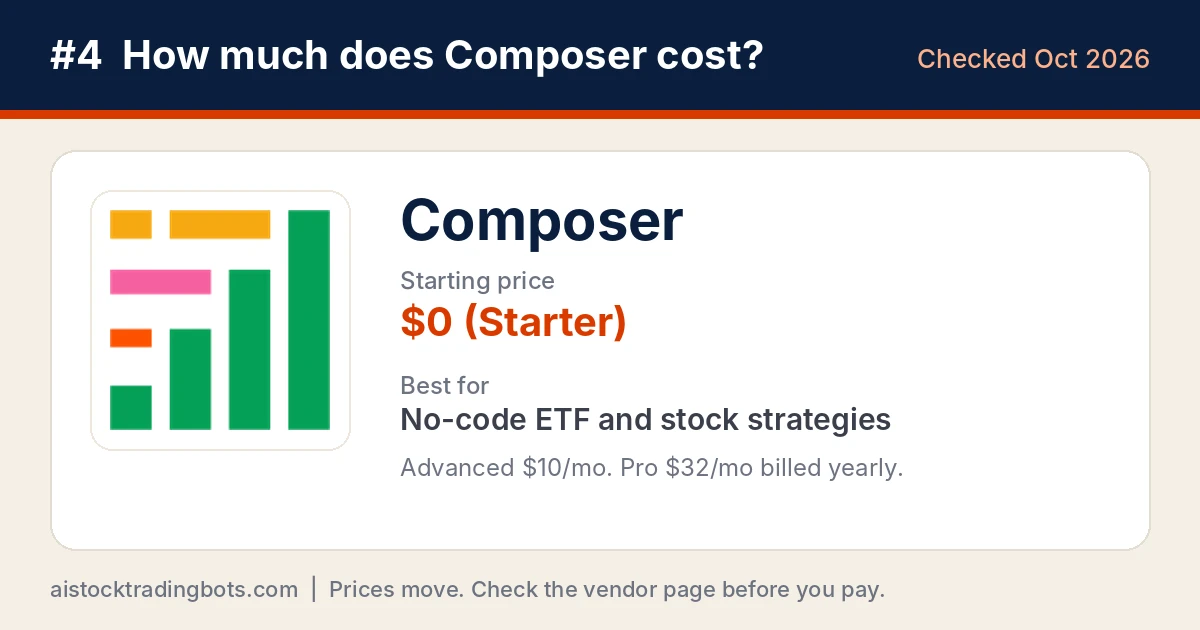
What it is: A no-code platform for building, backtesting and automating rule-based portfolios of stocks and ETFs, with a Trade with AI assistant for strategy ideas.
Who it’s for: Rotation and long-horizon investors who would rather drag blocks than write code.
Starting monthly price: Starter is $0 and automates your first strategy. Advanced is $10/mo for up to 5 automated strategies. Pro is $32/mo billed yearly ($384/yr) for up to 500 strategies plus API access. Source: Composer pricing.
Free plan or trial: Yes, Starter is free. FINRA and SEC regulatory fees still apply when you sell.
Our Composer review covers whether its AI-built algos are worth running.
5. Tickeron
What it is: An AI signals platform whose “AI Robots” publish simulated trades, plus pattern scanners and a trend prediction engine.
Who it’s for: Traders who want to follow model-generated signals instead of building their own.
Starting monthly price: AI Robots list at $1,080/yr, about $90/mo. When we checked, a sale price of $540/yr (about $45/mo) was running. Source: Tickeron pricing.
Free plan or trial: Free member account. Paid tools get a 14-day free trial, but the trial excludes AI Robots, Expert membership and annual plans.
The robots publish simulated trades, so treat their performance figures as vendor-claimed.
6. Capitalise.ai
What it is: A code-free automation tool: you write rules in plain English, such as buy when price crosses a moving average, and it executes through a connected partner broker.
Who it’s for: Traders who think in rules, not code, and whose broker supports it.
Starting monthly price: $0. Its support page says anyone can sign up and automate strategies “completely for free”, with no monthly payments. Source: Capitalise.ai fee page.
Free plan or trial: Yes. The company says it may add fees later and will notify users before it does. Broker fees are separate.
7. TradersPost
What it is: A webhook bridge that turns TradingView or other alerts into orders at brokers, crypto exchanges and prop firms.
Who it’s for: Signal traders who already have an alert they trust and want it executed automatically.
Starting monthly price: Starter is $41.65/mo billed yearly. Basic is $84.15, Pro $169.15 and Premium $254.15 a month on yearly billing. Extra live accounts cost $10/mo each, paper accounts $5/mo. Source: TradersPost pricing.
Free plan or trial: Free 7-day trial: manual submission on live accounts, automated submission on paper.
8. SignalStack
What it is: Pay-for-what-you-send alert routing. A TradingView alert becomes a live order at a connected broker.
Who it’s for: Traders who send a handful of signals a week and don’t want a big monthly bill.
Starting monthly price: Free plan with 5 live signals a month and unlimited paper signals. Paid plans are $27, $97 and $340 a month. Source: SignalStack pricing.
Free plan or trial: Yes, free for life at 5 signals a month. Unused signals expire at month end.
9. PickMyTrade
What it is: An automation bridge built around futures. It sends alerts to futures brokers and prop-firm accounts, with forex, options and CFD brokers also supported.
Who it’s for: Futures traders and prop-firm evaluators copying one signal across sub-accounts.
Starting monthly price: $50/mo or $500/yr, flat, with unlimited trades and strategies. A second broker login is a separate subscription. Source: PickMyTrade.
Free plan or trial: 7-day free trial, no credit card required.
10. QuantConnect
What it is: An algorithmic trading platform built on the open-source LEAN engine. You code strategies in Python or C# against hosted data for equities, options, futures, forex and crypto.
Who it’s for: Coders who want serious, institutional-style backtesting.
Starting monthly price: Free plan with unlimited backtesting. Paid plans are configured per user; we priced the Researcher tier at $84/mo in the stack table below. Live trading runs on paid compute. Source: QuantConnect pricing.
Free plan or trial: Yes, the free plan is permanent.
11. Option Alpha
What it is: A no-code options bot builder. You set entries, exits and risk rules with decision blocks, and bots trade options strategies on a connected broker.
Who it’s for: Options sellers who want their rules enforced every single day.
Starting monthly price: Pro is $99/mo billed annually or $149 monthly, with 50 bots and a $100k limit per bot. It drops to $0/mo if you connect TradeStation (with a $10k minimum balance), Tradier or tastytrade ($5k minimum). Source: Option Alpha pricing.
Free plan or trial: 30-day free trial, plus unlimited paper trading without a broker.
12. Intellectia
What it is: An AI stock research app with swing, day-trading and pattern signals, an AI stock picker and options strategy ideas. It’s research and signals, not an order-routing bot.
Who it’s for: Beginners who want AI-generated ideas before paying for automation.
Starting monthly price: Free-forever plan. Basic is $14.95/mo ($11.96/mo billed annually), Pro $29.95, Max $49.95, and Expert about $71.96/mo billed annually. Source: Intellectia pricing.
Free plan or trial: Yes, the free plan has no end date.
Crypto footnote: crypto-only bot platforms such as 3Commas, Pionex and StockHero’s sister app CryptoHero exist too. We left them off this list on purpose.
Summary table: popular trading bots and what they cost
| Bot | Best for | Markets | Starting price | Free tier |
|---|---|---|---|---|
| StockHero | No-code stock bots | US stocks, ETFs | $49.99/mo | No (14-day trial) |
| Trade Ideas | Active day traders | US stocks | ~$89/mo (Holly AI ~$189) | No |
| TrendSpider | Chart-based bots and backtests | Stocks, ETFs, futures, forex, crypto | $59 to $89/mo | No (paid trial) |
| Composer | No-code ETF and stock strategies | US stocks, ETFs | $0 | Yes |
| Tickeron | Following AI robot signals | Stocks, ETFs, crypto | ~$45 to $90/mo | Yes (robots extra) |
| Capitalise.ai | Plain-English rules | Varies by partner broker | $0 | Yes |
| TradersPost | TradingView alerts to brokers | Stocks, options, futures, crypto | $41.65/mo | No (7-day trial) |
| SignalStack | Low-volume alert routing | Varies by broker | $0 | Yes (5 signals/mo) |
| PickMyTrade | Futures and prop firms | Futures, forex, options, CFDs | $50/mo | No (7-day trial) |
| QuantConnect | Coded backtests | Equities, options, futures, forex, crypto | $0 | Yes |
| Option Alpha | No-code options bots | US options | $99/mo | Yes, via partner brokers |
| Intellectia | AI signals and research | US stocks, options ideas | $0 | Yes |
Do the annual math before you click subscribe. A $50 bot is $600 a year. Trade Ideas Premium is about $2,270 a year. On a $10,000 account, that second number is a 22.7% hurdle before your first winning trade.
What goes into a complete AI bot stack?
Five components: an AI assistant to write the code, market data, a broker with an API, a bridge to route signals, and somewhere to host it. Four of the five have a free option in 2026. Market data is the one that eventually bites. Answer how much does a trading bot cost by pricing these five layers one at a time.
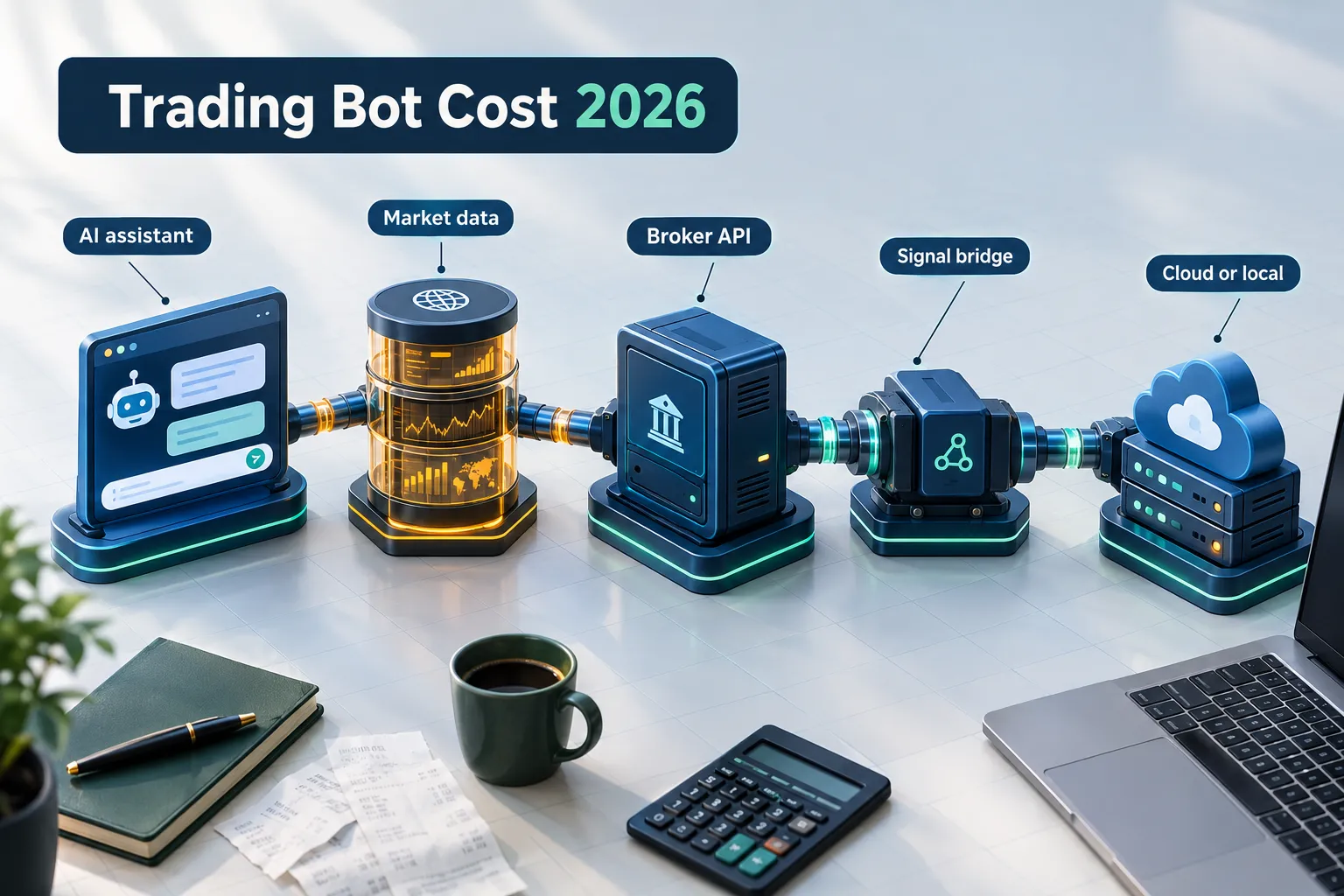
1. AI assistant: $0 to $100/mo. Claude Pro and ChatGPT Plus are both $20/mo; Claude Max starts at $100/mo. This is the layer that writes your strategy, your risk checks and your logging.
2. Market data: $0 to $199/mo. Alpaca’s IEX feed is free. Upgrades: Alpaca SIP $99/mo, Massive (ex-Polygon.io) across $29 to $199/mo tiers, Tiingo about $30/mo, EODHD from $19.99/mo, Databento $199/mo plans with OPRA options data far higher.
3. Broker and execution: usually $0 in commission. Alpaca charges no commission for self-directed US stock and options API trading. Futures brokers price per contract, so read the schedule. Our breakdown of how to pick a futures trading broker walks through the per-side math.
4. Signal bridge: $0 to $340/mo. SignalStack’s free tier covers 5 signals a month and paid plans reach $340/mo with 30+ brokers. TradersPost starts at $41.65/mo with 16+ brokers. PickMyTrade is $50/mo and the pick if you’re sending futures orders.
5. Hosting: $0 to $20/mo. Railway from a $5/mo minimum. Your own machine is free.
Cloud or local: where should your bot run?
Run it local while you paper trade, then move it to the cloud before you go live. Local costs nothing and is fine for testing. A laptop that sleeps at 2am, drops Wi-Fi, or reboots for updates will leave a position open with no stop loss attached.
What skill level does bot trading actually require?
Enough Python to read what the AI wrote and spot the lie. If you can’t tell a look-ahead bias from a legitimate signal, the assistant’s confidence becomes your risk. Our guide to backtesting a strategy without fooling yourself is the cheapest insurance in the stack. And if you want the honest version of a first build, read what happened when an AI built a bot with nobody supervising.
How much does a trading bot cost to build yourself with Alpaca and Claude?
About $20 to $40 a month for most self-builders, and roughly $230 to $270 if you want full-tape data and heavy AI use. The DIY route swaps a subscription for your own hours. Alpaca is the broker and data pipe, Claude writes and debugs the Python, and a small cloud box keeps the bot alive when your laptop sleeps.
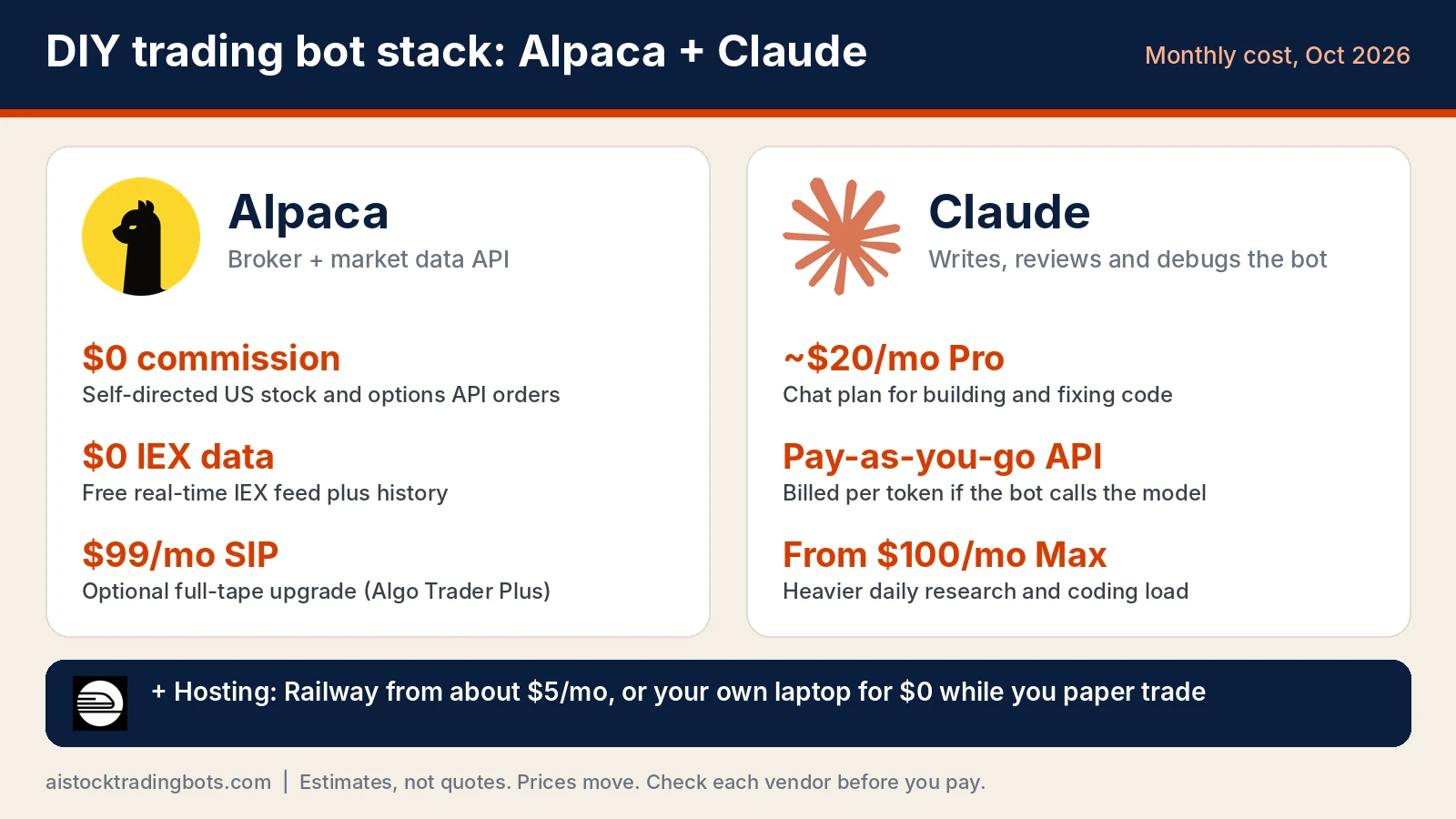
Alpaca: $0 commission API. Self-directed US stock and options orders through the API carry no commission. The free plan includes real-time IEX data plus history. The upgrade most people weigh is the SIP feed, the full consolidated tape, at $99/mo. Our Alpaca API pricing breakdown covers what is free and what isn’t.
Claude: about $20/mo, or pay as you go. Claude Pro at about $20 a month is enough to write, review and debug a first bot. If the bot itself calls the model, for example to read headlines before a trade, that’s the Claude API, billed per token as you use it. Claude Max starts at $100/mo for heavy daily coding and research. Our Claude trading bot guide walks through the build.
Hosting: about $5/mo. Railway’s entry plan starts around $5 a month. Your laptop costs nothing while you paper trade.
DIY monthly estimate: lean, standard, pro
These are our estimates for October 2026, not vendor quotes. API usage assumes a bot that calls the model a few dozen times a day, not on every tick.
| Line item | Lean | Standard | Pro |
|---|---|---|---|
| Claude | Pro, about $20 | Pro $20 plus API usage, about $5 to $15 | Max $100 plus API usage, about $20 to $50 |
| Alpaca trading | $0 commission | $0 commission | $0 commission |
| Market data | Free IEX, $0 | Free IEX, $0 | SIP, $99 |
| Hosting | Laptop $0, or Railway about $5 once live | Railway, about $5 | Railway with more compute, about $10 to $20 |
| Monthly total | about $20 to $25 | about $30 to $40 | about $230 to $270 |
| Yearly total | about $240 to $300 | about $360 to $480 | about $2,760 to $3,240 |
Put that next to the list above. The standard DIY stack at $30 to $40 a month undercuts StockHero Lite ($49.99) and PickMyTrade ($50), but you pay the difference in hours, debugging and your own risk checks. A bot that sends every price tick to an AI model will cost far more, and it will probably trade worse.
Which stack should you buy, and how much does a trading bot cost at each tier?
Three stacks, three price points. The starter stack runs under $50/mo and covers 90% of first-build needs. The mid stack adds a paid bridge and backtesting. The pro stack exists for futures and options traders who need real depth-of-book data.
Table: the three stacks, with the price column last.
| Component | Starter pick | What it does | Monthly price |
|---|---|---|---|
| AI assistant | Claude Pro or ChatGPT Plus | Writes and debugs strategy code | $20 |
| Market data | Alpaca real-time IEX | Live quotes and history for US equities | $0 |
| Broker and API | Alpaca | Commission-free self-directed stock and options orders | $0 |
| Signal bridge | SignalStack free tier | 5 signals a month to a live broker | $0 |
| Backtesting | vectorbt or backtesting.py | Open-source Python strategy testing | $0 |
| Hosting | Your own machine while paper trading | Runs the bot locally | $0 |
| Starter total | about $20 | ||
| Mid: bridge upgrade | TradersPost | Unlimited-style routing, 16+ brokers | from $41.65 |
| Mid: hosting | Railway | Always-on cloud bot | from $5 |
| Mid: research | QuantConnect Researcher | Hosted research environment and data | $84 |
| Mid total | about $150 | ||
| Pro: data | Alpaca SIP, or Databento | Full-tape US equities, or institutional feeds | $99 to $199+ |
| Pro: bridge | SignalStack top tier | High signal volume, 30+ brokers | up to $340 |
| Pro: AI | Claude Max | Heavier code and research workload | from $100 |
| Pro total | $400+ |
Who it’s for:
| Trader type | Pick | Why |
|---|---|---|
| Equities self-builder | Alpaca plus Claude Pro, free IEX data | Commission-free API, zero data cost |
| TradingView signal trader | SignalStack free tier, then TradersPost | Alerts to live orders without writing a router |
| Futures automator | PickMyTrade | Built for futures brokers, flat monthly |
| Researcher who wants no bills | QuantConnect free plan | Unlimited backtesting at no cost |
| Crypto-curious (reference only) | Paper trade first | Exchange bots are free software, but every fill pays a fee |
If you’re hunting for the best ai trading bot for beginners, start at the bottom row of that first table and work up. For a wider field, browse the tested roundup of AI trading bots.
What hidden fees in trading bots should you watch for?
Four line items eat more than your subscription: AI token burn, data upgrades, fee drag and slippage, and subscription creep. None appear in the build tutorials, which is why the math on screen never matches your statement. Ask how much does a trading bot cost after counting these four, not before.
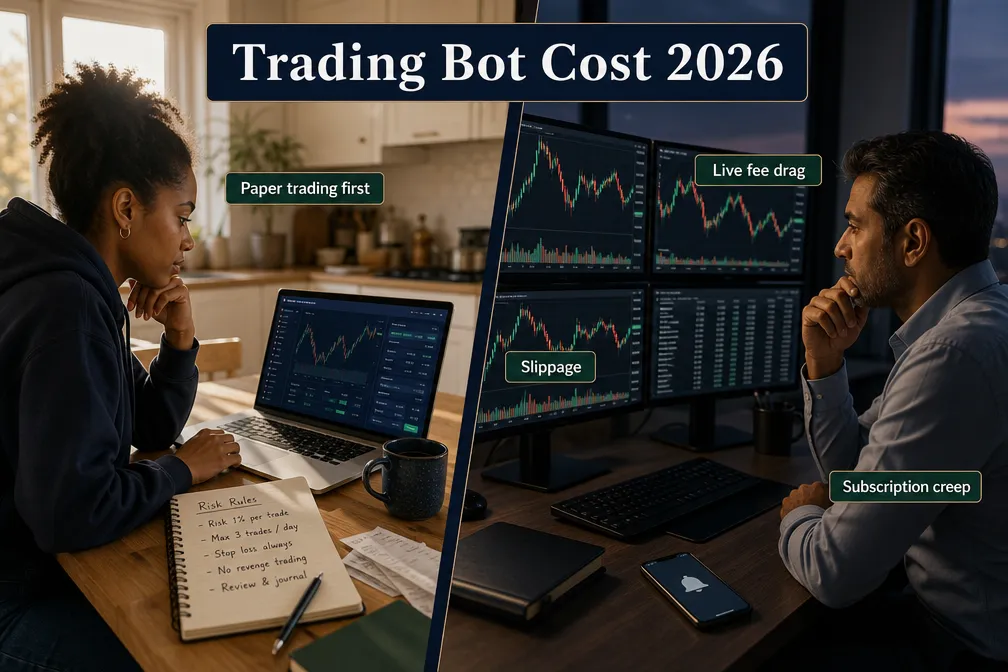
Token burn. Every AI call costs something once you pass a free tier. Robinhood’s new agents make this explicit: OpenAI’s lower-end Luna model is reportedly free through the end of 2026, while other models may carry usage-based charges. Fortune’s coverage of the launch noted the agents can research, build strategies and place trades in dedicated accounts.
Add-on agents. One announced Agent App, Options Trader by Unusual Whales, launched at $30 per month. Specialized research agents are becoming their own subscription line.
Fee drag. This is the big one for grid bots. A grid bot with 40 grid levels in a tight range might fill 200 orders a week. Each fill pays a taker or maker fee. Run that grid for a year and you’ve paid the exchange a meaningful slice of your capital for the privilege of oscillating.
Subscription creep. The scanner, the charting platform, the bridge, the data, the AI plan. Four tools at $29 to $50 each is a $600 year nobody budgeted.
Compliance costs, if you scale. ASIC announced algorithmic-trading reforms on September 24, 2026, adding a legal definition of “Trading Algorithm” plus testing, governance, kill-switch controls and seven years of records, effective March 2028. Legal analysts note those obligations mean budgeting for testing, audit logs, surveillance and independent validation, none of which fits inside a $20 retail plan.
Can you use a trading bot without paying exchange fees?
No. Every filled order pays something: a commission, a spread, or both. Alpaca is commission-free for self-directed US stock and options API trading, which gets you close to zero on equities, but spread and slippage still apply. On crypto, OKX and Pionex charge standard trading fees on each grid or DCA fill. Check the live fee page before you set the grid.
Crypto vs stocks: why the pricing differs
Crypto bots are usually free software with fee-based monetization. Equities and futures bots are usually paid software with cheap or free execution. Crypto exchanges can run bots free because they take volume fees 24/7 and earn funding on perpetuals. US equity brokers can’t bundle the same way, so the bot layer gets sold separately. Bitcoin and large-cap pairs are also liquid enough for grid logic to fill cleanly, which is why grid trading grew up on crypto venues first. Crypto appears here as a pricing comparison only, not a recommendation. That split is why how much does a trading bot cost depends so heavily on the asset class.
Top 5 favorite features worth paying for
Features that actually earn their price: paper trading, a grid bot with manual range control, a DCA bot with safety orders, a signal bot that routes external alerts, and a hard kill switch. Everything else is marketing.
1. Paper trading. Free on most platforms and the single highest-value feature. Always paper trade it first for 30 days.
2. Grid bot with manual range control. Grid bots shine in a ranging, choppy tape. You set an upper and lower price, the bot slices that range into grid levels, and it buys the dips and sells the rips inside the range. Set the range too wide and the grid barely fills. Set it too narrow and price leaves your grid entirely, parking you in a half-filled position. Trading futures grid bots with leverage turns a fee problem into a liquidation problem.
3. DCA bot with safety orders. A DCA bot buys on a schedule. The spot DCA martingale variant adds larger safety orders as price falls, which lowers your average entry and raises your risk at the same rate. Once a martingale ladder gets five deep, you’re no longer dollar-cost averaging, you’re catching a falling knife with borrowed conviction.
4. Signal bot routing. TradingView alert fires, bridge receives the webhook, order lands at the broker. The OKX signal bot does this natively for crypto; SignalStack and TradersPost do it for equities and futures. A signal bot is only as good as the signal.
5. Hard risk limits. A max daily loss and a position cap enforced at the broker, outside the bot, are worth more than any signal feature. Arbitrage, by contrast, gets quoted a lot in 2026 bot reviews. Spreads are thin, execution is everything, and the arbitrage edge usually belongs to whoever pays the lowest fee tier.
What we like and what we don’t like
Paying for a bot makes sense when it removes a decision you keep making badly. It stops making sense when the subscription is larger than the edge you’ve proven.
What we like
- Automation strips out revenge trading and FOMO entries. Rules don’t panic at the open.
- The $0 and $20 tiers are genuinely usable now. A beginner can learn the mechanics without a credit card.
- Open-source backtesting removed the last real paywall. vectorbt, backtesting.py and QuantConnect’s free plan cover it.
- Human-supervised automation is the arrangement experts actually endorse: the bot executes, you approve strategy changes and kill it in abnormal conditions.
What we don’t like
- Performance claims are mostly un-audited. Treat any vendor win rate as vendor-claimed until you see live results.
- Pricing pages hide usage charges. Token burn and data upgrades show up on month two.
- Terms of service on smaller bot vendors often disclaim everything, including your losses.
- The user interface on prebuilt bot dashboards tends to bury the total PnL that includes fees. Look for a net figure, not a gross one.
What do real users say about trading bot costs?
Three comments capture the whole debate better than any sales page: data is often free, backtesting rarely needs $30, and token costs are the question everyone forgets to ask.
“Trading is free, historic SIP is free, historical and real-time IEX is free.” r/algotrading
“The $30/mo isn’t the expensive part, bad assumptions are.” r/Trading
“How much tokens did you burn?” (292 likes) YouTube
That middle quote is the whole article in nine words. A $30 subscription is not what hurts you. A backtest that assumed perfect fills is.
Do trading bots make money, or lose it slower?
Some do, most don’t, and the fee bill decides more outcomes than the strategy does. The one public number worth repeating: a $10,000 AI-traded account that ended at $9,900 while the benchmark equivalent sat at $9,980, with fees and token costs missing from the on-screen math.
Regulators are blunt about it. The CFTC warns that fraudsters use AI claims to promote guaranteed or unusually high returns and that AI cannot reliably predict sudden market changes. FINRA flags “guaranteed winners,” “risk-free AI,” and consistent monthly returns above 10% as classic fraud markers. We ran the numbers ourselves in do AI trading bots actually make money.
Why did my trading bot lose money?
Usually one of five reasons, and none of them is the subscription price:
- Regime change. Your grid bot was built for a range and the market trended.
- Fee drag. 200 grid fills a week at any fee is a tax on a flat strategy.
- Slippage. The backtest filled at the mid; you filled three ticks worse.
- Overfitting. The strategy was tuned to 2023 data and nothing else.
- No kill switch. The bot kept adding safety orders through a gap down.
Is bot trading cheaper than manual trading?
Cheaper in time, not always in dollars. Manual trading costs $0 in software if you use a free broker and free charts. Bot trading adds $20 to $400/mo in fixed costs, plus more total trades, which means more fees. A bot is cheaper only when the automation prevents the behavioral errors that cost more than the stack: overtrading, revenge trading, and analysis paralysis. Our piece on the real math behind day trading costs runs that comparison in detail.
Prebuilt bots or a custom trading bot: which is cheaper?
Prebuilt is cheaper for the first six months. Custom is cheaper after a year, if you can code. A prebuilt SaaS bot at $50/mo costs $600 a year with no build time. A custom trading bot costs $20/mo in AI plus $5/mo hosting, about $300 a year, plus 40 to 80 hours of your own labor.
Prebuilt wins if you want to trade this month, don’t write Python, and need a tested interface. Most automated trading bots sold as SaaS fit here, so read at least one independent ai trading bot review before paying. The tradeoff: you can’t see inside. Transparency is the weakest link in this market, since roughly 95% of retail AI bots are rule-based scripts wearing AI branding. 2026 bot comparisons keep surfacing the same handful of names, and other roundups list ten more with no audited results anywhere.
Custom wins if you want to own the logic, log every fill, and change one rule without waiting for a vendor roadmap. You also get the benefit that matters most: you know exactly why the bot did what it did. For a no-code middle ground, see our review of Composer’s AI-built algos and the directory of fully automated AI trading bots.
Do you need a paid trading bot, or is free enough?
Free is enough for your first 90 days, full stop. A free-tier DIY build on paper teaches you position sizing, fee drag and drawdown without a single invoice. We’ve covered what the free options actually include in AI trading bot free tiers and the real tradeoffs in free AI trading bots: what you get and what it costs you. Upgrade only when a specific free limit, like SignalStack’s 5 signals a month, is the thing blocking a strategy you’ve already proven on paper. For anyone asking how much does a trading bot cost to start, the honest first answer is $0.
However you build it, keep the monthly bill under 1% of your account per year. That rule kills more bad subscriptions than any review ever will.
Our Take
Budget $20 to $60 a month for a first trading bot stack and nothing more until you’ve run 90 days of paper trading with a written risk plan. That’s Claude Pro or ChatGPT Plus at $20, Alpaca’s free IEX data and commission-free API, SignalStack’s free tier, open-source backtesting, and local hosting. Add Railway at $5/mo when you go live.
Skip the $200 data feed. Skip the prebuilt bot with the un-audited equity curve. If you trade crypto, remember that free exchange bots still charge a fee on every fill. Reviews of 2026 AI bots and the broader AI coverage in finance media keep circling the same conclusion: strategy and risk controls decide outcomes, not the execution wrapper. Also worth reading before you pay anyone: which bots are legit and which are scams.
Practical next step: write down your stack, add every line item, and divide the annual total by your account size. If that number is above 1%, cut something before you cut a check. That single number answers how much does a trading bot cost for your account specifically.
Running a bot we should test? One article covered the cost math. The FullStack Alpha network catalogues 200+ AI stock tools by category and price, and we take submissions. Contact us → aistocktradingbots.com/contact
Frequently asked questions
Are trading bots worth it?
Worth it depends on what you’re replacing. A bot earns its $20 to $60 monthly cost when it removes repeat behavioral errors like revenge trading or missed exits. It’s not worth it if you’re paying for an un-audited strategy you can’t inspect. Prove the edge on paper first, then pay for execution.
Is it illegal to have a trading bot?
No. Automated trading is legal for retail traders in the US and most markets, provided you follow your broker’s API terms and market rules. Regulators are tightening governance for professionals: ASIC’s 2026 reforms require testing, kill switches and seven years of records from March 2028. Selling bots with fake profit claims, though, is fraud.
What is the most successful AI trading bot?
No bot has a credible, independently audited claim to being the most successful. Vendor win rates are self-reported and backtests omit slippage, fees and outages. Treat any ranking that names one winner as marketing, including lists of the best automated trading bots. Judge a bot on transparency, live results you can verify, and total cost including fees.
How profitable is a trading bot?
Less profitable than the videos suggest. One public example showed a $10,000 AI-traded account finishing at $9,900 while the benchmark equivalent sat at $9,980, with token costs excluded. Profit depends on strategy, fee drag and market regime. Any seller promising consistent monthly returns above 10% is waving a fraud flag.
What is the price of algo trading software?
$0 to $400 a month in 2026. Open-source libraries like vectorbt and backtesting.py are free, QuantConnect has a free plan with unlimited backtesting and a Researcher tier at $84/mo, and signal bridges run from free up to $340/mo. Premium data is the biggest single cost, from $19.99/mo to $199/mo and higher for options feeds.
Do crypto bots make money?
Some do in ranging markets, many lose to fee drag. A grid bot collects small profits inside a price range and pays a trading fee on every fill, so high churn can erase the gains. Exchange-native bots on OKX, Binance and Pionex cost nothing in subscription but charge fees on every fill, so paper trade first.
How much are scalping bots?
Scalping is the most expensive bot type to run, because it needs low latency and real-time data. Expect $99/mo for Alpaca SIP equities data, $199/mo for institutional feeds like Databento, plus a paid bridge from $41.65/mo. Add per-contract futures commissions. Exchange fee tiers matter more than the software price.
Is there a free AI trading bot?
Yes. OKX, Binance and Pionex offer grid, DCA and signal bot tools with no subscription, and Alpaca’s commission-free API plus free IEX data supports a self-built bot at zero data cost. You still pay trading fees, spread and slippage. Free software, not free trading.
How much does an AI trading bot cost to build yourself?
About $25/mo and 40 to 80 hours. Claude Pro or ChatGPT Plus at $20/mo writes the code, Alpaca’s API and IEX data are free, open-source backtesting is free, and Railway hosting starts at a $5/mo minimum. The real cost is your time and the discipline to paper trade before going live.
Conclusion
So, how much does a trading bot cost? The full monthly bill in 2026 is smaller than most people fear and larger than any tutorial admits. Twenty dollars gets you a working DIY stack. Zero gets you a paper-trading stock bot on free data. Four hundred gets you data and bridges you probably don’t need yet.
Price the stack before you build it, keep the annual software cost under 1% of your account, and let the paper trading argue back for 30 days before you fund anything. Systems over hacks.
Prices are subject to change in this fast AI market. If a number moved since October, blame the robots, or Black Friday.
This article is education, not financial advice. Nothing here is a recommendation to buy or sell any security, and no returns are promised.
Your market edge starts with the right tool. Stay alpha.
Frequently Asked Questions
Are trading bots worth it?
Worth it depends on what you're replacing. A bot earns its $20 to $60 monthly cost when it removes repeat behavioral errors like revenge trading or missed exits. It's not worth it if you're paying for an un-audited strategy you can't inspect. Prove the edge on paper first, then pay for execution.
Is it illegal to have a trading bot?
No. Automated trading is legal for retail traders in the US and most markets, provided you follow your broker's API terms and market rules. Regulators are tightening governance for professionals: ASIC's 2026 reforms require testing, kill switches and seven years of records from March 2028. Selling bots with fake profit claims, though, is fraud.
What is the most successful AI trading bot?
No bot has a credible, independently audited claim to being the most successful. Vendor win rates are self-reported and backtests omit slippage, fees and outages. Treat any ranking that names one winner as marketing. Judge a bot on transparency, live results you can verify, and total cost including fees.
How profitable is a trading bot?
Less profitable than the videos suggest. One public example showed a $10,000 AI-traded account finishing at $9,900 while the benchmark equivalent sat at $9,980, with token costs excluded. Profit depends on strategy, fee drag and market regime. Any seller promising consistent monthly returns above 10% is waving a fraud flag.
What is the price of algo trading software?
$0 to $400 a month in 2026. Open-source libraries like vectorbt and backtesting.py are free, QuantConnect has a free plan with unlimited backtesting and a Researcher tier at $84/mo, and signal bridges run from free up to $340/mo. Premium data is the biggest single cost, from $19.99/mo to $199/mo and higher for options feeds.
Do crypto bots make money?
Some do in ranging markets, many lose to fee drag. A grid bot collects small profits inside a price range and pays a trading fee on every fill, so high churn can erase the gains. Exchange-native bots on OKX, Binance and Pionex cost nothing to run, which makes them the honest place to test before risking real capital.
How much are scalping bots?
Scalping is the most expensive bot type to run, because it needs low latency and real-time data. Expect $99/mo for Alpaca SIP equities data, $199/mo for institutional feeds like Databento, plus a paid bridge from $41.65/mo. Add per-contract futures commissions. Exchange fee tiers matter more than the software price.
Is there a free AI trading bot?
Yes. OKX, Binance and Pionex offer grid, DCA and signal bot tools with no subscription, and Alpaca's commission-free API plus free IEX data supports a self-built bot at zero data cost. You still pay trading fees, spread and slippage. Free software, not free trading.
How much does an AI trading bot cost to build yourself?
About $25/mo and 40 to 80 hours. Claude Pro or ChatGPT Plus at $20/mo writes the code, Alpaca's API and IEX data are free, open-source backtesting is free, and Railway hosting starts at a $5/mo minimum. The real cost is your time and the discipline to paper trade before going live.
Contributing writer at AI Stock Trading Bots.
