

The FullStack Alpha research desk tests AI trading bots on paper and live accounts. Reviewed and edited by Jay Rocco, Founder and Editor.
November 5, 2026, 7:55 a.m. ET | By FullStack Alpha Editorial Team | Reviewed by Jay Rocco, Chief Editor
GMO Internet Group shut down every server on its Onamae.com Desktop Cloud service at 4:00 a.m. JST on October 21, 2026, after confirming a third party had planted malicious programs inside customer environments. On November 2, founder Masatoshi Kumagai faced the press in Tokyo, took a pay cut, and admitted a 2024 internal security warning was never acted on.
If you rent a VPS to run an MT4 or MT5 expert advisor around the clock, this is your story.
Quick answer
A Japanese hosting service built for always-on FX trading bots was breached, putting up to 26,739 virtual servers at risk. Customers reported trades they did not place, and credentials saved inside MT4 and MT5 terminals may have been viewed. GMO refused a ransom, is paying every customer 5,000 yen, and will compensate verified losses from unauthorized trades. The lesson for bot traders: your bot is only as secure as the box it runs on.
Key facts
- 26,739 servers potentially affected. That is an exposure ceiling, not a count of confirmed infections or fraudulent trades.
- All plans shut down on October 21, 2026. GMO later said it would not restart the service on the infrastructure that was accessed.
- MT4 and MT5 credentials may have been viewed. Customers reported unauthorized operations in FX and securities accounts.
- Attackers claimed reach into more than 70 securities and FX firms and reportedly demanded about 8 billion yen, roughly $50 million. GMO refused to pay.
- $1 million bounty for information leading to an arrest, launched October 28.
- Compensation: a flat 5,000 yen to every current customer, plus verified realized losses from unauthorized trades.
- Pay cuts: Kumagai takes 30% for three months. Three other executives take 20% to 25%.
What exactly happened in the GMO Onamae.com Desktop Cloud breach?
GMO confirmed on October 20, 2026 that malicious programs had been installed in some customer server environments. It suspended new applications and the control panel the same day. Servers across all plans went dark at 4:00 a.m. JST on October 21.
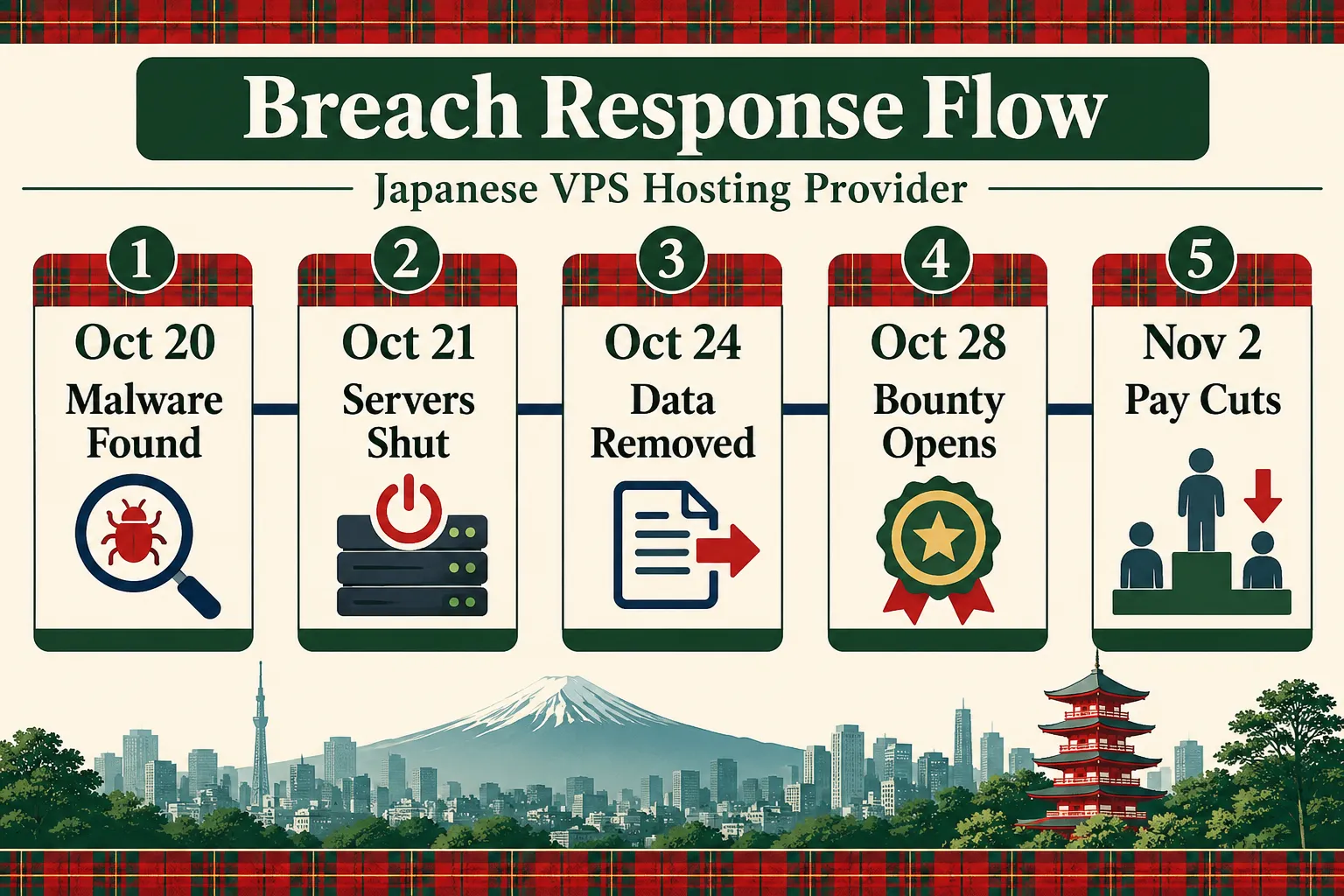
By October 24, GMO said its investigation had confirmed security weaknesses in the service, unauthorized access, and customer information taken outside the company. Some customers reported transactions they did not recognize.
In the same disclosure, GMO said the attackers threatened continued manipulation of customer accounts at more than 70 securities and FX companies in Japan and abroad. That is not a data leak. That is an attacker claiming live reach into brokerage accounts.
A hosting breach became a brokerage breach because the credentials were sitting on the host.
Why does this breach matter to retail bot traders?
Because of what lives on those machines. A Windows VPS running MetaTrader is the standard rig for anyone who wants an expert advisor trading while they sleep. It is cheap, always on, and close to the broker’s servers.
It is also a box full of logged-in trading terminals. If your EA is live, your terminal is authenticated. An attacker with host access does not need to crack anything. They just read what is already there.
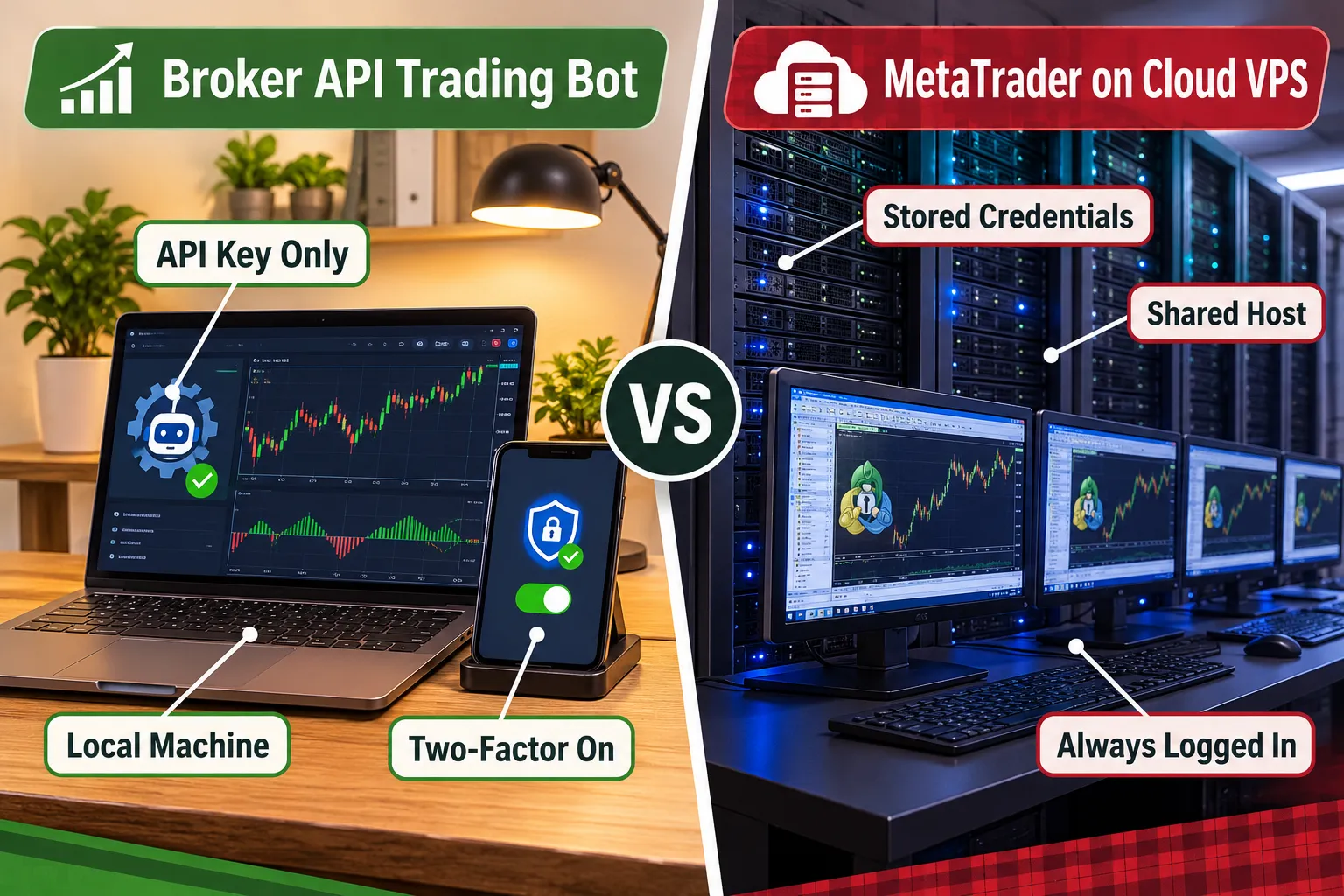
| Setup | Where credentials live | Blast radius if the host is compromised | Typical user |
|---|---|---|---|
| Rented Windows VPS running MT4/MT5 | Inside a logged-in terminal on a shared provider | Full account access, live order placement | Retail FX bot traders |
| Broker API bot on your own machine | API key, often scoped and revocable | Limited by key scope, withdrawals usually blocked | Stock and futures automation |
| Broker-hosted strategy builder | Never leaves the broker | Broker’s own security perimeter | No-code users |
| Paper trading account | No real funds attached | Zero financial loss | Anyone testing a new system |
Notice which row carries the most risk, and which row most retail FX bot runners actually use. Convenience picked their security model for them.
If you automate stocks or futures, the API key route gives you something MT4 on a VPS does not: granular permissions. Our guide to Alpaca API keys shows what scoped, revocable access looks like, and our rundown of AI trading bot repos on GitHub carries the same warning: never paste live keys into code you did not read.
What did GMO’s founder admit on November 2, 2026?
At a Tokyo news conference, Kumagai apologized and said the group’s security unit, GMO Cybersecurity by Ierae, had flagged problems with the service in April 2024. Its findings were not put to use in running the service.
That is not a sophisticated-attacker story. That is a backlog story. Every breach postmortem eventually arrives at the same sentence: somebody knew.
Kumagai’s pay drops 30% for three months starting with December compensation. President Tadashi Ito takes 25%, and two other executives take 20%. Against a reported $50 million demand and 26,739 exposed servers, that is a gesture, not accountability.
Credit where it is due: GMO shut everything down fast, published serial updates, and refused the ransom in public, since paying guarantees nothing and funds the next attack.
What is GMO paying affected customers?
Two separate buckets. Do not confuse them.
- Flat payment: 5,000 yen to every current Desktop Cloud customer, whether or not they lost a cent.
- Loss compensation: verified realized losses from unauthorized trades. Ordinary market losses, unrealized gains and indirect damages are excluded.
If your EA lost money because the market moved, that is yours. If an attacker placed a trade that closed at a loss, that is GMO’s. Proving which is which falls on you, and it takes trade records you should have been keeping anyway.
What should bot traders do this week?
Not panic. Audit.
- Rotate every credential from a clean device. Broker password, MT4/MT5 master and investor passwords, VPS login, email.
- Kill active sessions from your broker’s session screen.
- Turn on two-factor authentication anywhere it is offered. GMO told its own customers to do this.
- Pull 90 days of transaction history and reconcile it against your own log.
- Check withdrawal settings and whitelist your bank account if the broker supports it.
- Re-run your strategy on paper before you redeploy. Days offline make your assumptions stale. Start with our guide to paper trading apps.
What should investors watch next?
- November 6, 2026: GMO’s stated deadline to publish the claims process for unauthorized-trade losses, including documents and payment schedule.
- More numbered GMO reports: the company has issued serial updates since October 21. Watch for the confirmed count of affected customers.
- Japan’s FSA: whether regulators push brokers on credential storage, 2FA or VPS logins after more than 70 firms were named.
- Broker policy changes: any FX broker adding mandatory 2FA or restricting MT4/MT5 sessions is reacting to this.
AI agents with account access raise the same question. Our coverage of banks blocking AI agents from customer logins and the CFTC’s know-your-agent push tracks that thread.
Our take
The headline number was 26,739. The number that should worry you is 70, the count of brokerages attackers claimed they could still touch. One hosting provider’s unfixed weakness reached into accounts at firms that did nothing wrong.
Your bot’s security is not your bot’s security. It is your weakest vendor’s security.
Stored credentials on a rented always-on box are a single point of failure, and a stop loss will not protect you from one. Your next step takes an hour: rotate credentials from a clean device, turn on 2FA, and reconcile 90 days of trades against your own log. Then ask whether your strategy needs a rented Windows box at all, or whether a scoped API key would do the same work with far less exposure. If it must stay on a VPS, treat it like a hot wallet: minimum funds, maximum monitoring.
Systems over hacks. That applies to your security stack the same way it applies to your entries.
Know a bot vendor or VPS host that handles your credentials the right way?
We cover tools only after checking how they actually work, not what the landing page claims.
This article is for education only and is not financial, legal or security advice. Do your own research and talk to a licensed professional before acting.
Sources
- GMO Internet, Notice and Apology Regarding Unauthorized Access to Onamae.com Desktop Cloud (Second Report), October 22, 2026
- Associated Press via ABC News, Japanese online service company GMO apologizes for security breaches and promises compensation, November 2, 2026
- TokenPost, GMO Founder Acknowledges Security Warning Before Cloud Breach, November 2, 2026
- Bank Info Security, Japan’s GMO Group Offers $1M Bounty for Hacker’s Identity, October 28, 2026
- Rescana, GMO Onamae.com Desktop Cloud Breach: Customer Data Taken, Platform Will Not Restart, October 25, 2026
Your market edge starts with the right tool. Stay alpha.
Frequently Asked Questions
Was every one of the 26,739 GMO servers actually hacked?
No. GMO identified 26,739 servers as potentially affected. That is an exposure ceiling, not a confirmed count of infected machines or fraudulent trades.
Did GMO pay the ransom?
No. The attackers reportedly demanded about 8 billion yen, roughly $50 million. GMO refused and instead offered up to $1 million for information leading to an arrest.
My MT4 or MT5 password was saved on that VPS. What should I do?
Change it from a different, clean device. End active broker sessions, turn on two-factor authentication where offered, and reconcile your transaction history against your own records.
Will GMO cover my trading losses?
GMO is paying a flat 5,000 yen to every current Desktop Cloud customer and compensating verified realized losses from unauthorized trades. Ordinary market losses, unrealized gains and indirect damages are excluded. GMO said it would publish the claims process by November 6, 2026.
Is a VPS still safe for running trading bots?
It depends on what you store on it. The risk here came from logged-in trading terminals on a third-party host. Scoped broker API keys, two-factor authentication, withdrawal whitelists and smaller balances per account all reduce the damage a compromised host can do.
Is this article financial advice?
No. This article is for education only. It is not financial, legal or security advice. Do your own research and talk to a licensed professional before acting.
The FullStack Alpha research desk tests AI trading bots on paper and live accounts. Reviewed and edited by Jay Rocco, Founder and Editor.
