

The FullStack Alpha research desk tests AI trading bots on paper and live accounts. Reviewed and edited by Jay Rocco, Founder and Editor.
November 6, 2026, 7:50 a.m. ET | By FullStack Alpha Editorial Team | Reviewed by Jay Rocco, Chief Editor
TradeAlgo just stopped handing retail traders signals and started managing the money itself.
Quick answer
Fincera, an SEC-registered investment adviser, goes live today, November 6, 2026, for U.S. investors. It runs TradeAlgo’s AI models directly inside client accounts, with Apex Clearing as the custodian. TradeAlgo supplies the technology and Fincera manages the accounts. That is a move from “tool that suggests” to “firm that decides,” and it changes who carries the risk.
Key facts
- Fincera is the doing-business-as name of TradeAlgo Wealth Management LLC, CRD 312342, SEC file number 801-136615, with SEC registration effective August 13, 2026.
- TradeAlgo announced the launch on November 5, 2026, through ACCESS Newswire. The company says it has nearly 94,000 account holders.
- Apex Clearing Corporation, a FINRA and SIPC member, is named as the brokerage and custody provider. Fincera states it is not a broker-dealer.
- Four model portfolios are marketed as Jupiter 1 through Jupiter 4, from conservative to aggressive, assigned by an onboarding risk questionnaire.
- The Form ADV Part 2A reported $0 in regulatory assets under management as of May 2026, a pre-launch snapshot.
- The launch release does not state fees or account minimums.
What exactly launched on November 6, 2026?
Fincera puts TradeAlgo’s “Wealth Series” models in charge of whole portfolios. Not alerts. Not a watchlist. Portfolio construction, monitoring, rebalancing and trade execution on the client’s behalf, with the reasoning behind each change recorded for the client.
The registration predates the product. SEC adviser records show approval effective August 13, 2026, nearly three months before launch.
Market truth: registration is a license to operate, not a grade on performance.
How is this different from what TradeAlgo already sold?
TradeAlgo’s signal products gave users AI-generated ideas with explanations. You read the output, you decided, you clicked the button, you owned the result.
Fincera flips that. Under a discretionary advisory relationship, the adviser trades your account without calling you first, and it owes you a fiduciary duty when it does.
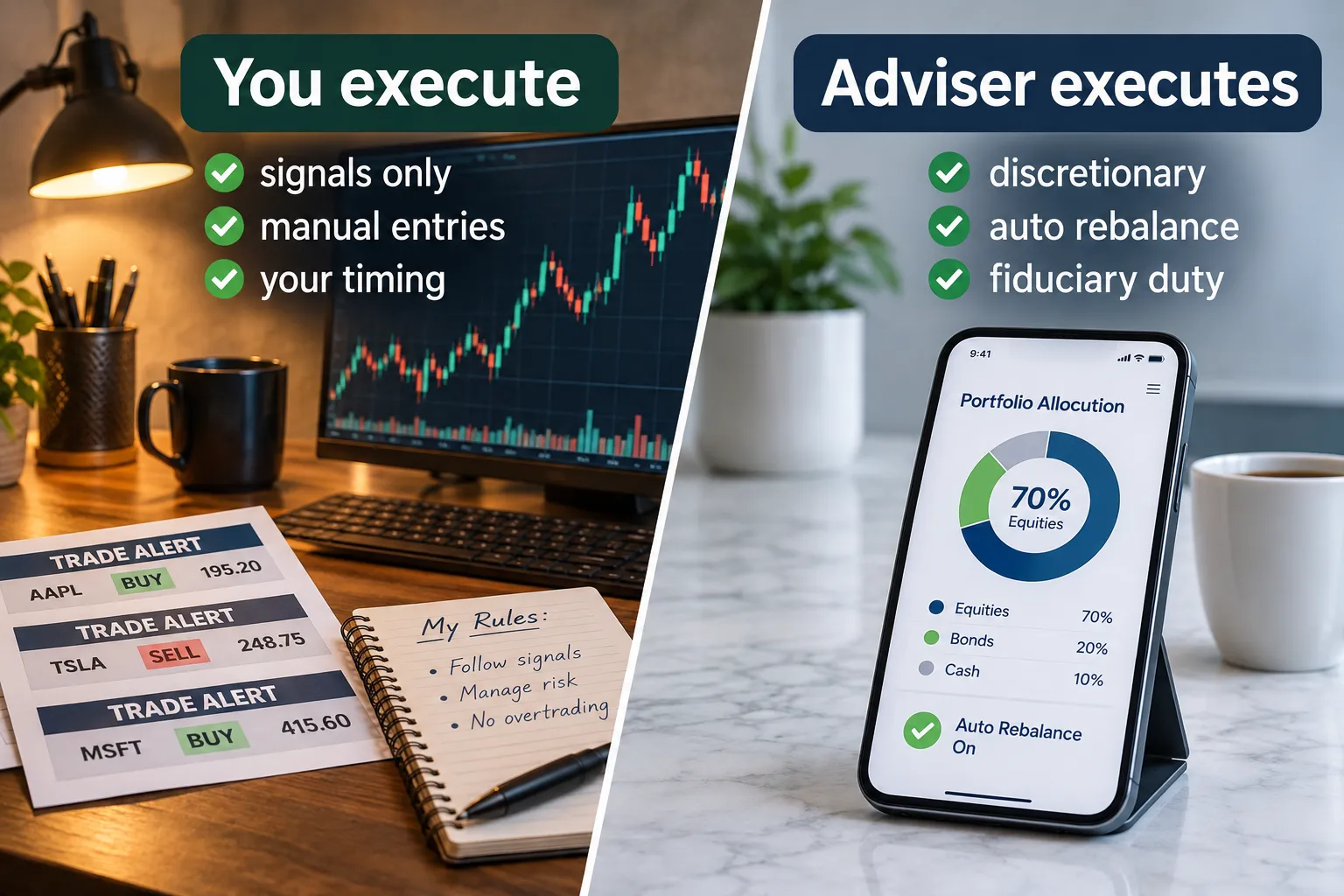
| Feature | TradeAlgo signals | Fincera adviser |
|---|---|---|
| Who places the trade | You | Fincera, with discretion |
| Legal standing | Software vendor | Investment adviser, fiduciary duty |
| Custody of assets | Your own broker | Apex Clearing Corporation |
| Portfolio construction | Your job | Algorithm-assigned model |
| Rebalancing | Manual | Automated |
| Oversight | None specific | SEC, public IAPD record |
The legal standing row matters most. Going from “tool I pay for” to “firm that trades my account” changes the complaint process, the disclosure duties and the paper trail. If you want to see how other fully automated products stack up, our look at what a fully automated AI trading app really is covers the spectrum.
What are the Jupiter models and who gets which one?
Jupiter 1 is conservative. Jupiter 2 is moderate. Jupiter 3 is moderate-high with global or alternative exposure. Jupiter 4 is aggressive with heavy equity weighting.
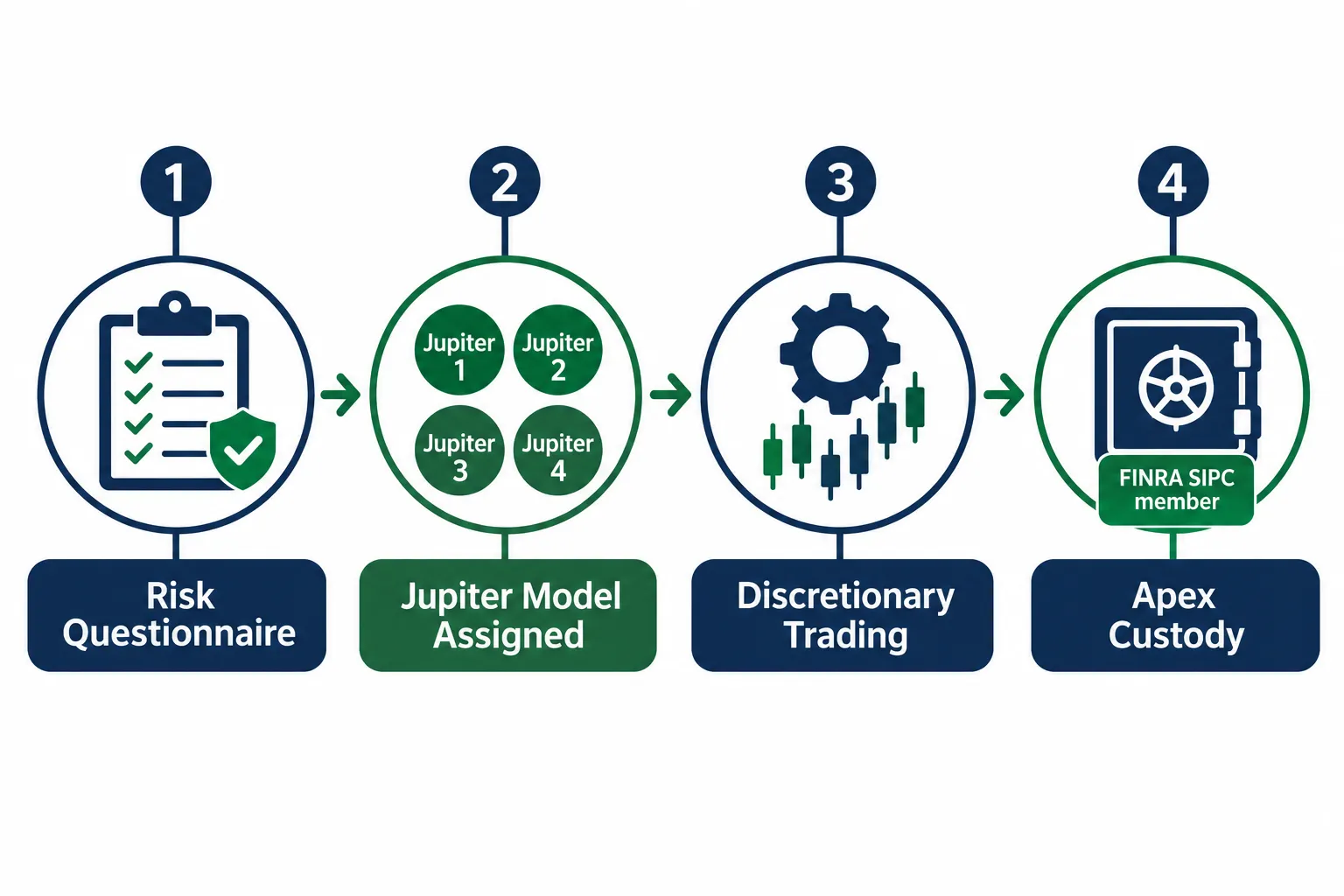
Assignment comes from the onboarding questionnaire: age, goals, time horizon, finances and risk tolerance. Standard robo-adviser plumbing with an AI label on the engine room.
The Form ADV Part 2A tells a flatter story. It describes one “Standard Managed Portfolio” delivered through the website and app, with algorithm-generated allocations. Four marketed flavors, one filed service description.
Market truth: when the marketing and the ADV disagree, the ADV governs.
Ask the firm how four Jupiter models map to one filed service. A straight answer is a good sign. A vague one is data.
What does Apex custody protect, and what does it not?
The adviser directs and the custodian holds. That separation is the right structure.
SIPC coverage protects you if the brokerage holding your securities fails. It does not cover market losses. If Jupiter 4 drops 30 percent in a bad quarter, SIPC has nothing to say. Fincera discloses this, and it is worth repeating because a lot of investors hear “SIPC” and file it next to FDIC.
Does SEC registration mean the AI is approved?
No. Fincera’s own release says registration does not imply a certain level of skill or training. The SEC does not approve or endorse advisers or their products.
What registration buys you is accountability: a public record, a Form ADV you can read, a fiduciary standard and an exam regime. Those are real. They are not a performance guarantee.
You can check any adviser yourself at the SEC adviser lookup for CRD 312342. Two minutes. Do it before you wire money, not after. Our AI trading bot red flags checklist covers the rest of the vetting.
What questions are still open about Fincera’s AI models?
The governance questions. The ADV says the process blends fundamental, quantitative and technical inputs. The public materials do not describe model validation, expected turnover, drawdown controls or any independent audit.
That is not an accusation. But “AI runs your portfolio” deserves more explanation than “AI runs your portfolio.”
Five things to ask before funding an account:
- Turnover and tax drag. Frequent rebalancing in a taxable account creates short-term gains.
- Drawdown controls. Is there a defined risk limit, or does the model ride it out?
- Human override. Who can stop the algorithm, and when?
- All-in cost. Advisory fee plus fund expenses plus any custody charges.
- Exit friction. How fast can you transfer out, and what does it cost?
CEO Carlos Cruz calls it self-driving investing: the client sets the destination, the AI does the driving. That is company positioning, not independent validation. Self-driving cars still need a steering wheel you can grab.
How does this fit the wider AI trading trend in 2026?
Signal products are a commodity now. Anyone can bolt a language model onto a data feed and charge monthly. The firms with bigger ambitions are moving up the stack into regulated, fee-charging, discretionary management, where the moat is compliance, not code.
Brokers are running the same play from the other side. Robinhood’s agents and Interactive Brokers’ autonomous trading let AI act inside accounts with user-set limits. Fincera goes one step further: you hand over the whole portfolio, not a capped allowance.
What should investors watch next?
- Fincera’s next Form ADV annual amendment, due within 90 days of fiscal year end. It should carry the first real assets under management figure.
- IAPD record updates at CRD 312342 for disclosures, custody changes or new state filings.
- A published fee schedule. The launch materials sell the service, not the cost.
- Any methodology paper or third-party audit of the Jupiter models. Its absence is information too.
Our take
The structure is legitimate. SEC registration, a named third-party custodian, a public ADV and a fiduciary duty put Fincera several rungs above the typical “proprietary AI” dashboard with a subscribe button. Credit where it is due.
The gap is governance. A firm asking for discretion over your money should publish more about validation, drawdowns and turnover than a four-tier risk label and a car metaphor. Zero reported assets as of May plus no public audit means day-one clients are funding a product with no live record.
Your next step takes five minutes: pull the IAPD record, download the Form ADV Part 2A and read the fee and conflicts sections before any marketing page. Decide whether you are buying information or outsourcing judgment. Those are different products with different ways to fail.
Weighing an AI tool that wants to run your money instead of just alert you?
We have tested more than 200 AI stock tools since 2022 and checked the claims against the fine print.
This article is for education only. It is not financial advice, and nothing here is a recommendation to use or avoid any firm, product or security.
Sources
- Fincera to Launch Friday as an SEC-Registered Investment Adviser Delivering TradeAlgo’s AI Models to Investor Portfolios (ACCESS Newswire via Yahoo Finance, Nov 5, 2026)
- SEC Investment Adviser Public Disclosure, TradeAlgo Wealth Management LLC dba Fincera, CRD 312342
Your market edge starts with the right tool. Stay alpha.
Frequently Asked Questions
Is Fincera the same company as TradeAlgo?
Related, not identical: Fincera is the DBA of TradeAlgo Wealth Management LLC, which manages accounts, while TradeAlgo supplies the AI technology.
When does Fincera launch and who can use it?
Fincera launches November 6, 2026, for U.S. investors.
Does Apex Clearing custody protect me from investment losses?
No. Apex is a FINRA and SIPC member, and SIPC covers the failure of the firm holding your assets, not declines in market value.
How can I verify Fincera's SEC registration?
Search CRD 312342 or SEC number 801-136615 on the SEC Investment Adviser Public Disclosure site; registration was effective August 13, 2026.
How much money does Fincera manage?
Its Form ADV reported $0 in regulatory assets under management as of May 2026, before launch, and no post-launch figure was public at publication.
Is this article financial advice?
No. This article is for education only and is not a recommendation to use or avoid any firm, product or security.
The FullStack Alpha research desk tests AI trading bots on paper and live accounts. Reviewed and edited by Jay Rocco, Founder and Editor.
