

Jay Rocco is the Founder and Editor of FullStack Alpha. He has tested 200+ AI stock tools since 2022 and run 15+ AI trading platforms on live accounts with his own money. He reviews the software. He does not tell you what stocks to buy.
Last updated: September 30, 2026
TradeAlgo tested 23 platforms advertising free AI trading in March 2026. Eight of them turned out to be truly free. The other fifteen were paid products wearing a trial period like a costume.
That ratio is the whole story of free AI trading bots. “Free” in this market rarely means free. It usually means one of three things: a bot built into an exchange that makes its money on trading fees instead of a subscription, a limited-time trial dressed up as a permanent feature, or an open-source project that costs nothing to download and everything to run correctly.
None of that makes free bots useless. It just means the price tag is hiding somewhere you’re not looking. This breakdown shows you exactly where.
The Short Version
- Truly free AI bots are rare. Of 23 platforms reviewed in a March 2026 audit, only 8 delivered real functionality without paying for core features.
- Exchange-native bots like Pionex and Binance’s built-in Grid and DCA bots are the closest thing to actually free. They monetize through trading fees, not subscriptions.
- Trial-based bots (SaintQuant, 3Commas, Cryptohopper, Wundertrading) give you 7 to 10 days of real or near-real functionality, then the meter starts running.
- Open-source bots like Freqtrade, Hummingbot, and QuantConnect skip licensing fees entirely, but they hand the infrastructure bill and the coding burden straight to you.
- The real cost of free rarely shows up as a dollar figure. It shows up as delayed data, capped strategies, and slippage that eats your edge.
The 3 Kinds of Free AI Trading Bots at a Glance
You pay with: trading fees on every fill
Watch: a busy grid bot can trade 40 times a day
You pay with: a subscription after 7 to 10 days
Watch: set a calendar reminder the day you sign up
You pay with: server costs, code and your weekends
Watch: budget a small VPS if it runs 24/7
What “Free” Actually Means With Free AI Trading Bots
Ask ten people what a “free AI trading bot” is and you’ll get ten different answers. That’s the problem. The label covers three completely different business models, and each one charges you in a different currency.
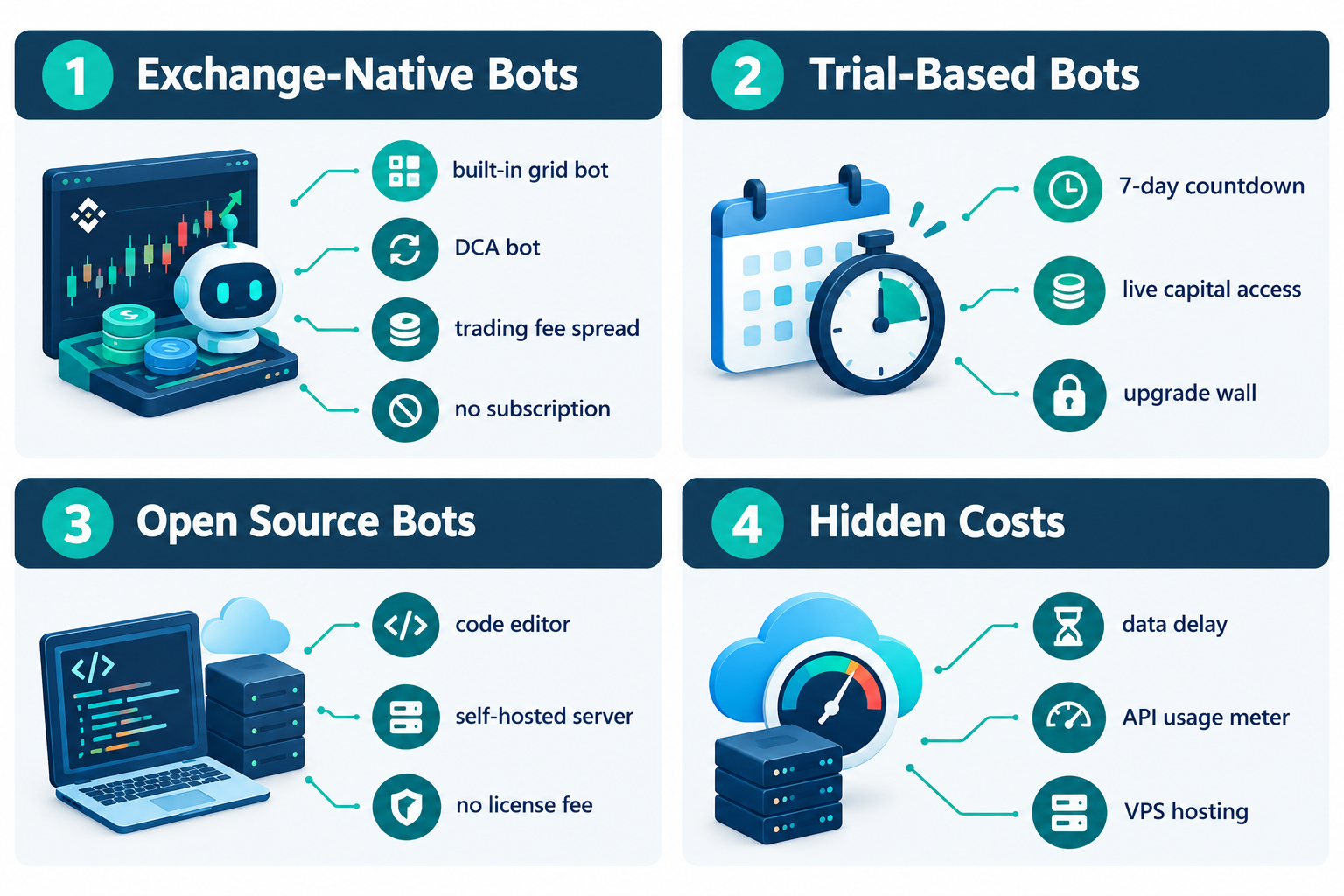
Exchange-native bots. These live inside a crypto exchange and never ask for a subscription. Pionex ships with roughly 16 built-in bots, grid trading, dollar-cost averaging, martingale, and more, at no bot fee. The exchange makes its money on a 0.05% trading fee spread, which happens to run lower than Binance’s standard structure. Binance offers a similar deal: free Grid, DCA, and rebalancing bots across more than 350 trading pairs. You still pay the exchange’s normal trading fees, and you’re still the one setting the risk parameters. The bot doesn’t think for you. It just executes.
Trial-based bots. This is the biggest category, and the most misleading one. SaintQuant hands new users a 10-day Starter trial with live capital access to its AI QuickStart DCA strategy. Cryptohopper gives you 7 days. 3Commas boxes free users into a plan so limited it barely qualifies as usable. Wundertrading runs a similar countdown. These aren’t scams. They’re demos with real money attached, built to get you comfortable before the paywall shows up.
Open-source bots. Freqtrade, Hummingbot, Superalgos, and QuantConnect’s LEAN engine cost nothing to download. No subscription, no trial clock, no upsell email. But there’s no interface holding your hand either. You need to know Python, manage your own server, and troubleshoot your own bugs at 2 a.m. when a strategy breaks on a weekend candle. If you want the technical deep end, the QuantConnect review of what LEAN actually runs is worth reading before you commit a weekend to it.
Three categories. Three different ways of making you pay. None of them are “just free.”
The Real Price Tag: Hidden Fees Behind Free AI Trading Bots
Here’s the thing about free tiers: the cost doesn’t disappear. It moves. Here is where the money actually goes.
Trading fee spreads. Pionex and similar exchanges don’t charge you a bot fee. They charge you every time the bot trades, and a grid bot can execute dozens of trades a day. A 0.05% fee sounds tiny until a hyperactive grid strategy runs it 40 times before lunch. Multiply that across a busy week and the “free” bot has billed you more than a $20 monthly subscription would have.
Quick math: a $1,000 grid bot placing 40 fills a day at 0.05% pays about $20 a day in fees if every fill uses the full balance. Smaller grid slices cut that down, but check your fee history after the first week.
API and data costs. Bots that pull live pricing, order book depth, or news sentiment need a data feed. Free tiers usually cap you at delayed data or a throttled number of API calls. Once you hit that ceiling, either the bot stalls or you’re upgrading to a paid data plan you didn’t budget for.
Premium tier upsells. Cryptohopper’s trial and 3Commas’ limited free plan exist to get you into the product, then show you exactly what you’re missing. Extra bot slots, backtesting depth, more exchange connections. It’s the freemium playbook, and it works because the free version is just good enough to make the gap frustrating.
Infrastructure for open-source bots. Freqtrade and Hummingbot are free to download and expensive to run properly. A cloud server running 24/7 costs money. So does the electricity if you self-host. So does your time, which is the least visible cost and the most real one.
None of this means free bots are a trap. It means the sticker price was never the whole price. If you want a broader breakdown of where paid tools earn their cost versus where free tools lose the trade, the comparison of what AI trading software you pay for versus what you actually get covers the paid side of that same coin.
Free Tiers vs Open Source: What You Get and What It Costs You Compared
Different free models solve different problems. None of them solve every problem. Here’s how they actually stack up when you strip away the marketing.
| Category | What you get free | What still costs you | Best for |
|---|---|---|---|
| Exchange-native (Pionex, Binance) | Built-in bots, no subscription, dozens of trading pairs | Per-trade fees, manual risk setup, exchange lock-in | Crypto traders who want automation without code |
| Trial-based (SaintQuant, Cryptohopper, 3Commas) | 7 to 10 days of live or near-live functionality | Countdown pressure, limited plan after trial ends | Testing a specific strategy before paying |
| Open-source (Freqtrade, Hummingbot, QuantConnect) | No licensing fee, full code access, unlimited customization | Server hosting, coding skill, your own debugging time | Technical traders who want total control |
| Equities free tiers (Trade Ideas Par Plan, StockHero free) | Delayed data, basic alerts, simple bot building | Real-time data, advanced automation, live execution | Beginners exploring stock-side automation before committing |
The pattern across every row is the same. Free removes the subscription line item. It doesn’t remove the work, the fees, or the ceiling on what the bot can actually do. That’s the honest version of what free AI trading bots cost you, and it’s the version most landing pages skip.
If you’re specifically weighing stock-side free options, the directory of free AI trading bots sorts them by category instead of by whoever bought the top ad slot, and the roundup of free AI stock trading bots beginners keep flocking to breaks down which ones beginners actually stick with past week one.
Where Free AI Trading Bots Fall Apart: Data, Latency, and Functionality Limits
A free bot that runs on delayed data isn’t a trading tool. It’s a history lesson with an alert sound.
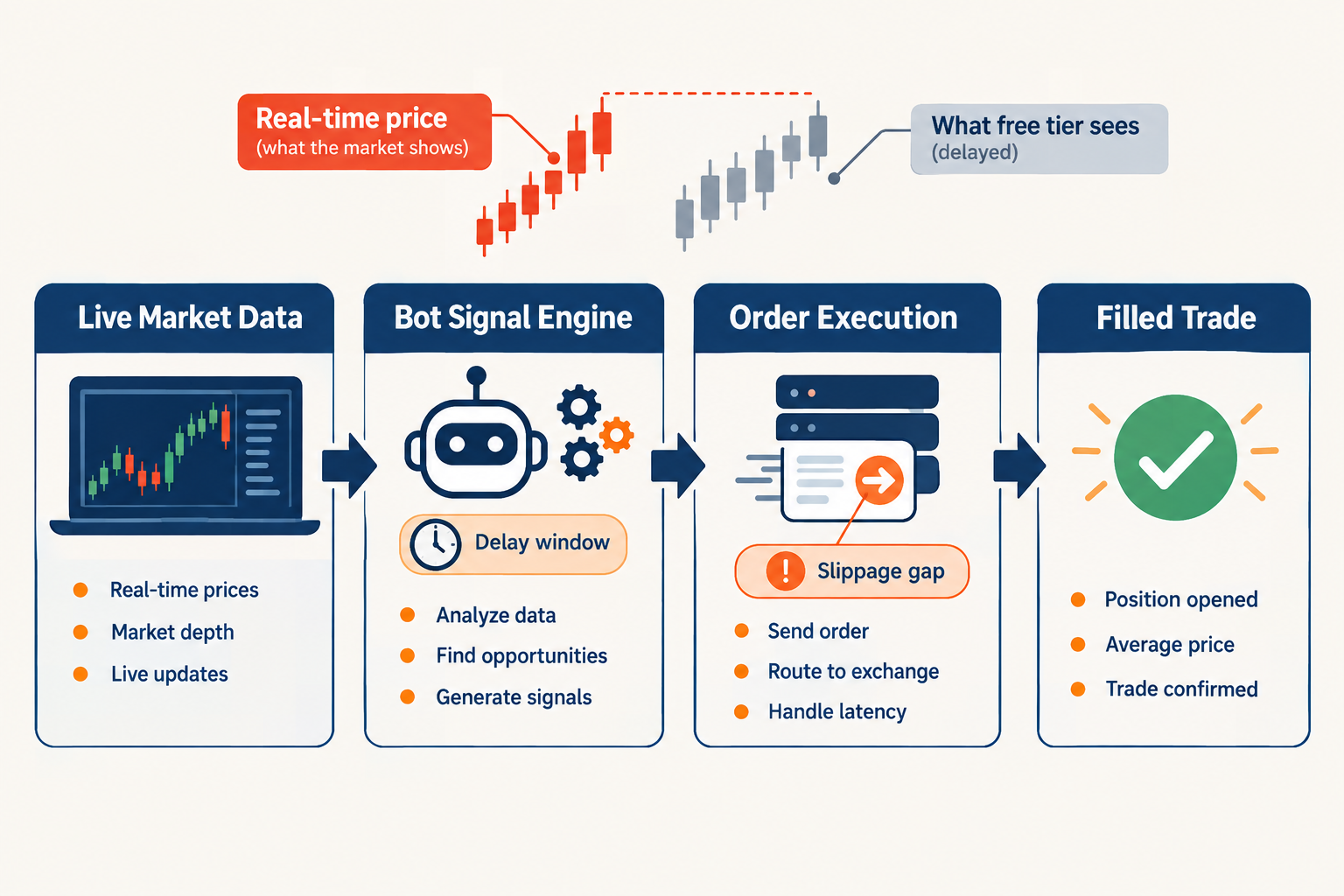
Delayed data is the single biggest functional gap in free tiers. Trade Ideas’ free Par Plan gives you stock racing visualizations and PiP charts, which look sharp, but the data behind them isn’t real-time. StockHero’s free plan lets you build and test simple bots, but the serious automation and live execution stay locked behind the paid version. That’s not a design flaw. It’s the entire business model. Free tiers exist to show you the shape of the product, not the full function of it.
Position and strategy limits stack on top of the data gap. Free plans typically cap you at one bot, one strategy, or one exchange connection. You can’t run a diversified basket of setups. You get one lane, and you drive it until the trial ends or the limit kicks in.
Slippage is the tax nobody advertises. When your data is a few seconds behind and your order routing isn’t optimized, the price you see isn’t the price you get. That gap between the setup you spotted and the fill you actually received is slippage, and it compounds every time the bot trades. A free bot trading 30 times a week on stale data is bleeding out in small cuts you’ll never see on a single statement, but you’ll feel it in the quarterly total.
Restricted strategy libraries close the loop. Grid bots and DCA bots are the two strategies almost every free tier offers, because they’re simple to run and cheap to support. Anything more sophisticated, momentum scanning, options flow reading, multi-timeframe confirmation, sits behind the paywall. That’s a hard limit if your actual edge depends on reading the tape across more than one signal.
This is exactly why systems over hacks matters more than which free bot you pick. A cleaner process with a mediocre free tool beats a great tool bolted onto no plan at all. If you want the mechanics of how automation actually behaves once real money is on the line, what to know before you automate trades walks through the setup questions most people skip.
The New Risk Layer: Binance’s AI Agents and Who’s Actually Watching
Here’s a development that changes the calculus. In August 2026, Binance rolled out AI agents with direct trading privileges on its platform, backed by seven “AI Agent Skills” that give agents access to Binance-grade market data, order execution, and account security functions. This isn’t a bot you configure once and forget. It’s an agent that can analyze markets and place trades on your behalf, autonomously, across a platform with over 300 million registered users.
That’s a real leap in capability. It’s also a real leap in exposure. TechCrunch’s coverage of the rollout made one detail clear: keeping these agents in check is largely up to the user. Binance built the rails. You’re still the one who has to set the guardrails, define the limits, and review the logs.
An unsupervised AI agent trading real capital is how small accounts get emptied overnight. It’s the exact risk industry roundups keep flagging: free and low-friction bots often ship without hard loss caps, without scenario testing, and without mandatory sandboxing before going live. The tool got smarter. The responsibility for watching it didn’t move an inch.
Position sizing and a stop loss aren’t optional extras when an agent is trading for you. They’re the entire safety net. If you wouldn’t hand a new employee your account password and walk away for a week, don’t do it with an AI agent either.
Who Should Actually Use a Free AI Trading Bot
Free bots are excellent at one job: letting you learn without paying tuition. They’re a poor fit for managing serious capital.
Use a free bot to:
- Paper trade it first. Test a grid or DCA strategy on a demo account before a dollar of real money touches it.
- Sandbox a strategy idea. Open-source tools like Freqtrade let you backtest against years of historical data at no cost, which is how you find out a strategy looks great on paper and falls apart in choppy tape.
- Learn the mechanics of automation. Understanding how a bot reads support and resistance, manages entry and exit, and reacts to a breakout is worth more than the bot’s actual output while you’re still learning.
- Run a small, capped allocation. Once you trust the process, size a position you can afford to lose completely, and treat that as the real test.
Skip the free tier and go paid when:
- Your strategy depends on real-time data and the free plan only offers delayed feeds.
- You’ve outgrown one bot slot and need multiple strategies running at once.
- The trial countdown is forcing decisions faster than your own testing timeline wants to move.
Beginners exploring this for the first time should start with the honest guide to AI stock trading for retail traders before opening any bot dashboard. And if you’re wondering whether any of this actually moves the needle on returns, the real numbers behind whether AI trading bots make money is the least hyped answer you’ll find on the topic. For the specific limits on each free plan, see the 8 free tier caps nobody lists.
Our Take
Free AI trading bots aren’t a scam and they aren’t a shortcut. They’re a sandbox with a fee structure hiding in plain sight, whether that’s a trading fee spread on an exchange-native bot, a countdown clock on a trial, or a server bill on an open-source project.
The move that actually protects your account: pick one free bot, run it on a small, defined allocation or a paper account, and track the real fees, not the advertised ones, for 30 days. If the numbers hold up, scale slowly. If they don’t, you learned that for the price of a trading fee instead of a blown account.
Cut the noise, keep the alpha, and let the free tier earn its place before you trust it with anything that matters.
Frequently Asked Questions
Are free AI trading bots actually safe to use with real money? They can be, but “free” doesn’t mean “risk-free.” Exchange-native bots like Pionex’s grid and DCA tools have a track record, but you’re still setting the risk parameters yourself. Start small and treat the free tier as a test, not a full deployment.
Why do free crypto bots charge trading fees instead of a subscription? Because the exchange makes money every time you trade, not every time you log in. Pionex’s roughly 0.05% fee spread and Binance’s standard trading fees replace the subscription model entirely. More trades from the bot means more revenue for the exchange, so don’t be surprised if a grid bot trades more often than you expected.
What’s the difference between a free trial and a truly free bot? A truly free bot, like Binance’s built-in Grid and DCA tools, has no expiration date and no forced upgrade. A trial, like SaintQuant’s 10-day Starter or Cryptohopper’s 7-day window, gives you real functionality on a clock. Read the fine print before you assume “free” means permanent.
Can open-source trading bots really run at zero cost? The software is free. The hosting, the coding skill, and your own time to debug it are not. Freqtrade and Hummingbot are popular precisely because they’re transparent about how they work, but budget for a small monthly server cost if you plan to run one continuously.
Do free AI bots on stock platforms work the same way as crypto bots? Not quite. Equities-focused free tiers, like Trade Ideas’ Par Plan, tend to offer delayed data and basic alerts rather than live automated execution. Crypto exchange bots are usually closer to real functionality because the exchange itself is the one monetizing the trades.
Should a beginner start with a free bot or go straight to a paid tool? Start free. Use it to learn position sizing, stop losses, and how automation actually behaves before you pay for anything. Once you understand what the free tier can’t do, a paid upgrade becomes a decision instead of a guess.
There are 200+ more AI trading bots and screeners catalogued in the FullStack Alpha directory, filterable by category and price. Browse the directory → aistockpickerapps.com
This article contains affiliate links. FullStack Alpha may earn a commission if you sign up through them, at no extra cost to you.
By Jay Rocco, Founder and Editor, FullStack Alpha.
Stay alpha.
Jay Rocco is the Founder and Editor of FullStack Alpha. He has tested 200+ AI stock tools since 2022 and run 15+ AI trading platforms on live accounts with his own money. He reviews the software. He does not tell you what stocks to buy.
