

Jay Rocco is the Founder and Editor of FullStack Alpha. He has tested 200+ AI stock tools since 2022 and run 15+ AI trading platforms on live accounts with his own money. He reviews the software. He does not tell you what stocks to buy.
Last updated: September 30, 2026
Quick Answer: Every ai trading bot free tier imposes at least one of eight structural limits that will stop a small account before the market ever gets a chance to. The cap that stops most people first is not a data fee or a broker restriction. It is the single-strategy limit that prevents running more than one bot at a time, which means the moment your first setup fails, you have nothing left running. Know all eight before you sign up.
The Short Version
- Most ai trading bot free tiers cap users at one active bot or strategy, confirmed across Composer, StockHero, and Tickeron free plans
- StockHero’s free trial runs 14 days and restricts users to one active bot with TradeStation as the only broker connection during that period
- Alpaca’s free Basic data plan caps API requests at 200 per minute, with HTTP 429 errors firing on any overage
- The pattern day trader rule required a $25,000 minimum equity in a margin account for unlimited day trading until it was retired in June 2026
- Free tiers on most platforms provide delayed data (often 15 minutes) rather than the real-time SIP consolidated feed paid tiers access
- TradingView’s free plan caps you at 3 active alerts, which makes any multi-condition bot strategy hard to run
- Paying for a single upgrade, typically the data feed tier, removes more friction than any other single paid feature
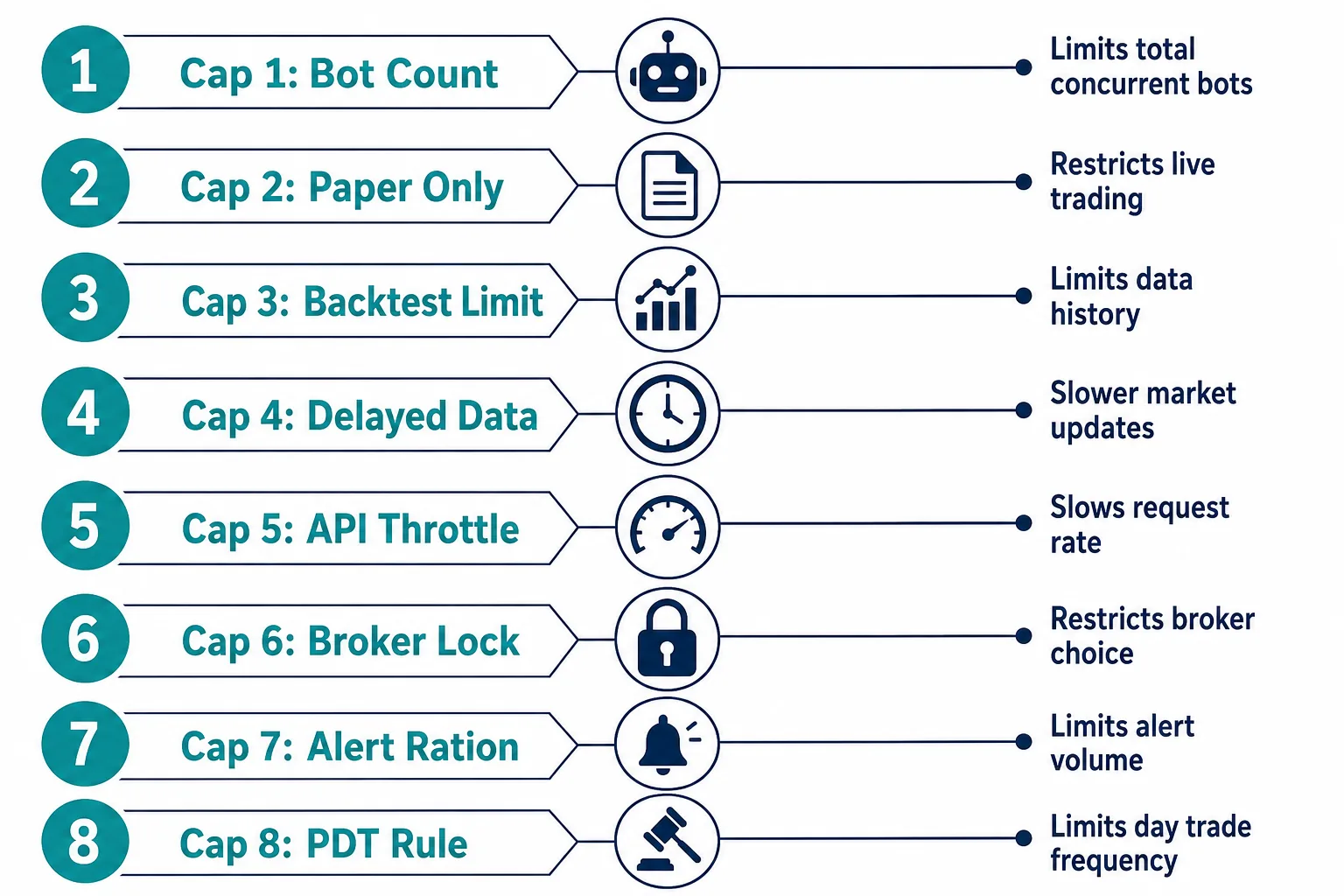
The 8 Free Tier Caps at a Glance
Scan this before you sign up for any ai trading bot free tier. Each card shows who the cap hurts most and the cheapest way around it.
Hurts: anyone testing more than one idea
Fix: rotate strategies weekly or upgrade bot count
Hurts: fast entries that need real fills
Fix: go live with the smallest size your broker allows
Hurts: strategies never tested in a bear market
Fix: retest on free Yahoo or Stooq data back to 2018
Hurts: intraday and breakout strategies
Fix: trade daily bars or pay for the real time feed
Hurts: scanners watching 20+ tickers
Fix: use WebSocket streams instead of polling
Hurts: traders tied to one broker
Fix: test on Alpaca paper first, then pick the broker
Hurts: multi condition setups
Fix: combine conditions into one Pine Script alert
Hurts: no longer small margin accounts
Fix: watch T+1 settlement in cash accounts
What Does an AI Trading Bot Free Tier Actually Give You?
A free ai trading bot tier is a limited-access version of an automated trading platform, designed to let you test the product before committing money. What it gives you depends entirely on which of three models the vendor chose: free forever, free trial, or freemium.
Free Forever Versus Free Trial Versus Freemium
Free forever means the core product never charges you, but specific features are permanently locked. Freemium means you get a functional tier with hard caps on volume, bots, or data. A free trial means you get full access for a window, typically 7 to 30 days, then the gates close.
StockHero runs a 14-day free trial with one active bot and TradeStation as the only supported broker. Alpaca offers a real free forever tier for paper trading and API access, but the data feed and rate limits are real constraints. TradingView’s free plan is freemium, with 3 alerts and limited indicators per chart.
Why Free AI Trading Bot Offers Exist at All
Vendors offer a free ai trading bot tier because acquisition cost drops when users self-qualify. A trader who runs a paper trading bot for two weeks and sees the interface is worth paying for converts at a much higher rate than one who read a landing page. The free tier is a sales funnel with a product attached.
That is not cynical. It is just the business model. And knowing it tells you exactly which caps to expect: the ones that make the product feel real enough to want, but limited enough to push you toward upgrading.
Cap 1: How Many Strategies You Can Run at Once
The single most common free-tier cap is a limit on the number of active bots or strategies running simultaneously. Most free plans allow exactly one.
The Single Bot Limit Most Free Plans Enforce
One bot means one strategy, one asset, one set of entry and exit rules. If that setup produces no signals for three weeks because the market is choppy, you sit idle. There is no second bot running a different strategy on a different instrument to pick up the slack.
Composer’s free tier limits the number of active symphonies (their term for automated strategies) a user can deploy. StockHero enforces one active bot during the free trial period, expanding to two on the paid Lite plan. Tickeron’s free tier similarly restricts the number of simultaneous AI-driven patterns a user can monitor. For anyone building a fully automated AI trading system, one bot is not a system. It is a single bet.
Cap 2: Paper Trading Only, No Live Deployment
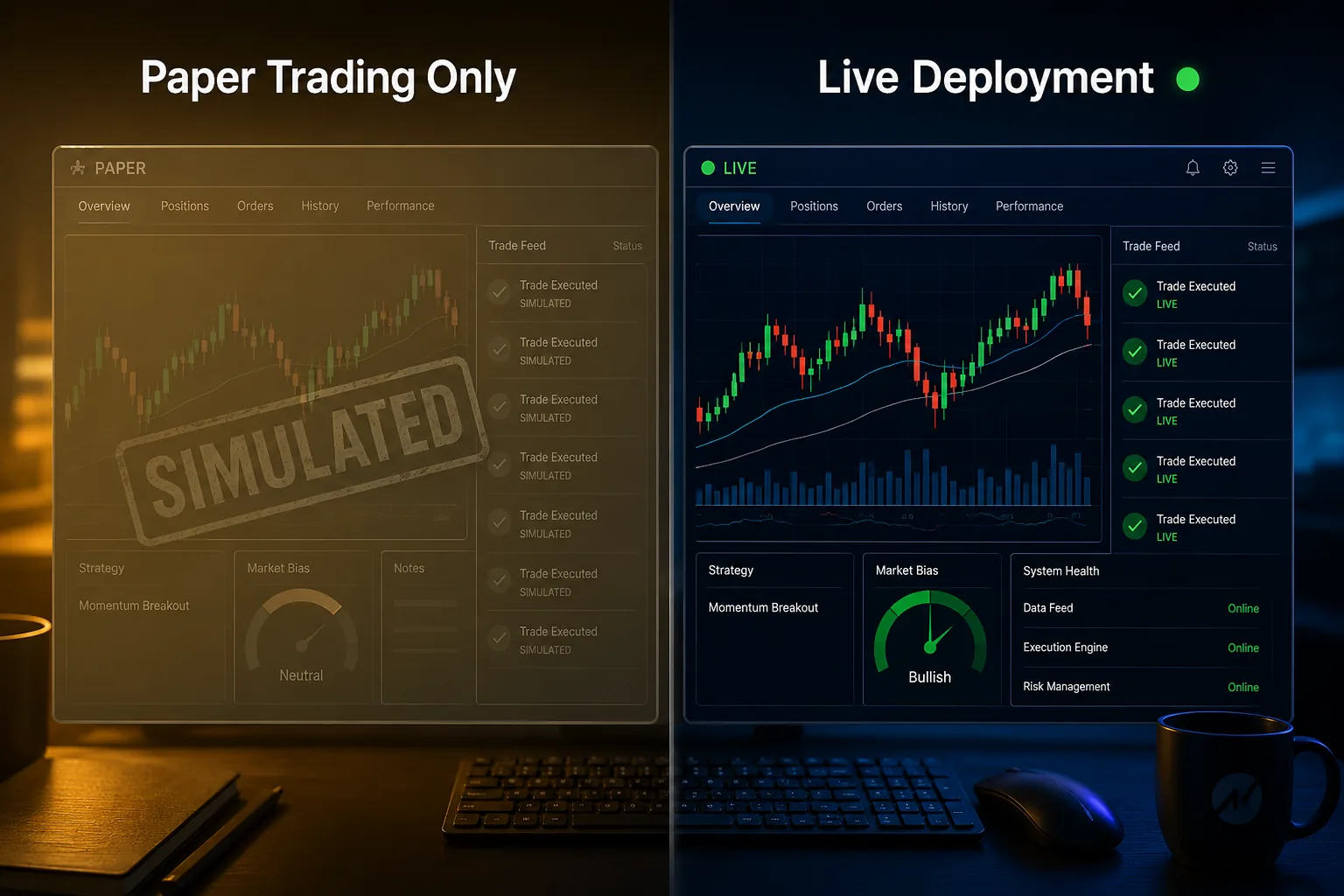
Several free ai trading bot platforms restrict free users to a paper trading environment, meaning the bot executes simulated trades with no real capital at risk and no real profit or loss. Alpaca’s free API tier includes full paper trading at paper-api.alpaca.markets, but live trading requires a funded brokerage account connected to the platform.
Where a Free AI Stock Trading Bot Stops Being a Bot
Paper trading is useful for testing a strategy’s logic. It is not useful for confirming execution quality, slippage behavior, or fill timing under real market conditions. A bot that looks clean in simulation can behave very differently when it hits a real order book.
The distinction matters most for strategies that depend on speed. A scalping bot or a breakout entry that requires execution within seconds of a signal will show zero slippage in paper trading and real slippage in live trading. That gap is not captured in simulation. Paper trading first is still the right move, but knowing the free tier never leaves that sandbox is a different thing entirely.
Cap 3: Backtest Lookback Is Shortened
Free tiers on most platforms cap the historical data available for backtesting, typically to one or two years. Paid tiers on platforms like TradingView and Composer extend this to five, ten, or more years of price history.
Why Two Years of History Is Not Enough
Two years of data covers roughly one market regime. A strategy backtested only on 2024 to 2025 data has never seen a 2020-style volatility spike, a 2022 rate-driven bear market, or a 2018 Q4 drawdown. The profit factor and win rate numbers it produces are regime-specific, not reliable.
Backtesting a trading strategy without enough history is like testing a raincoat only on sunny days. The strategy looks great until the first real storm. Shortened lookback is one of the caps that does the most damage because users rarely notice it until they see a live drawdown the backtest never showed.
Cap 4: Delayed Data Instead of Real Time
Free tiers almost universally provide delayed or partial market data. Alpaca’s free Basic plan, for example, streams the IEX exchange feed rather than the full SIP consolidated feed that paid tiers access.
IEX Versus SIP and What the Free Feed Misses
The SIP (Securities Information Processor) consolidated feed aggregates real-time quotes and trades from every US exchange. IEX is a single exchange, a small slice of total volume. For a swing trading bot holding positions for days, that gap is annoying but survivable. For any strategy that relies on intraday price action, it means the signal can fire on a price that does not match the real market.
Free crypto trading platforms face a similar split. Coinrule’s free tier, for example, connects to exchange data but limits the frequency and recency of data pulls. The version of the market your free bot sees is not the market that is actually trading. That gap is the free tier’s most dangerous hidden cost.
Cap 5: API Rate Limits Throttle Your Bot
API rate limits cap how many requests your bot can send to the platform or data provider per minute. Alpaca’s free Basic data plan caps requests at 200 per minute. Exceeding that returns an HTTP 429 error, and any orders queued behind that error simply do not go out.
Requests Per Minute and the Orders You Never Send
A bot running a multi-ticker scan across 50 symbols, checking prices every 10 seconds, can hit 200 requests per minute in under two minutes of active operation. At that point the bot is not broken. It is just silent. No error message appears in your trading interface. The orders never reach the exchange.
Alpaca’s paid Algo Trader Plus plan raises the market data API limit to 10,000 requests per minute, a 50x increase. For a REST API or WebSocket-based trading bot, the rate limit is the invisible ceiling that determines how many instruments you can actually monitor in real time. Free ai trading bot users who do not check this cap first will discover it at the worst possible moment.
Cap 6: Broker Connections Are Restricted
Free tiers typically support one or two broker connections, and the supported broker list on a free plan is usually the shortest version of the full list. StockHero’s free trial period restricts connections to TradeStation only. Composer connects to Alpaca on its free tier. Tickeron’s free analysis tools do not connect to any broker for live execution without an upgrade.
Robinhood AI Trading Bot Free Searches and What Actually Connects
Searches for a Robinhood ai trading bot free are common, and the answer changed in 2026. Robinhood launched Agentic Trading on May 27, 2026, which lets you connect your own AI agent to your account, and more than 150,000 accounts have done it, per Robinhood. The app is free. Paid Agent Apps run $5 to $30 a month.
That is not the same as a free bot. You still bring the strategy and the agent, and Robinhood still does not appear on the supported broker list of the third party bot platforms reviewed here. Our walkthrough of the Robinhood AI trading bot setup shows how to connect Claude and keep it in read only mode while you test.
Cap 7: Alerts and Notifications Are Rationed
Free tiers on most platforms cap the number of active alerts or notifications a user can have running simultaneously. TradingView’s free plan allows 3 active alerts. Tickeron’s free tier limits the number of AI pattern signals a user can monitor. Without alerts, a bot that identifies a setup cannot notify you or trigger an action.
Daily Alert Caps on the Best AI Trading Bot Free Plans
Three alerts means three conditions at most. A strategy that requires a price breakout above resistance AND a volume confirmation AND an RSI filter across several tickers burns through that cap fast. The workaround is to code all three conditions into one Pine Script alert, which works but takes skills most beginners do not have yet.
For anyone building a swing trading system that depends on confluence of signals, the alert cap is often the first limit that makes the free tier feel unusable. This is the cap that most review articles skip entirely.
Cap 8: The Pattern Day Trader Rule, Now Retired
The pattern day trader (PDT) rule was never a platform cap. It was a FINRA regulatory requirement that applied to any margin account placing four or more day trades within five business days. The rule required a minimum equity of $25,000 in a margin account to continue day trading without restriction.
Why $25,000 Was the Real Ceiling on a Small Account
The old $25,000 pattern day trader minimum was retired in June 2026, so small accounts are no longer blocked from day trading. The $2,000 standard margin minimum still applies, but the day-trade count restriction is gone.
Before that date, a free ai trading bot running an intraday strategy on a $5,000 account would hit the PDT limit after four round-trip trades in five days. The bot would keep generating signals. The broker would block execution. The alternative was a cash account, which avoids PDT designation but introduces T+1 settlement, meaning capital from a sold position is not available to trade again until the next business day. For high-frequency bot strategies, that settlement lag is its own cap.
Comparison Table: Free Tiers Across the Named Bots
| Platform | Strategies on Free | Live Trading | Backtest History | Data Feed | Broker Support |
|---|---|---|---|---|---|
| Composer | Limited active symphonies | Yes (Alpaca connected) | Limited lookback | Delayed on free | Alpaca only |
| StockHero | 1 bot (trial), 2 (Lite) | Yes (TradeStation trial) | Unlimited signals, capped frequency | Exchange feed (15 min min) | TradeStation (trial only) |
| Alpaca | Unlimited (paper) | Yes (funded account) | Not platform-capped | IEX feed on free plan | Alpaca brokerage |
| Tickeron | Limited AI patterns | No (analysis only free) | Short lookback on free | Delayed on free | Upgrade required |
| TradingView | 3 active alerts | Via connected broker | Limited on free | Delayed on free | Multiple (broker-dependent) |
Sources: Alpaca/StockHero documentation per research notes. Free tiers change frequently. Verify current limits at each vendor’s pricing page before committing.
Which Free AI Trading Bot Is Worth Starting With?
The best starting point depends on what you are actually trying to do. For pure strategy testing without writing code, Composer’s free tier gives you the most complete no-code experience. For API-based automated trading with a real broker connection, Alpaca’s free tier is the most functional because live trading is available from day one on a funded account.
Best AI Trading App Free Options and Every Free AI Trading App Tier
A free ai trading app that connects to a real broker and allows live execution is rare. Alpaca is the clearest example. Its paper trading environment is free forever, its API is free to access, and the rate limits are workable for strategies scanning fewer than 20 tickers at a time. For crypto trading, platforms like Coinrule offer a free tier that connects to major crypto exchanges, though bot count and trading volume are capped.
The best free AI trading bots for beginners are the ones where the free tier works for paper trading, not just a demo with fake data. Alpaca and TradingView both qualify on that standard.
Free AI Trading Bot For Beginners Who Will Not Code
For a free ai trading bot for beginners with no coding background, Composer is the most accessible. Its no-code strategy builder lets users construct logic with conditional blocks rather than Python or Pine Script. The free tier is limited in active strategies, but it is enough to paper trade it first and understand whether the logic holds before upgrading.
TradingView’s free plan supports Pine Script strategy testing, but 3 alerts is a hard ceiling for anyone trying to automate. It works well as a charting and analysis tool, less well as a live execution platform on the free tier.
Best AI Stock Trading Bot Free Picks by Use Case
- No-code strategy building: Composer free tier
- API automation with live trading: Alpaca free tier (funded account required)
- Crypto trading bot free: Coinrule free tier
- Chart-based analysis with bot signals: TradingView free plan for analysis, upgrade for execution
- AI pattern recognition: Tickeron free tier for signals, upgrade for live trading
- Bring your own AI agent: Robinhood Agentic Trading, free app
What Do You Get by Paying, and When Is It Worth It?
Paying removes the cap that is actually stopping you, not all eight caps at once. The upgrade that matters depends on which limit you hit first.
The Upgrade That Actually Removes a Cap
For most users, the data feed upgrade delivers the most immediate improvement. Moving from a partial or delayed feed to a real-time SIP feed on platforms like TradingView or Alpaca’s Algo Trader Plus plan means the bot is reacting to the whole market, not a slice of it. That single change affects every strategy that depends on intraday price action.
The second most impactful upgrade is usually the bot count limit. Going from one active strategy to five or ten means the system can run a diversified set of setups simultaneously, which is closer to how a real automated trading system operates. For a deeper look at what separates free from paid across the full tool market, the free vs paid AI trading bot feature breakdown is worth reading before committing to any subscription.
When Free Is Enough
Free is enough when the goal is learning the mechanics of automated trading without risking capital. Paper trading a single strategy on Alpaca’s free tier, or building and backtesting a symphony on Composer’s free plan, teaches the process without requiring a monthly fee. The free tier earns its place as a training environment. It earns skepticism as a production trading system.
If the strategy being tested trades weekly or holds positions for multiple days, the data cap matters less. A swing trading bot checking prices once per day is not meaningfully hurt by a 15-minute delay. The cap that matters changes with the strategy’s time frame.
Do AI Trading Bots Really Work?
AI trading bots execute rules-based strategies automatically, which removes emotional decision-making from the trade. Whether they produce positive results depends entirely on the quality of the underlying strategy, the accuracy of the data, and the market conditions the strategy was designed for. A bot running a poorly designed strategy executes that strategy faster and more consistently than a human would, which is not an advantage. No bot, free or paid, produces profit by default.
Which Trading Bot Is Most Profitable?
No trading bot can be reliably ranked by profitability because past performance in any backtest or live period reflects specific market conditions that may not repeat. Platforms like Composer, Tickeron, and StockHero publish community strategy performance data, but those figures are not audited and should not be treated as forward-looking projections. The question worth asking is not which bot made the most money historically, but which bot’s strategy logic holds up across multiple market regimes.
What Is the Best AI Trading Bot for Beginners?
For beginners, the best ai trading bot free option is one that allows paper trading with realistic market data and does not require coding knowledge. Composer and Alpaca both qualify on those criteria. Composer’s no-code interface is the lower barrier to entry. Alpaca’s free tier is more flexible for users willing to write basic Python. Both allow strategy testing without risking capital, which is the right place to start.
Can ChatGPT Build a Trading Bot?
ChatGPT can generate trading bot code in Python or Pine Script, and it can help structure the logic of a strategy. It cannot connect to a live broker, execute trades, or access real-time market data on its own. The code it produces needs to be reviewed, tested in a paper trading environment, and validated against real data before any live deployment. For a candid look at what that process actually looks like, the honest account of building a bot with AI assistance is worth reading before you start.
Final Verdict: Which Cap Will Stop You First
The cap that stops most people first is the single-bot limit, not the data feed and not the PDT rule. One active strategy means one point of failure with no fallback. The moment market conditions shift and that one setup stops producing signals, the free tier has nothing left to offer.
The data gap is the second most damaging cap for anyone trading intraday. A partial or delayed feed is not a minor inconvenience. It is a different market. The API rate limit is the third, and it is the one that fails silently, with no error message and no missed trade notification, just orders that never went out.
The PDT rule’s elimination in June 2026 removed what was previously the most brutal external cap for small accounts. That is good news. But it does not change the seven platform-level caps that still sit between an ai trading bot free tier user and a functional automated trading system.
Paper trade it first. Identify which of the eight caps you hit first on the platform you choose. Then decide whether the upgrade that removes that specific cap is worth the cost. Systems over hacks. That is the process.
One tool, examined through eight caps. There are 200-plus more in the FullStack Alpha directory, filterable by category, price, and what they actually do. Browse the full AI trading bot directory at aistockpickerapps.com
Affiliate disclosure: FullStack Alpha may earn a commission on purchases made through links in this article at no additional cost to you.
References
- Is There A Free Ai Trading Bot What You Need To Know
- 231 Free Crypto Trading Bot Vs Paid What You Get And Dont
- Best Ai Trading Bots 2026
- Top Ai Stock Trading Bots 2026 1797463
- Retail Algo Trading Rules Nse Circular
- 15 Best Free Ai Crypto And Stock Trading Bots To Get Started Safely
- The Truth About Free Arbitrage Bots Vs Paid Ai Solutions In 2025
- 8 Ai Stock Trading Bot Free Tools To Get Started Quickly In 2026
- Composer Vs Stockhero How Are We Different
- forum.alpaca.markets
By Jay Rocco, Founder and Editor, FullStack Alpha.
Stay alpha.
Frequently Asked Questions
Is there a truly free AI trading bot?
Yes. Alpaca offers a free forever API tier that supports paper trading and live trading on a funded account, with no monthly fee for the basic access level. The constraints are the data feed (IEX only on the free tier) and the API rate limit of 200 requests per minute. It works well for strategies scanning a small number of tickers.
What is the best AI trading app free version available?
For no-code strategy building, Composer's free tier is the most complete. For API-based automation with real broker connectivity, Alpaca's free tier is the most functional. For chart-based analysis and signal generation, TradingView's free plan covers the basics, though its 3 alert cap makes live automation hard without upgrading.
Can a free AI stock trading bot place live trades?
Some can. Alpaca's free tier allows live trading on a funded brokerage account. StockHero's free trial allows live trading via TradeStation during the 14-day window. Tickeron's free tier is analysis only and does not connect to a broker for live execution. The answer depends entirely on which platform and which specific free tier is being used.
Is there a free AI trading bot for beginners with no coding?
Composer is the clearest option for no-code automated trading. Its conditional block interface requires no Python or Pine Script knowledge. The free tier limits active strategies, but it is sufficient for building and paper testing a single strategy. TradingView's Pine Script has a learning curve but extensive documentation and a large community for support.
Does Robinhood have a free AI trading bot?
Not a ready made one. Robinhood launched Agentic Trading on May 27, 2026, which lets you connect your own AI agent to a separate Agentic account, and more than 150,000 accounts have done it, per Robinhood. The app is free, but you bring the agent and the strategy, and paid Agent Apps run $5 to $30 a month. Robinhood still does not appear on the broker list of the major third party bot platforms covered here.
What is the best free AI trading bot for a small account?
For a small account under $10,000, Alpaca's free tier is the most practical starting point because it allows live trading with no minimum balance beyond the standard $2,000 margin requirement. The PDT rule's elimination in June 2026 removed the $25,000 equity barrier that previously blocked small accounts from day trading, making Alpaca's free tier more useful for active small-account traders than it was before that date.
Do free trading bots use real time data?
Most do not. Free tiers on platforms including TradingView, Tickeron, and Composer provide delayed or partial data. Alpaca's free Basic data plan streams the IEX exchange feed rather than the full SIP consolidated feed. Full real-time data is almost always a paid feature. This is one of the most consequential caps on any free ai trading bot plan and one of the least prominently disclosed.
How does the pattern day trader rule affect a free bot?
The PDT rule required $25,000 minimum equity in a margin account for unlimited day trading. FINRA eliminated this rule on June 4, 2026. Before that date, a free bot running an intraday strategy on a small margin account would be blocked after four round-trip trades in five business days. The cash account alternative avoided PDT designation but introduced T+1 settlement, which prevented reusing capital from a sold position until the next trading day. With the PDT rule now eliminated, this external cap no longer applies to margin accounts, though the $2,000 margin minimum remains.
Jay Rocco is the Founder and Editor of FullStack Alpha. He has tested 200+ AI stock tools since 2022 and run 15+ AI trading platforms on live accounts with his own money. He reviews the software. He does not tell you what stocks to buy.
