

The headline says it plainly: Fake Claude Trading Bot Scam | Took $517K From 224 People. This ai trading bot scam did not hack anyone. It convinced beginners to build and fund their own wallet drainer [a program built to empty a crypto wallet and send the money to the scammer], then pressed the borrowed Claude name into service as the sales pitch. The Full Stack Alpha desk covers trading bot scams so readers can spot the next one before the first deposit.
Quick answer
A fake Claude trading bot scam took $517K from 224 people, according to a blockchain investigation [following payments on the blockchain, the public ledger that permanently records every crypto transfer] TRM Labs [a blockchain analytics firm, meaning a company that traces crypto money flows for investigators and banks] published on September 14, 2026. Nine near-identical YouTube tutorials walked viewers through building an “AI crypto arbitrage bot,” then routed them to a fake code compiler [a website that turns human-written code into the version a computer actually runs] that quietly swapped the harmless code for a drainer contract [a smart contract, meaning a program that lives on the blockchain, written to send your funds to the scammer]. TRM traced 274.6 ETH [Ether, the cryptocurrency of the Ethereum network] into six operator-controlled wallets [crypto accounts; each has a public address, like a bank account number on a public ledger] between February 12 and August 11, 2026. The deployed contracts had no Claude API calls [requests a program sends to another service, here to Anthropic’s Claude AI], no AI, and no arbitrage logic [rules for buying on one market and selling higher on another at the same moment] at all.
Key facts
- 274.6 ETH, roughly $517,000, stolen from 224 unique victim wallets, per the TRM Labs blockchain investigation.
- 234 victim-deployed contracts [programs the victims themselves published onto the Ethereum blockchain] but only 224 wallets, because some people deployed the thing twice, as Crypto Briefing reported.
- Nine videos, 310,474 views, still live as of September 2026 according to TRM, with earlier copies already deleted.
- Theft window: February 12 to August 11, 2026, with the earliest of the current videos posted in April 2026 and a median loss of 1 ETH [one Ether coin; its dollar value changes every minute] per victim.
- The hook was a claim of 1 ETH every 20 hours, repeated almost word for word across scripts read by AI-generated presenters.
- Claude was pure marketing. Anthropic’s model was named to borrow credibility. Crypto.news confirmed the 274.6 ETH figure and the absence of any real bot.
What happened with the fake Claude trading bot tutorials?
TRM Labs found a coordinated YouTube campaign that taught people to deploy their own wallet drainer while believing they were building a Claude-powered arbitrage bot. Nine videos used the same script, the same fabricated testimonials, and the same recycled screen recordings. The apparent variety of creators was manufactured.
Each video followed one sequence: create a fresh wallet, copy some Solidity code [Solidity is the programming language used to write Ethereum smart contracts], deploy it through a linked website, fund it, press Start. Written walkthroughs were hosted on Telegraph, Amazon S3, and Google Cloud Storage [a free anonymous publishing site plus two big cloud file-hosting services], so taking down one link did not kill the funnel.
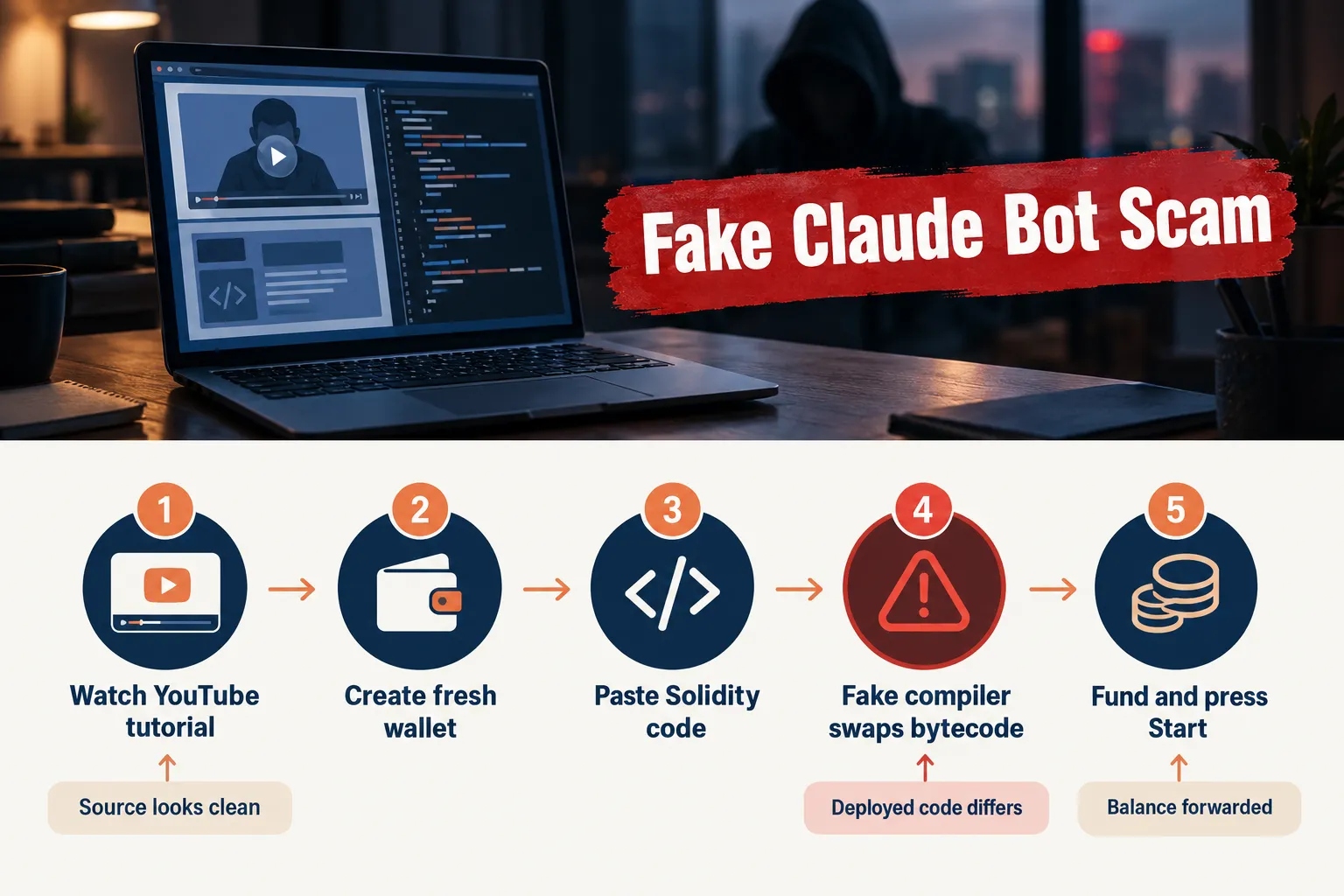
The YouTube wrapper is what made this ai trading bot scam effective: it felt more like a coding lesson than a sales pitch. The scam did not ask for a USDT transfer [Tether, a cryptocurrency designed to stay worth one US dollar] to a stranger. It asked you to fund a contract you had just deployed yourself.
What is an AI trading bot scam, and how do these scams work?
An AI trading bot scam is any offer that uses “AI” as the reason you should hand over funds or deploy code you cannot read. The payout mechanism is theft, not trading. This one was a code supply chain attack [tampering with code somewhere between where you get it and where it runs]: the victim became the deployer.
TRM’s finding was the clever part. The site you pasted your code into was a fake compiler imitating Remix, a well-known Ethereum development tool. You saw benign source code on screen. A background script threw it away and fetched malicious bytecode [the machine-readable version of a program that actually runs on the blockchain] from the operator’s server.
The deployed contract then forwarded any balance above 0.05 ETH to the attacker when you pressed Start or Withdraw, per Crypto Briefing’s account. Both buttons were presented as normal bot operation.
Then came the second bite. One fake compiler displayed an invented error asking for more “arbitrage gas” [gas is the real fee paid to process an Ethereum transaction; these labels dressed up a request for more money] or “gas nonce liquidity.” TRM noted that “gas nonce liquidity” is not an Ethereum concept. It is made-up jargon aimed at people too new to know.
This was not a Ponzi scheme [a fraud that pays earlier investors with newer investors’ money]. Nobody got paid to recruit the next person. There was one transfer, in one direction, and no trading of any kind.
How much was stolen, and from how many people?
TRM Labs traced 274.6 ETH, about $517,000, from 224 unique victim wallets across six collection addresses [the wallets the scammers used to gather the stolen funds]. The median victim lost roughly 1 ETH. Gate’s coverage of the TRM report carried the same totals.
Let that scale sink in. The average take per person was small enough that most victims had no realistic path to a lawyer and no chance of making the news on their own. That is the design. Binance Square’s summary of the report listed the same victim count.
And 310,474 views against 224 victims means the conversion rate was under one in a thousand. The operators did not need a good close. They needed volume and patience.
Why did smart people fall for this one?
Because the tutorial format disarms you. A scam that asks you to send money to a stranger triggers suspicion. A scam that teaches you to deploy code, keep your own keys, and fund your own contract feels like you are in control.
Three things did the heavy lifting:
- Self-custody theater. [Self-custody means holding your own crypto keys instead of leaving coins with an exchange.] You kept your seed phrase [the 12 or 24 secret words that open a crypto wallet], so it felt safe.
- Technical ritual. Wallet setup, code, compiler, deployment. Effort reads as legitimacy.
- A believable number. 1 ETH every 20 hours is greedy but not cartoonish.
Beginners are also walking into a market that already feels automated and opaque. A Vanguard survey reported by Business Insider on October 1, 2026, found 57% of investors uncomfortable with AI acting on their portfolios. Discomfort plus curiosity plus a free tutorial is a soft target.
How can you spot a fake AI trading bot tutorial?
Check where the money has to go before you can see any result. Real bot tutorials connect to a brokerage or exchange account through API keys you control [passwords that let software trade your account within limits you set] and recommend paper trading [practice trading with fake money] first. Fake ones require you to fund a contract or an address controlled by someone else.

| Red flag | What the fake Claude tutorial did | What a legitimate tutorial does |
|---|---|---|
| Profit claim | 1 ETH every 20 hours, stated up front | No return claim at all |
| Code source | Pasted from a video description or a Telegraph page | Public GitHub repo with commit history and issues |
| Compiler | A lookalike site that swapped your bytecode | Remix, Hardhat, or Foundry run locally |
| First action | Fund the contract, then press Start | Backtest, then paper trade, then risk small |
| Presenter | AI-generated voice or face, no track record | Named developer with a verifiable history |
| Error handling | Invented “gas nonce liquidity” upsell | Real error messages you can search |
| Verification | None offered | Contract verified on Etherscan, source matches bytecode |
A short pre-deploy checklist:
- Compare deployed bytecode to the source. If the explorer [a public lookup site, such as Etherscan, that shows every transaction and contract] does not show verified matching source, stop.
- Search the exact phrase used in the error or the pitch. “Gas nonce liquidity” returns scam writeups, not documentation.
- Never paste code into a website. Compile locally or in the official tool you typed the URL for yourself.
- Test with 0.001 ETH first. This contract only forwarded balances above 0.05 ETH, so dust tests [tiny test deposits] looked harmless. Treat a passing dust test as meaningless.
- Ask what the AI actually does. If there is no API call, there is no AI. TRM found none.
For the honest version of an ai trading bot claude build, see our guide to building a Claude trading bot and our broader breakdown of which AI trading bots are legit versus scams. If cost is the reason you clicked a random tutorial, start with AI trading bot free tiers instead.
Can you get your money back, and how do you report a trading bot scam?
Recovery odds are poor. An on-chain transfer [one recorded directly on the blockchain, where nobody can reverse it] to a contract you deployed yourself is final, and there is no chargeback. The realistic goal is documentation and reporting, not refund.

If you deployed one of these contracts:
- Stop immediately. Do not send “gas” to fix an error. That is the second extraction.
- Abandon the wallet. Move any remaining assets to a brand new wallet with a new seed phrase.
- Screenshot everything. Video URL, channel name, the written guide, the compiler domain, your transaction hashes [the unique ID code for each crypto transfer], the contract address.
- Report it. In the US, file with the FBI’s Internet Crime Complaint Center at IC3.gov and with the FTC at ReportFraud.ftc.gov. Report the video to YouTube and the domain to its hosting provider.
- Refuse recovery services. Anyone who DMs you offering to retrieve funds for a fee is running the follow-on scam.
- Warn the comment section. MalwareTips documented the same campaign, and public warnings are how the next person avoids it.
Are AI trading bots safe, and what separates real tools from scams?
Is AI trading safe? It can be. Legitimate AI trading tools exist, and none of them require you to deploy an anonymous smart contract. The dividing line is custody and verifiability: real bots execute through your own brokerage or exchange account, and you can audit their logic and results.
What a defensible setup looks like:
- Funds sit at a regulated broker or a major exchange, not in a contract from a video description.
- Strategy logic is readable, and you can backtest it without fooling yourself.
- Results are measured over months, not screenshots.
- Position sizing and a stop loss exist before the bot runs live.
Our honest take on automation lives in what to know before you automate trades and do AI trading bots actually make money. For the wider question of whether the category holds up, read is AI trading legit.
What should investors watch next?
Three dated markers matter. TRM published on September 14, 2026; the observed theft window closed August 11, 2026; and as of October 4, 2026 no public announcement confirms that all nine videos have been removed.
- Platform enforcement. TRM said the nine videos were still live in September 2026 even though earlier copies had been pulled. Watch whether YouTube removes the current set.
- New variants. The written guides sat on Telegraph, Amazon S3, and Google Cloud Storage. Expect the same script on new hosts with a different model name attached.
- Named-model lures. Claude was the brand borrowed this time. Any widely trusted AI name is next.
- Further tracing. Follow-on reporting at ChainCatcher and PANews may update the totals if more collection addresses surface.
Our take
This campaign worked because it inverted the usual tell. Nobody asked for your keys. They asked for your participation, and participation feels like diligence.
The lesson is boring and useful: the first deposit is the audit. If a tool needs funding before it can show you anything verifiable, it has told you what it is. Paper trade it first, and if there is nothing to paper trade, there is nothing there.
Got a bot you want checked before you fund it? Send it to the desk at aistocktradingbots.com/contact and we will look at it. FullStack Alpha has tested 200+ AI stock tools since 2022. We review the software. We do not tell you what to buy.
Crypto words in this article, explained
Crypto is the rail this scam ran on, not something we recommend. If the terms above read like gibberish, here is the plain-English version.
| Term | Plain English meaning |
|---|---|
| Blockchain | A shared public ledger that records every crypto transfer permanently |
| On-chain | Recorded directly on the blockchain; it cannot be reversed or charged back |
| Blockchain analytics | Following money across the public ledger to see where it went |
| TRM Labs | A company that traces crypto money flows for investigators, banks and exchanges |
| ETH (Ether) | The cryptocurrency of the Ethereum network; its dollar price moves constantly |
| Ethereum | A blockchain network that can run programs, not just move coins |
| Wallet | A crypto account you control with secret keys |
| Wallet address | A long string of letters and numbers that identifies a wallet, like a public account number |
| Seed phrase | The 12 or 24 secret words that open a wallet; whoever has them owns the funds |
| Self-custody | Holding your own keys instead of leaving coins with an exchange |
| Smart contract | A program on the blockchain that moves money automatically by its own rules |
| Deploy | Publishing a smart contract onto the blockchain so it starts running |
| Drainer | A smart contract or script built to empty a wallet into the scammer’s account |
| Compiler | A tool that turns human-written code into the machine version that runs |
| Bytecode | That machine version; it is what actually runs, whatever the screen showed you |
| Solidity | The programming language most Ethereum smart contracts are written in |
| Gas (gas fee) | The small fee paid to process an Ethereum transaction |
| USDT | Tether, a coin designed to stay worth one US dollar |
| Arbitrage | Buying on one market and selling higher on another at the same moment |
| Block explorer (Etherscan) | A public website for looking up any transaction, wallet or contract |
| Transaction hash | The unique ID code for one crypto transfer |
| API / API key | A connection that lets software talk to a service, and the password that controls it |
| Paper trading | Practice trading with fake money before risking real money |
FAQ
Is the AI trading bot legit?
There is no single “the AI trading bot.” Legitimate tools connect to your own brokerage or exchange through API keys and let you paper trade before risking money. The fake Claude bot TRM Labs documented had no AI calls and no trading logic at all. Verify custody and code before you fund anything.
Does AI robot trading pay real money?
Real automation moves real money in both directions, and losses are common. Scam bots pay nothing, because they do not trade. In the TRM Labs case, 224 wallets sent 274.6 ETH and received zero back. Any offer quoting a fixed daily return, like 1 ETH every 20 hours, is describing theft.
What is the latest AI scam?
The most recently documented large one is the fake Claude trading bot campaign TRM Labs published on September 14, 2026. Nine YouTube tutorials taught viewers to deploy a drainer contract through a lookalike compiler, taking roughly $517,000 from 224 victims between February and August 2026.
Can you actually make money with AI trading?
Some traders do, using AI for screening, backtesting, and execution inside a risk framework they control. Nothing guarantees it, and tooling does not change the odds on its own. AI changes your workflow speed, not the math of position sizing and risk.
Do trading bots actually work?
Bots execute rules reliably. That is all they do. A bot with a weak strategy loses faster and more consistently than a human would. Results depend on the edge you encode, your position sizing, and your stop loss, which is why backtesting and paper trading come before live capital.
Is there a legit AI trading bot?
Yes, several established platforms connect to regulated brokers and publish their logic. The test is simple: can you see the strategy, keep funds at your own broker, and run it on paper first? If yes, it is worth evaluating. If funding an unknown contract is step one, walk away.
Is Tradebot legit?
“Tradebot” is a name used by multiple unrelated products, so the name alone tells you nothing. Check for a registered company, a verifiable track record, custody at a regulated broker, and real user discussion outside the vendor’s own site. Thin or anonymous ownership is reason enough to skip it.
Sources
- TRM Labs, 2026: Fake AI trading bots are getting victims to build their own drainers
- Yahoo News, 2026: Fake AI crypto bot tutorials
- Crypto Briefing, 2026: TRM Labs fake AI bot tutorial scam
- Crypto.news, 2026: Fake AI trading bot tutorials steal 274.6 ETH from 224 victims
- TradingView, 2026: PANews report summary
This article is education and reporting, not financial advice.
Your market edge starts with the right tool. Stay alpha.
Frequently Asked Questions
Is the AI trading bot legit?
There is no single "the AI trading bot." Legitimate tools connect to your own brokerage or exchange through API keys and let you paper trade before risking money. The fake Claude bot TRM Labs documented had no AI calls and no trading logic at all. Verify custody and code before you fund anything.
Does AI robot trading pay real money?
Real automation moves real money in both directions, and losses are common. Scam bots pay nothing, because they do not trade. In the TRM Labs case, 224 wallets sent 274.6 ETH and received zero back. Any offer quoting a fixed daily return, like 1 ETH every 20 hours, is describing theft.
What is the latest AI scam?
The most recently documented large one is the fake Claude trading bot campaign TRM Labs published on September 14, 2026. Nine YouTube tutorials taught viewers to deploy a drainer contract through a lookalike compiler, taking roughly $517,000 from 224 victims between February and August 2026.
Can you actually make money with AI trading?
Some traders do, using AI for screening, backtesting, and execution inside a risk framework they control. Nothing guarantees it, and tooling does not change the odds on its own. AI changes your workflow speed, not the math of position sizing and risk.
Do trading bots actually work?
Bots execute rules reliably. That is all they do. A bot with a weak strategy loses faster and more consistently than a human would. Results depend on the edge you encode, your position sizing, and your stop loss, which is why backtesting and paper trading come before live capital.
Is there a legit AI trading bot?
Yes, several established platforms connect to regulated brokers and publish their logic. The test is simple: can you see the strategy, keep funds at your own broker, and run it on paper first? If yes, it is worth evaluating. If funding an unknown contract is step one, walk away.
Is Tradebot legit?
"Tradebot" is a name used by multiple unrelated products, so the name alone tells you nothing. Check for a registered company, a verifiable track record, custody at a regulated broker, and real user discussion outside the vendor's own site. Thin or anonymous ownership is reason enough to skip it.
Contributing writer at AI Stock Trading Bots.
