

Composer trading now costs nothing to start, and the gap between its backtests and your real account still has not closed. That is the whole story in one line, and it is worth reading on if you are about to automate real money. SoFi bought the company in June 2026, the free Starter plan lets you automate one live strategy, and the simulated curve on your screen is still a simulation.
Quick Answer
Composer is a no-code automated trading platform, now branded Composer by SoFi, that lets retail investors build rules-based strategies called symphonies and have them rebalanced automatically. The Starter plan is $0 per month and includes one automated strategy, up to 200 nodes, and unlimited no-code backtests per Composer’s pricing page. Composer is a real broker-dealer, Composer Securities LLC, member FINRA and SIPC. The honest catch: backtests run on end-of-day data, live fills happen in a late-afternoon window, and that difference is where optimistic numbers go to die.
Key Takeaways
- Starter is $0 per month with one automated strategy, 200-node ceiling, and unlimited no-code backtests, per the official Composer pricing page checked October 2026.
- SoFi completed the acquisition on June 23, 2026 and relaunched the product as Composer by SoFi, per SoFi’s own announcement.
- Trading happens in a window, generally 3:45 to 4:00 p.m. Eastern, per Composer’s trading period documentation. Pro users can request priority timing from 3:55 p.m.
- Ratings split hard: 4.44 from 691 ratings on the Apple App Store as of September 2026, while Trustpilot reviews skew far more negative on a much smaller sample.
- The backtest gap is structural, not a bug. Simulated curves use closing prices; your orders get real spreads.
- A $50 minimum deposit is required before the investing features do anything useful.
What is Composer and who is it for?
Composer is a no-code platform plus brokerage that lets you build conditional trading strategies, backtest them, and automate them without writing a line of Python. Composer Technologies Inc builds the software, Composer Securities LLC is the broker-dealer, and together they serve self-directed retail investors who want rules instead of impulses.
The core unit is a symphony: a decision tree of if-then logic. If SPY’s 200-day moving average is above price, hold short-term Treasuries. Otherwise hold equities. Rebalance daily. That is it, built by dragging blocks in an app.
Composer reported more than 175,000 investors and a community library of 2,000-plus automated strategies around the time of the SoFi deal, per Composer’s own company updates. Those same updates reported more than $250 million in total assets in February 2026 and a record $1.6 billion in traded notional volume that January.
Who it fits: the investor who has a rule in their head, keeps breaking it, and wants the software to hold the line. Discipline beats prediction, and a machine does not revenge trade.
Who it does not fit: day traders. Composer trades once in a late-day window. If you need intraday entry and exit, this is the wrong tool. Also wrong for anyone wanting crypto trading as a core feature, since the focus here is equities and ETFs.
How does Composer trading work in practice?
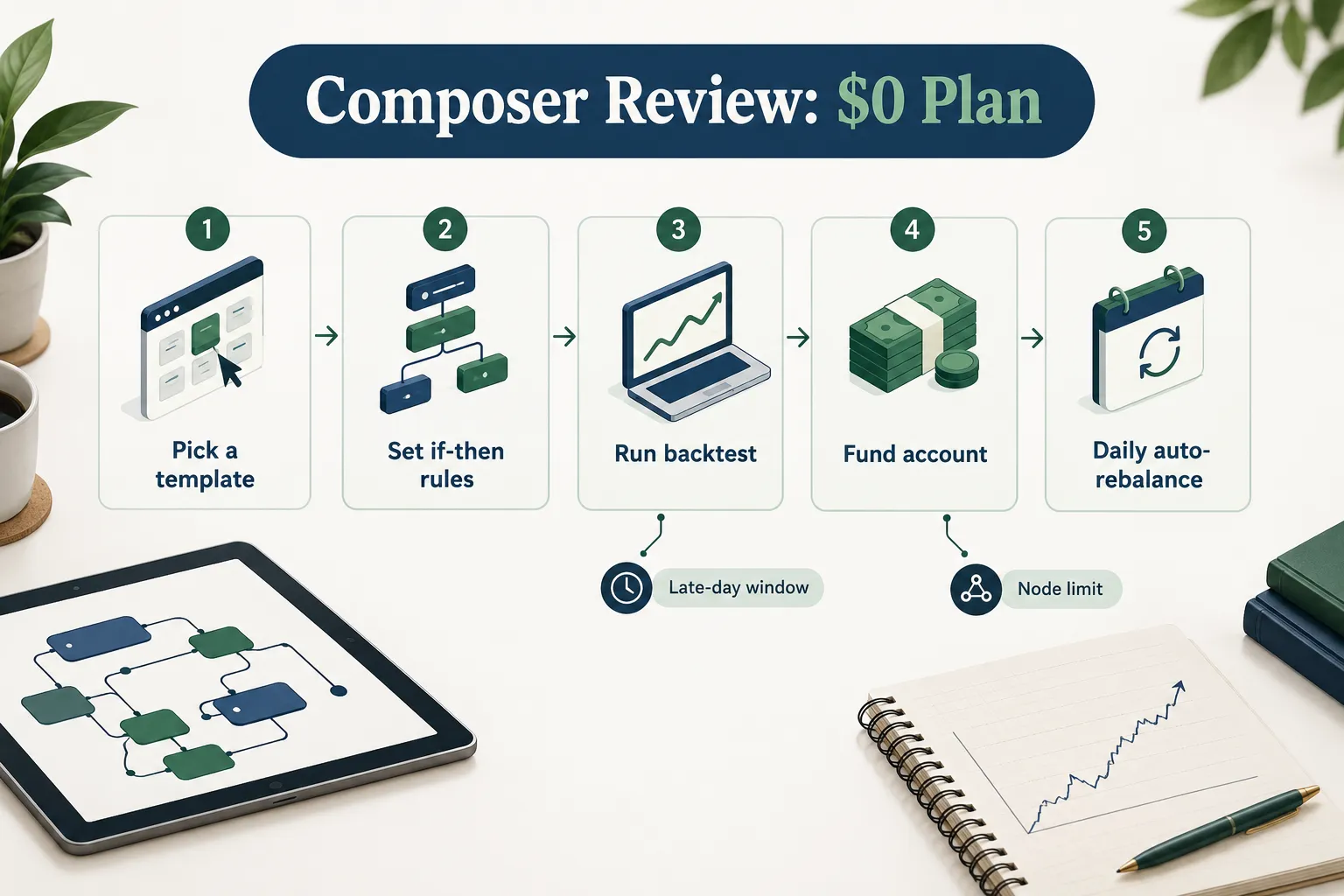
Composer trading means automating a rules-based portfolio inside Composer’s app and letting the platform place the orders for you, instead of clicking buy and sell yourself. You build the logic, backtest it against historical data, fund the account, and the symphony rebalances on its own schedule.
The mechanics of composer trading break into five steps:
- Pick or build. Start from a community symphony or an AI prompt, or assemble conditions by hand.
- Backtest. Run the strategy against historical data. Unlimited on every plan, including Starter.
- Fund. A $50 minimum deposit is required, per Composer’s deposit help article from September 15, 2026.
- Invest. The symphony goes live and trades inside the daily window.
- Monitor. Composer’s June 2026 update added Time-Weighted Return, Sharpe ratio, maximum drawdown, and standard deviation, plus charts overlaying live results against backtest results and benchmarks like SPY and QQQ.
That last addition matters more than anything else the company shipped this year. You can now see your live line and your simulated line on the same chart. Most platforms hide that comparison. Composer puts it on screen.
Decision rule: if your strategy depends on getting filled at a specific price at 10:07 a.m., composer trading cannot execute it. If your strategy is “hold X unless condition Y, checked once daily,” it fits perfectly.
For broader context on how this category stacks up, see our roundup of the best algorithmic trading platforms.
How much does Composer cost after the new $0 plan?
Composer’s Starter tier costs $0 per month with no subscription required, and that includes one automated strategy, strategies up to 200 nodes, Trade with AI, and unlimited no-code backtests, per Composer’s pricing page as of October 2026. Paid tiers add strategy count, node ceilings, API access, and priority execution timing. That makes composer trading cheaper to test than most paid bot subscriptions.
| Plan | Automated strategies | Node limit | Standout feature | Price |
|---|---|---|---|---|
| Starter | 1 | 200 | Unlimited backtests, Trade with AI | $0/mo |
| Advanced | Up to 5 | 350 | More weekly AI usage | $10/mo |
| Pro | Up to 500 | 10,000 | Full API access, manual overrides, priority trade timing | $32/mo billed yearly ($384/yr) |
| Business | Call for details | Call | Institutional setup | By call |
Pro runs $32 per month billed yearly, or $384 per year, per the pricing page. FINRA and SEC regulatory fees apply on sales, which is standard across the industry and documented in Composer’s customer fee schedule.
No commissions on trades is the headline, and it is accurate for the trade itself. Transparent pricing on the plan side, regulatory pass-throughs on the sell side. Compare that to what the category normally charges in our breakdown of how much a trading bot costs.
Common mistake: assuming free means risk-free. The Starter plan automates a real strategy with real money. Free pricing, real drawdowns.
How does Composer AI trading work?
Composer AI trading lets you describe a strategy in plain English and have the system assemble the node structure for you, which you then edit, backtest, and deploy. SoFi framed the acquisition around exactly this, saying the platform would let investors create, test, and execute rules-based strategies using natural-language prompts.
CEO Anthony Noto positioned the deal as part of making AI-powered investing more accessible, per the SoFi announcement. Translation: fewer people building from a blank canvas, more people prompting their way to a draft.
The practical workflow:
- Type something like “rotate between QQQ and short-term bonds based on the 10-day RSI”
- The AI generates a symphony skeleton
- You inspect every condition, because the AI will happily build something that curve-fit the last three years
- Backtest, then paper trade it first if your plan allows
- Deploy
The limitation nobody advertises: AI strategy creation is a drafting tool, not a research department. It does not know whether your idea has an economic reason to work. It knows how to translate words into nodes. Those are different jobs.
More automation also means more rope. A symphony that reacts to the market daily will trade more than you expect, which is fine in a tax-advantaged account and less fine in a taxable one. Composer markets tax-smart active trading in your retirement account for this reason, which is a legitimate point: an IRA removes the tax friction that kills high-turnover strategies.
Our full walkthrough of the builder lives in our piece on whether Composer trading can really build a bot without code.
Why do Composer backtests look better than live results?
Because backtests fill at closing prices and your account fills at whatever the market offers inside a 15-minute window. That is the single biggest reason a symphony that returned 24 percent in simulation delivers something different when it is your money. Every composer trading account lives with that gap.
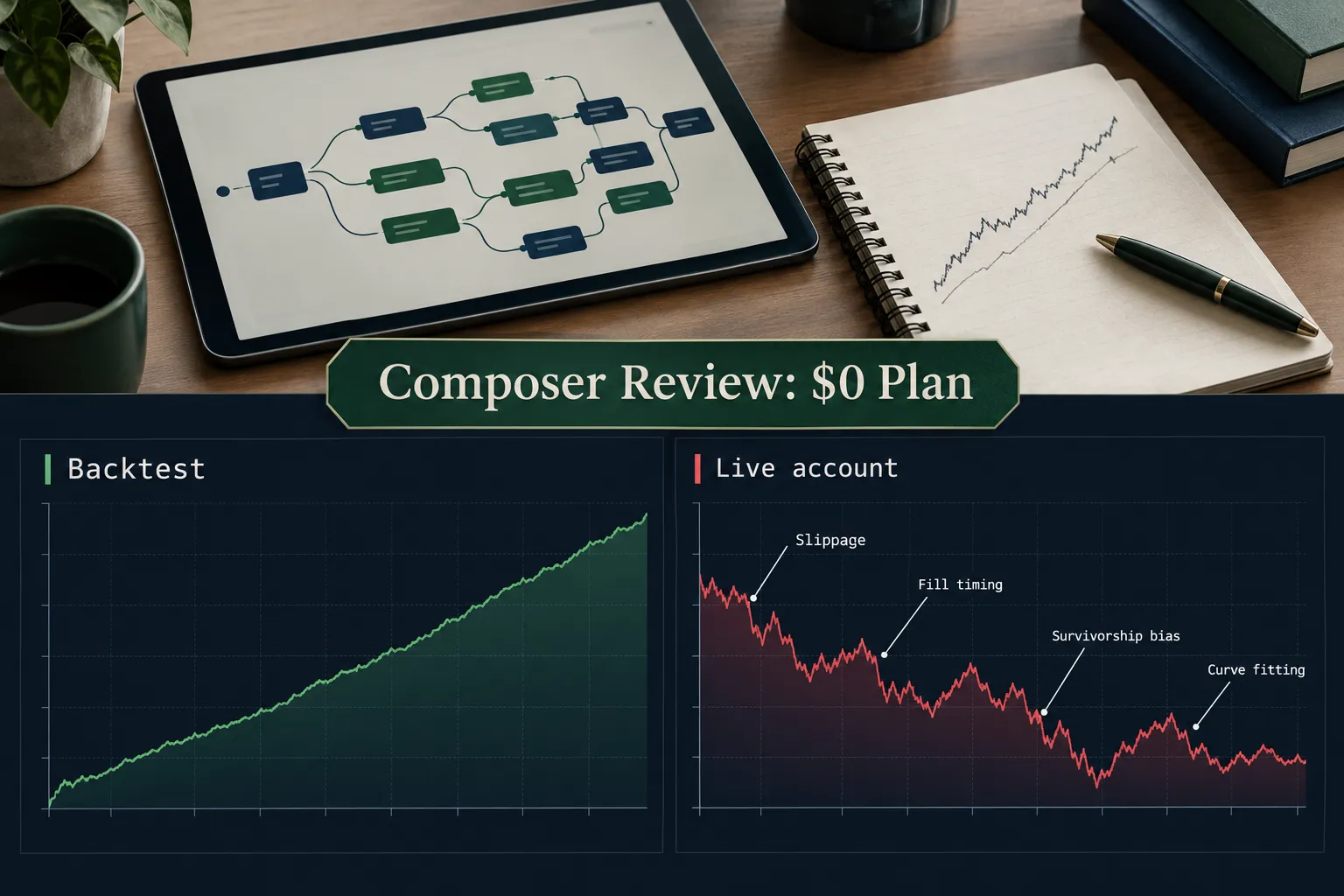
Three mechanical causes, in order of damage:
1. Execution timing. Composer’s trading window is generally 3:45 to 4:00 p.m. Eastern, moving to 12:45 to 1:00 p.m. on early-close days, per Composer’s trading period documentation dated September 15, 2026. A backtest that assumes the 4:00 p.m. close is not modeling a 3:47 p.m. fill. Pro users can request priority trade time starting at 3:55 p.m. Eastern, explicitly to improve consistency with end-of-day backtests. Paying $32 a month to narrow a data-alignment gap is an honest feature and an admission at the same time.
2. Slippage and spreads. One App Store reviewer put it bluntly on September 18, 2026: “The charts are meant to show what your money would turn into… the buy and sell orders never get filled at lower prices than the chart suggests” (Apple App Store). Thinly traded leveraged ETFs are where this bites hardest. We covered the mechanism in detail in our guide to paper trading slippage.
3. Curve fitting. A 10,000-node ceiling on Pro is a gift to anyone who wants to torture data until it confesses. The more conditions you stack, the better the past looks and the less the future cares. See our method for backtesting without fooling yourself.
Edge case worth knowing: survivorship bias. The community library shows you the symphonies whose backtests still look good, not the ones people quietly abandoned. And any symphony holding an ETF with a short history deserves a check on how the years before its launch were modeled.
Play stupid games with a 500-node backtest and you win stupid prizes.
Is Composer trade legit after the SoFi acquisition?
Yes. Composer Securities LLC is a registered broker-dealer, member FINRA and SIPC, and the platform is now owned by SoFi Technologies, a publicly traded company. The “is Composer trade legit” question gets asked constantly on Reddit, and the regulatory answer is unambiguous.
Composer stated the acquisition did not immediately change customers’ accounts, custody arrangements, saved strategies, historical performance, pricing, or fees, per Composer’s June 23, 2026 update. Assets stay in their existing custody structure while the product integrates into SoFi’s broader product set.
What legitimate does and does not mean:
- SIPC covers custody failure, not market losses. If your symphony drops 30 percent, SIPC is not involved.
- SEC and FINRA registration means oversight and disclosure, not performance validation.
- Explanatory brochures and fee schedules are published. Read them before funding.
Regulation makes composer trading legitimate. It does not make any strategy profitable.
The fair criticism is about presentation, not licensing: simulated returns sit very close to live ones in the app, and new users anchor on the prettier line. Composer does publish the standard disclaimer that past performance is no guarantee of future results.
Top 5 favorite features
The five things here that earn their keep: the free tier that actually automates, the community strategy library, the live-versus-backtest overlay chart, retirement account support, and the no-code builder itself.
- A $0 plan that trades. Starter is not a trial. One real strategy, automated, no subscription. That is rare. Compare it against other AI trading bot free tiers.
- Discover pre-built strategies. 2,000-plus community symphonies you can inspect, clone, and modify. You see the logic, not a black box.
- The overlay chart. Live results, backtest results, and a benchmark like SPY on one axis. This is the most honest feature on the platform.
- IRA support. High-turnover rules in a tax-advantaged wrapper removes the tax drag that quietly eats active strategies.
- Transparent node logic. Every condition is visible and editable. No proprietary score you cannot interrogate.
What we like and what we don’t like
Composer earns its place for investors who want systematic rules without code, and loses points for execution timing and a backtest presentation that flatters itself. Two real drawbacks, stated plainly.
What we like
- Genuinely free entry point with real automation
- Visible strategy logic, not a scoring black box
- Regulated brokerage: Composer Securities LLC, member FINRA and SIPC
- Live-versus-simulated performance charting
- SoFi ownership adds balance-sheet stability
What we don’t like
- The once-daily trading window. A 15-minute execution slot is structurally incompatible with any strategy sensitive to intraday price action. No workaround below Pro.
- Backtest optimism is baked in. Even with the overlay chart, the default experience shows a smooth simulated curve first. New users anchor on it.
- Trustpilot reviews skew negative, a thin sample but a sharp contrast with the App Store’s 4.44.
- Node ceilings as a paywall. 200 nodes on Starter is workable, but complexity gating is a soft nudge toward overbuilding.
What do real users say?
Sentiment splits by source. The app holds 4.44 from 691 ratings on the Apple App Store as of September 2026, while Trustpilot reviews, on a far smaller sample, lean negative. App store prompts fire after good moments; Trustpilot collects billing and service complaints. The gap is the finding.
The positive case, from a June 25, 2026 App Store review: “Composer offers a place for me where I (the casual long investor) can do copycat or easily utilize AI with my own parameters” (Apple App Store). Simple to use, casual investor, works as advertised.
The critical case is the fill-price complaint quoted earlier. Both reviews describe the same product accurately. One values the ease, the other values the math.
Composer trading reddit threads echo the split: praise for the builder, recurring frustration with the execution window and with symphonies that underperform their backtests. We track this pattern across the category in our look at honest AI stock tool reviews and what real users say.
The iOS app ships steadily. Version 1.34 landed September 25, 2026 with benchmark alignment fixes, an email-verification fix, and smaller reliability improvements, per the Apple App Store version history.
Composer trading versus TradingView and other platforms
Composer competes on automation, not charting. TradingView wins on technical analysis and alerts; Composer wins on actually placing the trade without you. Code-first platforms beat both on flexibility and lose on learning curve.
| Platform | Best for | Coding required | Executes trades | Entry price |
|---|---|---|---|---|
| Composer by SoFi | No-code rules automation | No | Yes, daily window | $0/mo |
| TradingView | Charting, alerts, scripting | Pine Script optional | Via broker integrations | Free tier available |
| Code-first API platforms | Custom intraday logic | Yes, Python | Yes | Varies |
| Robo-advisors | Hands-off allocation | No | Yes | Varies by AUM fee |
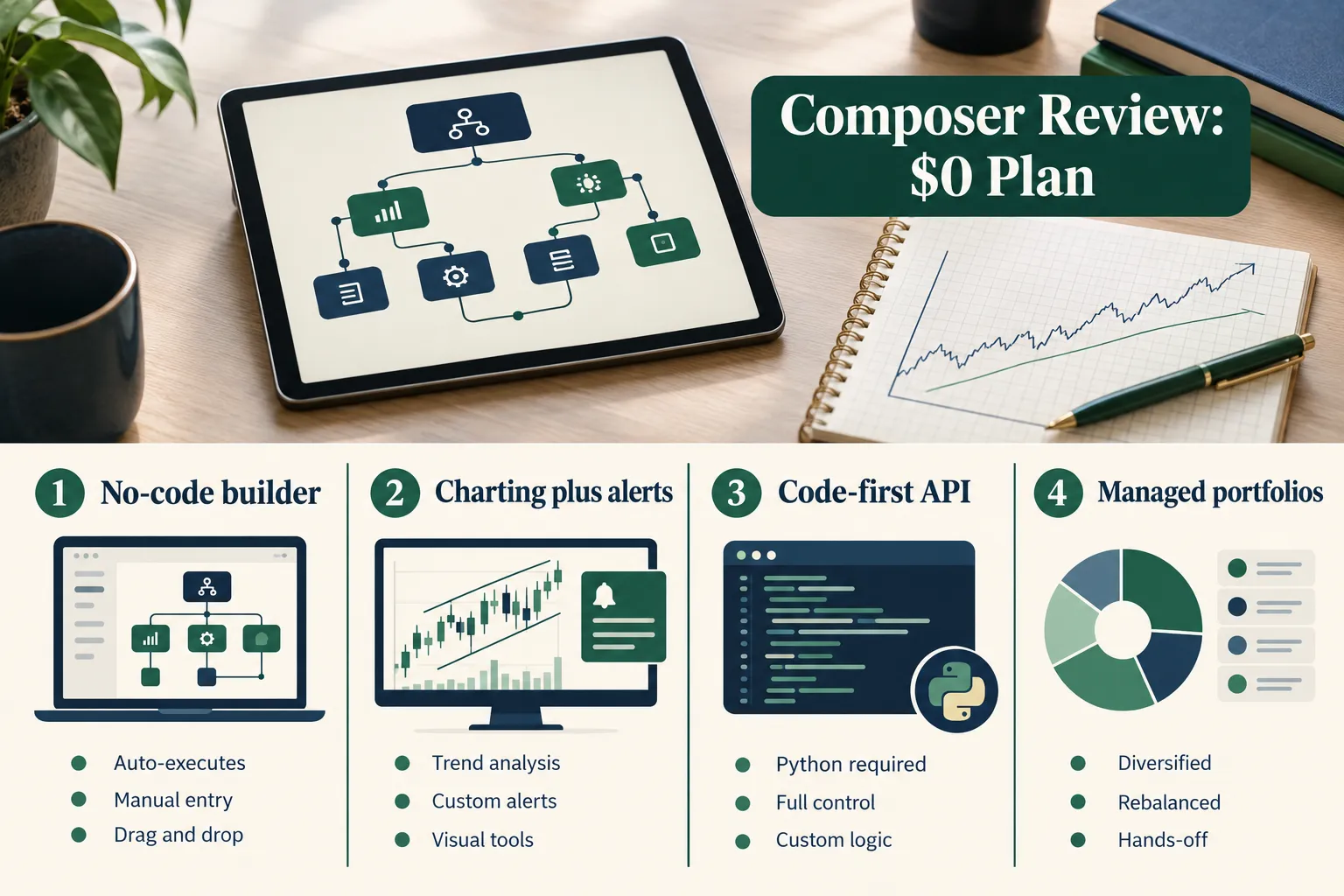
Choose Composer if you want a rules engine and have no interest in writing code. Choose TradingView if your edge is discretionary and you need better charts. Choose a code-first platform if your strategy needs intraday timing. For side-by-side scoring across the category, see our ranking of the best AI trading tools of 2026 put head to head and the directory of best AI trading platforms. Our earlier Composer Trade review asking whether AI can build an algo you’d actually run goes deeper on the builder itself.
Also useful: a list of backtesting websites if you want to validate a symphony’s logic outside Composer’s own engine.
Our take
Composer is the most honest no-code automation product in its category, and the $0 Starter plan makes it close to a free lunch for anyone who wants rules enforced by software instead of willpower. The backtest gap has not closed, and no pricing change fixes a 15-minute execution window.
The practical approach to composer trading, in order:
- Open Starter. Build one simple symphony with under 20 nodes.
- Run the backtest, then mentally discount the return by a meaningful margin for slippage and timing.
- Fund the $50 minimum and watch the live-versus-backtest overlay for 90 days before scaling.
- If the two lines diverge wildly, your logic was fit to the past.
- Only consider Pro if API access or priority trade timing solves a problem you have actually hit.
Conclusion
Composer trading in 2026 is cheaper to try than ever and no more forgiving of sloppy assumptions. The $0 Starter plan removes the cost barrier entirely, SoFi ownership removes most counterparty worry, and the live-versus-backtest overlay chart gives you the one piece of data most platforms hide. What remains is the same discipline problem it always was: a simulated curve is a hypothesis, and your fills are the test.
Next step: open the free Starter plan, build one symphony under 20 nodes, and track the live line against the backtest for a full quarter before adding a dollar. Process over prediction.
One tool, examined closely. There are 200+ more catalogued and compared in the FullStack Alpha reviews library, filterable by category and what they actually do. Compare the full field at aistockpickerapp.com/reviews
Plan prices are subject to change in this fast AI market. If a tier moved, blame the robots, not your symphony.
This article is education, not financial advice.
Your market edge starts with the right tool. Stay alpha.
Frequently Asked Questions
Is Composer good for trading?
Composer is good for rules-based, low-frequency strategy automation and poor for day trading. Its once-daily execution window, generally 3:45 to 4:00 p.m. Eastern, suits portfolio rotation and trend-following rules. It cannot handle intraday entries.
How does Composer trading work?
You build a symphony: a decision tree of if-then conditions using ETFs and stocks. Composer backtests it against historical data, then after you fund the account with at least $50, it executes the rebalances automatically inside a daily trading window. You monitor results against the backtest and benchmarks like SPY.
Is Composer trade legit?
Yes. Composer Securities LLC is a registered broker-dealer and member of FINRA and SIPC, and the company was acquired by SoFi in June 2026. SIPC protects against custody failure, not market losses. Legitimate regulation does not mean any individual strategy will be profitable.
Is Composer free?
The Starter plan costs $0 per month with no subscription, including one automated strategy, up to 200 nodes, Trade with AI, and unlimited no-code backtests per Composer's pricing page. Advanced is $10 per month and Pro is $32 per month billed yearly, or $384 per year. FINRA and SEC regulatory fees apply on sales.
Who owns Composer trading?
SoFi Technologies owns it. SoFi completed the acquisition and launched the rebranded Composer by SoFi on June 23, 2026. Composer stated that accounts, custody arrangements, saved strategies, historical performance, and pricing were not immediately changed by the deal.
What do Composer trading reddit users say?
Sentiment splits. Users praise the no-code builder and the community strategy library, and criticize the single daily trading window and symphonies that underperform their backtests. That mirrors the rating gap between a 4.44 Apple App Store rating and a smaller, more negative set of Trustpilot reviews.
Can you make money with Composer trading?
Composer executes your rules; it does not generate returns on its own. Profitability depends entirely on whether your strategy has a real edge after slippage, spreads, and execution timing. Platform-wide marketing figures say nothing about individual outcomes, and past performance is no guarantee of future results.
What are the most common Composer trading mistakes?
Overbuilding node counts until the backtest looks perfect, deploying without discounting for slippage, running high-turnover symphonies in taxable accounts, chasing community strategies with short live histories, and scaling capital before 90 days of live data exist.
Contributing writer at AI Stock Trading Bots.
