

Jay Rocco is the Founder and Editor of FullStack Alpha. He has tested 200+ AI stock tools since 2022 and run 15+ AI trading platforms on live accounts with his own money. He reviews the software. He does not tell you what stocks to buy.
Last updated: September 30, 2026
Quick answer
The best algorithmic trading course for most serious retail traders is QuantInsti’s EPAT, a roughly six-month, Python-first program with live faculty, a graded capstone, and an actual risk-management module. If you don’t want to spend four figures, QuantConnect’s Boot Camp teaches you to write and backtest strategies inside a production engine for $0. Everything else on this list sits between those two poles, and every pick here makes you write code. None of them sell signals.
Pick one of the best algorithmic trading courses in 10 seconds
Six months, live faculty, graded capstone.
Learn inside the LEAN engine that runs live money.
Broker API plus cloud deployment in 30+ hours.
Graded projects a human actually reads.
Python TWS API lessons from the broker itself.
Google Cloud plus NYIF, three courses.
Best algorithmic trading courses: the short version
- Top overall: QuantInsti EPAT. Around six months part-time, Python plus market microstructure and options, graded capstone project. Budget roughly $5,000 (quoted on application, varies by region). Confirm current pricing before you commit.
- Best free path: QuantConnect Boot Camp and Learning Center. $0, Python or C#, and you’re writing strategies inside LEAN, the same open-source engine that runs their live trading.
- Best under $100: “Algorithmic Trading A-Z with Python, Machine Learning & AWS” on Udemy (Alexander Hagmann). 30+ hours, broker API integration, cloud deployment. Lists at $19.99 to $129.99 depending on the sale.
- Most portfolio proof: Udacity AI for Trading. Multiple graded projects with human code review, $249/month at list price, so plan on roughly $750 for a three-month sprint.
- Cheapest structured ML track: Coursera’s Machine Learning for Trading specialization from Google Cloud and the New York Institute of Finance, three courses, around $49 to $59 a month.
- The filter that matters: if a course never shows you a backtest that loses money, you’re watching marketing. Transaction costs, slippage, and look-ahead bias should appear in week one, not never.
- No course fixes position sizing. Code is the easy part. Sizing, stop placement, and not overriding your own system at 10:04 a.m. are where most automated accounts die.
How did we pick the best algorithmic trading courses?
We only kept courses where you finish with code you wrote, running against real market data, connected to a real API. Anything that ended in a Telegram channel, a “proprietary indicator,” or a lifetime membership got cut.
The specific criteria:
- You write the code, not paste it. Fill-in-the-blank notebooks are fine. Watching an instructor type for 20 hours is not.
- Real data and a real broker or platform API. Alpaca, Interactive Brokers, Oanda, QuantConnect’s data feeds. If the course stops at a CSV of daily closes, you’ve learned pandas, not trading.
- Honest backtesting. Transaction costs, slippage, look-ahead bias (using data your strategy wouldn’t have had at the time), and survivorship bias (testing only on companies that still exist) need to be taught explicitly. This is the single biggest separator between courses that matter and courses that don’t.
- A live or paper deployment step. Backtest to production is where most self-taught traders stall. The good courses walk you through scheduling, logging, and failure handling.
- Risk management as a module, not a footnote. Position sizing, drawdown limits, kill switches.
- Instructors with a verifiable track record. Named practitioners, published papers, or a real engineering résumé. Not a rented Lamborghini.
- A refund window or a free tier. You should be able to tell within two weeks whether it’s for you.
We also scored down anything that upsells a paid signal service on the back end. A course that teaches you to build your own edge has no reason to rent you someone else’s. For more on where automation actually helps retail accounts, read our breakdown of what retail traders get wrong about algorithmic trading AI.
Comparison table: all 7 algorithmic trading courses
| Course | Language taught | Level | Approx. hours | Projects included | Certificate | Price (verify current) |
|---|---|---|---|---|---|---|
| QuantInsti EPAT | Python (plus some C++ context) | Intermediate to advanced | 300+ over ~6 months | Yes, graded capstone | Yes, verified | ~$5,000, quoted on application |
| Udacity AI for Trading | Python | Intermediate | ~170 (3-4 months at 10 hrs/wk) | Yes, multiple reviewed projects | Yes, Nanodegree | $249/mo list, ~$750 for 3 months |
| Quantra (QuantInsti self-paced) | Python | Beginner to advanced | 4-20 per course | Yes, strategy notebooks | Yes, per course | Free intro courses; paid ~$50-$500 each |
| Coursera: Machine Learning for Trading | Python, TensorFlow | Beginner to intermediate | ~60-80 (3 courses) | Yes, graded labs | Yes, specialization | ~$49-$59/mo subscription |
| Udemy: Algorithmic Trading A-Z (Hagmann) | Python | Beginner to intermediate | 30+ | Yes, full bot build | Yes, completion | $19.99-$129.99 |
| QuantConnect Boot Camp + Learning Center | Python or C# | Beginner to advanced | Self-paced, ~20-60 | Yes, in-engine algorithms | No | $0 (paid live-trading nodes optional) |
| IBKR Campus: Python TWS API + Traders’ Academy | Python | Beginner to intermediate | ~10-25 | API scripts, not portfolio projects | Completion certificate | $0 |
Prices are list prices at publication and move constantly, especially on Udemy and Udacity. Check before you buy.
1. QuantInsti EPAT
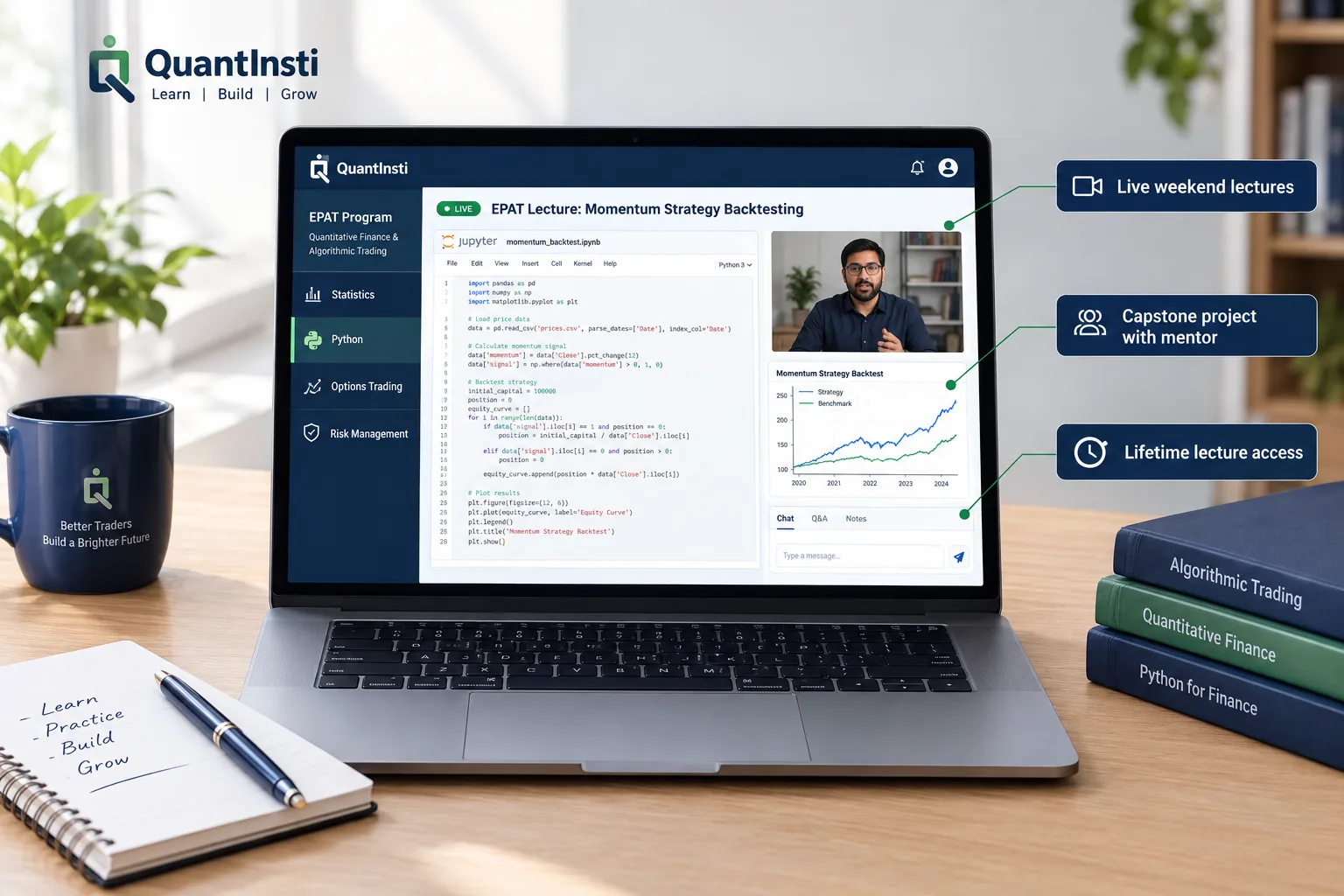
Best for: traders who want the full quant stack and a credential that hiring desks recognize.
EPAT (Executive Programme in Algorithmic Trading) is the closest thing retail has to a professional quant bootcamp. It runs roughly six months on weekends, taught live by practitioners, and it covers the parts everyone else skips: statistics, market microstructure, options greeks, portfolio optimization, and execution logic. You finish with a mentored capstone project, not a certificate of attendance.
Key features
- Live weekend lectures with recordings you keep
- Python as the core language, with modules on data handling, backtesting frameworks, and ML applications
- Dedicated sections on risk management and trading infrastructure
- Career support and placement assistance
- Access to broker and data-provider integrations through partner platforms
Pros
- The curriculum treats trading as a discipline, not a script
- Faculty are working practitioners, and you can question them live
- The capstone forces you to defend a strategy, including why it fails
- Alumni network and career desk are real assets if you want a job, not just a bot
Cons
- Price is the highest here by a wide margin. Budget around $5,000 and confirm the current quote
- Weekend live sessions across time zones are brutal if you have a family and a job
- You need working Python and comfortable high-school statistics before day one, or you’ll drown in week three
Who should skip it: anyone who hasn’t written a for-loop yet, or anyone with less than $5,000 of trading capital. Spending your account on a course about trading your account is a bad trade.
2. Udacity AI for Trading
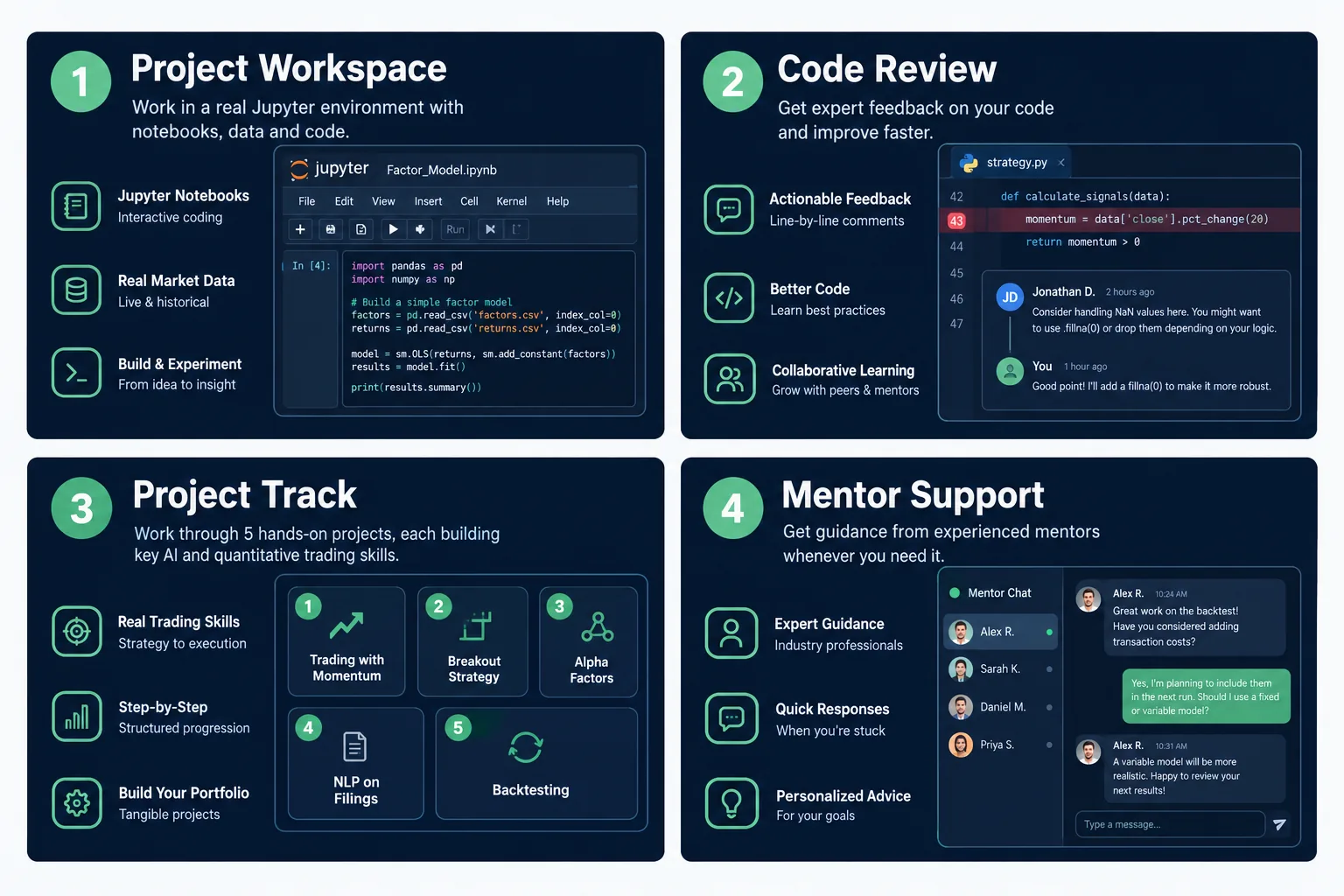
Best for: people who learn by shipping projects and want a human reviewing their code.
Udacity’s AI for Trading Nanodegree is built around graded projects: momentum strategies, alpha factor construction, NLP on SEC filings, and a full backtest. A reviewer reads your notebook and tells you what’s wrong with it. That feedback loop is the product, and it’s what you can’t get from YouTube.
Key features
- Python throughout, with pandas, NumPy, scikit-learn, and Zipline-style backtesting patterns
- Multiple reviewed portfolio projects using real equity and text data
- Mentor and community support channels
- Roughly 10 hours a week for three to four months
Pros
- Human code review catches look-ahead bias and data leakage you’d never notice alone
- The alpha-factor and filings-NLP projects are the most transferable work on this list
- Finished projects sit on GitHub and speak for you in interviews
Cons
- The monthly subscription punishes slow learners. At $249/month list, a six-month pace costs more than EPAT’s tuition buys you in depth
- Light on execution plumbing. You’ll build models, not a live trading loop
- Financial theory is assumed more than taught
Decision rule: choose Udacity if you already know Python and want proof of work in 90 days. Choose EPAT if you want the market knowledge underneath the code.
3. Quantra by QuantInsti
Best for: filling one specific gap without buying a whole program.
Quantra is QuantInsti’s self-paced platform, and it’s the most modular option here. Courses run four to twenty hours each, run Python in the browser, and end with a strategy template you can adapt. Several intro courses are free, which makes it the cheapest way to test whether you like this work at all.
Key features
- Interactive Jupyter notebooks that execute in-browser, no local setup required
- Individual courses on mean reversion, momentum, options strategies, machine learning, and Interactive Brokers API integration
- Learning tracks that bundle courses toward a role
- Per-course certificates
Pros
- Buy exactly the gap you need, skip the rest
- Free intro courses give you a real preview before spending anything
- Code runs first try, which sounds trivial until you’ve spent a weekend on dependency errors
Cons
- No live instructor, no project review, no accountability
- Paid courses add up fast. Four at $300 each and you’re in Udacity territory with less structure
- Quality varies by course. The strategy courses are stronger than the introductory programming ones
Common mistake: buying six courses and finishing none. Pick one, finish it, deploy something, then buy the next.
4. Coursera: Machine Learning for Trading (Google Cloud + NYIF)
Best for: the cheapest structured path from Python basics to a machine-learning strategy.
This three-course specialization pairs Google Cloud’s engineering side with the New York Institute of Finance’s market side. You build trading strategies in Python, train models with TensorFlow, and run graded notebooks. At around $49 to $59 a month on a Coursera subscription, finishing in two months puts your total under $120.
Key features
- Three sequenced courses moving from quantitative basics to reinforcement-learning concepts
- Hands-on labs in Google Cloud with graded notebook submissions
- Shareable specialization certificate
- Financial context supplied by NYIF instructors, which most ML courses lack entirely
Pros
- Best cost-to-structure ratio on the list
- Cloud labs remove environment setup as an excuse
- The subscription model rewards you for moving fast
Cons
- Heavily oriented toward Google Cloud tooling, which you may never use again
- Thin on live execution and broker connectivity
- Peer-graded and auto-graded work is no substitute for a reviewer who understands trading
Who it’s for: the trader who wants to know whether ML belongs anywhere near their process before committing real money or real months. Related reading: why AI stock prediction accuracy numbers lie.
5. Udemy: Algorithmic Trading A-Z with Python, Machine Learning & AWS
Best for: the best value on the list, and the only pick that takes you all the way to a deployed bot.
Alexander Hagmann’s 30+ hour course is the most practical end-to-end build here. You go from pandas fundamentals to backtesting to connecting a broker API to running your script on a cloud server. On sale it costs less than a month of most data subscriptions.
Key features
- Python data analysis and vectorized backtesting from scratch
- Broker API integration for live and paper accounts
- Cloud deployment so your strategy runs without your laptop open
- Machine-learning strategy sections layered on top of the rules-based work
- Lifetime access, 30-day Udemy refund window
Pros
- Under $130 at list, frequently under $25 on sale
- Deployment coverage is rare at any price
- Lifetime access means you can come back when you’re ready for the ML chapters
Cons
- Video-only. No grading, no review, no mentor
- Skews toward forex and CFD brokers, so equities traders need to adapt the API sections
- Some tooling and library versions age between updates, and you’ll debug a few of them yourself
- The certificate is a completion badge, worth nothing on a résumé
Decision rule: if your goal is one working strategy running on a cloud server within 60 days, start here. If your goal is a career, start with EPAT or Udacity.
6. QuantConnect Boot Camp and Learning Center
Best for: learning inside a production engine, for free.
QuantConnect’s Boot Camp is free, browser-based, and teaches you to write algorithms in LEAN, the open-source engine that powers the platform’s own backtesting and live trading. You’re not learning a toy syntax. You’re learning the actual framework, with free access to historical equity, options, futures, and forex data on the research tier.
Key features
- Guided Boot Camp lessons with in-browser code editing and instant backtests
- Python or C#, your pick
- Free cloud backtesting and paper trading
- Research notebooks for hypothesis testing before you write a strategy
- Deep documentation plus an active community forum where people post real code
Pros
- $0, and the skills transfer directly to running strategies live on the platform
- Backtests include transaction cost and slippage models by default, which teaches good habits without a lecture
- LEAN is open source, so you can self-host later instead of paying rent forever
Cons
- No certificate, no instructor, no structure beyond the lesson list
- You learn LEAN’s API conventions, which don’t all transfer to a bare-metal Python setup
- Live trading requires a paid node, so the free tier ends at paper trading
- Documentation is excellent and enormous, which means it’s easy to get lost
Edge case: if you’ve already got a discretionary edge and just want to automate it, skip the paid courses entirely and start here. Then paper trade it first for at least 60 sessions before funding it.
7. IBKR Campus: Python TWS API and Traders’ Academy
Best for: connecting code to an actual equities and options brokerage account.
Interactive Brokers gives away its education, and the Python TWS API lessons are the most useful free material anywhere on broker connectivity. You learn to authenticate, request market data, place and modify orders, and handle the callbacks that trip up everyone building their first order-management layer.
Key features
- Free Python TWS API lessons with runnable code samples
- Traders’ Academy courses on options, futures, margin, and order types, with completion certificates
- IBKR Quant articles covering backtesting, statistics, and strategy research
- Built against the API you’d likely use for live US equities and options
Pros
- $0, no upsell, from a broker with real infrastructure
- Order types and margin mechanics are taught properly, and misunderstanding those costs real money
- Fills the exact gap that Coursera and Udacity leave open
Cons
- Not a strategy course. There’s no alpha research here
- The TWS API is famously awkward, and the lessons don’t fully hide that
- Fragmented across Campus, Traders’ Academy, and the Quant blog, so you assemble your own curriculum
Who it’s for: anyone whose strategy works in a backtest and now needs to place orders. Pair it with QuantConnect or the Udemy course. Compare brokers and execution platforms in our AI trading platforms breakdown, and see which brokers let a bot place real orders.
Top 5 things the best algorithmic trading courses teach
The syllabus items that separate a real course from a content farm are pretty consistent. If four of these five are missing, close the tab.
- Backtest hygiene. Look-ahead bias, survivorship bias, and overfitting, taught with an example where the instructor’s own strategy falls apart once costs are added.
- Transaction cost and slippage modeling. A strategy that makes money at zero cost and loses at realistic cost is the default outcome, not the exception.
- Position sizing and drawdown control. How much per trade, what stops it, and what shuts the whole system off after a bad week.
- Data handling and cleaning. Splits, dividends, timezone alignment, missing bars. Boring, and it’s where most homemade backtests silently break.
- Deployment and monitoring. Scheduling, logging, reconnect logic, and what your code does when the data feed dies mid-session.
What should you look for before you choose?
Match the course to the constraint you actually have: time, money, or knowledge. Most people buy for the wrong one.
- If you can’t write Python yet, don’t buy a strategy course. Spend two weeks on free Python fundamentals, then start with Quantra’s free intro courses or QuantConnect’s Boot Camp.
- If you have a strategy and no automation, buy the Udemy course or work through QuantConnect plus the IBKR API lessons. You need plumbing, not theory.
- If you want a job or a fund seat, EPAT or Udacity. Credentials and reviewed projects are the whole point.
- If your account is under $5,000, stay free. Tuition that’s 100% of your capital is not an investment in your edge.
- Check the refund window. Udemy gives 30 days. Coursera has a trial period. Udacity bills monthly. EPAT requires a conversation. Know the exit before the entry.
- Ask what data comes with it. A course with no data access sends you to buy a subscription you didn’t budget for.
The common mistake: buying the most advanced course you can afford. Deep reinforcement learning is useless if you can’t clean a price series. Start one level below where your ego wants to be.
How do these compare to other options?
Paid courses aren’t the only route, and for some people they’re the wrong one. Here’s who each alternative actually fits.
Free YouTube and documentation paths. The pandas docs, the QuantConnect docs, Alpaca’s tutorials, freeCodeCamp’s algorithmic trading walkthroughs, and a dozen good channels will get you to a working backtest for $0. This suits self-directed engineers who already know how to debug and who can tell a rigorous tutorial from a channel selling a course in the description. The cost is time and sequencing. You’ll spend 40 hours discovering the order you should have learned things in, and nobody will tell you your backtest has look-ahead bias. Free is cheap on money, expensive on months.
University programs. Master’s degrees in financial engineering or computational finance (Baruch, CMU, Berkeley, Oxford, and WorldQuant University’s tuition-free MSc) are the right call if you want to work at a fund. You get measure theory, stochastic calculus, and a recruiting pipeline. The cost is one to two years and, outside WorldQuant, often five to six figures. A degree is career infrastructure. It’s overkill if you just want to automate a swing strategy in a $20,000 account.
No-code platforms. Composer, Tradetron, and similar tools let you build and run rule-based strategies without writing a line. Faster to a live strategy, and a hard ceiling on what you can express. We looked at whether that tradeoff holds up in our Composer review. Good for testing an idea in a weekend. Not a substitute for knowing what your code does.
Signal services and “algo bot” subscriptions. Not education. You’re renting someone’s undisclosed logic and inheriting their risk. If the vendor won’t show you the rules or an audited record, you’re the counterparty to their marketing spend. See which AI trading bots are legit versus expensive hype.
Our Take
The best algorithmic trading courses all make you write, test and break your own code. Here’s how the seven shake out.
QuantInsti EPAT if you want the whole quant stack and a credential, and you can absorb roughly $5,000 plus six months of weekends. Udacity AI for Trading if you already code and want reviewed projects on GitHub in 90 days. Quantra if you need one specific gap filled without a program. Coursera’s Machine Learning for Trading if you want the cheapest structured route to a working ML strategy. The Udemy A-Z course if you want a deployed bot for under $130. QuantConnect Boot Camp if you want to learn free inside a production engine. IBKR Campus if your backtest works and you now need to place real orders.
Your next step, today: pick one, open the free lesson or free trial, and code a single strategy end to end this month. A finished bad strategy teaches more than four unfinished courses. Then paper trade it for 60 sessions before a dollar goes near it. Cut the noise, keep the alpha.
There are 200+ AI stock tools, scanners, and trading platforms catalogued in the FullStack Alpha directory, filterable by category, price, and what they actually do. Browse the directory → aistockpickerapps.com
Some links in this guide are affiliate links. We may earn a commission at no extra cost to you, and it never changes a ranking.
By Jay Rocco, Founder and Editor, FullStack Alpha.
Stay alpha.
Frequently Asked Questions
What is the best AI course for trading?
For applied machine learning in markets, Udacity's AI for Trading is the strongest pick because reviewers grade your code on real alpha-factor and NLP projects. If cost matters more, Coursera's Machine Learning for Trading specialization from Google Cloud and NYIF covers similar ground for roughly $49 to $59 a month.
Is algorithmic trading actually profitable?
It can be, and most retail attempts aren't. Automation removes hesitation and emotional overrides, and it removes none of the edge problems. The FINRA and SEC investor materials on automated and day trading are blunt about how many active traders lose money; see [Investor.gov](https://www.investor.gov) for the regulator's own framing. Profitability comes from a real edge, honest costs, and risk limits. Code just executes whatever you built, faster and more consistently, including your mistakes.
Can ChatGPT write a trading algorithm?
It can write the code. It can't tell you whether the strategy has an edge. Large language models will happily produce a backtest with look-ahead bias, a data-cleaning step that silently drops bars, or a strategy fitted to the exact window you handed it. Use an LLM to accelerate the syntax, then verify the logic yourself. That verification skill is what these courses actually sell.
Do I need to know Python before starting an algorithmic trading course?
For EPAT, Udacity, and most Quantra strategy courses, yes. You should be comfortable with functions, loops, and pandas dataframes. The Udemy A-Z course and QuantConnect Boot Camp both start from near-zero, so either works as a first stop.
How long until I have a strategy running live?
Realistically, three to six months of consistent part-time work: roughly four weeks on Python and data handling, six weeks on backtesting and cost modeling, four weeks on broker integration and deployment, then a minimum of two months paper trading before real money. Anyone promising two weeks is selling something.
Are free algorithmic trading courses good enough?
For learning to code a strategy and backtest it properly, yes. QuantConnect's Boot Camp plus IBKR's Python TWS API lessons plus Quantra's free intro courses cover the mechanics at $0. What you don't get for free is sequencing, feedback on your specific code, and a credential.
Is an algorithmic trading certificate worth anything?
QuantInsti's EPAT and Udacity's Nanodegree carry some weight with trading firms because both require defended project work. Udemy and Coursera completion certificates carry almost none. Your GitHub repo and your ability to explain why a strategy fails are the real credential.
How much capital do you need to trade an algorithm?
Mechanically, you can automate a US equities account from a few thousand dollars, and the old $25,000 pattern day trader minimum was retired in June 2026. Practically, commissions, data fees, and slippage eat small accounts, so start on paper and size positions as a fixed small percentage of equity when you go live.
Jay Rocco is the Founder and Editor of FullStack Alpha. He has tested 200+ AI stock tools since 2022 and run 15+ AI trading platforms on live accounts with his own money. He reviews the software. He does not tell you what stocks to buy.
