

Alpaca API pricing is $0 or $99 per month, and most bot builders never need the $99 tier. That’s the whole decision tree. Alpaca API pricing has exactly two consumer rows: a free plan that gives you real-time IEX stock data and delayed consolidated data, and Algo Trader Plus at $99 per month that gives you the full SIP tape across every US exchange.
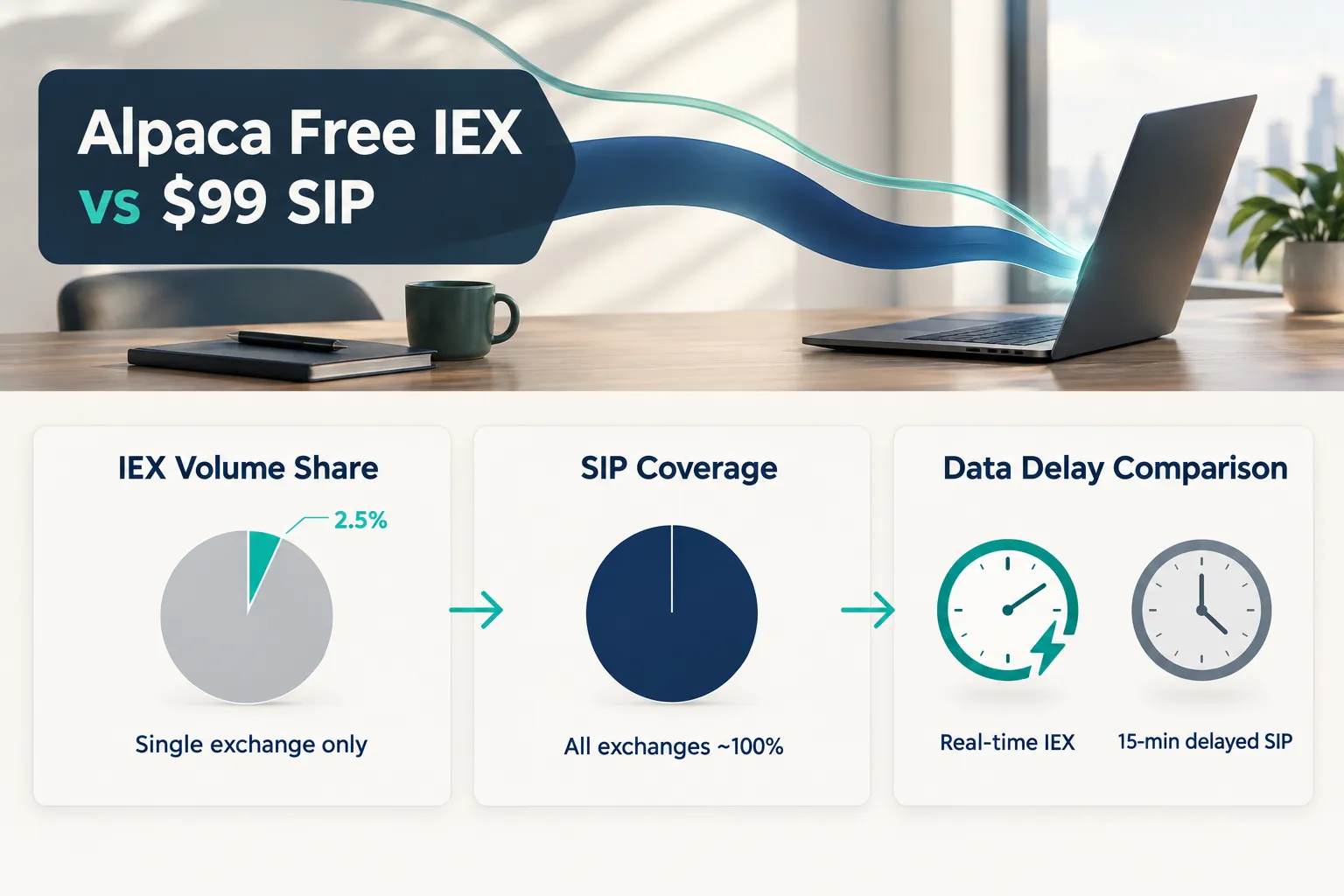
The twist nobody tells you: IEX handles roughly 2.5% of US equity volume while the SIP covers close to 100% of reported volume, according to Alpaca’s own historical data guide. So you’re paying $1,188 a year to see 40x more of the tape. Whether that’s smart money or wasted money depends entirely on what your bot does with it.
Quick Answer
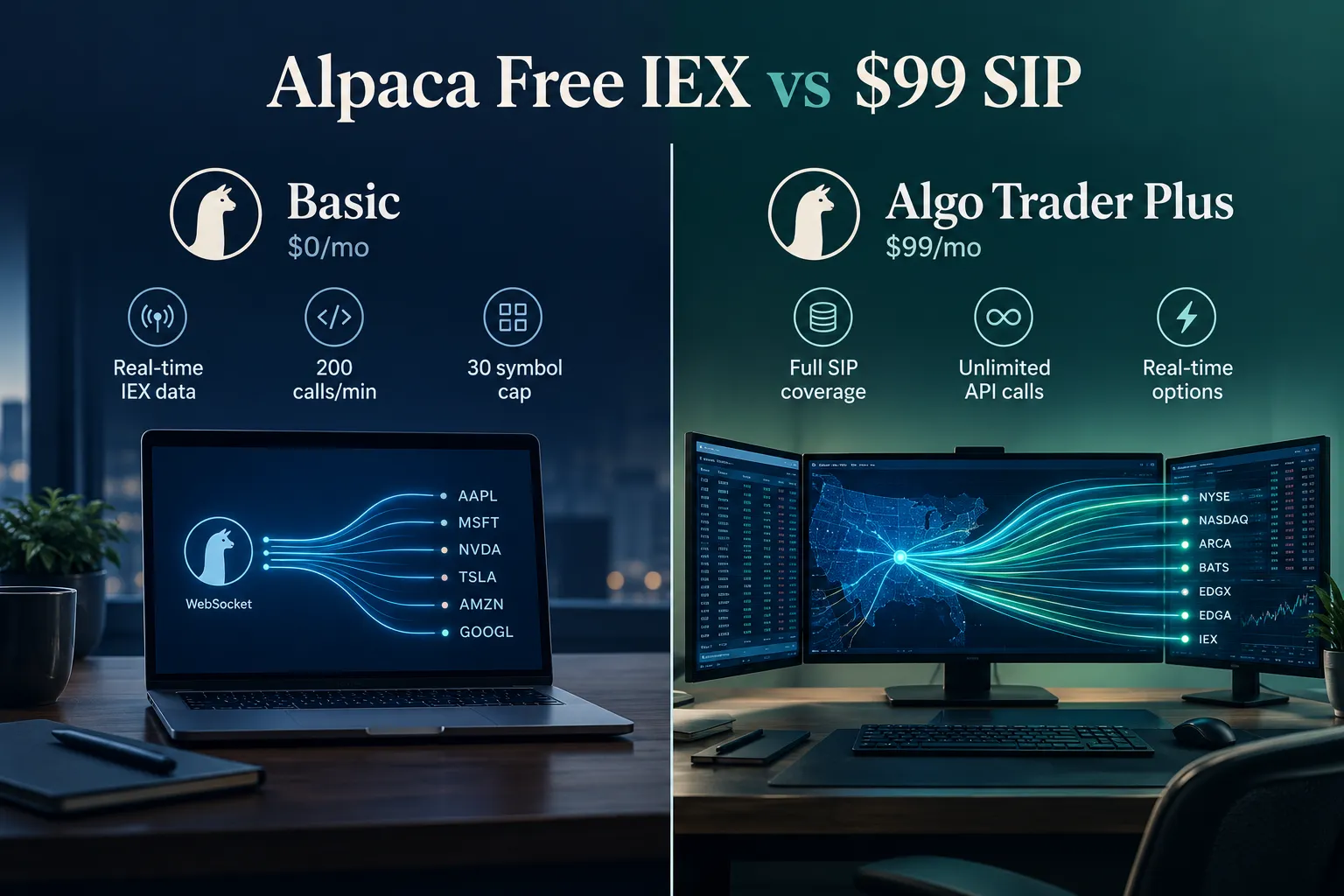
Alpaca API pricing starts at $0 per month for the Basic plan, which includes real-time IEX stock data via websocket, 15-minute delayed SIP data via API, 200 API calls per minute, and websocket subscriptions capped at 30 symbols, per the Alpaca data plans page as of October 2026. Algo Trader Plus costs $99 per month and adds all US exchanges through the consolidated SIP feed, unlimited API calls, unlimited websocket symbols, and real-time OPRA options data. Trading itself is commission free on both plans for self-directed US stocks and options through the Alpaca trading api. Paper trading is free on either tier.
Key Takeaways
- Alpaca api pricing has two tiers: $0/mo Basic and $99/mo Algo Trader Plus, both documented on the Alpaca data page, checked October 2026.
- IEX is about 2.5% of US equity volume; SIP is about 100%, per Alpaca’s historical data guide. That gap is the entire product difference.
- The free tier caps you at 200 API calls per minute and 30 websocket symbols. A scanner watching 500 tickers hits that wall fast.
- One Apple example from Alpaca’s docs: roughly 12,630 eligible IEX trades on September 29, 2023 versus more than 535,000 trades across all exchanges, per the Alpaca data FAQ.
- Historical SIP data is free. You only pay for recent SIP. Query recent SIP trades without a subscription and the API returns a “subscription does not permit querying recent SIP data” error, per the same FAQ.
- Alpaca Elite advertises free Algo Trader Plus data (valued at $99/mo) for personal use, with the Elite page describing a $100,000 deposit threshold.
- A 166-session community test of free IEX against SIP was posted to r/algotrading in September 2026, and the comment thread is more useful than most vendor marketing.
What do you get for free on the Alpaca API?
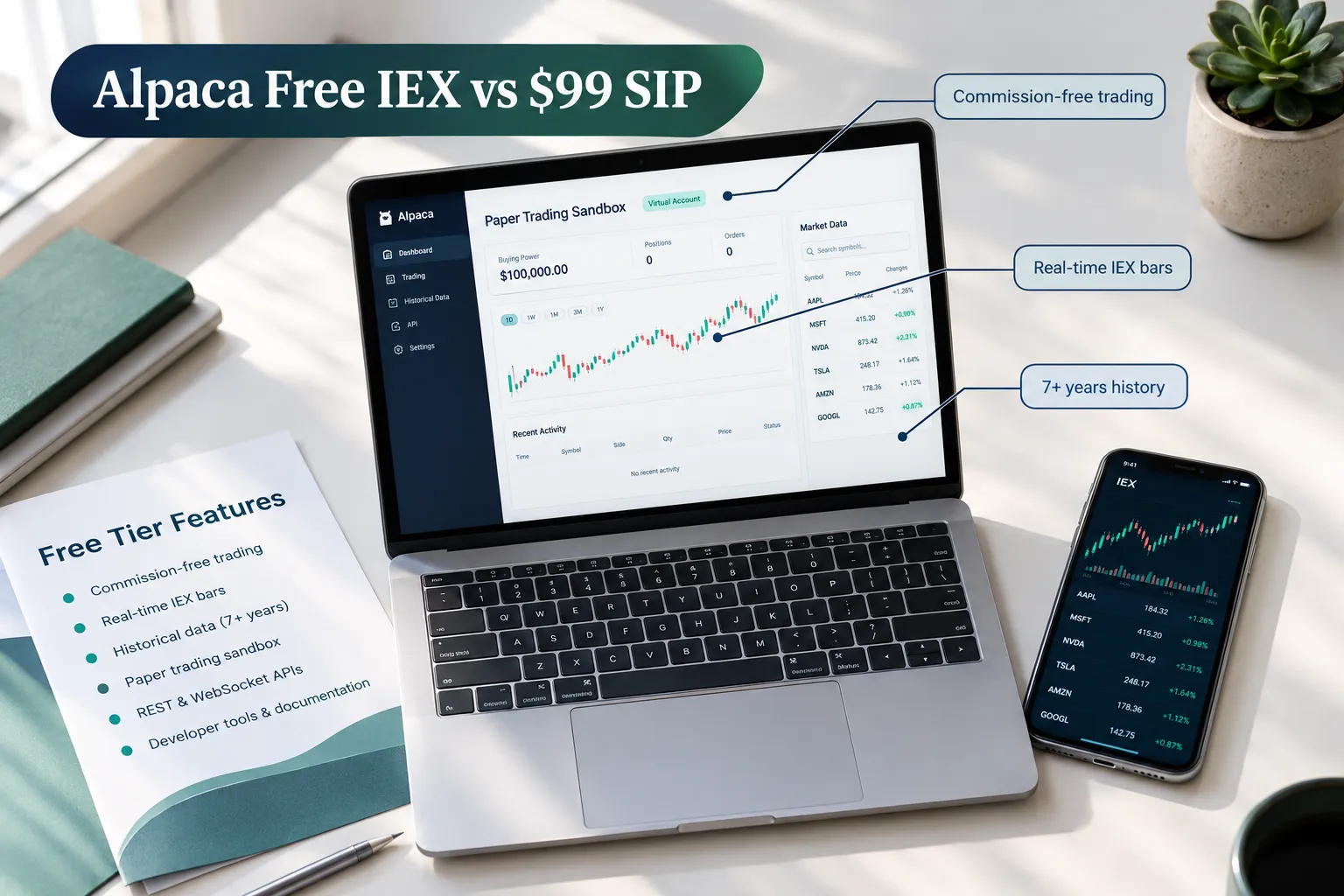
The free tier of Alpaca gives you commission free trading, a full paper trading sandbox, real-time IEX stock quotes and bars, 15-minute delayed consolidated data, 7+ years of history, and indicative options data. That is a working algorithmic trading stack for $0 per month.
Here’s what the Basic plan actually includes, per the Alpaca data plans page as of October 2026:
- Real-time IEX data over websocket, limited to 30 symbols at a time
- 15-minute delayed data via REST API for the broader market
- 200 API calls per minute rate limit
- 7+ years of historical bars, including free historical SIP
- Indicative options quotes (not real-time OPRA)
- Unlimited free paper trading through the alpaca paper trading api
The paper account is the part people undervalue. You get the same order endpoints, the same fill logic, the same REST and websocket structure as live, with fake money. If you’re just learning the alpaca api, start there. Our walkthrough on getting started with the Alpaca API as a beginner covers the first-bot setup end to end.
Market truth: free data on Alpaca isn’t a crippled demo. It’s a real feed from a real exchange, just a small one.
Practical takeaway: build and run your strategy on the free tier for 30 sessions before you even look at the upgrade button. You’ll learn more from your own fill logs than from any feature comparison.
One thing to know about the free account before you wire up a scanner: 30 websocket symbols is tight. If your watchlist is 80 tickers, you’re rotating subscriptions or polling REST, and polling at 200 calls per minute burns out fast. That limit, not the data quality, is what pushes most builders to pay.
Alpaca API pricing
Alpaca api pricing is $0 per month for Basic and $99 per month for Algo Trader Plus. There’s no middle tier, no per-call billing, no pricing calculator to run, and no hidden per-day charge. Trading commissions are $0 for self-directed US stocks and options.
| Plan | Stock data coverage | API calls | Websocket symbols | Options data | History | Price |
|---|---|---|---|---|---|---|
| Basic | IEX real-time, SIP 15-min delayed | 200/min | 30 | Indicative | 7+ years | $0/mo |
| Algo Trader Plus | All US exchanges (SIP) real-time | Unlimited | Unlimited | Real-time OPRA | 7+ years | $99/mo |
Source: Alpaca data plans and the about market data api documentation, checked October 2026.
People search for “alpaca api pricing per day” and “alpaca api pricing calculator” expecting metered billing. There isn’t any. The subscription is flat monthly. If you cancel, you drop back to IEX and delayed SIP, and your historical queries still work.
Is alpaca api free? Yes, for trading and for IEX market data. You pay only for recent consolidated data and real-time options. That’s the honest version of alpaca pricing.
A few notes on what alpaca api pricing does not cover, because this is where people get surprised:
- Regulatory fees still apply. SEC and FINRA pass-through fees on sales are standard across every US broker and are set by regulators, not Alpaca. Check the official fee schedule before you model costs.
- Options contract fees and exchange fees can apply on certain order types. Alpaca’s published fee schedule is the only source worth trusting here.
- Margin interest applies if you borrow. Margin and short selling are available on eligible accounts, and margin rates are a real cost on a leveraged bot.
- Alpaca crypto trading has its own spread-based fee structure, separate from equities.
Read Alpaca’s current fee schedule before you size a strategy around cost assumptions. Alpaca api pricing for data is flat, but fees on trades change, and we won’t print a number we can’t confirm. For broader context on what else is out there, our guide to choosing a broker with an API for automated trading compares the field.
What is the difference between IEX and SIP data?
IEX is one exchange. SIP is the consolidated tape from all of them. IEX data shows you trades and quotes that happened on IEX only, roughly 2.5% of US equity volume. SIP consolidates reports from every exchange through the CTA and UTP Securities Information Processors, covering close to 100% of reported volume.
That difference shows up in the numbers. Alpaca’s documentation gives an Apple example for September 29, 2023: approximately 12,630 eligible IEX trades against more than 535,000 trades across all exchanges, per the Alpaca data FAQ.
What that means in practice:
- Your volume readings are wrong on IEX. Not slightly off. Off by a factor of 20 to 40 on liquid names. Any strategy using relative volume as a filter is working from a sample, not the market.
- Your bars can gap. On a thin small-cap, IEX may print nothing for minutes. Your 1-minute bar series will have holes the consolidated tape doesn’t have.
- Your quote isn’t the NBBO. The national best bid and offer is built from all exchanges. IEX top-of-book is one venue’s view. Spreads look wider than they are.
- The open is the worst case. Opening auction volume concentrates on primary listing exchanges. IEX sees a sliver of it.
SIP also has limits worth naming. Alpaca’s own analysis of stock market data notes that consolidated feeds carry aggregation and distribution latency and aren’t built for the most latency-sensitive strategies. Consolidated quotes traditionally report exchange top-of-book and may not fully expose deeper order book liquidity or all odd-lot pricing.
So SIP isn’t a direct feed. If you’re comparing Alpaca’s $99 SIP to a colocated exchange feed, you’re comparing a Honda to a Formula 1 car. Both move. One is not the other.
One more wrinkle in the market data stack: Alpaca’s historical data guide documents that historical overnight stock data uses the BOATS feed tied to Blue Ocean ATS, while some real-time overnight endpoints use a separate overnight feed depending on your account plan. If your bot touches 24/5 trading hours, read that page before you assume one feed covers everything.
When is the $99 Algo Trader Plus plan worth paying for?
Pay the $99 when your strategy’s edge depends on data the free feed structurally cannot give you: accurate volume, true NBBO, more than 30 live symbols, or real-time options quotes. If your strategy holds for days and trades liquid large caps, you’re probably buying coverage you won’t use.
Use this decision rule:
Pay for Algo Trader Plus if:
- You run intraday and your entries depend on volume confirmation or relative volume
- You need real-time OPRA options quotes for a multi-leg options strategy
- Your scanner watches more than 30 symbols in real time
- You trade small caps, low float names, or anything where IEX prints sparsely
- You place market orders near the open and care about the actual NBBO
- You’re building a product on the broker api where clients see quotes
Stay on free if:
- You swing trade, holding positions from days to weeks
- Your signals come from daily bars or 15-minute bars on liquid names
- You’re backtesting on historical SIP, which is free anyway
- You’re still in paper trading and measuring your process
- You trade fewer than 30 tickers and accept a wider apparent spread
The common mistake: paying for SIP to fix a strategy problem. Alpaca’s own market data analysis points out that direct exchange feeds matter for very short-term quantitative trading, while longer-horizon strategies are less likely to benefit materially. The feed is not the edge. Position sizing and a stop loss are closer to the edge than any data subscription.
Edge case worth flagging: if you’re backtesting on free IEX bars and then going live, your backtest and your live results will diverge for reasons that have nothing to do with your logic. We wrote about this failure mode in detail in our piece on why paper trading slippage breaks live bots.
There’s also an escape hatch. Alpaca Elite advertises free Algo Trader Plus market data, valued at $99 per month, for personal use, with eligibility tied to deposits. The Alpaca Elite page describes a $100,000 deposit threshold for the free market data subscription. If you’re already funding at that level, the data question answers itself.
What did a 166-session IEX vs SIP test find?
In September 2026, an r/algotrading poster ran free IEX data against SIP across 166 trading sessions and published the results. The thread, titled “Worth paying Alpaca for real-time data? I tested free IEX data against SIP for 166 trading sessions,” is the closest thing to an independent field test on this question. The comments are where the real information lives.
Two responses in that thread matter more than most of the article you’ll read on this topic.
“You don’t have to pay to trade on Alpaca either. Trading is free, historic SIP is free, historical and real-time IEX is free.” u/strat-run, r/algotrading
That’s the structural point people miss. Historical SIP is already included on the free plan. The $99 buys recent SIP. Alpaca’s market data FAQ states that querying recent SIP trades or quotes without the subscription returns an error such as “subscription does not permit querying recent SIP data.” So your backtest can run on the consolidated tape for free. Your live bot cannot.
The second comment names the alternative nobody at Alpaca will mention:
“My conclusion was that the data i already had from Schwab was better and free. So I kept Schwab.” u/d_e_g_m, r/algotrading
Schwab’s API gives data free to account holders. If you already hold a Schwab account, running Alpaca for execution and Schwab for data is a legitimate setup, and it costs $0. It’s more plumbing. It’s also $1,188 a year cheaper.
Practical takeaway: before you subscribe, open the thread, read the comments, and check whether your own broker already hands you consolidated data for free.
How does Alpaca market data compare to Schwab, Massive and Databento?
Alpaca at $99 per month for real-time SIP sits in the middle of the market: cheaper than most institutional vendors, more expensive than a brokerage feed you already have access to. Schwab gives API data free to account holders. Massive, formerly Polygon, charges $199 per month for real-time stocks.
| Provider | What you get | Real-time SIP included | Price |
|---|---|---|---|
| Alpaca Basic | IEX real-time, delayed SIP, free trading | No | $0/mo |
| Alpaca Algo Trader Plus | All US exchanges, OPRA options, unlimited calls | Yes | $99/mo |
| Schwab API | Data free to account holders | Yes (account holders) | $0 |
| Massive (ex-Polygon) Starter | 15-min delayed stocks | No | $29/mo |
| Massive Developer | Stocks, delayed tier up | No | $79/mo |
| Massive Advanced | Real-time stocks | Yes | $199/mo |
Sources: Alpaca data plans and Massive pricing, checked October 2026. Databento prices usage-based per feed rather than per flat tier, so a direct monthly comparison isn’t meaningful; check their current rate card.
Two honest observations on this comparison. First, Alpaca bundles a brokerage with the data, and most pure data vendors don’t. You can’t send orders to Massive. Second, if you want institutional-grade direct feeds, neither Alpaca nor Massive is the answer. Third-party comparisons like this Alpaca versus Polygon breakdown and a round-up of market data APIs for stocks, options and crypto feeds cover the field, and an Alpaca versus Interactive Brokers API comparison is worth reading if you’re weighing broker choice rather than data choice. Aggregator listings like this Alpaca plans and pricing page can also help you cross-check tiers, though the official page is always the source of record.
Decision rule for high frequency trading: if your strategy’s holding period is measured in milliseconds, none of these consumer plans fit. Fast order processing doesn’t change the fact that consolidated SIP carries aggregation latency by design. Direct feeds and colocation are a different budget entirely.
Top 5 favorite features of the Alpaca API
The best parts of Alpaca aren’t the data tiers. They’re the developer-first API design, free paper trading, commission free execution, and broad asset coverage on one account.
-
Easy to use, developer-first API. The trading API and broker API share clean REST and websocket patterns, and the market data API documentation ships copy-pasteable code snippets. Python, JavaScript, Go and C# SDKs are available.
-
Commission free trading across asset classes. US stocks, ETFs and options on one account, with crypto available as a side line. Multi-leg options, margin and short selling are part of the product set. Our guide to the Alpaca options API covers the options side in depth.
-
Free paper trading that mirrors live. Same endpoints, same order types, no cost. Paper trade it first is not a slogan here, it’s the default path.
-
Self-clearing broker. Alpaca Securities LLC is a member FINRA and SIPC broker dealer that clears its own trades. SIPC covers custody failure, not market losses.
-
Flat, predictable data pricing. Two rows on the price sheet and no metering. Alpaca algo trader plus is one number, $99 a month, and you can cancel back to the free tier without losing historical access.
What we like and what we don’t like about Alpaca API pricing
Alpaca’s pricing is genuinely cheap for what you get, but the free tier’s IEX-only data is a real limitation that trips up new builders, and the $99 jump is steep with nothing in between.
What we like:
- Trading is commission free and paper trading is free, so your cost of learning is $0
- Historical SIP is included free, so backtests run on the full tape
- Two plans, flat pricing, no per-call metering or alpaca api pricing calculator math
- Self-clearing broker dealer, member FINRA and SIPC
- The $99 tier removes the 200 calls/min and 30-symbol caps entirely
What we don’t like:
- No middle tier. Going from $0 to $99 is a cliff with no $29 or $49 option. Massive offers graduated tiers; Alpaca doesn’t.
- The free tier’s IEX data misleads beginners. Volume readings off by 20x will quietly break any relative-volume filter, and nothing in the API warns you. You find out when live results don’t match the backtest.
- Options data on free is indicative only. If you’re running options, the free plan isn’t really usable.
- Please check the fee schedule yourself. Regulatory pass-throughs, margin rates and crypto spreads aren’t in the headline $0 number.
What do real users say about paying for Alpaca market data?
Community sentiment in the September 2026 r/algotrading thread is split, with several commenters arguing the free tier is sufficient and at least one concluding a Schwab account already provided better data at no cost. The discussion volume on this specific question is thin, so treat it as directional, not definitive.
The two comments quoted above are the substance of it. One commenter emphasized how much is already free: trading, historic SIP, and both historical and real-time IEX. Another tested it and kept Schwab, saying the data he already had was better and free.
That’s not a referendum. It’s two data points from one thread. The only sources cited here are the ones linked, and we won’t manufacture a consensus out of a handful of comments. If you want more voices, read the full 166-session test thread and the api docs side by side.
Practical takeaway: before you weigh alpaca api pricing at all, the cheapest research you can do is ask whether your existing brokerage account already includes consolidated data. Many do.
Competitors and alternatives to the Alpaca API
If Alpaca’s $99 data tier doesn’t fit, the three realistic alternatives are Schwab’s free API data for account holders, Massive’s graduated tiers from $29 to $199 per month, and running Alpaca for execution while sourcing data elsewhere.
- Schwab API. Free data to account holders. Strongest option if you already bank there. More account friction, less developer-friendly than Alpaca.
- Massive (ex-Polygon). Stocks Starter at $29/mo for 15-minute delayed, Developer at $79/mo, Advanced at $199/mo for real-time, per Massive pricing. Data only, no execution.
- Interactive Brokers. Deeper instrument coverage and global markets, with a steeper API learning curve. Data subscriptions are itemized per exchange.
- Split stack. Alpaca trading api for orders, a separate vendor for market data. More moving parts, often cheaper.
- Free charting first. If you’re still deciding what data you need, start with our comparison of free stock charts across TradingView, Finviz and Yahoo and the Alpaca tool profile in the directory.
Before you spend anything, run your sizing math. The swing trade position size calculator and the trading expectancy calculator will tell you more about whether your strategy survives than any feed upgrade will.
Our take on Alpaca API pricing
Start free. Measure for 30 sessions. Only pay the $99 if you can point at a specific decision your bot makes that IEX data got wrong. That’s the position, and the numbers support it.
The free tier is not a trial. It’s a complete alpaca trading stack with commission free execution, free paper trading, 7+ years of history, and free historical SIP for backtests. The constraint that actually forces upgrades isn’t data quality, it’s the 30-symbol websocket cap and the 200 calls per minute ceiling. Those are capacity limits, and you’ll feel them before you feel the IEX coverage gap.
If you swing trade liquid large caps, the $99 is probably dead money. If you run intraday scans across hundreds of symbols, trade low float names, or need real-time OPRA options quotes, it’s the cost of doing business.
The honest framing: $1,188 a year is roughly the cost of one mid-sized losing trade for a $25,000 account. Spending it to see the full tape is defensible. Spending it to avoid fixing your risk management is not. Systems over hacks.
Your practical next step: set up a free account, generate your keys using our walkthrough on creating and securing Alpaca API keys, run your strategy in paper for 30 sessions, and log every instance where a volume reading or quote looked suspect. If that log is long, subscribe. If it’s empty, you just saved $1,188.
Built something on the Alpaca API you want covered? Submit your bot for review.
One tool, examined closely. There are 200+ more catalogued in the FullStack Alpha directory, filterable by category, price and what they actually do. Browse the directory at aistockpickerapps.com.
Pricing note: $99 today, who knows after Black Friday. The robots set the price tag, the official page has the final word.
This article is education, not financial advice. Nothing here is a recommendation to buy or sell any security, and no outcome is promised. Review Alpaca’s official fee schedule before trading.
Your market edge starts with the right tool. Stay alpha.
Frequently Asked Questions
Is the Alpaca API free?
Yes. The Alpaca API is free to use for trading, paper trading, real-time IEX market data, and historical SIP data. You only pay $99 per month for Algo Trader Plus if you need recent consolidated SIP data, real-time OPRA options quotes, unlimited API calls, or unlimited websocket symbols.
What does Alpaca Algo Trader Plus include?
Algo Trader Plus costs $99 per month and includes real-time data from all US exchanges via the consolidated SIP feed, unlimited API calls, unlimited websocket symbol subscriptions, 7+ years of history, and real-time OPRA options data, per the Alpaca data plans page checked October 2026.
What are the limits of the free Alpaca data plan?
The free plan gives real-time IEX data over websocket, 15-minute delayed data via the API, 200 API calls per minute, websocket subscriptions limited to 30 symbols, and 7+ years of history. Options data on the free plan is indicative, not real-time OPRA.
How can I get a free API key for Alpaca Markets?
Create a free Alpaca account at alpaca.markets, verify your email, then generate keys from the dashboard. Paper trading keys are available immediately with no funding required. Live keys require account approval, and the free data tier costs $0 per month.
Is Alpaca really commission free?
Yes for self-directed US stock and ETF trades placed through the API, and options are commission free too. Regulatory pass-through fees from the SEC and FINRA, exchange fees on some order types, margin interest and crypto spreads still apply, so check Alpaca's official fee schedule.
Is Alpaca paper trading API free?
Yes. The Alpaca paper trading API is free with no funding requirement and no monthly charge. It mirrors the live trading API endpoints, order types and websocket streams, so code written against paper runs against live with a URL change. Paper fills are simulated, so expect differences from real execution.
Is there a free API for stock prices?
Yes. Alpaca's free tier provides real-time IEX quotes and 15-minute delayed consolidated data with 7+ years of history, and Schwab provides free API data to account holders. The tradeoff on Alpaca's free plan is IEX coverage, roughly 2.5% of US equity volume versus near 100% for SIP.
Does IEX data work for day trading bots?
Sometimes, with caveats. IEX covers roughly 2.5% of US equity volume, so volume filters and NBBO-sensitive entries will be inaccurate. For liquid large caps with simple price-based rules, IEX can work. For low float names, relative volume signals, or anything near the open, the free feed will mislead you.
Which broker is best for API trading?
For US retail algo traders, Alpaca and Interactive Brokers lead. Alpaca wins on developer experience, commission free trading, free paper trading, and simple two-tier data pricing. Interactive Brokers wins on global instrument coverage and depth. Schwab is strong if you want free API market data with your account.
Contributing writer at AI Stock Trading Bots.
