

The FullStack Alpha research desk tests AI trading bots on paper and live accounts. Reviewed and edited by Jay Rocco, Founder and Editor.
November 4, 2026, 7:55 a.m. ET | By FullStack Alpha Editorial Team | Reviewed by Jay Rocco, Chief Editor
On November 2, 2026, Tel Aviv startup 42AI came out of stealth with $62.5 million and a product that tells brokerages what their own customers are likely to trade over the next 24 hours.
It is not a stock picker and it will not appear in your trading app. It is a risk tool sold to the house, and the practical effect is simple: your broker may soon understand your habits better than you do.
Quick answer
42AI sells a “behavioral world model” to brokerages. Ten large brokerages reportedly use it to forecast each client’s likely instrument, direction and size up to 24 hours out, then hedge before that flow hits the firm’s book. For retail and bot traders, the risk is not front-running. It is that predictable behavior can now be modeled and priced.
Key facts
- 42AI exited stealth on November 2, 2026 with $62.5 million gathered over three years from its founders and Infinity Group, not a single priced venture round.
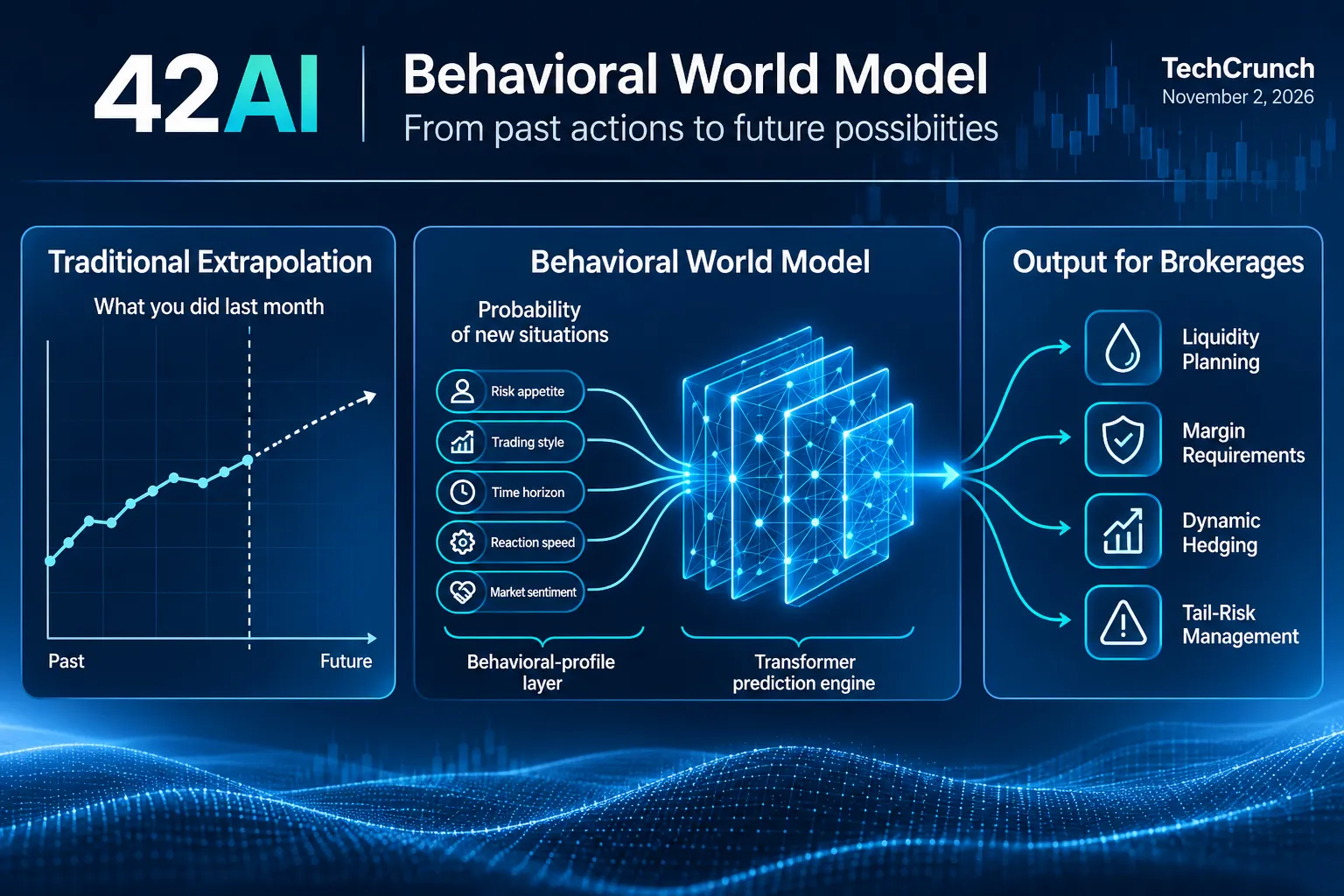
- The company says ten large brokerages use it for liquidity planning, margin requirements, dynamic hedging and tail-risk management. None are named.
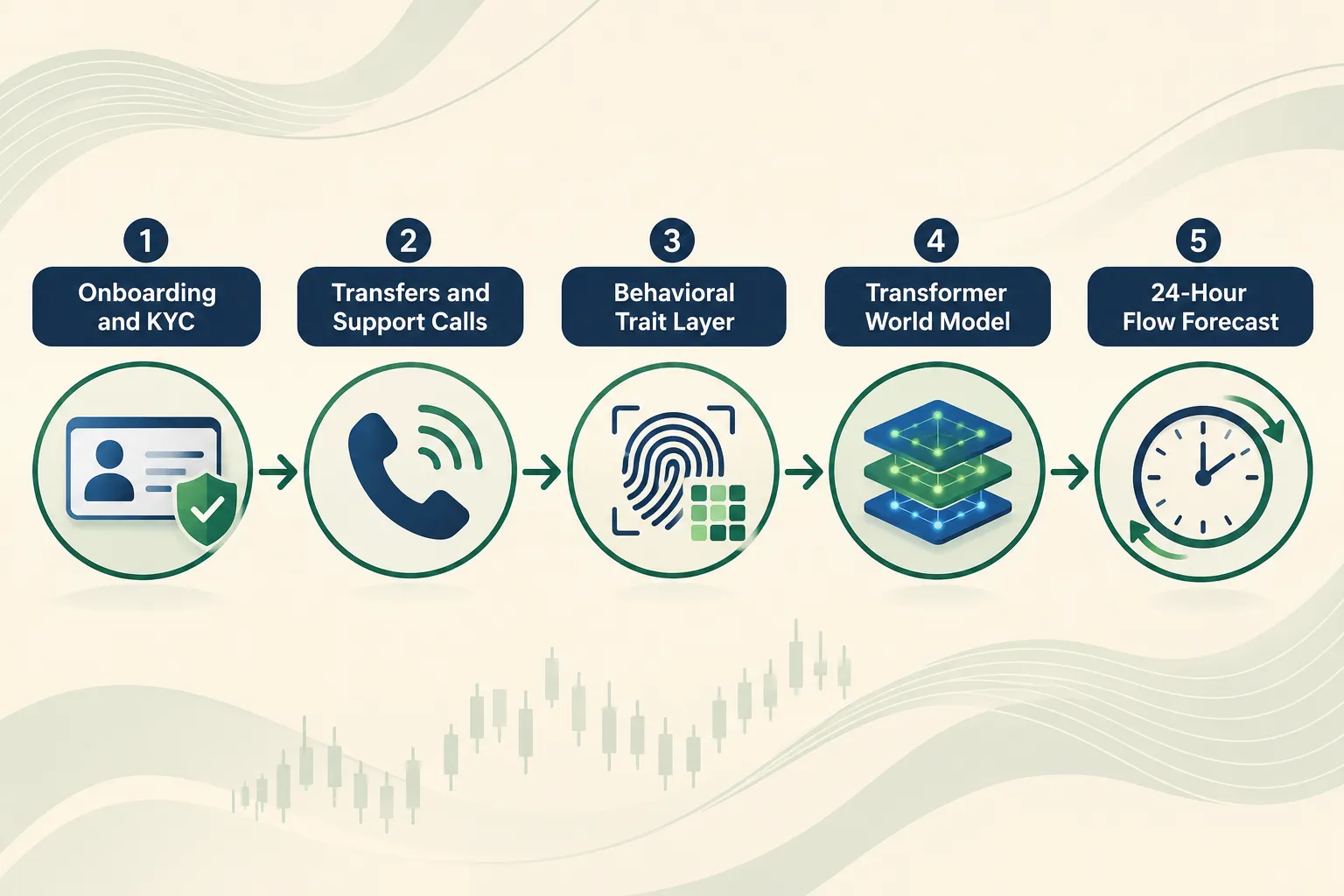
- Inputs go well past trade history: onboarding and KYC interactions, fund transfers, support call frequency, voice characteristics, sentiment and timing.
- The headline “98% accuracy” refers to aggregate flows landing inside a predicted range, not individual trade calls. Per-client direction and volume carry a reported F1 score of 0.80 to 0.85.
- CTO Ehud Ezra called the risk of brokerages using predictions against their own clients “a valid concern,” according to SiliconANGLE.
What exactly did 42AI launch on November 2?
Instead of extending what you did last month into next month, the model tries to estimate how a person will act in situations they have not faced before.
The money is unusual too. CEO Amit Gal-Or said the $62.5 million built up over three years from the founders and Infinity Group, whose founder Amir Gal-Or is 42AI’s chairman. No outside split. No priced valuation.
Translation: a well-funded insider round with a product already deployed, not a cold start.
How does 42AI’s model predict a client’s next trade?
Two layers. First, a profile layer turns observed interactions into trait representations. Second, those traits feed a transformer model, the same architecture family behind large language models, which simulates likely next actions. A separate language model writes an explanation for each forecast.
Gal-Or’s thesis: circumstances change, psychological tendencies move slowly.
The input list is the part worth reading twice:
- Onboarding and KYC interactions
- Fund transfer patterns
- Support contacts and call frequency
- Voice characteristics and sentiment
- Transaction timing
- Prior buying and selling behavior
42AI says its customer-linked datasets cover close to 30 million people. That is a company claim, not an audited count. Gal-Or says the model does not need personally identifiable information. Profiles are still built per person.
What do the 98% accuracy and 0.80 F1 numbers really mean?
Gal-Or himself said the 98% figure measures whether aggregate flows land inside a predicted range. Predicting that a broker’s book will net long a sector tomorrow is a far easier problem than predicting that you, personally, will buy 40 shares at 10:14 a.m.
| Claim | What it sounds like | What it actually measures |
|---|---|---|
| 98% accuracy | The model nails individual trades | Aggregate flow lands in a predicted range |
| F1 of 0.80 to 0.85 | An edge you could trade | Direction and volume classification, test design undisclosed |
| About $30M gained at one brokerage | Realized profit | Company-reported dynamic hedging result, no independent check |
| Seven-figure revenue | A scaled business | No customer names, contract sizes or retention data |
| About 30M people in datasets | Audited coverage | Company-stated |
Every model has a number it leads with. Ask what it was measured against before you care.
Is your broker front-running you with this?
No, and the line matters.
Front-running means trading ahead of a customer order the firm already holds. FINRA Rule 5270 prohibits trading ahead of an imminent block transaction while holding that information. Separately, SEC Regulation Best Interest requires broker-dealers to put retail customers first on recommendations.
42AI’s described uses sit on the firm’s own balance sheet: cash, margin and hedging. Forecasting that the retail book will lean long tech tomorrow and hedging for it is inventory management, a sharper version of what market makers have always done.
The gray zone is personal use. Forecasts that shape individual margin terms, product prompts or notification timing are not front-running, and no SEC or FINRA rule is written specifically for behavioral profiling of clients. The founders cited regulation, monitoring and an ethics committee as safeguards, without specifics.
That gap is the story. Not the $62.5 million.
What does this mean for retail traders?
Three practical consequences, none of them doom.
Your predictability is now a priced asset. If a model can place you inside a probability band on a 24-hour clock, you are running a pattern consistent enough to model. Panic selling at the open. Averaging down into weakness. Chasing green candles at 3:40 p.m. That is FOMO with a timestamp.
Margin terms may get more personal. Better behavioral forecasts make risk-based margin sharper.
Nothing here picks stocks. 42AI forecasts order flow, not prices.
The fix is boring on purpose: trade a written plan so your behavior is a decision, not a tell.
What does this mean for bot traders and algo builders?
Read 42AI as a signal about the other side of your fill.
Brokerages that forecast order flow hedge more precisely. That can mean steadier liquidity on normal days, and a firm better prepared for the exact crowded moment your strategy depends on.
Three checks for your own stack:
- Does your edge rely on predictable retail flow? Meme momentum, gamma squeezes and post-earnings chasing get thinner when the house models that flow in advance.
- Have you read your broker’s routing disclosures? Brokers publish order routing and payment for order flow data in quarterly SEC Rule 606 reports. Ten minutes tells you who touches your order.
- Is your backtest built on a liquidity regime that still exists? If broker hedging changes, so does slippage. Our paper trading slippage guide shows how to stress it.
Your bot is a pattern too. API order timing is at least as readable as a human’s. Change anything, then forward test it first. This week’s study of AI agents raising their own spending limits made the same point: check the controls you assume exist.
How is this different from AI tools retail traders can buy?
Retail screeners and rating engines forecast stocks. Broker AI agents execute the strategy you give them. 42AI forecasts people, and only brokerages can buy it. That is why Robinhood’s 200,000 agentic accounts and Jefferies’ call on agent-driven volume belong in the same conversation: more automated retail flow means more flow for the house to model.
What should investors watch next?
- The next quarterly Rule 606 reports. Any shift in routing or internalization at large brokers shows up there first.
- A named 42AI customer. No brokerage has been identified publicly. A named partner moves this from claim to fact.
- Independent validation of the F1 figures. Until a third party sees the test design, treat 0.80 to 0.85 as vendor-claimed.
Our take
42AI’s launch is a real story with an inflated headline. The money came mostly from the chairman’s own group over three years, the 98% figure answers the easier of two questions, and the $30 million result is self-reported.
Strip that out and what remains still matters: ten large brokerages reportedly pay to model their customers’ next moves using KYC records, call frequency and voice sentiment.
You cannot opt out of being modeled. You can stop being easy to model, which happens to be the same thing as trading with rules.
Next step: pull your last 30 trades and mark each one as rule-driven or feeling-driven. The feeling column is what a model like this sees first.
Know a trading bot that makes claims nobody is allowed to test?
We check submissions against primary sources and live behavior before anything gets published.
This article is for education only and is not financial advice. Trading involves risk, including loss of principal. Company claims are reported as stated and have not been independently verified.
Sources
- SiliconANGLE, “42AI launches with $62.5M to predict how traders act when markets turn volatile,” November 2, 2026: https://siliconangle.com/2026/11/02/42ai-launches-with-62-5m-to-predict-how-traders-act-when-markets-turn-volatile/
- TechCrunch coverage of the 42AI launch, November 2, 2026
- FINRA Rule 5270, Front Running of Block Transactions: https://www.finra.org/rules-guidance/rulebooks/finra-rules/5270
- SEC, Regulation Best Interest: https://www.sec.gov/regulation-best-interest
- SEC, Disclosure of Order Handling Information (Rule 606) final rule: https://www.sec.gov/rules/final/2018/34-84528.pdf
Your market edge starts with the right tool. Stay alpha.
Frequently Asked Questions
What is 42AI?
42AI is a Tel Aviv AI company that came out of stealth on November 2, 2026 with $62.5 million. It sells a behavioral world model to brokerages that forecasts what each client is likely to trade over the next 24 hours.
Is 42AI available to retail traders?
No. The product is sold to brokerages for liquidity planning, margin, hedging and tail-risk work. No consumer version has been announced.
Does 42AI predict stock prices?
No. It forecasts the likely instrument, direction and size of client order flow up to 24 hours ahead. That is an exposure forecast for the broker, not a price forecast.
Is a broker using this model front-running its clients?
Not by itself. Front-running means trading ahead of a customer order the firm already holds, which FINRA Rule 5270 restricts. Using forecasts to hedge the firm's own book is risk management, though no rule is written specifically for behavioral profiling of clients.
Should bot traders change their strategies because of 42AI?
Not reflexively. Check whether your edge depends on predictable retail flow, read your broker's Rule 606 routing report, re-test slippage assumptions, and paper trade any change before going live.
Is this article financial advice?
No. This article is for education only. It reports company claims as stated and does not recommend buying, selling or holding any security. Speak with a licensed financial professional about your own situation.
The FullStack Alpha research desk tests AI trading bots on paper and live accounts. Reviewed and edited by Jay Rocco, Founder and Editor.
