

Public AI agents can trade stocks, ETFs, options, bonds, crypto and Kalshi event contracts, but they cannot invent a strategy you didn’t approve first. That one sentence is the whole product. Public AI Agents | What They Can Trade and What They Can’t comes down to a permission question, not an intelligence question, and most retail investors get that backwards before they flip the switch on.
Public reported roughly 20,000 agents and more than $200 million in assets overseen by agents by October 2, 2026, according to a Dow Jones report carried on TradingView. That’s real adoption in six months. It’s also a lot of people handing a rule engine the keys without reading the manual.
Quick Answer
Public AI agents are rule-based automations inside the Public brokerage app that let you describe a trading or portfolio condition in plain English, then convert it into fixed rules you review and approve before anything executes. They can act on stocks, ETFs, options (including multi-leg), bonds, crypto and prediction-market contracts through Kalshi. They cannot trade outside your approved parameters, cannot access products you aren’t approved for, and cannot promise a return. Prediction markets sit under the CFTC, not the SEC, which makes them a separate high-risk product rather than investing.
Key Takeaways
- Public launched its AI agents on March 31, 2026, and calls itself the first brokerage to do it, a claim made by Public in its own announcement.
- On September 24, 2026, Public extended agents to prediction markets through Kalshi, letting an agent monitor an event probability and trigger a separate trade, per its press release.
- You approve a policy, not every ticket. Public converts your plain-English intent into fixed rules you must review before activation, described on the Public AI Agents page.
- A Vanguard survey found 57% of investors are uncomfortable with AI acting on their portfolios (Business Insider, October 1, 2026). Discomfort is not a bug, it’s a reasonable prior.
- Event contracts are regulated by the CFTC, and a Sixth Circuit ruling on September 25, 2026 said Ohio and Tennessee may regulate Kalshi sports contracts under state gambling law, per Reuters.
- Prediction-market access requires you to be 18 or older with a valid SSN and a permanent U.S. address, per Public’s prediction markets page.
- No agent, at Public or anywhere, has a verified long-run edge. Treat three-day model results as noise, not a benchmark.
What are Public AI agents?
Public AI agents are automated rule-runners built into the Public investing app that watch markets and place orders inside limits you set in advance. Public describes them as agents that handle conditional trades across stocks, options, crypto and bonds, plus cash sweeps, hedges, stop-losses and portfolio-risk workflows. They are not a chatbot that picks stocks for you. That positioning, a public agentic brokerage built around standing rules rather than a chat window, is what separates it from a generic ai investing app.
The pitch from cofounder Leif Abraham, quoted in Fortune: “AI agents can do work for you, and in investing, that means they can monitor markets when you’re not looking at a screen.” That’s the honest framing. Attention, not alpha.
Think of it like a smart thermostat for your brokerage account. You don’t negotiate with it every morning. You set the temperature range once, and it acts when the room drifts. The thermostat doesn’t decide it wants the house at 82 because it read a blog post.
Market truth: an agent is only as good as the rule behind it. Garbage intent in, garbage execution out, just faster.
Where this sits in the broader market matters. Public is one of several brokers racing to ship agentic features, and the whole category deserves the same scrutiny you’d give any AI trading bot before you automate trades.
public ai agents
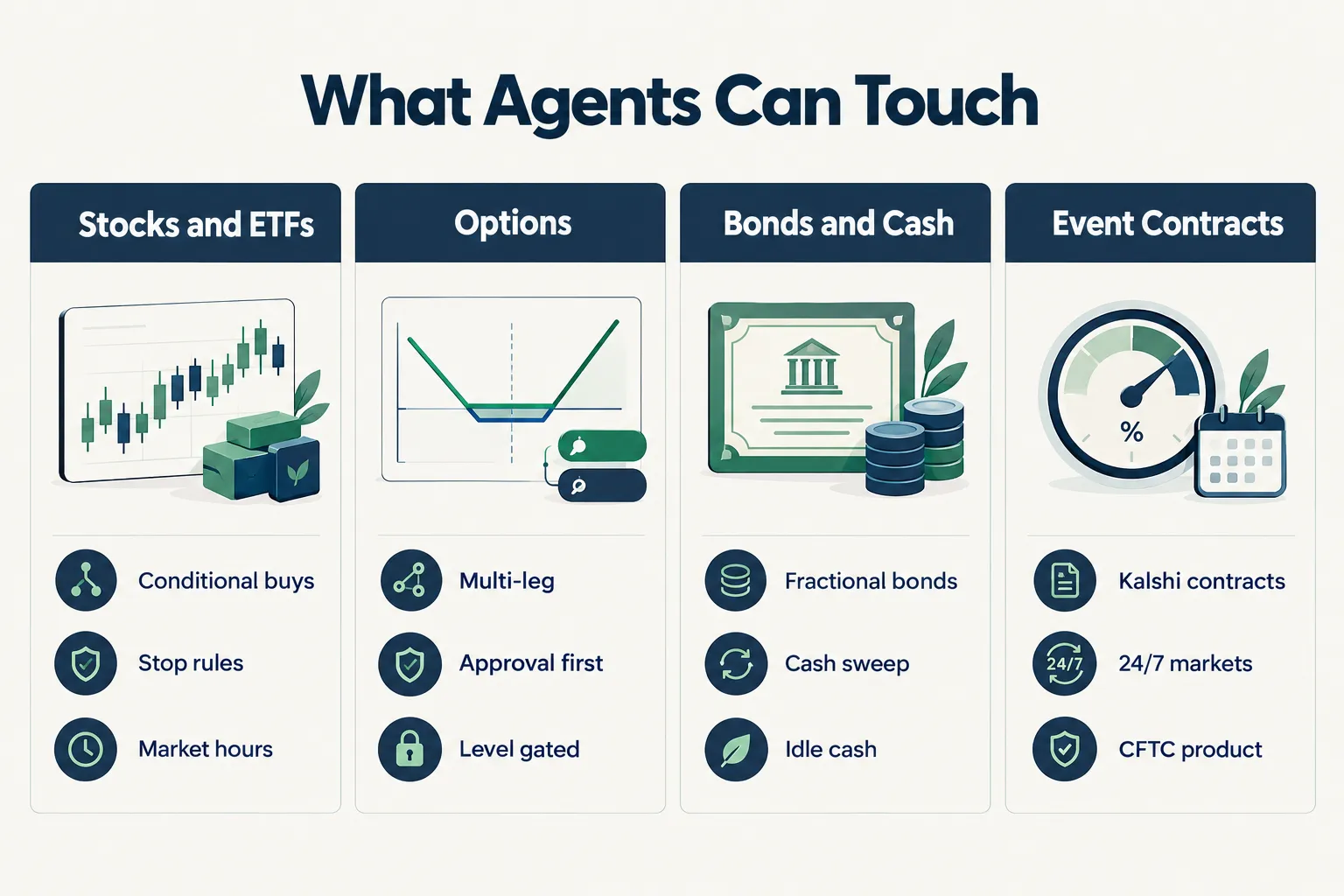
The exact answer to what public ai agents can and can’t trade: they can place orders in U.S. stocks, ETFs, single-leg and multi-leg options, fractionalized bonds, crypto through Zero Hash LLC, and Kalshi event contracts. They can’t trade anything you lack approval or eligibility for, can’t operate outside the rules you approved, and can’t be relied on to interpret a vague instruction the way you meant it.
Here’s the honest inventory, based on what Public documents publicly.
What public ai agents can trade
- Stocks and ETFs. Conditional entries and exits, trailing rules, rebalancing logic. The bread and butter.
- Options, including multi-leg. Covered calls, protective puts, spreads. Only if your options level covers that strategy.
- Bonds, fractionalized. Treasury and corporate exposure in small sizes, which is one of Public’s better-known features.
- Crypto. Offered through Zero Hash LLC, not Public Investing itself. Separate rails, separate risk.
- Prediction market contracts via Kalshi. Economics, corporate events, policy, elections, crypto, commodities, climate, markets and technology, per Public’s Kalshi announcement.
- Cash management. Sweeping idle cash into a high-yield cash account rather than letting it rot at zero.
What public ai agents can’t do
- Invent a new strategy after activation. The agent executes the approved workflow, full stop.
- Trade an asset class your account isn’t approved for. Options levels and margin eligibility still gate everything.
- Override securities rules. Pattern day trading math, settlement, margin calls and good-faith violations all still apply.
- Guarantee a fill, a price or an outcome. Thin markets, gaps and halts don’t care about your rule.
- Act on a bad prompt charitably. If your intent is mushy, the rules will be mushy.
One hard line worth repeating: prediction markets are event contracts regulated by the CFTC, not securities regulated by the SEC. Public’s own prediction markets page lays out the eligibility gates. Treat that sleeve as speculation with a probability readout, never as a retirement plan.
How do Public’s rule-based agents work?
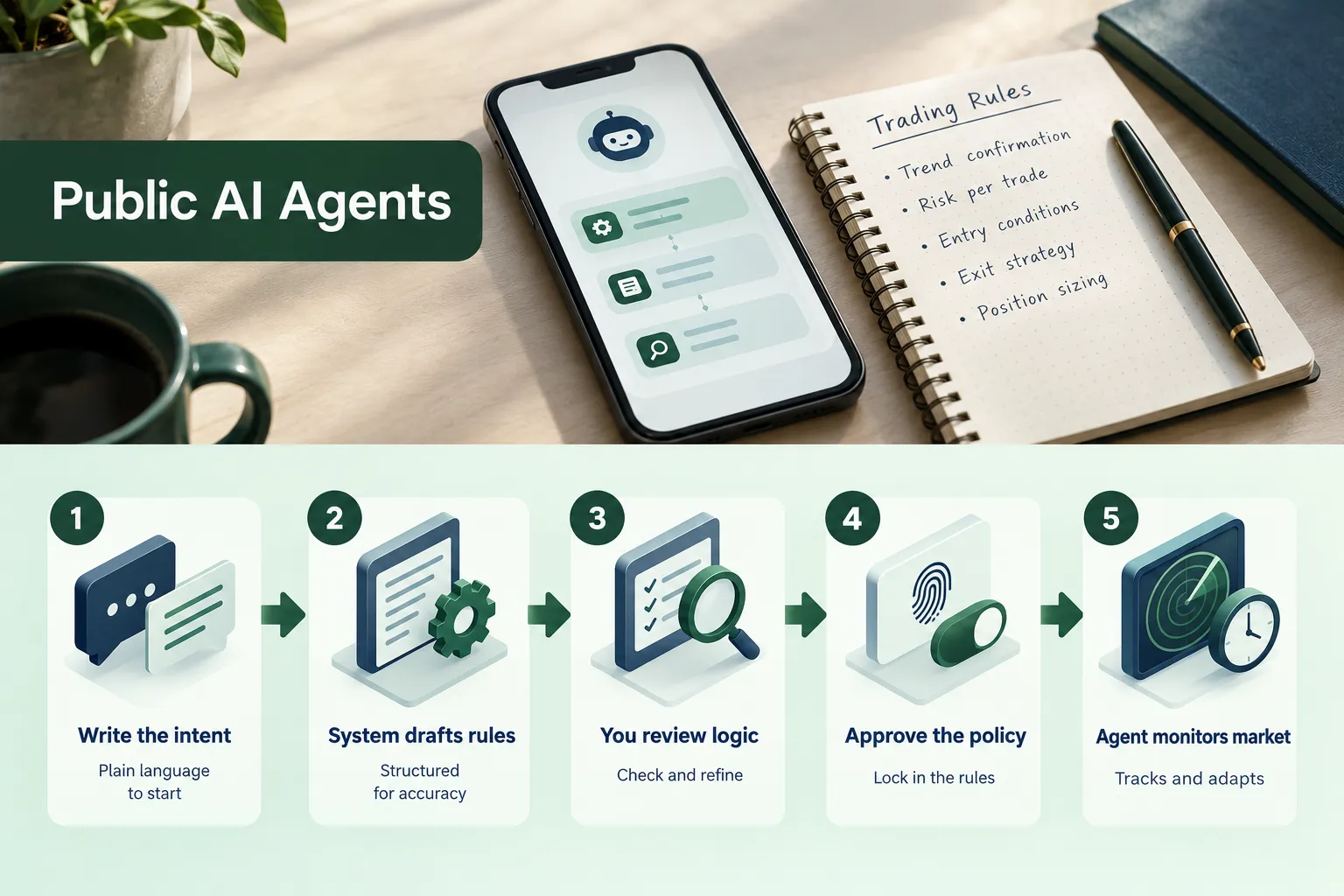
You write what you want in plain English, Public’s system converts it into fixed, readable rules, and nothing runs until you approve those rules. Once activated, the agent is intended to execute only inside the approved parameters, which Public spells out across its AI Agents and prediction markets documentation.
Enter a prompt, choose an agent
The flow is short. Enter a prompt describing the condition and the action. Pick an agent, either one you build or one from the marketplace. Review the generated logic. Approve or edit. The agent goes live.
Public’s own marketplace examples give you the flavor of what people actually run: $5k covered calls, a CPI hedge, retail darlings baskets, idle cash management, a Zuck’s VR put, a presidential pump play, USO spike protection, and a down payment cash rule. Some of those are serious risk tools. Some are a meme with a ticket attached. Know which one you’re building.
Expressing your intent (and why prompting matters)
The difference between a clean setup and a mess is specificity. “Hedge my tech exposure” is not a rule. “If QQQ closes below its 50-day moving average, buy one QQQ put 30 days out, max 1% of portfolio value” is a rule.
Three prompting habits that save money:
- Name the trigger precisely. Price level, moving average, implied probability threshold, calendar date. Not a vibe.
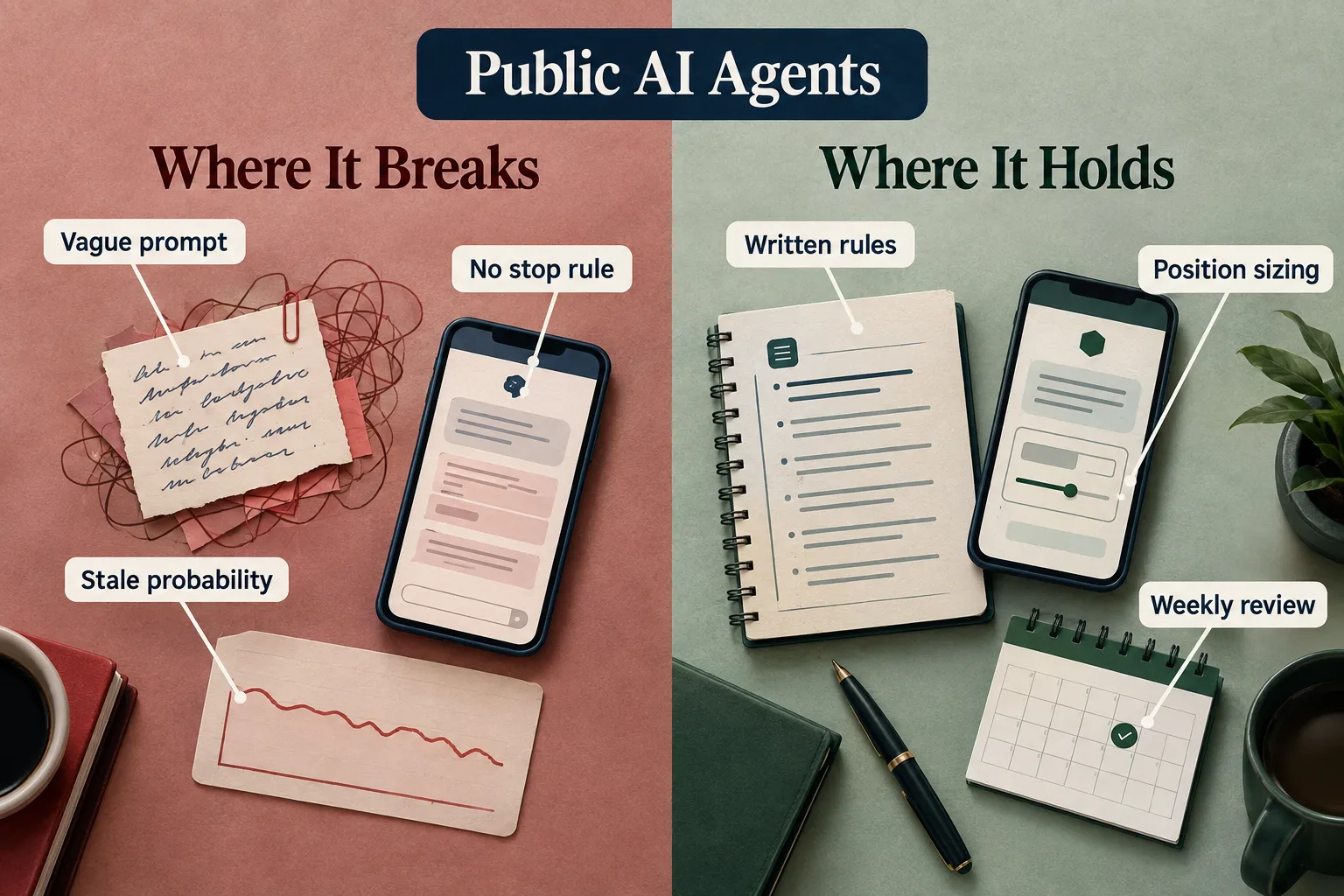
- Cap the size. Position sizing is the single control that keeps a wrong rule from becoming a wrecked account. Run the numbers in a swing trade position size calculator before you type the prompt.
- Define the exit. Agents will happily hold a loser forever if you never told them when to stop out.
You always have the final say
This is the part the marketing gets right and users skim. Public’s model is approval-before-activation. The agents monitor, the agents execute, and you own the policy. That’s a meaningful design choice compared with tools that confirm every single order or, worse, auto-approve by default.
Practical takeaway: write the rule on paper first. If you can’t explain it in two sentences to a friend, the agent can’t either.
Comparison table: Public AI agents vs Robinhood Agents vs Webull Cloud MCP vs IBKR MCP
Four brokers shipped agentic features in 2026, and they differ most on the approval model, which is the setting that actually matters. Public approves a policy once. Robinhood ships with approvals on by default. Webull and IBKR confirm every order.
| Platform | Launch | What the AI can trade | Approval model | Cost |
|---|---|---|---|---|
| Public AI agents | March 31, 2026 (agents); Sept 24, 2026 (prediction markets) | Stocks, ETFs, options incl. multi-leg, bonds, crypto, Kalshi event contracts, cash sweeps | You approve the rules once, then the agent runs inside them | Check public.com for current pricing and membership tiers |
| Robinhood Agents | GA September 29, 2026 | Stocks, ETFs, options per account approval | Approvals on by default, can be switched off | See our Robinhood Agents review and Robinhood’s site |
| Webull Cloud MCP | September 29, 2026 | Securities supported in the connected account | Confirms every order | Confirm on Webull’s official pricing page |
| IBKR MCP | July 28, 2026 | Broad multi-asset access via the IBKR account | Confirms every order | Confirm on Interactive Brokers’ pricing page |
Pricing changes often and we don’t publish numbers we can’t verify. Check the broker’s official page before you commit.
Decision rule: choose Public if you want standing rules that run while you sleep. Choose Webull or IBKR if the idea of an unattended order makes your stomach drop. Choose Robinhood only after you’ve gone into settings and decided deliberately whether default approvals stay on.
If you’re still picking the underlying platform, our breakdown of the best AI trading app covers the broker layer before the agent layer.
What are the risks of AI agents on prediction markets?
The biggest risk is legal, not technical. Prediction markets are event contracts under CFTC jurisdiction, and the regulatory ground moved underneath them in late September 2026. A rule that depends on a contract category that gets restricted in your state is a rule that can break at the worst moment.
On September 25, 2026, the Sixth Circuit ruled that Ohio and Tennessee can regulate Kalshi sports contracts under state gambling laws, rejecting the argument that the contracts sit exclusively under federal CFTC authority, Reuters reported. That deepened a circuit split and raised the odds of Supreme Court review. Three days later, on September 28, the CFTC sent proposals to the White House addressing whether event contracts fall within the swaps definition, per Yahoo Finance. None of it was resolved as of October 4, 2026.
The specific risks stack like this:
- Jurisdictional whiplash. Availability may vary by contract category and state. Your agent’s logic doesn’t know that.
- 24/7 exposure. Public advertises prediction-market access around the clock, including weekends and holidays. An agent can act at 3 a.m. on a Sunday when you can’t react.
- Thin liquidity on niche contracts. Implied probability can gap on low volume. That’s a bull trap in a different costume.
- Cross-asset chains. Public’s product can use a probability threshold to trigger an unrelated trade, like buying a stock if FDA approval probability clears 75%, or buying puts if an earnings-miss probability clears 60%, per the prediction markets launch release. Clever, and also two points of failure instead of one.
- Category confusion. Public’s framing, echoed by Kalshi’s Max Crowley, is that market-implied probabilities are continuously updated information useful for research and risk management. Fair. But a probability is a price, and prices are wrong often.
Edge case worth naming: if a state restricts a contract category your agent depends on, the trigger may simply never fire, leaving an unhedged position you believed was hedged. Silence is a failure mode too.
Top 5 favorite features
Five things about Public AI agents hold up under scrutiny, and the standout is the approval-first design that keeps a human in the loop on the policy rather than the paperwork.
- Policy-level approval. Reviewing readable rules beats rubber-stamping forty tickets a week. Fewer clicks, more actual thinking.
- Cross-asset conditional logic. Linking an event probability to a securities trade is genuinely new plumbing. Whether it’s a good idea depends entirely on your rule.
- Breadth inside one account. Stocks, ETFs, options, fractionalized bonds, crypto and event contracts under one roof, with brokerage services provided by Public Investing and crypto through Zero Hash LLC.
- Idle cash management. An agent that sweeps uninvested cash into a high-yield cash account solves a boring problem that costs real money. The least exciting feature is the most reliably useful one.
- Marketplace starting points. Create your own custom agent, or pick one from the marketplace and edit it. Starting from a working template beats staring at a blank prompt box.
Public also announced Reserve, a membership tier providing higher yield, alongside its agent rollout. Verify the current terms on Public’s site before you factor it in.
What we like / What we don’t like
Public built the most thoughtful approval model of the agentic brokers, and it also shipped the broadest surface area for things to go wrong. Both are true at once.
What we like
- Human approval sits at the rule level, where judgment actually belongs.
- Plain-English intent lowers the barrier for people who’d never write Python. Compare that to the algorithmic trading mistakes retail traders make when they code their own.
- The agents monitor markets overnight and on weekends, which is the one thing humans are objectively bad at.
- Transparent documentation on eligibility, and clear disclosure that crypto runs through Zero Hash LLC.
What we don’t like (two real drawbacks)
- Prediction-market exposure is regulatory quicksand right now. Public’s partnership describes Kalshi as a CFTC-regulated exchange, but the Sixth Circuit decision and pending CFTC rulemaking mean the legal position may differ by contract category and by state. Building standing rules on top of that is a bet on the courts.
- Policy-level approval cuts both ways. Approve once, and a sloppy rule can fire repeatedly without a second look. Webull Cloud MCP and IBKR MCP confirming every order is slower and, for some investors, safer.
A third gripe: performance framing. Public’s company-reported three-day comparison showed Claude at 2.9%, Gemini at 0.9% and ChatGPT at a loss of 0.7%, per the Dow Jones report. Three days is weather, not climate. Nobody should choose a model on that.
What do real users say about public ai agents?
Verified public commentary is thin, which is itself the finding. The clearest signals available are Public’s own reported adoption numbers and a broad industry survey showing most investors remain uneasy about AI touching their portfolios.
What’s documented:
- Roughly 20,000 agents and $200 million-plus in assets overseen, Public-reported as of October 2, 2026 (Dow Jones/TradingView).
- 57% of investors are uncomfortable with AI acting on their portfolios, per a Vanguard survey reported by Business Insider on October 1, 2026.
- Trade press coverage has been descriptive rather than evaluative. Finance Magnates and Unite.ai both walked through the mechanics of the Kalshi tie-up. The Lines framed it from the prediction-market industry angle, and Yahoo Finance covered the wiring of the two products together.
- Industry chatter on LinkedIn has picked up the “money never sleeps” angle, which is the always-on monitoring story again.
Searching “public ai agents reviews” or “top public ai agents” right now mostly returns launch coverage, not seasoned user verdicts. Six months is not enough tape. We’d wait for a full earnings season and at least one real volatility event before treating any of it as settled. Our roundup of honest AI stock tool reviews from real users in 2026 explains why solicited praise and unsolicited complaints rarely agree.
Competitors and alternatives
If Public’s agentic model doesn’t fit, the alternatives split into three camps: other agentic brokers, rules-based strategy builders, and plain scanners that leave execution to you.
- Robinhood Agents. Closest direct competitor. Approvals on by default, switchable. Our Robinhood Agents review covers the settings.
- Webull Cloud MCP and IBKR MCP. Order-by-order confirmation. Slower, more control, better for larger accounts.
- Composer. Rules-based strategy building with backtests. See our Composer Trade review.
- Trade Ideas Holly. Scanner first, execution second, built for active traders rather than set-and-forget rules. Read what Holly AI gets right and where it falls short.
- Tastytrade. If options are your main business, a purpose-built options broker may beat a generalist agent. Our Tastytrade review has the details.
- Open-source frameworks. Search “AI agent for trading github” and you’ll find plenty. Free, flexible, and entirely your problem when it breaks.
If you came here for a full public.com review of the platform itself, not just the agents, our Public review for 2026 covers the brokerage side.
Our Take
Public AI agents are a real step forward in how retail investors delegate attention, and a real step sideways in how they manage risk. The approval-first design deserves credit. The prediction-market sleeve deserves caution until the courts and the CFTC stop moving the goalposts.
Three positions we’ll defend:
One. Agents solve the attention problem, not the edge problem. Abraham’s own framing was about monitoring markets when you’re not at a screen. That’s valuable, and it is the right job for ai agents for investing. It is not a strategy. If your rules are bad, automation just executes bad faster and more consistently.
Two. Start with the boring agent. Idle cash management and stop-loss enforcement are the two highest-expected-value rules on the whole menu. Not the presidential pump. Not the VR put.
Three. Treat prediction markets as a separate account in your head. Event contracts are a CFTC product with open legal questions as of October 2026. Size them like speculation, because that’s what they are.
Your next three steps, in order:
- Write one rule in plain English, with a trigger, a size cap and an exit. One rule.
- Paper trade it first, or run it at the smallest size your account allows for 30 days.
- Review it on a calendar, not on a feeling. Weekly, same day, same question: did the rule do what I meant, or what I typed?
Discipline beats prediction, and that holds whether a human or an agent is clicking the button.
One line to keep: an agent inherits your judgment. Fix the judgment before you scale the automation.
Browse the field before you commit. This article compares tools, and depth here is only half the picture. See the full set of tested breakdowns at aistockpickerapp.com/reviews, and the 200-plus tool directory at aistockpickerapps.com.
Conclusion
Public AI agents give retail investors something genuinely useful: a way to turn a written rule into an always-on process across stocks, ETFs, options, bonds, crypto and Kalshi event contracts, with human approval at the policy level. What they don’t give you is judgment, a guaranteed fill, or immunity from a regulatory ruling that lands on a Thursday afternoon.
Start with one rule. Cap the size. Keep prediction markets in their own mental bucket. Review on a schedule. If the agent does something you didn’t expect, the prompt was the problem, and that’s a fixable problem.
This article is education, not financial advice. Nothing here is a recommendation to buy or sell any security, contract or asset.
Your market edge starts with the right tool. Stay alpha.
Frequently Asked Questions
What is the best AI agent for stock trading?
There is no single best AI agent for stock trading, because the right choice depends on your approval comfort and asset mix. Public suits standing rules across stocks, options, bonds and event contracts. IBKR MCP suits investors who want every order confirmed. No agent has a verified long-run performance edge.
Is Public.com legit?
Yes. Public is a real U.S. brokerage. Brokerage services are provided by Public Investing, Inc., a member of FINRA and SIPC, under Public Holdings, Inc., with investment advisory services provided by Public Advisors. Crypto is offered through Zero Hash LLC. SIPC protects against broker failure, not market losses. See additional disclosures on Public's site before opening an account.
Are there any free AI agents available?
Yes. Several brokers bundle basic agentic or automation features into standard accounts at no extra charge, and open-source agent frameworks on GitHub are free to run yourself. Free rarely means risk-free: you still pay in data costs, setup time and mistakes. Confirm current pricing on each broker's official page before assuming anything is included.
Is there a legal AI agent?
Yes, in two senses. AI agents operating inside a registered broker-dealer, like Public's agents through Public Investing, are legal and regulated. Separately, AI tools built for legal work exist, though that is a different category entirely. Agents trading event contracts face open jurisdictional questions after the Sixth Circuit's September 2026 ruling on state authority.
Are there any open source AI agents?
Yes. Numerous open-source trading agent projects are published on GitHub, covering backtesting, signal generation and broker API connections. They cost nothing and offer full transparency into the logic. They also come with no support, no compliance wrapper and no safety rails. If you cannot read the code, you cannot audit the risk you are taking.
How to earn $5000 per day from the stock market?
There is no reliable method, and anyone selling one is selling you. Earning $5,000 daily would require either an enormous account or leverage that routinely wipes traders out. Most day traders lose money over time. A better question is what repeatable process you can run at a size that survives a bad month, then scale slowly from there.
Contributing writer at AI Stock Trading Bots.
