

Jay Rocco is the Founder and Editor of FullStack Alpha. He has tested 200+ AI stock tools since 2022 and run 15+ AI trading platforms on live accounts with his own money. He reviews the software. He does not tell you what stocks to buy.
Last updated: August 31, 2026
Every paper trading app fills your order. That is the problem. The simulator says you bought at $47.23, the real market would have given you $47.41 on a good day and a partial fill on a bad one. That gap is not a rounding error. It is the difference between a strategy that works and one that quietly bleeds you dry the moment real money is involved.
This guide names which platforms model reality closest, which ones flatter every trade you place, and which paper trading app you should actually use if you are testing a bot or learning to trade options.
Quick Answer
The most realistic paper trading app for retail traders is either thinkorswim paperMoney (Charles Schwab) or Interactive Brokers’ paper account. Both require price to cross a limit level before filling, model slippage, and support options. Interactive Brokers adds full API access for bot testing. Robinhood has no paper trading feature at all as of 2026. Webull does offer paper trading but fills at price touch with no slippage, which inflates simulated results by 20 to 35 percent versus live outcomes.
Key Takeaways
- Robinhood has no paper trading or virtual cash demo as of July 2026. There is no workaround inside the app.
- Webull paper trading uses real-time data but fills limit orders on price touch with no queue position or slippage modeled, inflating results by an estimated 20 to 35 percent versus live trading.
- Thinkorswim paperMoney is widely considered the gold standard for retail options practice and requires price to cross a limit level before filling.
- Interactive Brokers’ paper account supports full API access, making it the standard choice for testing automated strategies and bots before going live.
- TradingView paper trading uses idealized fills and is best suited for chart-reading practice, not execution testing.
- Paper profits do not predict live results. Slippage, partial fills, and emotional pressure in live trading routinely close the gap between paper and real performance.
- Match your simulator to your actual live broker. Testing on thinkorswim while trading live on Robinhood tells you almost nothing about your real execution.
What Does a Paper Trading App Actually Simulate?
A paper trading app creates a virtual account with fake money and routes your orders through a simulated version of the market. The quality of that simulation varies enormously across platforms, and most traders never realize how wide the gap is until they go live and watch their results collapse.
Price Feed, Fill Logic, and Fees
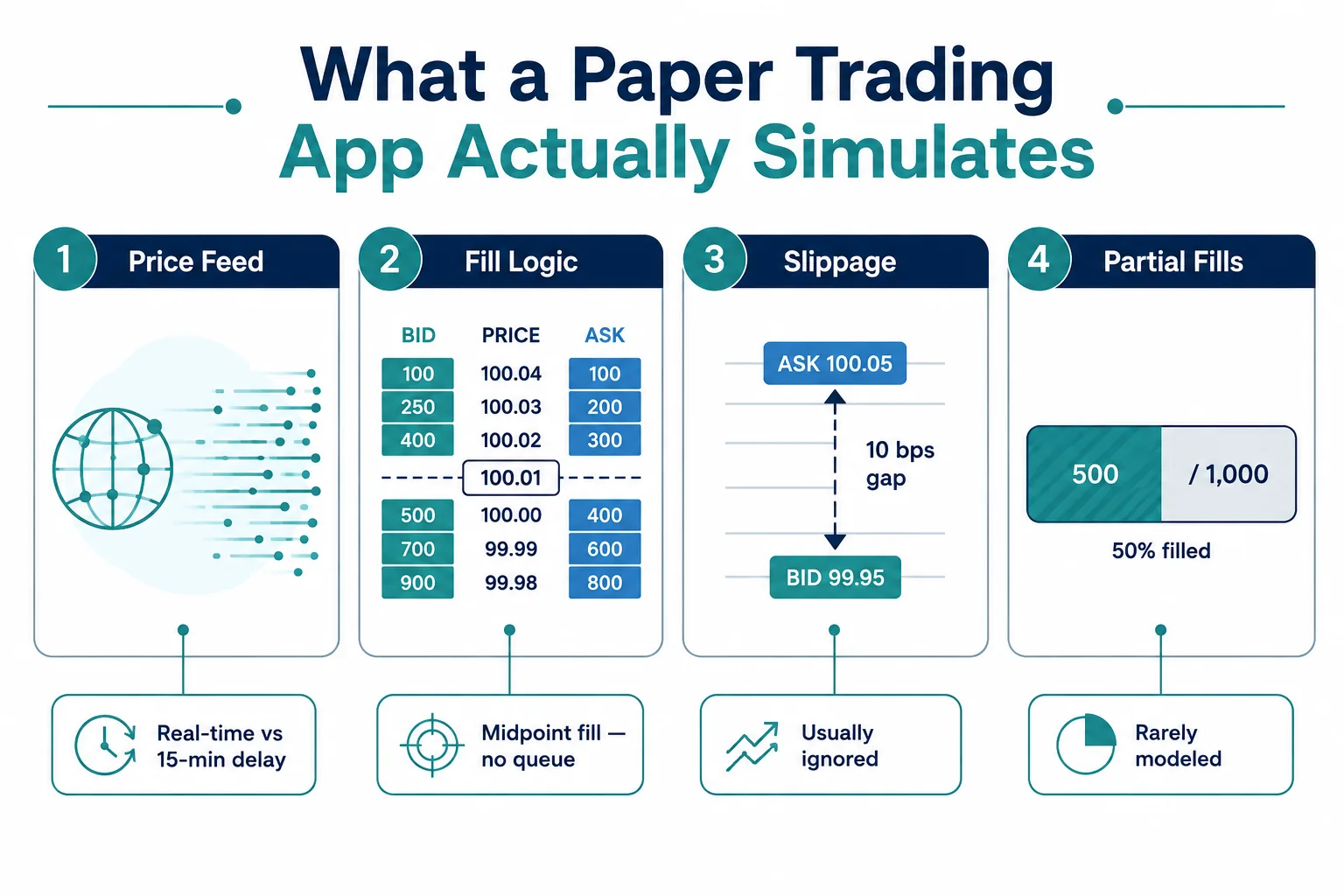
Three things determine how honest a simulator is: the price feed it uses, the logic it applies to fill your orders, and whether it charges simulated commissions.
Price feed is the starting point. Some platforms use real-time data. Others use a 15-minute delayed feed, which means every entry and exit you practice is based on prices that no longer exist. Webull paper trading uses real-time data according to its own documentation, which is a genuine advantage over delayed-data simulators. TradingView paper trading also uses live data on its paid plans.
Fill logic is where most simulators fail. The two most common approaches are price touch and price cross. Price touch fills your limit order the moment the market ticks to your price. Price cross requires the market to actually trade through your level before you get filled. In a real market, your order sits in a queue behind every other order at the same price. You only get filled when the market moves far enough to work through the entire queue ahead of you. Almost no retail simulator models that queue position correctly.
Fees matter more than traders expect. A strategy that looks profitable at zero commission can lose money at $0.65 per options contract. Thinkorswim paperMoney applies realistic commission structures. Many free simulators charge nothing, which makes every strategy look cleaner than it is.
The Three Things Almost None of Them Model
Partial fills. In a real market, a 500-share order at a thinly traded level might get 200 shares filled and the rest left hanging. Simulators almost universally fill the entire order at once.
Bid-ask spread impact. When you buy at the ask and sell at the bid, you start every trade in a small hole. Simulators that fill at the midpoint give you a free half-spread on every trade.
Market impact. A large order in a low-float stock moves the price against you as it fills. No retail simulator models this. For small accounts trading liquid names, it barely matters. For anyone testing a strategy in thinner names, it is a serious blind spot.
For a deeper look at how execution quality shapes strategy results, see how to backtest a trading strategy without fooling yourself.
Does Robinhood Have Paper Trading?
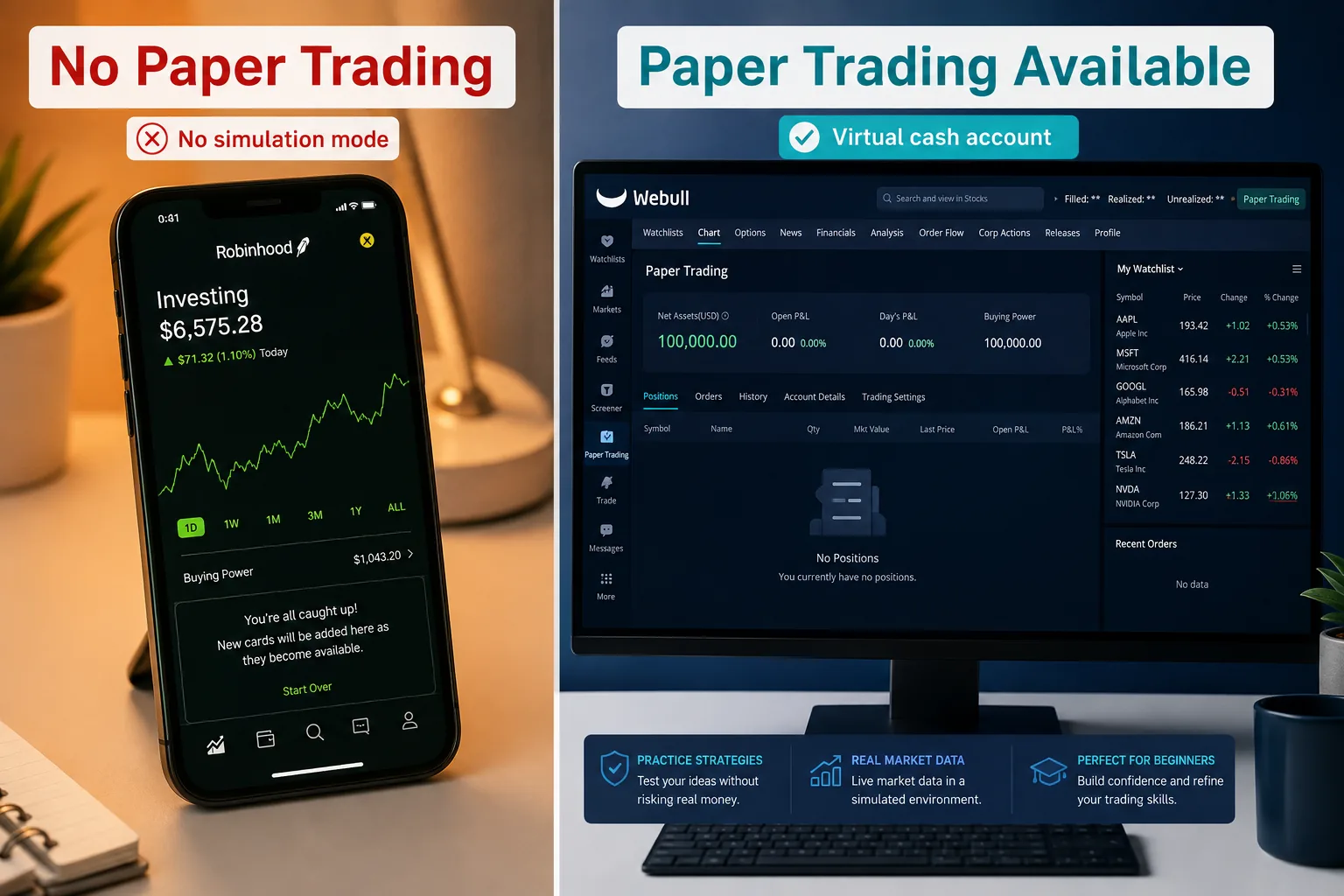
Robinhood does not offer paper trading. As of July 2026, there is no virtual cash account, no simulation mode, and no demo feature anywhere in the Robinhood app. This is a verified fact, not a settings issue.
The Honest Answer for Robinhood Users
Robinhood’s product has always prioritized simplicity and speed to first trade over education tools. Paper trading is not on the roadmap as of mid-2026. If you are searching “does Robinhood have paper trading,” the answer is no, and it has been no for the entire history of the platform.
This matters because Robinhood is one of the most popular entry points for new traders, particularly in the United States and in markets like India where mobile-first trading apps have grown rapidly. The absence of a simulation mode means beginners are going straight to live money with no practice environment.
What to Use Instead If You Trade There
If Robinhood is your live broker, the closest practice environment is thinkorswim paperMoney or Webull’s paper trading account. Neither will perfectly replicate Robinhood’s execution since Robinhood routes through its own market maker arrangements, but both give you a place to test a strategy before risking real money. Webull paper trading is free and accessible, making it a reasonable starting point for anyone learning the ropes.
Does Webull Have Paper Trading?
Yes, Webull does offer paper trading. The app includes a virtual trading account with a default starting balance and access to stocks, ETFs, and options in simulation mode. The data feed is real-time, which is better than many competitors.
Webull Paper Trading Fills and Data Delay
The honest assessment of Webull paper trading is that the data is good but the fill model is not. Webull fills limit orders on price touch, not price cross. That means your order gets filled the moment the market ticks to your price, regardless of how many other orders are ahead of you in the queue. In a real market, touching your price is not the same as getting filled at it.
Reddit users who have compared their Webull paper results to live results consistently report that paper trading overstates performance. One common observation is that paper trades get filled on ticks that would never have reached your position in the real order queue. The estimated deviation between Webull paper results and live outcomes runs 20 to 35 percent, based on tiered simulator analysis from 2026.
Webull also does not model slippage or partial fills. For stocks trading millions of shares per day, this barely matters. For options in lower-volume names, it is a significant distortion.
Contest Mode Versus Realistic Practice
Webull runs periodic paper trading contests where users compete on simulated returns over a set period. Contest mode is designed for engagement, not realism. If you are using Webull paper trading to validate a strategy, ignore the contest leaderboard and focus on whether your entry and exit logic holds up, not whether your simulated P&L looks impressive.
Thinkorswim Paper Trading: The Closest to Real for Retail Traders
Thinkorswim paperMoney, now operated under Charles Schwab after the TD Ameritrade acquisition, is widely regarded as the gold standard for retail paper trading. It models slippage, requires price to cross a limit level before filling, and supports the full range of options strategies that retail traders actually use.
How Thinkorswim Models the Book
Thinkorswim paperMoney applies a price-cross fill model. Your limit order does not get filled the moment the market touches your price. The market has to trade through your level. This is a more honest approximation of real execution than price-touch models, though it still does not model your actual queue position or partial fills at scale.
The platform also applies simulated commissions by default, which forces you to account for transaction costs in your strategy math. For options traders, this is particularly important because commission drag on multi-leg spreads can turn a marginally profitable strategy into a losing one. Thinkorswim paperMoney is the right tool to learn that lesson before it costs real money.
For traders comparing charting and analysis platforms alongside their simulation work, the TrendSpider vs TradingView comparison covers how each handles real-time data and analysis tools.
What OnDemand Adds for Replay Testing
Thinkorswim OnDemand is a historical replay feature that lets you trade through past market sessions in real time. You pick a date, set the playback speed, and trade as if the session is happening live. This is genuinely useful for testing how a setup behaves across different market conditions without waiting for the current market to present those conditions.
OnDemand survived the Schwab migration and remains available on the thinkorswim desktop platform as of 2026. It does not replicate live execution perfectly since historical fills are simulated against historical bid-ask data, but it is one of the most practical tools available for testing a strategy across a range of market environments quickly.
Paper Trading Interactive Brokers: Institutional Realism
Interactive Brokers offers a dedicated paper trading account that runs on the same TWS (Trader Workstation) platform as live accounts. It is the most realistic retail paper trading environment available, with simulated fills that model volume-weighted slippage and partial fills more accurately than any other platform in this comparison.
The IBKR Paper Account and Its Data Feed
The IBKR paper trading account receives a real-time data feed through the same infrastructure as live accounts. Fills are simulated against the actual bid-ask spread and volume at the time of the order, not at a theoretical midpoint. The estimated deviation between IBKR paper results and live outcomes is 8 to 12 percent, the tightest of any retail platform reviewed here.
The account supports stocks, options, futures, forex, and bonds. The level 2 market data feed, which shows the full order book depth, is available in paper mode, which matters for traders who use order flow as part of their decision process. For a full review of Interactive Brokers as a platform, see the Interactive Brokers tool breakdown.
Why It Is the Standard for Bot Testing
Interactive Brokers’ paper account exposes the same API as the live account. This means an automated strategy can connect to the paper environment through the IBKR API, execute trades, receive fills, and generate a realistic performance record before a single dollar of real money is committed. No other retail platform offers this level of API parity between paper and live environments.
For anyone building or renting an automated strategy, this is the correct place to test it. The AI trading bots guide covers what to verify before connecting any bot to a live account, and the IBKR paper environment is the recommended first step in that process.
TradingView and Charles Schwab Paper Trading
TradingView offers a built-in paper trading simulator directly on its charting platform. Charles Schwab’s primary paper trading offering is thinkorswim paperMoney, covered above, though Schwab also offers a StreetSmart Edge paper trading mode for its legacy platform users.
TradingView Paper Trading Simulator for Chart Traders
TradingView paper trading is available to all users, including those on the free plan. The simulator lets you place orders directly from the chart interface, which makes it genuinely useful for practicing entry and exit timing based on price action and technical levels.
The fill model is idealized. TradingView fills orders at price touch with no slippage and no partial fills. It also does not model commissions by default. The platform expanded paper trading to cover futures contracts in a notable update, which broadens its usefulness for traders who work across asset classes.
TradingView paper trading is best suited for chart-reading practice and for testing whether your entry and exit logic is consistent, not for validating whether a strategy survives real execution. For traders who use TradingView’s Pine Script to build and test strategies, the paper trading environment provides a quick way to see how a script behaves in real-time conditions before committing to a live deployment. See the TradingView tool review for a full breakdown of the platform’s capabilities.
Charles Schwab Paper Trading After the Ameritrade Move
Charles Schwab completed its integration of TD Ameritrade in 2023. The thinkorswim platform, which was TD Ameritrade’s flagship, now operates under the Schwab brand. Schwab paper trading through thinkorswim remains fully functional in 2026 and is the recommended paper trading option for Schwab account holders. The legacy Schwab StreetSmart Edge platform also includes a paper trading mode, though thinkorswim paperMoney is the more feature-complete option for active traders.
Comparison Table: 6 Paper Trading Apps on Fills, Data, and Cost
| Platform | Data Feed | Fill Realism | Options Support | API for Bots | Cost |
|---|---|---|---|---|---|
| Webull | Real-time | Low (price touch, no slippage) | Yes | Limited | Free |
| thinkorswim | Real-time | High (price cross, slippage modeled) | Yes, full chains | Yes (thinkScript) | Free with Schwab account |
| Interactive Brokers | Real-time | Highest (volume-weighted slippage, partial fills) | Yes, full chains | Yes, full IBKR API | Free with IBKR account |
| TradingView | Real-time (paid plans) | Low (price touch, idealized) | Limited | Via Pine Script only | Free tier available |
| Charles Schwab | Real-time | High (via thinkorswim paperMoney) | Yes, full chains | Yes (thinkScript) | Free with Schwab account |
| Alpaca | Real-time (IEX feed) | Moderate (basic slippage model) | No (stocks and ETFs only) | Yes, full REST and WebSocket API | Free tier available |
Which Paper Trading App Should You Use to Test a Bot?
For bot testing, Interactive Brokers is the correct answer. No other retail platform gives you full API parity between paper and live environments, combined with a realistic fill model. Alpaca paper trading is a strong second choice for developers who want a simpler REST API and do not need options support.
API Access in Paper Mode
The IBKR paper trading account connects to the full TWS API, which supports order routing, position management, real-time data subscriptions, and account queries. A strategy that runs correctly in the IBKR paper environment can be migrated to a live account by changing a single connection parameter. That is the correct way to test a bot before it touches real money.
Alpaca paper trading uses the IEX data feed and exposes a clean REST and WebSocket API that is well-documented and widely used by developers building automated strategies. The fill model is less sophisticated than IBKR’s, but the API is easier to work with for developers who are newer to algorithmic trading. For a broader view of what to check before automating any strategy, the algorithmic trading guide for retail traders is worth reading first.
Option Paper Trading and Where It Breaks
Options paper trading introduces a layer of difficulty that most simulators handle poorly. Options pricing depends on implied volatility, time decay, and the bid-ask spread on the options chain itself, not just the underlying stock price. A simulator that fills options at the midpoint of a wide bid-ask spread is giving you a fill that a real market maker would never honor.
Thinkorswim paperMoney is the best retail option for practicing options strategies. It uses realistic options pricing, applies commissions per contract, and supports multi-leg strategies including spreads, condors, and calendars. For anyone serious about options trading, this is where to learn. The best AI options trading tools page covers what else is available once you are ready to add analytical tools to your options process.
Matching the Simulator to Your Live Broker
This point gets overlooked constantly. If you paper trade on thinkorswim and then go live on Robinhood, you have learned almost nothing about how your orders will actually behave. Robinhood routes through its own payment-for-order-flow arrangements. Thinkorswim routes differently. The fills will not match.
The correct process is to paper trade on the same platform where you will trade live, or as close to it as possible. If your live broker does not offer paper trading (Robinhood being the obvious example), use a simulator with a similar execution model and adjust your expectations downward accordingly.
How Do You Paper Trade Without Fooling Yourself?
Paper trading is only useful if you treat it as a serious test, not a video game. Most traders paper trade in a way that guarantees their results will not survive contact with a live account. Three habits close most of that gap.
Trade the Size You Will Actually Trade
Paper trading 1,000 shares of a stock you would never buy 1,000 shares of live is not practice. It is cosplay. Trade the exact position size you plan to use with real money. This forces you to confront the math of risk-reward and position sizing before it matters.
Assume the Worse Fill Every Time
Whatever price your simulator gives you, assume you got a slightly worse fill in real life. If the simulator filled your limit buy at $50.00, record it as $50.05. If it filled your limit sell at $52.00, record it as $51.95. This is not pessimism. It is an approximation of the bid-ask spread impact and queue position effect that your simulator is not modeling. Do this consistently and your paper results will be a more honest predictor of live performance.
Log Expected Versus Actual and Compare Later
Keep a trade log that records your expected fill price, the price your simulator gave you, and the price you would have gotten in the real market (check the time and sales data after the fact). After 30 trades, you will have a clear picture of how much your simulator is flattering you. That gap number is the most important data point in your entire paper trading practice. For a free tool to track your trading expectancy, the trading expectancy calculator at FullStack Alpha is a practical starting point.
One more thing that needs to be said plainly: paper profits do not predict live results. The psychology of trading with real money is categorically different from trading with virtual cash. Revenge trading, overtrading, and the urge to break your own rules all disappear in paper mode because there is nothing at stake. They come back hard the moment real money is on the line. Paper trading tests your system. It does not test you. That is a gap only live trading closes.
Final Verdict: Pick the Simulator That Matches Your Real Broker
The honest ranking is this: Interactive Brokers for bot testing and maximum fill realism, thinkorswim paperMoney for options practice and serious strategy validation, Webull for accessible free practice with the understanding that results will be inflated, and TradingView for chart-reading and entry logic practice rather than execution testing. Robinhood users have no in-app option and need to practice elsewhere.
The deeper point is this: no simulator fills orders the way a real market does. Every paper trading app gives you better fills than you will get live. The gap ranges from 8 percent on the best platforms to 35 percent on the worst. Build that assumption into your strategy math before you go live. If your edge disappears when you subtract 20 percent from every simulated result, you do not have an edge yet. Paper trade it more. Fix the system. Then trade real money.
Systems over hacks. Process over prediction. Paper trade it first, then go live with a setup that has already been stress-tested.
One tool reviewed here, or 200 more in one place. The FullStack Alpha directory catalogues AI stock tools, simulators, and trading platforms by category and what they actually do. Browse the directory at aistockpickerapps.com.
Affiliate disclosure: FullStack Alpha may earn a commission on purchases made through links to Interactive Brokers, Webull, and other platforms in this article. This does not affect editorial rankings or scores.
References
-
Paper Trading FAQ, https://www.webull.com/help/faq/11069-Paper-Trading
-
How Realistic On Webulls Option Paper Trading, https://www.reddit.com/r/Webull/comments/x50y39/how_realistic_on_webulls_option_paper_trading/
-
How Realistic Are These Papertrading Results See, https://www.reddit.com/r/Webull/comments/14mhbs3/how_realistic_are_these_papertrading_results_see/
-
Is Paper Trading On Stocks Realistic, https://www.reddit.com/r/Webull/comments/1j6xfd3/is_paper_trading_on_stocks_realistic/
-
Paper Vs Real Trading On Webull, https://www.reddit.com/r/Webull/comments/xddgtw/paper_vs_real_trading_on_webull/
-
Best Paper Trading Simulators 2026, https://tradeiqblog.com/articles/best-paper-trading-simulators-2026
-
Webull Paper Trading, https://www.webull.com/paper-trading
-
Getting Filled, https://www.reddit.com/r/Webull/comments/1fq2vsp/getting_filled/
-
Full Support Futures Paper Trading, https://www.tradingview.com/blog/en/full-support-futures-paper-trading-53525/
-
Paper Simulated Trading Live For All Users, https://www.tradingview.com/blog/en/paper-simulated-trading-live-for-all-users-1198/
By Jay Rocco, Founder and Editor, FullStack Alpha.
Stay alpha.
Frequently Asked Questions
Which is the best paper trading app?
The best paper trading app depends on what you are testing. For options practice and overall realism, thinkorswim paperMoney (Charles Schwab) is the top choice for retail traders. For bot testing with API access, Interactive Brokers' paper account is the standard. For beginners who want a free and accessible starting point, Webull paper trading works for learning the basics, with the understanding that its fill model is not realistic.
Can I make $1000 a day day trading?
Some traders do generate that level of return, but the data on retail day trading is sobering. [FINRA](https://www.finra.org) and academic research consistently show that the majority of active day traders lose money over time, with estimates ranging from 70 to 80 percent of retail day traders losing on a net basis. A $1,000 daily target requires either a very large account or very high risk per trade. Paper trading can help you test a strategy, but it cannot replicate the psychological pressure of real money, which is where most performance gaps actually originate.
Is $100 enough for day trading?
One hundred dollars is not enough for meaningful day trading. The old $25,000 pattern day trader minimum was retired in June 2026, so the rule no longer blocks you, but at $100 fees and position size are the real limits. Paper trading with a $100 virtual balance is a reasonable way to practice position sizing at that scale before adding real money.
Is paper trading free?
Most paper trading platforms are free. Webull paper trading is free with no account requirement. TradingView paper trading is available on the free plan. Thinkorswim paperMoney and Interactive Brokers' paper account are free but require opening a brokerage account with each platform. Alpaca paper trading is free with a developer account. None of the major platforms charge separately for paper trading access in 2026.
What is the most realistic paper trading app?
Interactive Brokers' paper account is the most realistic paper trading app for retail traders, with simulated fills that model volume-weighted slippage and partial fills. Estimated deviation from live results is 8 to 12 percent, the tightest of any retail platform. Thinkorswim paperMoney is a close second and is the better choice for options traders who do not need API access.
Does Robinhood have paper trading?
No. Robinhood does not offer paper trading, a virtual cash account, or any simulation feature as of July 2026. This has been true for the entire history of the platform. Traders who use Robinhood as their live broker should practice on thinkorswim paperMoney or Webull paper trading as the closest available alternatives.
Does Webull have paper trading and is it real time?
Yes, Webull offers paper trading with a real-time data feed. The limitation is the fill model: Webull fills limit orders on price touch rather than price cross, and does not model slippage or partial fills. This means paper results will typically outperform what you would see in a live Webull account, particularly in faster-moving markets.
Is thinkorswim paper trading accurate?
Thinkorswim paperMoney is among the most accurate retail paper trading environments available. It uses a price-cross fill model, applies realistic commissions, and supports the full options chain. Estimated deviation from live results is 12 to 20 percent, which is better than most retail alternatives. The main gap is queue position: even thinkorswim does not model where your order sits in the book relative to other orders at the same price.
Jay Rocco is the Founder and Editor of FullStack Alpha. He has tested 200+ AI stock tools since 2022 and run 15+ AI trading platforms on live accounts with his own money. He reviews the software. He does not tell you what stocks to buy.
