

Jay Rocco is the Founder and Editor of FullStack Alpha. He has tested 200+ AI stock tools since 2022 and run 15+ AI trading platforms on live accounts with his own money. He reviews the software. He does not tell you what stocks to buy.
Last updated: September 30, 2026
Quick Answer: Is AI trading legit? Yes, as a technology it is entirely legitimate and has been used by institutional desks for over two decades. The harder question, the one that actually matters for your account, is whether a specific AI trading platform or bot produces real, audited returns for retail traders, or whether it just produces convincing marketing. Those are two very different things.
The Short Version
- AI trading technology is legal in the US and regulated under existing SEC and FINRA frameworks, with FINRA issuing dedicated AI suitability and supervision guidance as recently as July 2026.
- A backtest is not evidence of future performance. Backtest overfitting and survivorship bias mean that a published backtest can look perfect and still fail on live fills.
- FullStack Alpha reviewed 53 product mentions across 34 public forum threads. 19 of those mentions came from seller or affiliate accounts, and one handle seeded 8 separate threads with the same product.
- The FTC endorsement guides require paid reviewers to disclose the relationship. Most posts you see on Reddit, TikTok, and YouTube do not.
- SIPC coverage protects against custody failure at a brokerage, not against market losses. If an AI bot loses your money trading, SIPC does not cover that.
- You can verify any platform in under 20 minutes using FINRA BrokerCheck, the SEC Investment Adviser Public Disclosure database, and cross-referenced review surfaces.
- Legitimacy is the floor. The real bar is a verifiable, audited track record with live fills, not paper results.
Is AI Trading Legit? The Numbers That Answer It
of Brazilian day traders who kept at it for 300+ days lost money, per a peer reviewed study (SSRN 3423101). A bot does not change that math on its own.
lost to investment fraud in 2025, the top loss category in the FBI IC3 report released April 2026. Fake AI trading platforms sit inside that number.
in Bitcoin taken by Mirror Trading International, a fake AI trading bot the CFTC called the largest fraud scheme it had charged involving Bitcoin.
frontier AI models lost money trading real accounts in the Nof1 Alpha Arena Season 1 live test, each starting with $10,000.
The technology is legit. The results are a different story. Keep both facts in your head at the same time.
Is AI Trading Legit as a Technology?
AI trading is legitimate as a technology, full stop. The question of whether it is a scam confuses the tool with the people selling it.
What Institutions Have Run for Two Decades
Quantitative hedge funds have used algorithmic and AI-driven trading strategies since the early 2000s. Renaissance Technologies, Two Sigma, and DE Shaw built billion-dollar businesses on systematic, data-driven models long before retail platforms existed. The SEC has been actively monitoring AI-driven trading at hedge funds, with a formal inquiry into agentic AI trading launched in August 2026 to assess systemic risk and investor protection implications. Congressional pressure on the SEC over broker-dealer and AI developer responsibilities in agentic trading intensified in June and July 2026, which tells you the technology is real enough that lawmakers are worried about it at scale.
FINRA governs algorithmic trading under its existing ruleset and has a dedicated framework covering algorithmic trading supervision and compliance. The technology is not operating in a legal gray zone. It is regulated, monitored, and used by the largest financial institutions on earth.
Why Legitimacy and Profitability Are Different Questions
Legitimacy means the technology exists and operates within a legal framework. Profitability means a specific implementation of that technology produces returns that exceed its costs and risks for a specific account size. Those two things have almost nothing to do with each other. A hammer is a legitimate tool. That does not mean every carpenter builds a good house.
The retail AI trading market is full of platforms that are technically legitimate, meaning they are real software that executes real trades, and also bad at producing returns. Calling something legit is the lowest possible bar. The question worth asking is whether the specific platform you are looking at has an audited, live-fill track record that holds up under scrutiny. Almost none of them do.
So Is AI Trading Profitable for a Retail Account?
For most retail traders, AI trading tools improve process and reduce emotional errors more reliably than they generate alpha. Profit is possible, but the evidence for consistent, audited returns from retail AI trading platforms is thin.
What the Vendors Report Versus What Gets Audited
Every AI trading platform has a marketing page. Most of them show win rates, return percentages, or backtest curves that look compelling. The problem is that almost none of these figures come from an independent audit. They are vendor-claimed numbers, and vendor-claimed numbers are not evidence.
An audited track record means a third party, typically an accounting firm or a registered performance verification service, has reviewed the actual trade logs, confirmed the fills against real brokerage statements, and signed off on the reported figures. That is the standard institutional investors apply when evaluating a fund manager. It is also the standard you should apply when evaluating an AI trading tool. For a deeper look at what real results actually show, see what automated trading bot results look like when you check the actual numbers.
Why a Backtest Is Not Evidence
A backtest runs a strategy against historical data and reports how it would have performed. The word “would” is doing enormous work there. Backtests are vulnerable to overfitting, which means a model tuned on historical data can look perfect on that data and fall apart on new data. They also assume fills at the exact price shown on the chart, which never happens in live trading. Slippage, spread, and latency all eat into returns in ways a backtest ignores.
If a platform shows you a backtest curve that goes up and to the right with no drawdowns, that is a red flag, not a selling point. Real strategies have losing periods. A backtest without visible drawdowns usually means the model was tuned until the drawdowns disappeared, which is a form of data manipulation even if it is not intentional. How to backtest a trading strategy without fooling yourself walks through exactly where these traps appear.
Survivorship Bias in Published Track Records
The platforms you see being reviewed and recommended are, by definition, the ones that survived long enough to get reviewed. The ones that failed are not in the comparison tables. This is survivorship bias, and it makes the overall picture of AI trading look better than it actually is. For every platform with a published track record, there are dozens that launched, underperformed, and shut down without leaving a trace. AI trading signals accuracy, tested against real outcomes, covers this problem in detail.
The Review Problem: Who Wrote the Recommendation You Read
Most online reviews of AI trading platforms are not independent. A significant portion come from affiliates, sellers, or promotional accounts that have a financial interest in the recommendation. Understanding this is not cynicism. It is due diligence.
53 Product Mentions Across 34 Threads
FullStack Alpha swept public forum threads across Reddit’s trading-related subreddits over a 90-day window in 2026, focusing on threads where retail traders asked for AI trading platform recommendations. The methodology was simple: collect every thread that matched the query, log every product mention, and then check the posting history of each account that made a recommendation. A mention was classified as promotional if the account had a history of recommending the same product across multiple threads, if the account was new with no other trading discussion, or if the post used language that mirrored the product’s marketing copy.
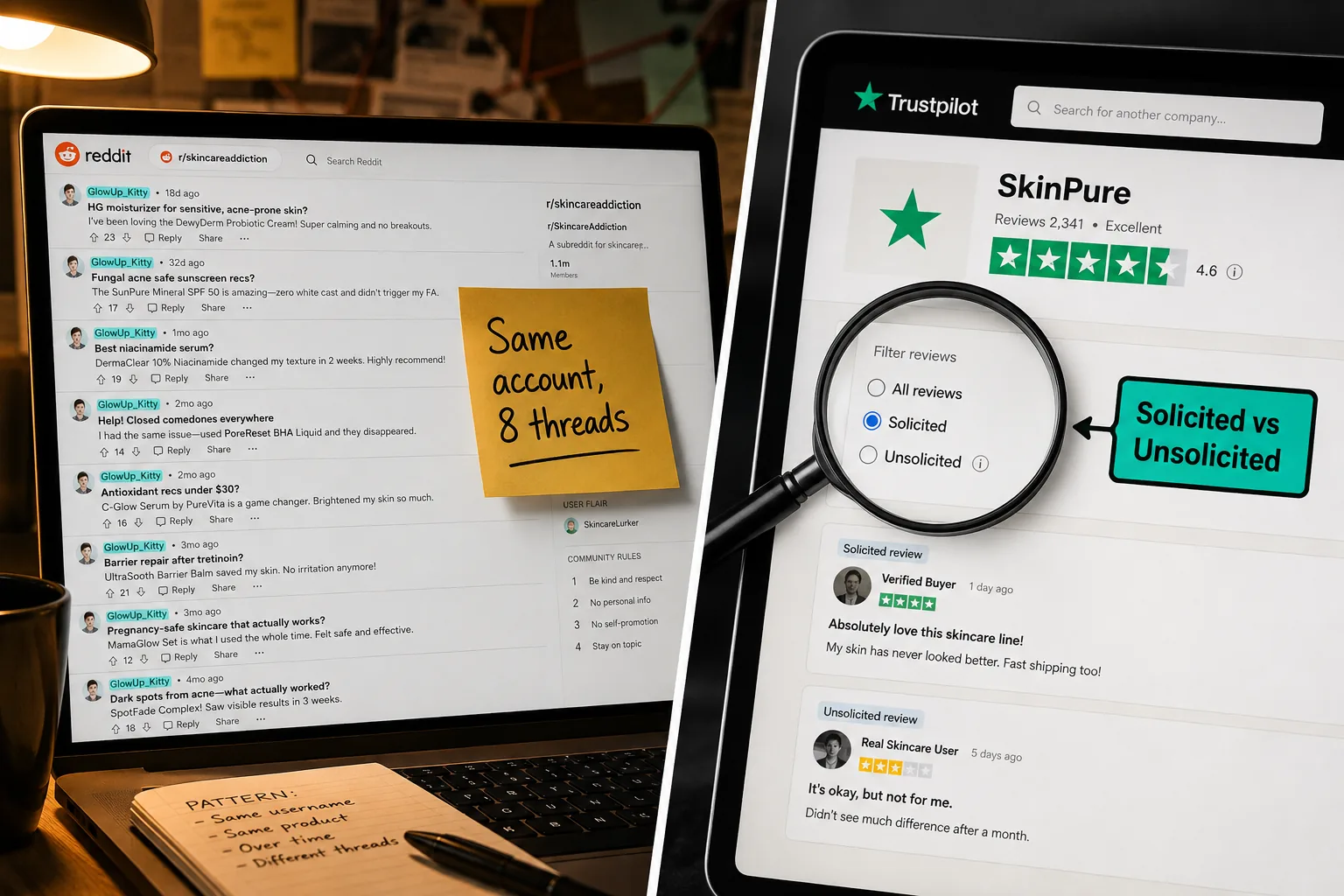
The result: 53 product mentions across 34 threads. 19 of those 53 mentions came from accounts that met at least one of the promotional criteria above. That is 36% of all recommendations in the sample. This is not an accusation against any specific platform. It is a description of a pattern that any skeptical reader should account for when reading forum recommendations.
19 of Them Came From Sellers or Affiliates
Of the 19 promotional mentions, most came from accounts with thin posting histories that appeared specifically in recommendation threads. Several used nearly identical language across different threads, which is a strong signal of coordinated promotion. Some had affiliate links embedded in the post or in the account bio. None of them disclosed the relationship, which puts them in potential violation of FTC endorsement guidelines.
This pattern is called astroturfing, which means creating the appearance of organic grassroots support for a product when the support is actually paid or incentivized. It is not unique to AI trading. It is common across any product category with high affiliate commissions and an audience that relies on peer recommendations.
The Single Handle That Seeded 8 Separate Threads
One account in the sample appeared in 8 separate threads across a 60-day period, each time recommending the same product in response to a different user’s question. The posts were not identical, which suggests manual effort rather than a bot, but the product recommendation was consistent across all 8 appearances. The account had no other trading discussion in its history and had been created roughly two weeks before the first appearance in the sample. That is not a coincidence. That is a promotional operation.
How Do You Tell a Real Review From a Paid Placement?
A real review discloses financial relationships, shows evidence of actual use, and includes specific criticisms alongside praise. A paid placement does none of those things.
The FTC Disclosure Rule Most Posts Ignore
The FTC endorsement guides require anyone who receives compensation, free access, or any material benefit in exchange for a recommendation to clearly disclose that relationship. This applies to blog posts, YouTube videos, TikTok content, and Reddit posts. The disclosure must be clear and conspicuous, not buried in a bio or hidden in fine print.
Most AI trading platform recommendations you see online do not include this disclosure. That does not automatically mean the review is dishonest, but it does mean you cannot rule out a financial relationship. A post that recommends a platform, includes a referral link, and has no disclosure is either ignorant of the FTC rules or is deliberately ignoring them. Either way, weight the recommendation accordingly.
Reading a Bio Against a Recommendation
When you read a recommendation, check the account bio and posting history before you check the recommendation itself. A credible reviewer has a history of discussing trading broadly, not just recommending one product. They have posts where they criticize tools, describe losses, and ask questions. A promotional account looks like a thin bio, recent creation date, and a posting history that is almost entirely product recommendations.
On YouTube and TikTok, check whether the video description contains affiliate links and whether those links are disclosed. On Reddit, check the account age and karma distribution. On Trustpilot and G2, look at the ratio of five-star to one-star reviews and read the one-star reviews specifically, because those are the ones that are hardest to fake.
Cross Checking Reddit Against Trustpilot and the App Stores
No single review surface tells the whole story. Reddit skews negative because people post when they are frustrated. G2 and Capterra skew positive because vendors solicit reviews after good onboarding experiences. The Apple App Store and Google Play skew positive because review prompts fire after positive interactions. Trustpilot captures billing and cancellation complaints that rarely appear elsewhere.
The signal is in the gap between these surfaces. A platform with a 4.7 on G2 and a 2.1 on Trustpilot is telling you something specific: the product onboards well and the customer service is a disaster. A platform with strong Reddit sentiment and thin G2 coverage might be good but not yet widely adopted. Read all surfaces, then look for the pattern, not the average. For a structured look at what real users say across these surfaces, see honest AI stock tool reviews from real users in 2026.
Which AI Trading Platform Is Legit, and How Would You Know?
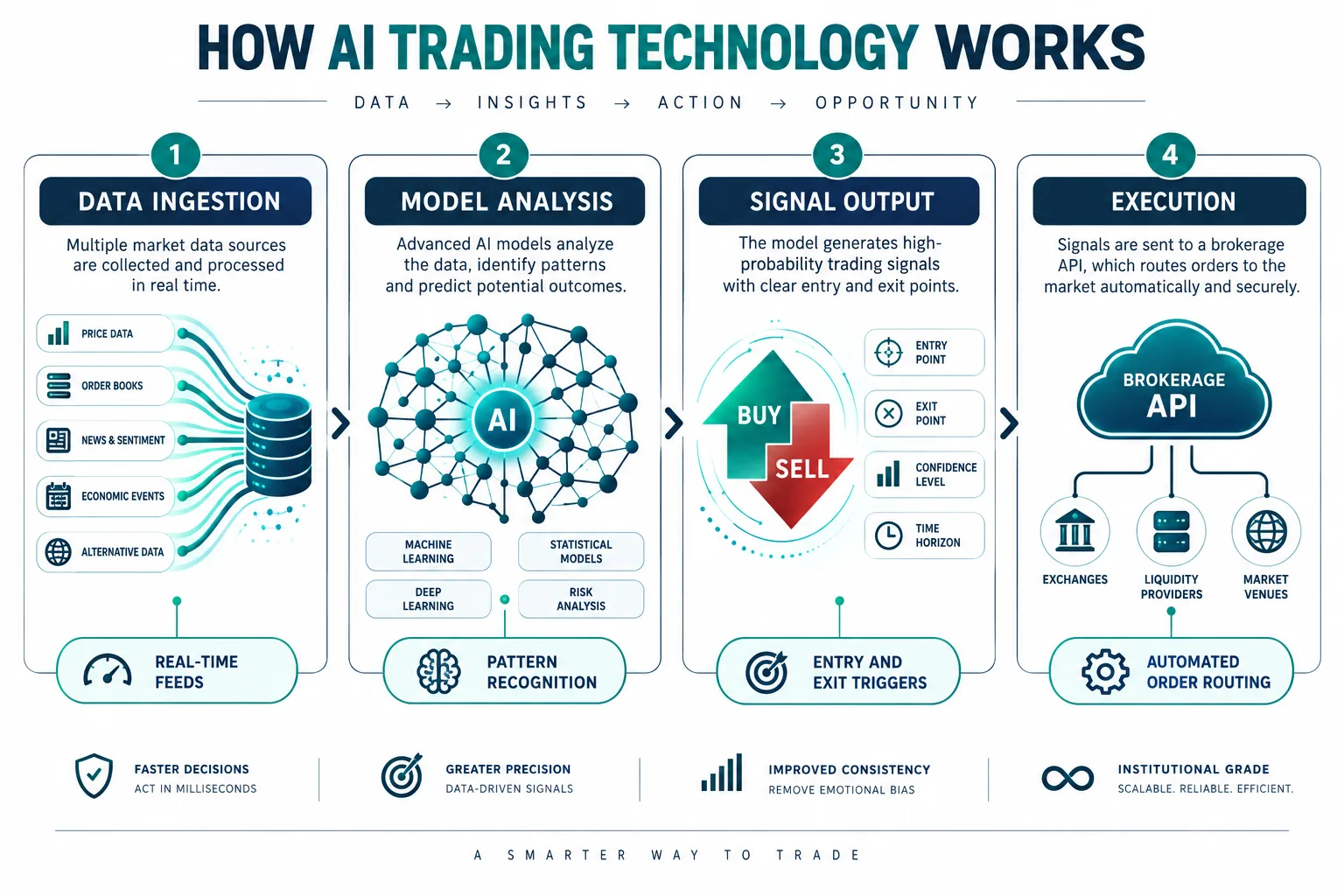
A legitimate AI trading platform is registered with the relevant regulatory bodies, publishes its methodology in enough detail to evaluate, and can show live-fill performance data rather than just backtests. Most platforms fail at least one of these three criteria.
Registration Checks: SEC, FINRA and BrokerCheck
If a platform executes trades on your behalf or provides personalized investment advice, it should be registered either as a broker-dealer with FINRA or as a registered investment adviser with the SEC. You can check broker-dealer registration at FINRA BrokerCheck, which is free and takes about two minutes. You can check investment adviser registration at the SEC’s Investment Adviser Public Disclosure database. Both searches return registration status, disciplinary history, and ownership information.
If a platform is not in either database and is executing trades or providing personalized recommendations, that is a significant red flag. Some platforms operate as software tools rather than advisers, which means they are not required to register, but in that case they should not be making personalized buy and sell recommendations. The distinction matters.
FINRA’s 2026 Annual Regulatory Oversight Report includes a standalone section on generative AI, covering requirements for prompt and output logging, model version tracking, and human-in-the-loop review. Brokers using AI tools for retail recommendations are expected to demonstrate client-specific suitability and maintain model governance documentation. FINRA has explicitly flagged agentic AI as an emerging risk for broker-dealers as of March 2026. That regulatory attention is a signal that the space is being watched closely.
Published Method Versus Proprietary AI Claims
A platform that describes its approach as “proprietary AI” and stops there is telling you it does not want you to evaluate its method. That is a reasonable business decision for protecting intellectual property. It is also a reason to be skeptical about performance claims, because you cannot evaluate what you cannot see.
A platform that publishes its factor model, describes the data inputs, explains how signals are generated, and shows where the model has been wrong is giving you something to work with. Transparency does not guarantee performance, but opacity guarantees you cannot verify performance. The FINRA AI guidance for broker-dealers emphasizes that firms must be able to explain and supervise their AI outputs, which is a regulatory version of the same principle.
Is an AI Trading Bot Legit if Claims Match the Audited Record
The test for any trading bot is simple: does the claimed performance match an independently verified record of live fills? Not a backtest. Not a paper trading simulation. Live fills, with timestamps, matched against real brokerage statements, verified by a third party. Very few retail AI trading bots meet this standard. Most publish backtests or paper trading results and present them as evidence of live performance. They are not the same thing. For a direct comparison of legit tools versus expensive hype, see best AI trading bot legit tools versus expensive hype.
What SIPC Actually Covers, and What It Never Will
SIPC, the Securities Investor Protection Corporation, covers you if your brokerage fails and your assets go missing due to fraud or insolvency. It covers up to $500,000 in securities and $250,000 in cash per account. What it does not cover, under any circumstances, is market losses. If an AI trading bot executes a strategy that loses money, SIPC provides zero protection. Your money is gone because of trading decisions, not because of custody failure, and SIPC only covers the latter. Anyone who implies otherwise is either confused or misleading you.
Is AI Stock Trading Legit for Beginners Specifically?
AI trading tools can be useful for beginners, but the risks are higher for small accounts and inexperienced traders, not lower. The tools do not remove the need to understand what they are doing.
Is AI Trading Legit for Beginners Who Cannot Verify a Backtest
A beginner who cannot read a backtest critically is in a worse position with an AI trading tool than without one. The tool produces signals. If you do not understand how those signals are generated, you cannot evaluate when the tool is likely to fail. You will follow it into bad setups because you have no framework for disagreeing with it. That is not a trading system. That is delegation without oversight.
The right entry point for beginners is paper trading, which means running the tool in simulation mode with no real money at risk, for long enough to see how it performs across different market conditions. Not two weeks. At least 60 to 90 days, covering at least one choppy tape and one trending period. If the tool cannot be paper traded, that is itself a red flag. For beginners specifically, the AI day trading platforms beginners are starting with in 2026 gives a grounded starting point.
The Account Size Where Fees Eat the Edge
Most AI trading platforms charge monthly pricing that ranges from roughly $30 to $200 per month depending on the tier. On a $2,000 account, a $100 monthly subscription is $1,200 a year, a 60% annual hurdle before the first trade is placed. On a $10,000 account, the same subscription is a 12% annual hurdle. Even on $50,000 it is 2.4%. The strategy has to beat that number just to break even on the tool. The math on fees is not complicated, but it is easy to ignore when a platform is showing you impressive backtest returns.
Is AI Trading App Legit Without Verifiable Live Fills
A trading app that shows signals, recommendations, or automated execution without publishing live fill data is asking you to trust a claim you cannot verify. That is not necessarily fraud. It might be a useful tool with a methodology that works. But you have no way to know that from the marketing page. Before funding any account connected to an AI trading app, ask the platform directly for live performance data, not backtests, and ask whether that data has been independently verified. The answer you get will tell you a lot. For a detailed checklist before downloading any trading app, see what to check before you download an AI trading app.
The Verification Checklist Before You Fund Anything
Run these eight checks before connecting any AI trading platform to a funded account. Each one takes under five minutes.
| # | What to Check | Where to Check It | What a Failing Answer Looks Like |
|---|---|---|---|
| 1 | Broker-dealer registration | FINRA BrokerCheck | No record found for a platform that executes trades |
| 2 | Adviser registration | SEC Investment Adviser Public Disclosure | Personalized recommendations with no adviser record |
| 3 | Live fill performance | Ask the platform directly | Backtests or paper results only; no live fills |
| 4 | Independent audit | Third-party audit report | No auditor named; vendor-claimed numbers only |
| 5 | Review authenticity | Reddit threads, Trustpilot one-star reviews | All five-star reviews, no criticism, thin posting histories |
| 6 | Promoter history | Posting history of the top recommending accounts | Thin, new accounts repeating nearly identical praise |
| 7 | Fee transparency | Terms of service, not the marketing page | Hidden fees revealed only at checkout; performance fees undisclosed |
| 8 | Custody protection | SIPC.org, brokerage disclosure | Platform holds funds directly; no SIPC-member custodian named |
Eight Checks That Take Under Twenty Minutes
- Search the platform name on FINRA BrokerCheck. If it executes trades, it should appear.
- Search the parent company on the SEC Investment Adviser Public Disclosure database if it provides personalized recommendations.
- Ask the platform for live fill performance data. Not a backtest. Live fills.
- Check whether the performance data has been independently audited. Ask who audited it.
- Search the platform name on Reddit in the relevant subreddits and read the one-star reviews on Trustpilot.
- Check the posting history of the top three accounts recommending the platform in forum threads.
- Read the fee structure in the terms of service, not the marketing page.
- Confirm that any connected brokerage is a SIPC member at SIPC.org.
When to Walk Away
Walk away if the platform cannot answer questions 3 and 4 directly. Walk away if the registration check returns nothing and the platform is executing trades. Walk away if the review pattern looks like the astroturfing pattern described above. Walk away if the fee structure is not clearly disclosed before you create an account. And walk away if anyone, on any platform, promises you a specific return. That is not how markets work, and it is not how legitimate financial services operate. Scammers in this space rely on urgency and vague promises. Slow down and check. Our AI trading bot scams guide lists the red flags regulators see most.
Best AI Trading Bots and Platforms: Top Picks Worth Examining
The AI trading tools that hold up under scrutiny share a few common traits: they are transparent about their methodology, they do not promise returns, and they offer a paper trading mode so you can test before committing real capital. Three platforms that consistently appear in credible research and survive the verification checklist above are worth naming.
Trade Ideas is a scanner and AI-assisted alert platform built around its Holly AI engine. It is used by active day traders and has a published track record that distinguishes between paper and live performance. The platform is transparent that Holly is a pattern-recognition and scanning engine, not a return-guarantee machine. It runs on real-time data and integrates with major brokers. For a detailed breakdown, see the Trade Ideas review covering Holly AI’s real win rate.
StockHero is a bot creation platform that lets traders build and deploy trading bots without writing code. It is notable for making the bot-building process accessible to non-programmers while still requiring the user to define the strategy logic. The platform does not generate strategies for you. It executes the strategy you define, which keeps the accountability where it belongs.
TrendSpider offers a strong selection of bot trading tools alongside its AI-assisted charting. Its raindrop charts and multi-timeframe analysis tools are among the more technically differentiated offerings in the retail space. For a direct comparison against TradingView, see TrendSpider vs TradingView, which AI charting tool wins.
None of these are recommendations. They are examples of platforms that survive basic scrutiny. Whether any of them fits your specific strategy, account size, and risk tolerance is a question only you can answer after doing the verification work above.
AI Trading Versus Manual Trading: Which Is Better
AI trading tools are better than manual trading at eliminating emotional errors, executing rules consistently, and processing large volumes of data simultaneously. Manual trading is better at adapting to truly novel market conditions that fall outside a model’s training data.
The honest answer is that the best retail traders in 2026 use both. They use AI tools for scanning, screening, and rules-based execution while retaining manual judgment for position sizing, risk management, and adapting to market regimes the model was not trained on. Treating AI as a replacement for judgment is how retail traders get hurt. Treating it as a tool that enforces discipline and cuts noise is how it actually helps. For a grounded look at where AI fits in a trading process, see algorithmic trading AI, what retail traders get wrong.
Is AI Trading Legal in the US
AI trading is legal in the US for retail traders. There are no laws prohibiting individual investors from using algorithmic or AI-driven tools to trade their own accounts. The regulatory framework covers the platforms and brokers that provide these tools, not the traders who use them.
The relevant regulators are the SEC for investment advisers and securities markets, FINRA for broker-dealers, and the CFTC for futures and derivatives. A July 2026 rulemaking petition to the SEC requested a rule banning the commercial sale of algorithmic trading systems that use APIs to place orders, which signals that some participants want tighter restrictions. That petition has not been adopted as a rule. As of September 2026, retail use of AI trading tools remains legal.
What is not legal is using AI trading tools to engage in market manipulation, front-running, or other forms of fraud. The technology does not change the underlying rules. If the strategy is illegal when done manually, it is illegal when automated.
Why AI Trading Bots Fail Sometimes
AI trading bots fail when the market conditions they encounter differ significantly from the conditions they were trained or optimized on. This is called regime change, and it is the most common cause of live performance diverging from backtest performance.
A bot optimized on a trending bull market will often fail badly in a choppy tape. A bot trained on low-volatility data will get stopped out repeatedly in a high-volatility environment. The model does not know what it does not know. It keeps applying the same rules to conditions those rules were never designed for. This is not a flaw in AI trading specifically. It is a flaw in any rules-based system that cannot adapt in real time. The fix is not a better bot. The fix is understanding the market regime you are trading in and matching your tools to it. For a detailed look at the real numbers behind bot performance, see do AI trading bots actually make money, the real numbers.
Do Professional Traders Use AI
Yes, professional traders use AI extensively, but not in the way retail marketing suggests. Institutional desks use AI for data processing, pattern recognition, risk modeling, and execution optimization. They do not use a single AI bot that makes all their decisions. They use AI as one input among many, supervised by experienced analysts and governed by strict risk management frameworks.
The retail version of “AI trading” is often a much simpler tool, a scanner, a signal generator, or a rules-based bot, marketed with language borrowed from institutional AI. That gap between the marketing and the reality is where most retail traders get into trouble. The tool is real. The implied equivalence to institutional AI is not.
Final Verdict: Legit Is the Floor, Not the Bar
Is AI trading legit? Yes. That question has been answered. The technology is real, regulated, and used by the most sophisticated financial institutions on earth. Asking whether it is legit is like asking whether a scalpel is a real tool. Of course it is. The question that matters is whether the person holding it knows what they are doing and whether the specific platform you are looking at has the track record to justify your money and your trust.
Most do not. The review problem is real. The backtest problem is real. The astroturfing problem is real. And the gap between institutional AI and the retail tools borrowing its language is enormous. None of that means you should avoid AI trading tools. It means you should verify them before you fund them.
Run the eight checks. Paper trade it first. Read the one-star reviews. Check the registration. Ask for live fills. If the platform survives all of that, you have something worth testing with real money. If it does not, you just saved yourself a very expensive lesson.
Systems over hacks. Process over prediction. Cut the noise, keep the alpha.
There are 200+ AI stock tools in the FullStack Alpha directory, filterable by category, price, and what they actually do. Browse the full directory at aistockpickerapps.com.
Affiliate disclosure: FullStack Alpha may earn a commission from some tools linked in this article. This does not affect scores or editorial positions.
References
- Rulemaking Petition Requesting Rule Bans Commercial Sale Algorithmic Trading Systems Use Apis Place
- Democratic Lawmakers Press Sec On Broker Dealer And Ai Developer Responsibilities In Agentic Trading
- Is Agentic Trading Safe What The Sec Inquiry Means For Investors
- Algorithmic Trading
- Finras Genai Playbook Real Accountability For Broker Dealers
- Artificial Intelligence
- Finra Tightens Ai Suitability Rules Brokers Race To Rework Tools Ahead
- 2026 Annual Regulatory Oversight Report
- Day Trading for a Living? (SSRN 3423101)
- FBI IC3 2025 Internet Crime Report
- CFTC: Mirror Trading International
- Finra 2026 Genai Governance Financial Services
By Jay Rocco, Founder and Editor, FullStack Alpha.
Stay alpha.
Frequently Asked Questions
Is AI trading legit or a scam?
AI trading as a technology is entirely legitimate and regulated. The scam risk is not in the technology itself but in specific platforms that make unverifiable performance claims, use fake reviews, or collect fees without delivering real value. Run the eight-check verification process before funding any account. Legitimate platforms survive it. Scams do not.
Is AI stock trading legit for a small account?
AI stock trading tools can work for small accounts, but the math on fees is brutal at low account sizes. A $100 monthly subscription on a $2,000 account is a 5% annual hurdle before the first trade. Paper trade the tool for 60 to 90 days first, verify the fee structure against your account size, and make sure the edge justifies the cost before committing real capital.
Can you actually make money with AI trading?
Some traders do make money using AI trading tools, but the evidence for consistent, audited retail returns is thin. AI tools reduce emotional errors and enforce discipline better than they generate alpha. Profit is possible, not guaranteed, and highly dependent on the strategy, account size, market conditions, and whether the trader understands what the tool is actually doing. Never trust a platform that implies otherwise.
Can you make $1000 a day day trading?
A thousand dollars a day requires either a large account or very high risk per trade. On a $50,000 account, that is a 2% daily return, which is aggressive and unsustainable as a consistent target. Most professional traders aim for much lower daily return targets and focus on consistency over time. About 70% of day traders lose money over any meaningful period. The traders who hit large daily numbers do so occasionally, not reliably, and they manage risk tightly on the days they do not.
Is it safe to use AI for trading?
Using AI for trading is safe in the sense that the technology itself does not create unique dangers beyond those inherent in trading. The risks are the same as any trading activity: you can lose money, fees can exceed returns, and tools can fail in unexpected market conditions. The additional risk specific to AI trading is over-reliance, meaning following a tool into bad setups because you do not understand when it is likely to fail. Understand the tool before you trust it with real capital.
Is an AI trading bot legit if it publishes a backtest?
No. A backtest is not evidence of live performance. Backtests are vulnerable to overfitting, assume perfect fills, and do not account for slippage or latency. A legitimate AI trading bot publishes live fill data, ideally with third-party verification. If a platform shows only backtests and no live performance record, treat the performance claims as unverified.
Which AI trading platform is legit and regulated?
Any platform that executes trades or provides personalized investment advice should be registered with FINRA as a broker-dealer or with the SEC as a registered investment adviser. Check both databases before funding an account. Platforms that operate as software tools rather than advisers have different registration requirements, but they should still be transparent about methodology and fees. Registration is the floor. An audited track record is the bar.
Is AI trading legit for beginners with no experience?
AI trading tools are accessible to beginners, but accessibility is not the same as safety. A beginner who cannot evaluate a signal cannot evaluate when the tool is wrong. Start with paper trading, spend at least 60 days testing before using real money, and focus on understanding the strategy logic before automating anything. The tool should enforce your discipline, not replace your judgment.
Jay Rocco is the Founder and Editor of FullStack Alpha. He has tested 200+ AI stock tools since 2022 and run 15+ AI trading platforms on live accounts with his own money. He reviews the software. He does not tell you what stocks to buy.
