

AI trading just got its retail verdict, and it was a thumbs down from the majority of investors. Three surveys landed between September 21 and October 1, 2026, and the pattern is blunt: 57% of investors say no to AI trading | brokers ship it anyway. Inside the same nine weeks, Interactive Brokers, Webull, tastytrade, Public and Robinhood all pushed agent access into live brokerage accounts. The gap between what customers asked for and what the product teams built is the actual story here.
Quick Answer
A Vanguard survey of 6,686 personal investors found 57% are uncomfortable letting AI act on their portfolios, and a separate survey of 8,506 CMC Markets clients found only 29% trust the broker’s own AI insights. Yet five brokers shipped agentic trading features between July 28 and September 29, 2026, including Robinhood’s general release with more than 150,000 agentic accounts. Discomfort is high, adoption is being pushed anyway, and the control settings are where the real risk sits.
Key Takeaways
- 57% of investors are uncomfortable with AI acting on their portfolios, per the Vanguard research reported by Business Insider on October 1, 2026.
- Vanguard’s own AI Advice Frontier report surveyed 6,686 investors in June 2026 and found only 4% use AI to make financial decisions for them.
- Only 29.4% of 8,506 surveyed CMC Markets clients trust its AI market insights, even though 48.6% already use AI somewhere in their process, per Finance Magnates.
- A Benzinga viewer poll of 161 respondents found just 12% would never allow it, 67% wanted partial help, and 21% would go fully automated.
- Robinhood reported 150,000+ agentic accounts since May 2026 and roughly 30 million agent tool calls per day, per Yahoo Finance.
- Robinhood is the only one of these brokers where the customer can switch trade approvals off, which is both a feature and the single setting worth arguing about.
- Australia’s ASIC finalized algorithmic trading controls on September 24, 2026, including mandatory kill switches, with effect in March 2028.
What did the three investor surveys actually find?
Three different samples, three different methods, one consistent finding: investors like AI as a research assistant and distrust it as a decision maker. The number that moves is not trust, it is control.
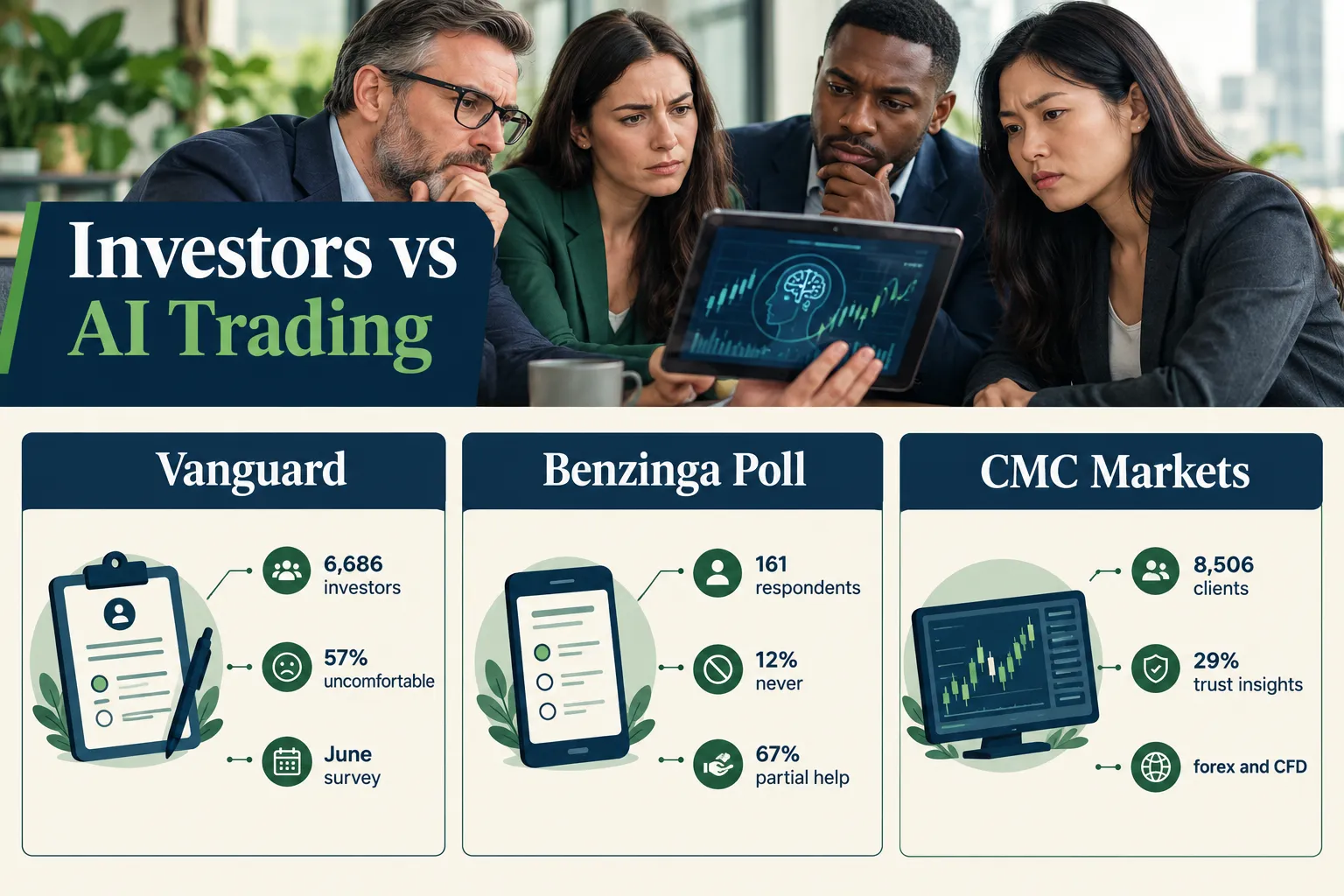
Vanguard’s study, published September 30, 2026, drew on a June survey of 6,686 personal investors. About 32% had used AI for personal finance, investing or retirement planning, rising to 43% among Gen Z and millennials and 41% of Gen X, against just 15% of boomers and older. Comfort with AI taking action, though, collapsed across every age group: 80% of younger investors, 83% of Gen X and 85% of boomers said they were uncomfortable with it.
Trust in conversational AI for financial guidance was similarly thin. 63% of younger investors and 78% of older investors reported little or no trust, per the same Vanguard data.
The CMC Markets data is the one brokers should read twice. Usage at 48.6% and trust at 29.4% is not adoption, it is people kicking the tires with the handbrake on.
AI trading: what it is and how it actually works
AI trading is software that reads market data, generates a view, and in some setups places the order itself. The honest definition splits into three tiers, and most retail disputes come from mixing them up.
- Tier 1, the analyst. A large language model or scoring engine summarizes filings, news and price action. No account access. This is where most people actually are.
- Tier 2, the co-pilot. The system drafts an order and you approve it. Robinhood’s trade approval gate sits here by default.
- Tier 3, the agent or trading bot. An AI trading bot runs a rule set or a model with permission to execute. 3Commas, StockHero and Superalgos live here, mostly on crypto venues, while broker agents now do it on stocks and options.
A trading bot is not the same thing as a model with an opinion. One is code with a mandate, the other is a research assistant with a chat box. Learn which tier a product sits in before you fund it, and read the Terms of Service for who owns the loss.
If a vendor cannot tell you plainly which tier it operates in, that is your answer.
Why are brokers shipping AI trading anyway?
Because distribution beats sentiment. Brokers are not building for the 57% who flinch, they are building for the fast-moving minority who will route order flow through an agent and never leave.
The 2026 shipping calendar is tight:
- July 28, 2026: Interactive Brokers releases MCP access for AI agents.
- August 4, 2026: Webull ships a command-line interface for agent connections.
- August 31, 2026: tastytrade adds MCP support, a win for options trading platforms.
- September 24, 2026: Public launches AI agents on Kalshi event contracts.
- September 29, 2026: Webull adds Cloud MCP, and Robinhood Agents goes generally available.
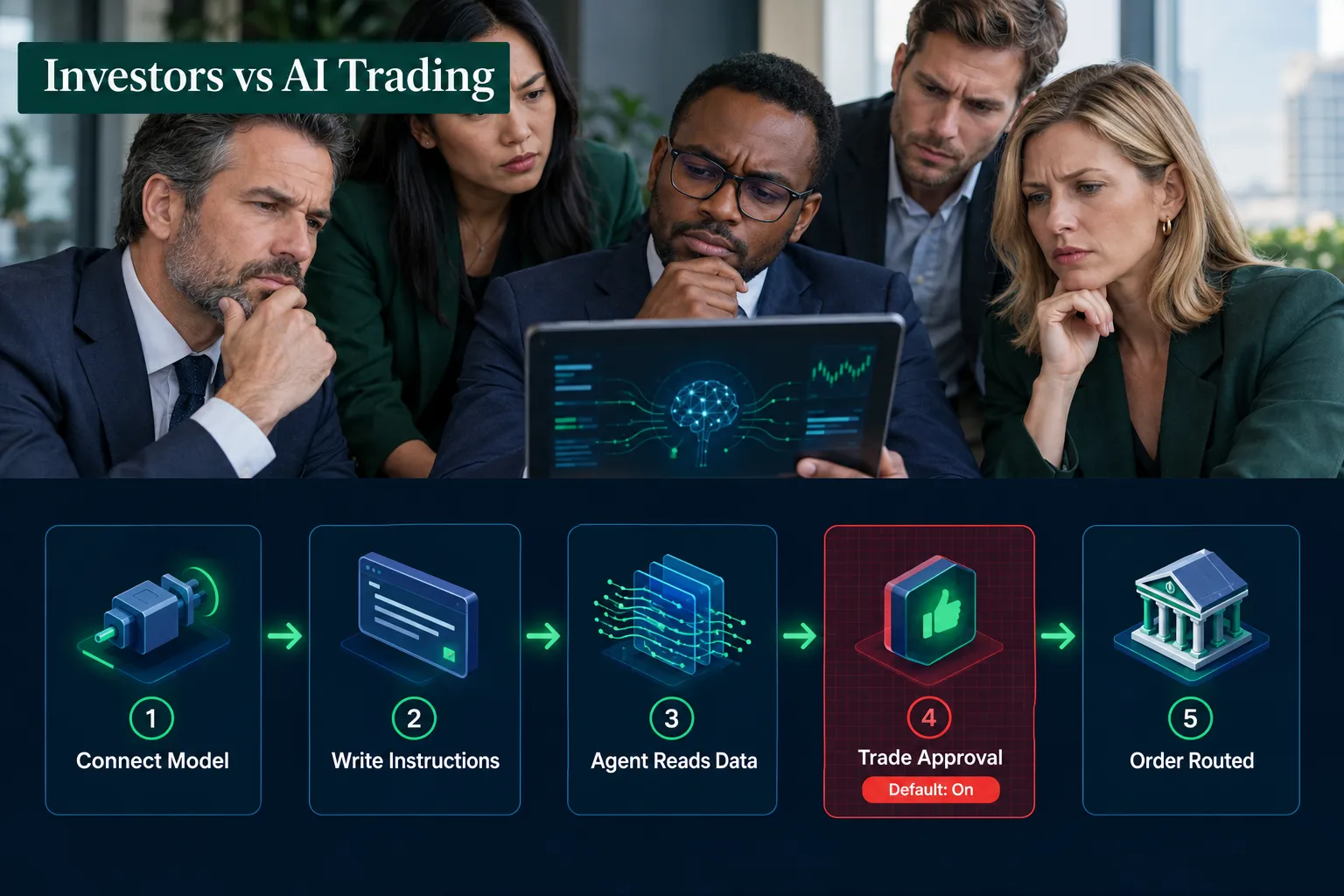
Robinhood’s feature followed CEO Vlad Tenev’s September 9 comments at Goldman Sachs about cutting the friction between external models and brokerage accounts. At the HOOD Summit in late September, eligible U.S. customers got the ability to pick an OpenAI or Anthropic model, write instructions, and let it research or trade. Margin was excluded at launch. We broke down the mechanics in our Robinhood AI agents broker comparison.
The Benzinga poll explains the business logic: only 12% said never. Openness depended almost entirely on how much control the user keeps. So brokers kept approval gates on and shipped.
Comparison table: Vanguard vs Benzinga vs CMC Markets
These three data sets are not interchangeable. One is a large probability-style investor survey, one is a self-selected audience poll, one is a single broker’s client base in forex and CFD markets.
| Survey | Who was asked | Sample | Headline finding | Source |
|---|---|---|---|---|
| Vanguard, published Sep 30, 2026 | Vanguard personal investors, June 2026 | 6,686 | 57% uncomfortable with AI acting on their portfolios; only 4% let AI decide | Vanguard report |
| Benzinga PreMarket Playbook poll, Sep 30, 2026 | Self-selected Benzinga viewers | 161 | 12% never, 67% partial help, 21% fully automated | Benzinga |
| CMC Markets client survey, reported Sep 21, 2026 | CMC Markets clients, stocks and forex CFDs | 8,506 | 48.6% use AI, only 29.4% trust its insights | Finance Magnates |
Treat the 161-person poll as a temperature check, not a mandate. The 6,686 and 8,506 samples carry the weight.
Is AI trading actually profitable, or mostly hype?
No credible, audited data shows retail AI trading beats a disciplined manual process over a full cycle, and nobody reviewed here publishes live third-party results. Backtests are marketing. Live, fee-adjusted track records are evidence.
Vendor win rates are vendor-claimed until an auditor signs them. Most of the accuracy claims in this market come from in-sample tests that never faced slippage, a halt, or an earnings gap. We dug into the numbers in do AI trading bots actually make money and in our breakdown of how accurate AI trading signals really are.
Decision rule: if you cannot reproduce a tool’s edge in paper trading across at least 30 trades, do not fund it. Paper trade it first, every time.
One useful counterweight from the Vanguard data: AI was 11 times more likely to increase than decrease the perceived value of human advice, with 32% saying it raised that value against 2.9% who said it lowered it. AI is crowding in, not crowding out.
What are the risks of AI stock trading, and what if the software crashes?
The three risks that actually cost money are unsupervised execution, silent model drift, and outage behavior. Robinhood states plainly that customers bear responsibility for agent-executed trades and that it does not supervise or audit the agents.
Common mistakes with AI trading, in order of how often they show up:
- No position sizing cap. An agent with full buying power and a bad prompt is a margin call waiting for a trigger.
- Leaving trade approval off on day one. Switch it on, watch 20 orders, then decide.
- Confusing activity with alpha. Robinhood’s ~30 million daily tool calls include research and watchlist requests, not trades.
- Running the same bot into a choppy tape. Mean-reversion logic gets shredded in a trend; trend logic gets shredded in a range.
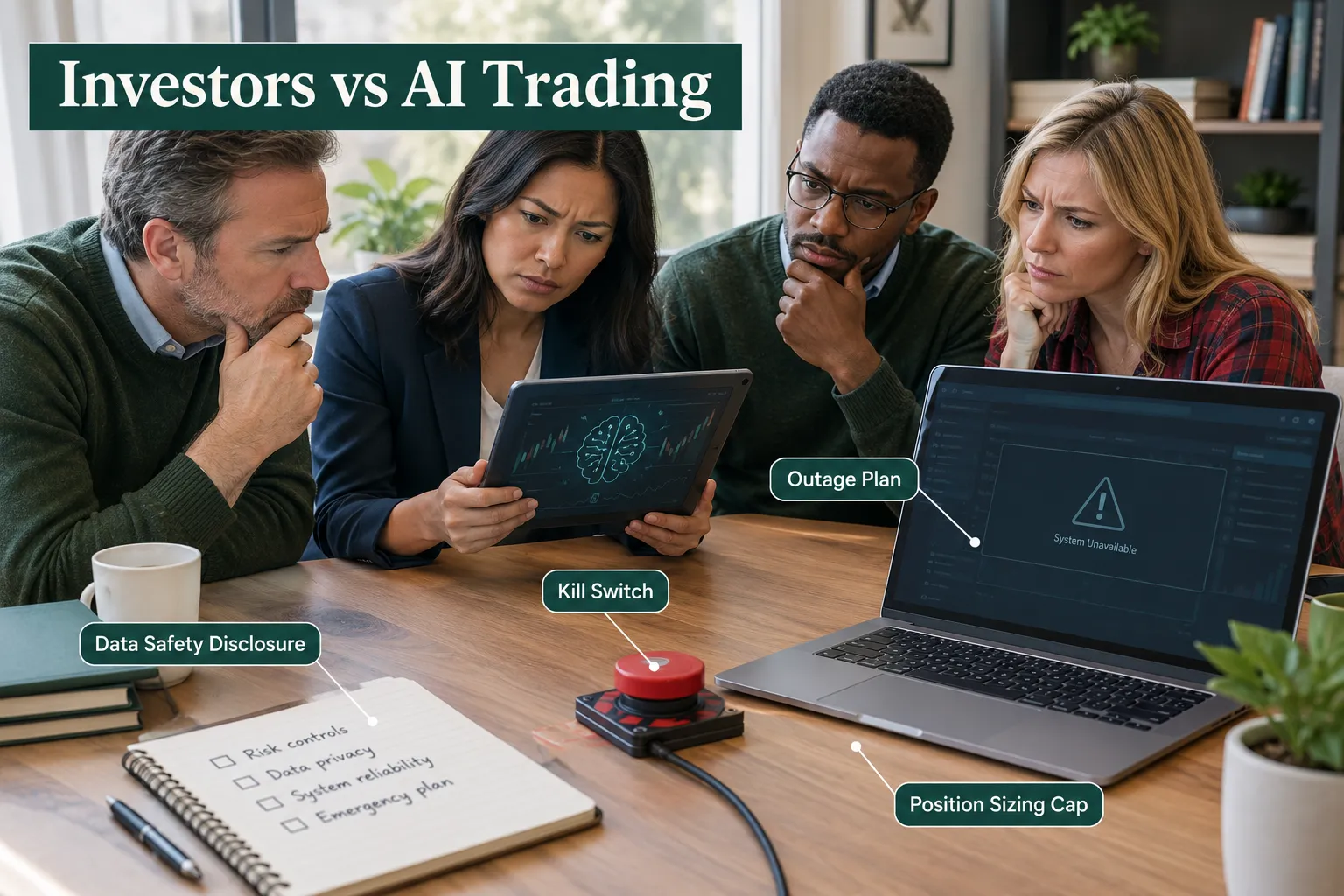
- No crash plan. If the platform or the model API goes down mid-position, who closes the trade? If your answer is “the bot,” you do not have a plan.
Keeping a manual exit path open is not pessimism, it is the job. Our five settings to change before your first AI trade covers the exact toggles.
Is AI trading safe and regulated? The 2026 security checklist
AI trading is regulated at the broker level, not at the model level, which is the gap everyone is arguing about. Your account custody is covered by SIPC rules for broker failure, and SIPC does not cover market losses from a bad agent decision.
Two 2026 developments matter. ASIC finalized amendments on September 24, 2026 that define a “trading algorithm” in law and require testing, governance, monitoring and emergency kill switches, including for machine learning systems, effective March 2028 after an 18-month transition, per Finance Magnates. Vanguard, meanwhile, is pushing a functional equivalence standard: similar guidance should face similar investor protection whether a human, a firm, or a model delivers it.
The checklist, run it before you connect anything:
- Confirm the broker is a registered U.S. broker-dealer. Check FINRA BrokerCheck and Investor.gov.
- Turn trade approval on. See whether the platform even offers an off switch, and who controls it.
- Set a hard dollar cap per order and per day.
- Use API keys with trade-only permissions, never withdrawal rights.
- Read the app’s data safety disclosure on Google Play or the App Store, plus the ratings and reviews and how fast app support replies.
- Test the desktop and mobile kill switch while flat, not while down 4%.
For the legitimacy question more broadly, see our standing piece on whether AI trading is legit.
AI trading vs manual trading, and do professional traders use it?
Institutions use AI trading under governance that retail accounts simply do not have. On September 3, 2026, BGC Group’s Fenics AI arranged what it called its first fully AI-brokered institutional listed derivatives trade, a Swiss SMI options trade on Eurex between two institutional accounts including Hudson Bay Capital.
That is not the same product as a retail agent with a chat box. Formal testing, compliance sign-off, and market-convention controls sit behind it.
| Factor | AI trading agent | Manual process |
|---|---|---|
| Speed to act | Seconds | Minutes |
| Emotional bias | Low on entry, zero on exit discipline unless coded | High, and it is the main leak |
| Transparency of reasoning | Often a black box | You wrote it, so you know it |
| Failure mode | Silent, fast, repeated | Loud, slow, usually smaller |
Best use for most self-directed traders: AI for scanning and research, human for the decision. That is the hybrid 67% of Benzinga’s poll respondents already said they wanted.
Can beginners use AI trading, or is it too complex?
Beginners can use AI trading tools safely in research mode. Letting an agent place orders before you have a written rule set is where it goes wrong. The complexity is not technical, it is behavioral.
Vanguard’s data shows how newer users actually behave: among younger AI users, 61% used it to start learning a topic, 61% as a sounding board, and 58% as a fact-checker. Low-stakes exploration, not execution.
Start free, stay free for a month. Our roundups of free AI trading bots and free trading calculators cost nothing and will tell you fast whether a system is a system or a vibe. Play stupid games with an agent on day one and you will pay for the lesson.
Top 5 favorite features in the new broker AI trading stack
The genuinely useful parts of this wave are the plumbing, not the predictions. Five features worth having, ranked by how much they protect you.
- Trade approval gates. The default-on approval flow in Robinhood Agents is the single best safety feature shipped in 2026.
- A real off switch. Robinhood is the only one of these five where the customer can switch trade approvals off, which means the control is explicit and visible.
- Model choice. Picking an OpenAI or Anthropic model means the reasoning layer is swappable instead of a sealed black box.
- MCP and CLI access at Interactive Brokers, Webull and tastytrade. Open protocols let you run your own code against your own brokerage accounts.
- Instruction scoping. Writing explicit constraints, position sizing, no margin, no earnings-day entries, is the closest thing to a stop loss for an agent.
What we like and what we don’t like
Short version: we like the controls and the openness, we don’t like the responsibility shift or the absence of audited results.
What we like
- Margin was excluded at Robinhood’s launch, which caps the worst-case blowup.
- Open protocols mean no vendor lock-in for traders who can code.
- CMC Markets’ reported response was portfolio analysis and controlled execution rather than unrestricted autonomy. Correct call.
What we don’t like
- Responsibility sits with the customer. Robinhood does not supervise or audit the agents, which means a model error is your P&L problem.
- No audited live performance data from any retail AI trading product in this cycle, which makes “is AI trading profitable” unanswerable with evidence today.
- Headline engagement numbers like 30 million daily tool calls get read as trading success. They are not.
What do real users say about AI trading on Reddit?
Retail sentiment on Reddit has been sharper than any survey. The most-upvoted reply on the r/StockMarket thread about Robinhood’s rollout was eight words long.
“I can lose money on my own, thanks.”
That comment drew 713 upvotes on r/StockMarket. It lines up neatly with the 85% of boomers and 80% of younger investors in the Vanguard data who were uncomfortable with AI acting for them. The AI trading Reddit mood is not anti-technology, it is anti-delegation.
Competitors and alternatives to broker AI trading agents
If you want AI in your process without handing an agent your brokerage account, the independent tool market is where most traders land. Scanners and assistants, not executors.
| Tool | What it does | Market focus | Automation level | Pricing |
|---|---|---|---|---|
| Trade Ideas (Holly AI) | AI scanner generating day trading candidates | U.S. stocks | Signals, optional auto-trade | See official pricing page |
| TrendSpider | Automated technical analysis and backtesting | Stocks, ETFs, futures | Alerts and bots | See official pricing page |
| Tickeron | AI pattern recognition and robo-agents | Stocks, forex, crypto | Signals to semi-auto | See official pricing page |
| Intellectia.ai | AI research and stock analysis summaries | Stocks, ETFs | Research only | See official pricing page |
| Edgeful | Probability and backtest reports on setups | Futures, stocks | Research only | See official pricing page |
| MetaTrader 4/5 with AI plugins | Expert Advisor automation | Forex, CFDs | Full automation | Platform free, plugins vary |
| 3Commas / StockHero / Superalgos | Rule-based and AI-assisted trading bots | Mostly crypto, some stocks | Full automation | See official pricing page |
| Public Agents | Agent trading on Kalshi event contracts | Event contracts | Semi-auto | See official pricing page |
We do not publish prices we cannot confirm, so check each vendor’s page directly. Our tested rankings sit at best AI trading bots 2026 and best AI trading platforms, and gentler brokerage accounts like SoFi Invest remain a reasonable starting point for small balances.
What should investors watch next?
Four dated items decide whether 2026’s agent wave becomes normal or gets reined in.
- Q3 2026 earnings season, late October 2026. First full reporting cycle with 150,000+ agentic accounts live. Watch for agent behavior around earnings gaps and halts.
- Robinhood’s next quarterly report. Whether agentic accounts and margin eligibility get updated disclosure matters more than the account count itself.
- March 2028, ASIC algorithmic trading rules take effect. Kill switches and testing requirements become law in Australia, and that language tends to travel.
- Ongoing: U.S. rulemaking on functional equivalence. Vanguard’s September 30 policy commentary is a live lobbying position, not settled regulation.
Watch one more thing: the first well-publicized agent-caused loss. That event, not a survey, will set the retail default.
Our Take
The surveys and the shipping calendar are not contradictory, they are the same story told from two seats. Customers want AI to help them think. Brokers built AI that can act, because acting is what generates order flow.
The 57% are not being irrational. They are pricing in the fact that nobody has published an audited live track record for retail AI trading.
Our position: run AI in research mode, keep trade approval on, cap position sizing before you cap anything else, and treat any agent order as a trade you placed yourself, because legally you did. Process over prediction. That is the whole edge here.
Next step: open a paper trading account, give one AI tool one narrow job for 30 days, log every signal it produced against what price actually did, and only then decide whether it earns a dollar of real capital.
Built an AI trading bot or platform you want tested? Submit it for review and we will run it against the same framework we use on every tool. Submit a bot for review
Conclusion
Three surveys in eleven days said the same thing from three angles: retail investors will use AI to think and resist AI deciding. Brokers read the same data and shipped execution anyway, because the 12% who say never are not the customers they are designing for.
So the decision moved to you. Not whether AI trading exists in your account, it already does at five major brokers, but which tier you allow it to operate in and which switches you leave on.
Do three things this week. Audit the agent permissions on every brokerage account you hold. Turn trade approval on and leave it on. Then pick one AI tool, give it a single narrow job, and log 30 results before it touches live capital.
This article is education and research, not financial advice, and nothing here is a recommendation to buy or sell any security.
Sources
Primary first: Vanguard, The AI Advice Frontier (September 30, 2026) · Vanguard policy commentary on AI and advice · Vanguard research library · BGC Group AI-brokered trade announcement (2026) · Business Insider on agentic AI trading (2026) · Benzinga AI trading poll (2026) · Yahoo Finance on Robinhood’s AI trading launch (2026) · Finance Magnates on CMC Markets AI trust (2026) · Finance Magnates AI coverage, including ASIC rules (2026)
Your market edge starts with the right tool. Stay alpha.
Frequently Asked Questions
Do investors trust AI with their money?
Mostly no. Vanguard's survey of 6,686 investors found 57% uncomfortable with AI acting on their portfolios, with 78% of boomers reporting little or no trust. A separate survey of 8,506 CMC Markets clients found 48.6% use AI but only 29.4% trust its market insights. Trust lags usage badly.
Which brokers let AI trade my account?
As of October 2026: Interactive Brokers (MCP, July 28), Webull (CLI August 4, Cloud MCP September 29), tastytrade (MCP, August 31), Public (AI agents on Kalshi, September 24) and Robinhood (Agents generally available, September 29). Robinhood is the only one where the customer can switch trade approvals off.
Is AI trading safe?
AI trading is as safe as the controls around it. Trading through a registered U.S. broker keeps SIPC custody protection, which covers broker failure and not market losses. The real danger is unsupervised execution: Robinhood states customers bear responsibility for agent-executed trades and that it does not supervise or audit the agents.
Is AI trading profitable?
No audited, independent data shows retail AI trading is reliably profitable. Vendors publish backtests, not live fee-adjusted results. Vanguard's 2026 research found only 4% of investors let AI make financial decisions for them, so the real-world sample is small. Treat any profitability claim as vendor-claimed until an auditor verifies it.
Can I make money on AI trading?
Possibly, but not because the AI is magic. Money comes from an edge you can measure, applied with position sizing and a stop loss. AI can speed up scanning and research. It cannot create an edge you have not tested. Paper trade any system for at least 30 trades before funding it.
What is the best AI trading bot for beginners?
For beginners, the best AI trading bot is one that does not execute. Start with research-only tools such as Intellectia.ai or Edgeful, or a free scanner, and keep trade approval on if you use a broker agent. Full automation suits traders who already have written, tested rules.
Can ChatGPT help in trading?
Yes, as an analyst rather than an executor. Vanguard found 61% of younger AI users treat it as a sounding board and 58% as a fact-checker. ChatGPT can summarize filings, explain options mechanics in plain English, and stress-test your thesis. It has no live market data unless connected, and it cannot verify prices.
Contributing writer at AI Stock Trading Bots.
