


October 12, 2026, 7:50 a.m. ET | By FullStack Alpha Editorial Team | Reviewed by Jay Rocco, Chief Editor
Quick answer: Catalyst, a startup founded in 2025, raised a $30 million seed round led by Sequoia, Fortune reported on October 8, 2026. Its AI agents turn plain-English trade ideas into strategies that can run and trade on their own. Its Terms of Service, last revised October 7, 2026, say the company is not registered with the SEC as an investment adviser or with the CFTC as a commodity trading advisor, and that trades run through a non-custodial crypto wallet, not a brokerage account.
Key Facts
- The round: $30 million seed led by Sequoia. Jump Trading, PeakXV, Lux Capital, AntiFund, Coinbase and Premji Invest also invested, per Fortune’s October 8 report.
- The founders: cofounders Justin Zheng, 25, and Dylan Iskandar, 21.
- The pilot: the company says its pilot generated hundreds of millions in trading volume over a couple of weeks, focused on power traders. That figure is a company claim with no independent breakdown.
- The markets: Catalyst’s FAQ lists spot tokens, perpetuals, tokenized stocks and prediction markets.
- The price: free during its research preview, according to the FAQ.
- The plumbing: trades go through a non-custodial wallet built on Privy infrastructure. Deposits by Apple Pay, credit card or crypto. Withdrawals are stablecoin only for now, with fiat listed as coming soon.
- The status: Section 6.3 of the terms says Catalyst is not a registered investment adviser or commodity trading advisor, and users “will not be afforded the protections that may be available to clients of a registered investment adviser or commodity trading advisor.”
- Access: users are being let off a waitlist now.
What Is Catalyst Actually Building?
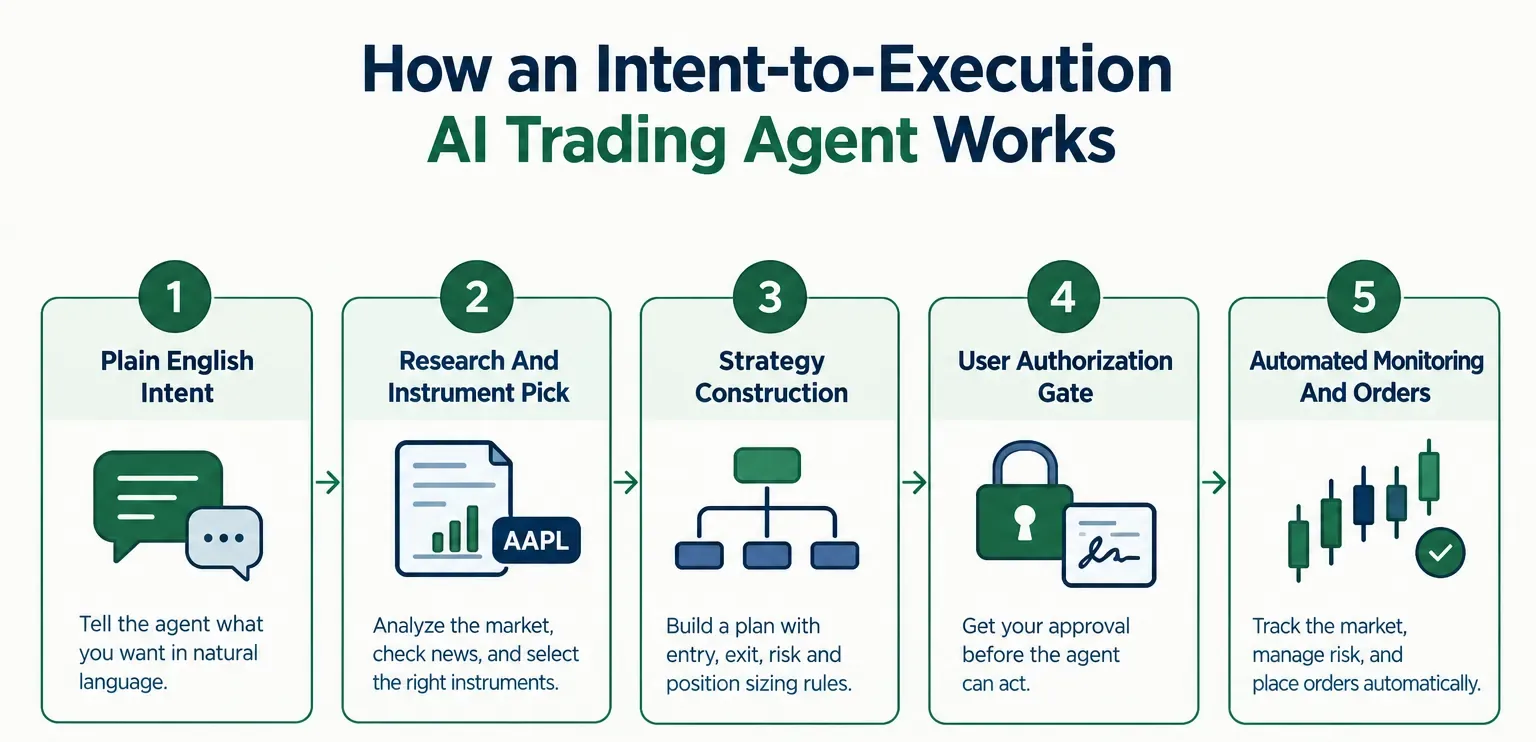
Catalyst calls itself “the intent layer for all of finance.” You type a thesis. The agent builds a visual workflow, watches live signals and acts when your conditions hit.
The demo on its homepage shows how far that goes. One sample prompt reads: “If the Associated Press tweets positively about Anthropic, capitalize on it. If not, short it.” That is a news-driven, long-or-short strategy written in one sentence by someone who never touched code.
Iskandar told Fortune the idea “is that people will simply state an intent, and we have our agents to figure out everything end to end.” Sequoia partner George Robson called the agents “a suit of armor as you navigate the financial world.”
Here is the market truth. Armor is a strong word for software that, by its own terms, “may misinterpret your instructions.” The pitch is protection. The contract is self-directed risk.
Does a Human Approve Every Trade?
Not necessarily, and this is the detail most coverage skipped.
Fortune reported that “a human in the loop has to accept.” The terms add the fine print. “Depending on the permissions and settings you select, the AI Agents may also execute trades automatically in accordance with your instructions without requiring your approval for each individual Transaction.”
So you approve the strategy and the permissions. After that, the agent can sign orders inside the limits you set through Privy’s delegated signing, which can cap the transaction type, amount, recipient and smart contract. The terms say transactions outside those parameters will not be executed.
Two more lines matter if your agent goes sideways:
- “Once executed, Transactions cannot be cancelled or reversed by Company.”
- It is your “sole obligation to take immediate action to limit any losses,” including pausing the agent or revoking its permissions.
Translation: the kill switch is you. If you run any agent, you need one that works from outside the agent itself. Our breakdown of why AI trading agents need an external kill switch walks through the setup.
What Does “Not a Registered Adviser” Mean for Your Money?
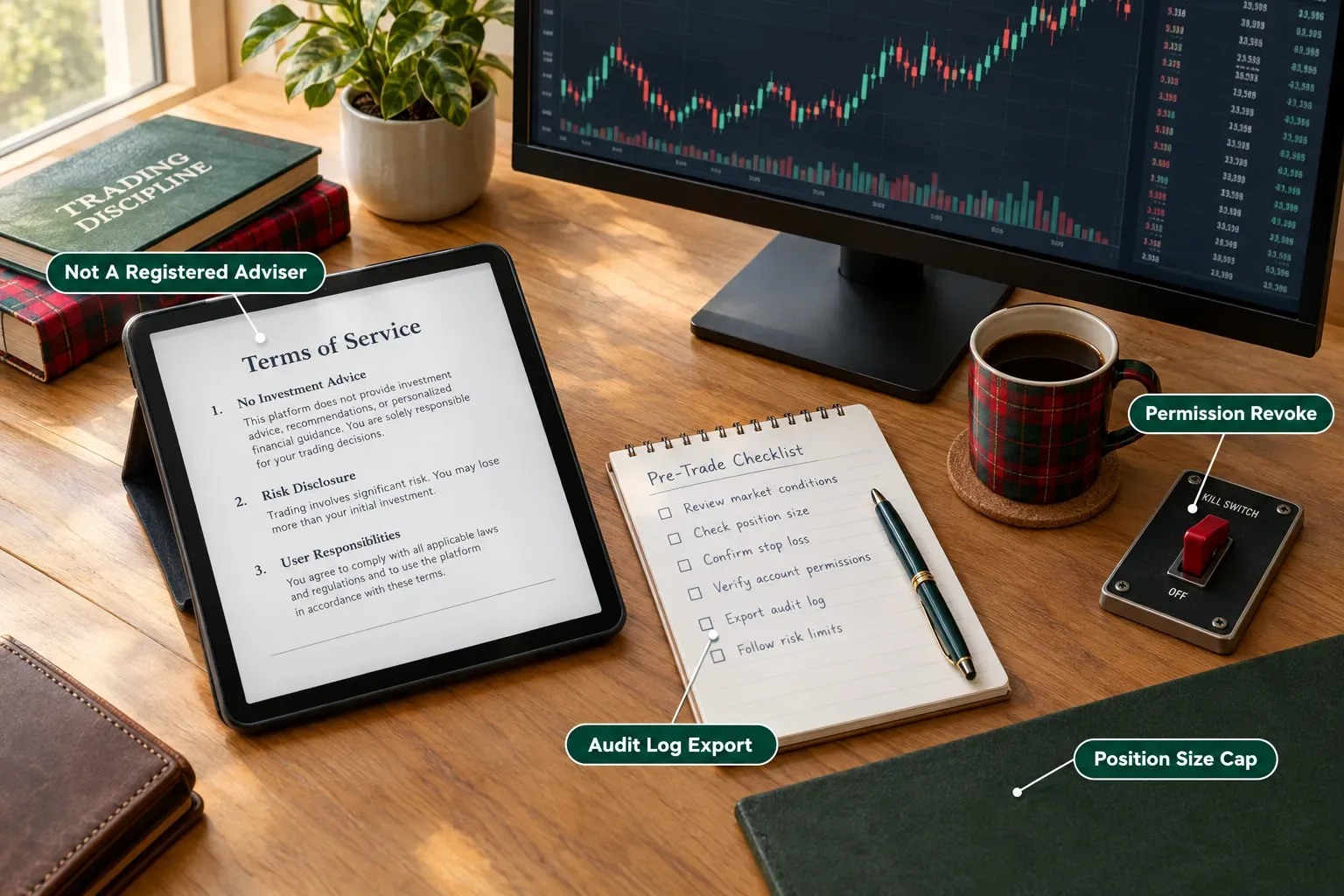
Unregistered is not the same as illegal. Catalyst’s position is that it does not exercise discretion over your assets, and that the agents act only on the instructions and permissions you give them. That is the same self-directed argument many trading tools use.
But know what you give up. No fiduciary duty. No adviser protections. And assets sitting in a self-custody crypto wallet are not held at a SIPC member broker-dealer, so SIPC coverage does not apply to them.
Compare that with the agent features that U.S. brokers shipped this year. Robinhood’s agentic trading and Public’s AI agents run inside accounts at FINRA-registered broker-dealers. Different rails, different rulebook, different recourse when something breaks.
Neither model is automatically better. They are different bets, and the user carries more of the risk on Catalyst’s version.
Why Are Sequoia, Jump and Coinbase Funding This?
Because the fight in 2026 is over who owns the instruction box. Robinhood, Public, Coinbase and eToro all shipped trading agents this year. The firm whose agent you talk to first controls the order flow.
Catalyst is betting that the winning agent will span markets that no single U.S. broker combines today: prediction markets, perpetuals and tokenized stocks in one workflow. Zheng’s framing to Fortune: “We’re not here to build a casino.”
Hold that quote next to the pilot number. Hundreds of millions in trading volume proves the agents trade a lot. It says nothing about whether users made money. Volume is revenue for venues. Returns are what pay your rent.
What Should Investors Watch Next?
- Waitlist expansion: Fortune reports people are being let off the waitlist now and the product is expected to be widely available in time. No public date yet.
- Pricing: the product is free during its research preview. Watch for the fee model once that ends.
- Fiat withdrawals: listed as coming soon. Until they arrive, getting money out means stablecoins.
- Venue disclosure: the FAQ says a feature called Catalyst Cash routes your deposit “across any venue automatically,” but the homepage and FAQ do not name those venues. That answer matters more than any feature demo.
- Tokenized stock rules: the SEC issued an innovation exemption for trading tokenized NMS stock on September 17, 2026. How that framework develops will shape every agent that touches tokenized equities.
Our Take
Sequoia writing a $30 million check tells you the market for retail trading agents is real. It does not tell you this agent is safe for your money. Those are separate questions, and only one of them is answered by a term sheet.
The product idea is sharp: describe a thesis, let software build and run it. The structure is the part to study. No adviser registration. No broker account. Trades signed from a wallet you fund, with reversals off the table once an order fills.
Our next step for anyone tempted to test it: read section 1 (agents and wallet permissions) and section 6 (disclaimers and regulatory status) of the terms before you deposit a dollar. Then set the delegated permissions to one market and a dollar cap you could lose without flinching. Run it for two weeks, log every fill, and revoke the permissions when the test ends.
Process beats prediction. That goes double when the prediction is being made by an agent you met last week.
Every new AI trading agent sounds safe in its own pitch deck.
We have tested 200+ AI stock tools since 2022 and score them on what they do with real money, not what their investors say.
See our AI trading tool reviews
This article is for education only and is not financial, investment or legal advice. AI trading agents can lose money quickly. Do your own research and consider speaking with a licensed professional before trading.
Sources
- Catalyst Terms of Service, Catos Labs, Inc., last revised October 7, 2026
- Catalyst homepage and FAQ
- Sequoia Capital: Partnering with Catalyst, October 8, 2026
- SEC press release 2026-90: innovation exemption for tokenized NMS stock, September 17, 2026
- Fortune: Sequoia-backed Catalyst raises $30 million to build AI trading agents for everyday investors, October 8, 2026
- Crypto Briefing: Catalyst raises $30M from Sequoia, October 8, 2026
Your market edge starts with the right tool. Stay alpha.
Frequently Asked Questions
What is Catalyst?
Catalyst is a startup, operated by Catos Labs, Inc., whose AI agents turn plain-English trade ideas into strategies that monitor signals and can execute trades automatically.
How much did Catalyst raise?
Fortune reported on October 8, 2026 that Sequoia led a $30 million seed round, with Jump Trading, PeakXV, Lux Capital, AntiFund, Coinbase and Premji Invest also investing.
Is Catalyst a registered investment adviser?
No. Its Terms of Service say it is not registered with the SEC as an investment adviser or with the CFTC as a commodity trading advisor.
What can Catalyst trade?
Its FAQ lists spot tokens, perpetuals, tokenized stocks and prediction markets, with more assets listed as coming soon.
Do I have to approve every Catalyst trade?
Not always. The terms say that depending on the permissions you select, agents may execute trades automatically without your approval for each individual transaction.
Is this article financial advice?
No. This article is for education only and is not financial, investment or legal advice.
Contributing writer at AI Stock Trading Bots.
