

Jay Rocco is the Founder and Editor of FullStack Alpha. He has tested 200+ AI stock tools since 2022 and run 15+ AI trading platforms on live accounts with his own money. He reviews the software. He does not tell you what stocks to buy.
Last updated: August 31, 2026
Quick Answer: An ai trading bot is not one product. It is a label applied to at least five structurally different tools: no-code visual builders, signal bridges, managed quant services, code-first platforms, and scanner-driven bots. Each type controls a different part of the trading process, requires a different skill level, and fails in a different way. Picking the wrong type is the most common reason retail traders automate once and quit.
Key Takeaways
- The phrase “ai trading bot” covers five distinct product categories with almost nothing in common beyond the name.
- No-code builders like Composer let you build strategy logic without writing a single line of code, but you still own the strategy.
- Signal bridges like SignalStack execute alerts you generate elsewhere; they add no intelligence of their own.
- Managed quant services like Tickeron run strategies for you, which removes work but also removes control.
- Code-first platforms like QuantConnect give you full control and the steepest learning curve.
- Scanner-driven bots like Trade Ideas with the Holly AI engine surface setups; execution is still yours to confirm or automate.
- Automation changes who places the order. It does not change whether the underlying strategy works.
- The algorithmic trading market is projected to grow by USD 18.74 billion from 2025 to 2029, which explains why every tool suddenly has “AI” in its name.
What Is an AI Trading Bot, Really?
An ai trading bot is software that monitors market data and places or suggests trades based on pre-defined or learned rules, removing the need for a human to click the buy or sell button manually. The “AI” part ranges from a simple if-then rule engine to a genuine machine-learning model trained on historical price data. Most retail products sit closer to the rule-engine end than the machine-learning end, regardless of how their marketing reads.
Automation Versus Intelligence
Automation and intelligence are two separate axes. A trading bot can be fully automated and completely dumb, running a fixed moving-average crossover 24 hours a day with no adaptive logic. It can also be highly intelligent and still require a human to approve every order. Most products mix the two in ways their landing pages obscure. When a vendor says “AI-powered,” ask which specific model, trained on what data, with what live track record. If they cannot answer, you are probably looking at a rule engine with a chatbot interface bolted on.
Why the Label Covers Five Different Things
The algorithmic trading market grew fast enough that every fintech needed an “AI” angle to stay competitive. The result is a single label applied to products that differ on every dimension that matters: who writes the strategy, who connects to the broker, who monitors the position, and who takes the loss when the logic breaks. Before you compare prices or read reviews, you need to know which of the five types you are actually evaluating. See our full breakdown of AI trading bots and what to know before you automate for a broader orientation.
Type 1: No-Code Visual Builders
No-code visual builders let you construct a trading strategy by connecting logic blocks in a drag-and-drop interface, then backtest and deploy it without writing code. You own and control the strategy; the platform handles the execution infrastructure.
How Composer, TrendSpider and StockHero Work
Composer is the clearest example. You build a strategy as a decision tree, selecting assets, conditions, and rebalancing rules through a visual editor. The platform connects to Alpaca for execution and handles the brokerage plumbing. A free tier exists; the Pro plan runs around $30 a month. See our Composer trading review for a deeper look at whether the algo it produces is actually worth running.
TrendSpider adds AI-assisted chart analysis and automated alert triggers on top of a visual strategy builder, with plans starting around $33 a month billed annually. It connects to several brokers and is strong for traders who want to automate entries based on technical conditions like support and resistance levels or breakout patterns.
StockHero targets beginners with a simpler interface and plans from roughly $14 to $30 a month. It focuses on stock and ETF bots rather than options, making it a reasonable starting point for someone paper trading a first automated strategy.
Tradetron and Surmount AI round out the category. Tradetron is popular for multi-leg options strategies; Surmount AI emphasizes portfolio-level automation with pre-built strategies you can clone and modify.
Who This Type Suits
Traders who have a clear strategy hypothesis but no coding background. If you can describe your entry and exit rules in plain English, a no-code builder can probably implement them. This is also the right type for beginners starting with AI day trading platforms who want to learn how automation works before committing to a code-first environment.
Where It Stops
The visual interface limits strategy difficulty. Anything requiring custom data feeds, multi-broker routing, or statistical models beyond basic indicators will hit a ceiling fast. You also still need a working strategy. The builder executes your logic; it does not generate alpha for you. Garbage in, garbage out, regardless of how clean the interface looks.
Type 2: Signal Bridges That Execute Your Alerts
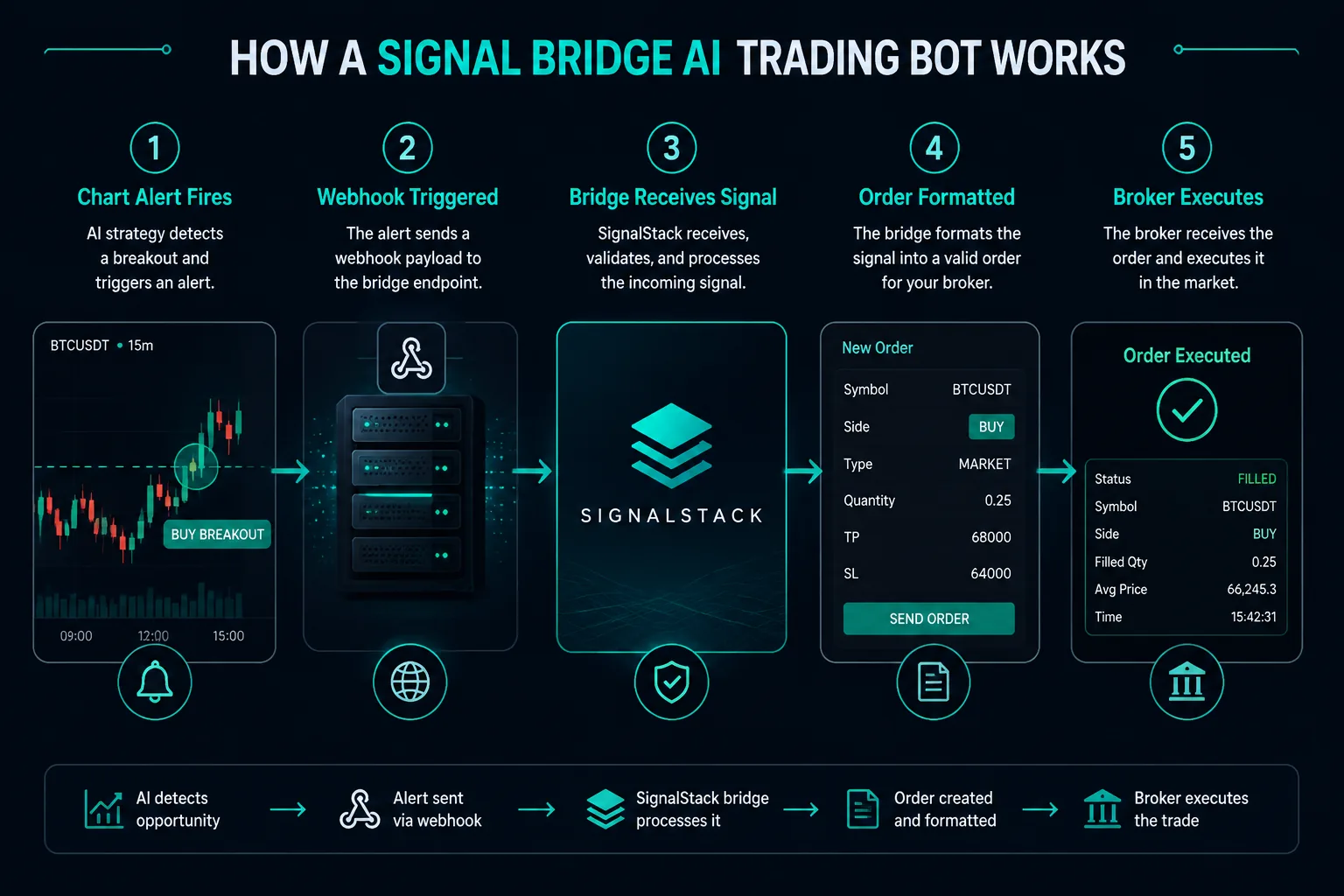
Signal bridges sit between a charting platform and a broker. They receive an alert, usually via a TradingView webhook or a REST API call, and translate it into a live order. They add no analytical layer; they are pure execution pipes.
How SignalStack and Capitalise.ai Turn Alerts Into Orders
SignalStack charges per signal rather than a flat monthly fee, which makes it cost-effective for low-frequency strategies. You set up your alert in TradingView, point the webhook at SignalStack, configure your position size and broker, and the bridge fires the order when the alert triggers. It connects to Interactive Brokers, Tradier, and several other brokers.
Capitalise.ai takes a slightly different approach, letting you write trading rules in plain English sentences that it converts into automated orders. It is free with supported brokers, which lowers the barrier to entry significantly. WunderTrading adds a crypto-first angle but also supports futures, making it relevant for traders who want to explore WunderTrading’s full feature set across asset classes.
Who This Type Suits
Traders who already have a signal source they trust, whether that is their own TradingView Pine Script alerts, a scanner output, or a paid signal service, and simply want reliable automated execution. The strategy work is done elsewhere; the bridge just removes the manual click.
Where It Stops
A signal bridge is only as good as the signals feeding it. If your alerts are late, noisy, or based on a flawed strategy, the bridge will execute every bad trade faster and more consistently than you would have by hand. Play stupid games, win stupid prizes. This type also requires you to manage position sizing, stop loss levels, and risk management externally. The bridge does not know your account size or your risk tolerance.
Type 3: Managed and Autonomous Quant Services
Managed quant services run pre-built or AI-generated strategies on your behalf. You connect your brokerage account, select a strategy or risk profile, and the service handles everything else. This is the closest thing retail traders have to a quant fund in an app.
How Tickeron, AlgosOne and MoneyFlare Run Hands Off
Tickeron is the most established name in this category for stocks. It offers AI-generated trading signals and autonomous bots across stocks, ETFs, and crypto, with plans ranging from roughly $30 to $60 a month depending on the tier. Tickeron publishes performance data for its bots, which is more transparency than most competitors offer. The platform has been cited for its real-time intraday signals and its library of trending robots that users can view and subscribe to. For a full view of what Tickeron’s AI trading capabilities actually deliver, see our tested breakdown of top AI trading tools.
AlgosOne and MoneyFlare operate in a similar space, offering hands-off portfolio management with AI overlays. Pluto targets a younger audience with a mobile-first interface and automated portfolio strategies. In July 2026, SaintQuant launched a free AI trading bot with a no-code interface covering U.S. Equities and futures, which signals that the managed-quant category is moving toward lower price points and broader asset coverage.
Who This Type Suits
Traders who want automation without the work of building or maintaining a strategy. This type also suits time-poor investors who accept that delegating control means accepting the service’s risk parameters rather than their own. If you want someone else to run it, this is your category.
Where It Stops
You are trusting a black box with your capital. Most services disclose limited methodology detail, which makes it hard to know whether a good run reflects genuine edge or a favorable market regime. When the market shifts, you may not understand why the bot is losing or when to pull the plug. The managed quant space also has the highest concentration of outright scams in the entire bot market. Any service promising specific annualized returns should be treated as a red flag until independently verified. FINRA and the SEC have both issued warnings about fraudulent automated trading services targeting retail investors.
Type 4: Code-First Platforms
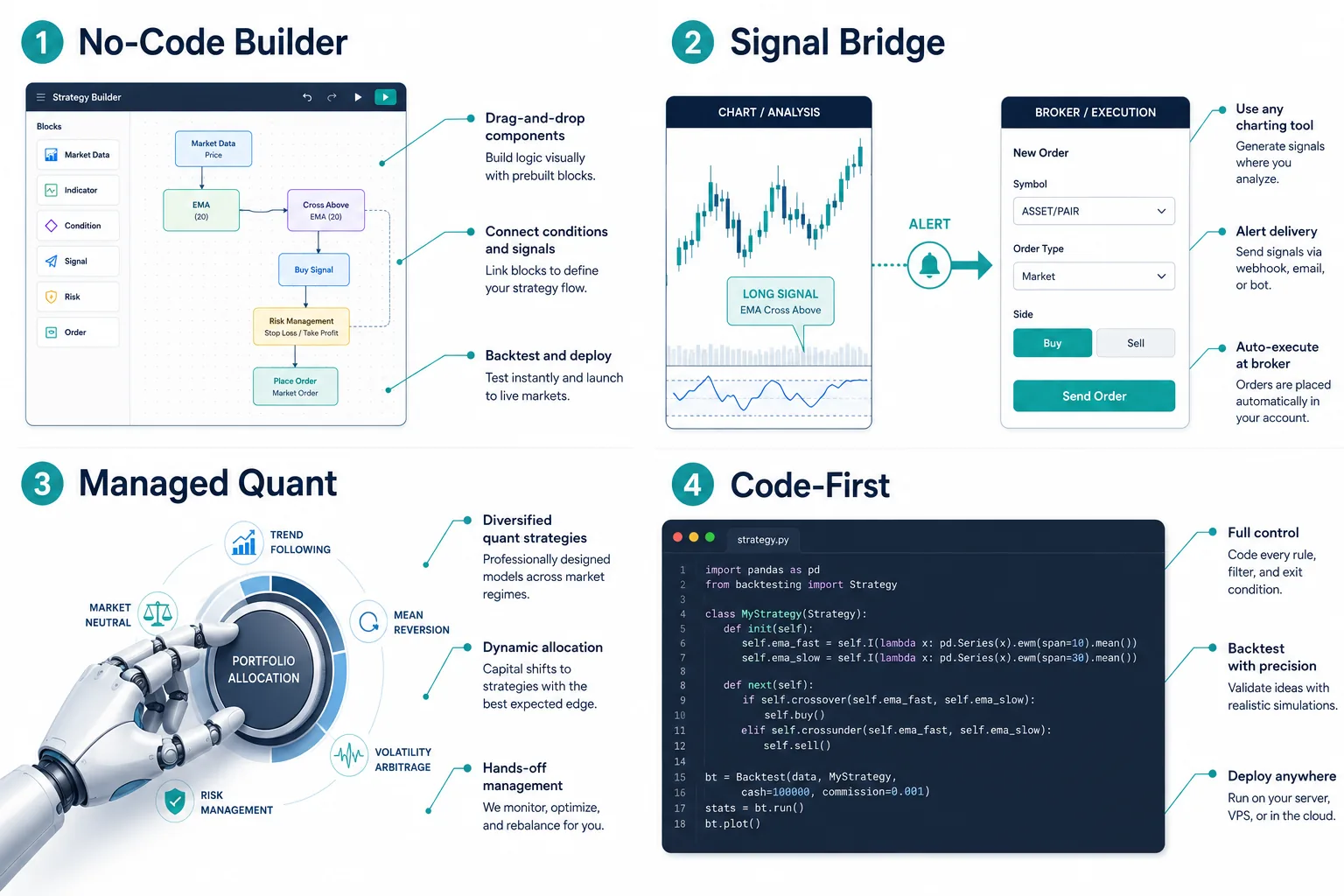
Code-first platforms give you a full development environment to write, backtest, and deploy algorithmic strategies. You write the logic in Python or C#, the platform provides historical data and a backtesting engine, and execution connects through a broker API. This is ai in algorithmic trading at its most literal.
How QuantConnect and Superalgos Differ From the Rest
QuantConnect runs on the open-source LEAN engine and is the most widely used code-first platform for retail quant traders. The cloud environment is free; paid tiers start around $20 a month for live trading features. It connects to Interactive Brokers, Alpaca, and several other brokers via REST API and WebSocket feeds. The backtesting engine is rigorous enough that serious retail quants use it as a primary research environment.
Superalgos is fully open source and self-hosted, which means zero subscription cost but a steep setup curve. It is built around a visual node editor that generates code, sitting somewhere between a pure visual builder and a full code environment. For traders who want to understand how to backtest a trading strategy without fooling yourself, QuantConnect’s LEAN engine is one of the most honest environments available because it enforces point-in-time data and prevents look-ahead bias by default.
Alpaca functions primarily as the execution layer here rather than a strategy builder. Its commission-free brokerage with a clean REST API and WebSocket feed makes it the default broker connection for many code-first strategies.
Who This Type Suits
Traders with Python or C# skills who want full control over strategy logic, data inputs, and execution parameters. Also the right choice for anyone who wants to understand exactly what their bot is doing at every step, rather than trusting a vendor’s description.
Where It Stops
The learning curve is real. Most retail traders who start here spend months on infrastructure before they trade a single live dollar. Automation also amplifies coding errors. A bug in a no-code builder might produce a bad trade. A bug in a code-first platform can produce hundreds of bad trades in seconds.
Type 5: Scanner-Driven Bots
Scanner-driven bots use AI to identify high-potential setups from a universe of stocks or options, then either alert the trader or route the order automatically. The intelligence lives in the scanning and ranking layer, not in a fixed strategy rule set.
How Trade Ideas and Holly Turn a Scan Into a Trade
Trade Ideas is the benchmark for AI-powered stock scanners. Its Holly AI engine runs millions of simulated trades overnight to identify high-probability setups for the next trading session. The Standard plan runs around $118 a month. Holly generates a watchlist each morning; traders can view the signals, filter by setup type, and either trade manually or connect to a broker for semi-automated execution. This is scanner-driven trading at its most developed.
Option Alpha applies the same concept to options, with a free tier and paid plans starting around $99 a month. Its “bots” are decision trees that trigger options orders based on conditions like implied volatility rank or days to expiration. The platform is designed for traders who want to automate a defined options strategy, such as a weekly iron condor, without writing code.
TuringTrader offers a similar scanner-driven approach for systematic portfolio strategies, sitting between the managed quant and scanner categories.
Who This Type Suits
Active traders who want AI to do the scanning and ranking work but still want a human decision point before execution, or who want to automate a well-defined, rules-based strategy on top of a scanner output. This type pairs well with traders who already have a stock screener for swing trading in their workflow.
Where It Stops
Scanner quality varies enormously. A scanner that surfaces 200 setups a day is not better than one that surfaces 20 if the 200 have no edge. The Holly engine has a published methodology and a live track record, which puts it above most competitors on transparency. But even the best scanner cannot guarantee that a clean setup on the chart reflects a genuine opportunity rather than a bull trap or a dead cat bounce.
Comparison Table: The 5 Types on Coding, Control, Cost and Broker Support
| Type | Coding Required | Who Controls Strategy | Broker Connection | Typical Monthly Cost | Best Suited For |
|---|---|---|---|---|---|
| No-Code Visual Builder | None | You | Alpaca, Tradier, others | Free to ~$33 | Non-coders with a clear strategy |
| Signal Bridge | None to minimal | You (via alert source) | IB, Tradier, broker API | Free to pay-per-signal | Traders with existing signal sources |
| Managed Quant Service | None | The service | Varies by platform | ~$30 to $60+ | Hands-off investors |
| Code-First Platform | Python or C# required | You (full control) | IB, Alpaca, REST API | Free to ~$20+ | Developers and quant traders |
| Scanner-Driven Bot | None | AI scanner plus you | Broker-dependent | ~$99 to $118+ | Active traders wanting AI-ranked setups |
Which Type of AI Trading Bot Do You Actually Need?
The right type of ai trading bot depends on one question: how much of the strategy work are you willing and able to do yourself? Each of the four decision paths below maps to a different type.
If You Will Not Write Code
Start with a no-code visual builder or a managed quant service. Composer is the cleanest entry point for building your own logic without coding. If you want someone else to run the strategy entirely, Tickeron or a similar managed service is the honest choice. Do not let a vendor sell you a code-first platform by calling it “no-code” because it has a visual interface. Check whether you can deploy a live strategy without touching a terminal.
If You Already Have a Strategy
A signal bridge is probably all you need. If your TradingView alerts are already profitable in paper trading, SignalStack or Capitalise.ai will automate the execution without adding unnecessary difficulty. This is the systems-over-hacks answer: do not rebuild what already works.
If You Want Someone Else to Run It
Managed quant is your category, but do your due diligence before connecting a brokerage account. Verify that the service is registered with the SEC or operates under a registered investment adviser. Read the best AI trading bot: legit tools versus expensive hype breakdown before handing over account access to any platform.
If You Want Full Control
QuantConnect with Alpaca as the execution layer is the standard setup for retail quant traders who want to analyze data, write custom logic, and own every parameter. Paper trade it first. Every serious quant runs a strategy in simulation for at least 30 to 60 days before going live.
How Much Does an AI Trading Bot Cost by Type?
Costs range from zero to several hundred dollars a month depending on type, feature tier, and whether you need live execution. The algorithmic trading market is projected to reach significant scale through 2029, and competition is pushing more vendors toward free or freemium entry points.
Free and Freemium Options Across the Five Types
- No-code builders: Composer has a free tier. Surmount AI offers a limited free plan.
- Signal bridges: Capitalise.ai is free with supported brokers. SignalStack charges per signal with no monthly minimum.
- Managed quant: SaintQuant launched a free AI trading bot in July 2026 covering U.S. Equities and futures. Most other managed services require a paid subscription.
- Code-first: QuantConnect’s cloud environment is free for backtesting. Superalgos is fully open source. These are the most genuinely free options in the entire category.
- Scanner-driven: Option Alpha has a free tier with limited bot functionality. Trade Ideas does not offer a meaningful free tier.
For a curated view of which free tools are actually worth your time, see the free AI stock trading bots beginners keep using.
What the Paid Tiers Add
Paid tiers typically open live trading execution (versus paper trading only), faster data feeds, more simultaneous bots, and priority broker connections. For scanner-driven tools like Trade Ideas, the paid tier is where the Holly AI engine lives. For code-first platforms like QuantConnect, paid tiers add live brokerage connections and higher data usage limits. The free tiers are genuinely useful for learning and backtesting. They are rarely sufficient for live trading at any meaningful scale. See what you actually pay for versus what you get with AI trading software for a cost-by-feature breakdown.
Are AI Trading Bots Legal and Regulated?
Automated trading is legal for retail traders in the United States. The SEC and FINRA regulate the brokers and registered investment advisers that bots connect to, not the bots themselves. Using a managed quant service that makes discretionary trading decisions on your behalf may require that service to be registered as an investment adviser under the Investment Advisers Act of 1940. If a platform is managing your money autonomously, ask whether it is registered. The SEC’s investor resources and FINRA’s broker check tool are the right starting points for verifying any service’s registration status.
The old $25,000 pattern day trader minimum was retired in June 2026, so small accounts can day trade with or without a bot. That removes a guardrail as much as a barrier: a bot can now trade a small account as often as its rules allow.
AI Trading Bot Risks and Limitations
Every type of ai trading bot carries risks that its marketing will not lead with. Automation changes who places the order. It does not change whether the underlying strategy has an edge. A losing strategy executed automatically loses faster and more consistently than a losing strategy executed manually. That is not a feature.
Overfitting is the most common failure mode in backtesting. A strategy that looks perfect on historical data often falls apart in live trading because it was tuned to the specific noise of the training period rather than a genuine pattern. The crypto trading bot market has documented this extensively, and the same failure applies to stock and futures bots. Always validate on out-of-sample data before going live.
Scams are disproportionately concentrated in the managed quant category. Any service guaranteeing specific returns, claiming a 191% annualized return without an audited track record, or requiring you to fund a proprietary account rather than connecting your own brokerage should be treated as a serious warning sign. Discipline beats prediction. If the pitch sounds too clean, it probably is.
How to Set Up and Backtest an AI Trading Bot
The setup process differs by type, but the backtesting discipline is the same across all five. Define your entry rule, your exit rule, your position sizing logic, and your maximum drawdown tolerance before you touch the platform. Then backtest on historical data, check the results on a separate out-of-sample period, paper trade for at least 30 days, and only then consider live capital.
For no-code builders, backtesting is built into the interface. For code-first platforms, QuantConnect’s LEAN engine enforces point-in-time data by default, which prevents the most common backtesting error. For scanner-driven bots, Trade Ideas publishes Holly’s historical performance, giving you a baseline to compare against your own results. See how to backtest a trading strategy without fooling yourself for a full methodology.
AI Trading Bots for Crypto Versus Stocks
The five-type framework applies to both asset classes, but the product landscape differs. The crypto bot market is larger and more fragmented, with the crypto trading bot market showing significant projected growth through the late 2020s. Most crypto-native platforms like 3Commas are excluded from this guide because they do not cover stocks, options, or futures, which is where most of this site’s audience trades.
For stock and futures traders, the key difference is that crypto markets run 24 hours a day with no circuit breakers, which makes risk management parameters more critical in a bot context. A stop loss that would limit damage in a stock bot may not execute at the expected price in a thin crypto market at 3 a.m. The best AI trading platforms for 2026 covers both asset classes with that distinction in mind.
Final Verdict: Pick the Type Before You Pick the Tool
Most traders waste months comparing tools within the wrong category. They read reviews of Composer and QuantConnect as if they are competing products. They are not. One is a no-code builder for traders who want to own their strategy without coding. The other is a development environment for traders who want to write every line of logic themselves. Comparing them on price or interface is like comparing a food processor to a chef’s knife because both cut vegetables.
The algorithmic trading market’s projected growth of USD 18.74 billion from 2025 to 2029 means more products, more marketing, and more noise. The five-type framework cuts through that. Identify which type fits your skill level and strategy ownership preference first. Then compare products within that category. That sequence alone will save you significant time and money.
Data over noise. Process over prediction. Pick the type, then pick the tool.
One tool, scored five ways. There are 200+ more in the FullStack Alpha directory, filterable by category, price, and what they actually do. Browse the directory at aistockpickerapps.com.
Disclosure: Some links in this article are affiliate links. FullStack Alpha may earn a commission if you subscribe through them, at no additional cost to you. All tools are evaluated independently.
References
- Algorithmic Trading Market
- Algorithmic Trading Market
- Algorithmic Trading Market
- Crypto Trading Bot Market
- Crypto Trading Bot Market
- Algorithmic Trading Market To Grow By USD 18.74 Billion From 2025-2029
By Jay Rocco, Founder and Editor, FullStack Alpha.
Stay alpha.
Frequently Asked Questions
Is there a legit AI trading bot?
Yes. Legitimate ai trading bots exist across all five categories. Composer, QuantConnect, Trade Ideas, and Tickeron are real products with verifiable track records and transparent pricing. The key test is whether the platform connects to a regulated broker, discloses its methodology, and avoids promising specific returns. Any bot guaranteeing profits or requiring you to fund a proprietary account rather than your own brokerage is a significant red flag. FINRA and the SEC both maintain resources for verifying the legitimacy of automated trading services.
Are AI trading bots any good?
They are good at executing a strategy consistently and removing emotional decision-making from the order entry process. They are not good at generating alpha on their own. A bot running a flawed strategy will lose money faster and more consistently than a human running the same strategy manually. The best ai trading bot for any individual trader is the one that matches their skill level, fits their strategy type, and connects reliably to their broker. Performance depends almost entirely on the quality of the underlying strategy, not the sophistication of the bot interface.
Can AI trading make you money?
Automation can improve execution consistency and remove revenge trading and overtrading from the equation, which helps traders who already have a profitable strategy. It does not create a profitable strategy from nothing. Research on whether AI trading bots actually make money consistently shows that the strategy quality is the dominant variable, not the automation layer. Never invest capital in any automated system without understanding the strategy it runs and the conditions under which it is expected to fail.
Which AI is best for trade?
There is no single best ai trading bot across all use cases. For no-code strategy building, Composer is the most polished option for stocks. For scanner-driven signals, Trade Ideas with the Holly AI engine has the most transparent track record. For code-first development, QuantConnect is the standard. For managed hands-off trading, Tickeron offers more transparency than most competitors. The right choice depends on whether you want to build the strategy yourself, execute signals you generate elsewhere, or delegate the entire process to a service.
What is an AI trading bot and how does it work?
An ai trading bot is software that monitors market data and places or suggests trades based on rules or machine-learning models, removing the need for manual order entry. It connects to a brokerage account via API, receives a data feed, evaluates conditions defined by the strategy, and sends buy or sell orders when those conditions are met. The "AI" component ranges from simple if-then logic to neural networks trained on price and volume data. Most retail products use rule-based logic with AI-assisted scanning or signal generation rather than fully autonomous machine learning.
What is the best AI trading bot for a beginner?
Beginners should start with a no-code visual builder or a free scanner-driven tool before committing to a paid subscription. Composer's free tier is a reasonable first step for building and backtesting a simple strategy without coding. Option Alpha's free tier works for beginners interested in options automation. Paper trading any bot for at least 30 days before using real capital is the single most important step a beginner can take. The AI day trading platforms beginners are starting with in 2026 covers the current starting options in detail.
Do AI trading bots need coding?
Three of the five types require no coding: no-code visual builders, signal bridges, and managed quant services. Scanner-driven bots like Trade Ideas and Option Alpha also require no coding. Only code-first platforms like QuantConnect and Superalgos require Python or C# skills. The no-code options have improved significantly and can handle moderately complex strategies without any developer background.
How much does an AI trading bot cost per month?
Costs range from free to over $100 a month depending on type and tier. Free options include QuantConnect's backtesting environment, Superalgos, Capitalise.ai with supported brokers, and Composer's basic tier. Mid-range paid tiers run $20 to $60 a month for most no-code builders and managed quant services. Scanner-driven tools like Trade Ideas Standard run around $118 a month. Pricing changes frequently; always verify current pricing on the vendor's site before subscribing.
Jay Rocco is the Founder and Editor of FullStack Alpha. He has tested 200+ AI stock tools since 2022 and run 15+ AI trading platforms on live accounts with his own money. He reviews the software. He does not tell you what stocks to buy.
